Stop Sign Violation Fine in Florida What You Pay Now
Stop sign violation fine in Florida explained — fines, points, insurance hikes and how to fight your ticket. Protect your record with Ticket Shield today.

You're sitting in your car with a Florida stop-sign citation in your hand, trying to decide whether paying it is easier than fighting it. The fine may look manageable, but that number doesn't tell you what a conviction can do to your driving record, insurance costs, or future license status.
A stop-sign ticket is generally treated as a noncriminal moving violation in Florida. The base fine can be modest, yet court costs, surcharges, and administrative fees can make the actual amount substantially higher. A first moving-violation offense can also add 3 points to your license under Florida's citation structure, creating consequences that last beyond the payment deadline. Florida's traffic statutes show why the legal and financial exposure deserves closer attention.
Protective rule: Don't treat the ticket as a bill until you understand what accepting it means.
A payment can function as an admission that closes off important options. Your decision should account for the full stop sign violation fine, possible points, and the insurance consequences that may follow. You can review Florida traffic rules in more detail through this guide to Florida traffic laws, but the practical recommendation is simple: investigate your options before you pay.
Table of Contents
How Much You Really Pay for a Stop Sign Violation Fine in Florida
Insurance Hikes and the Long Tail Cost You Do Not See on the Ticket
What Florida Law Actually Requires at a Stop Sign
Florida law requires more than slowing down and looking both ways. Under Florida Statute 316.123, a driver approaching an intersection marked by a stop sign must stop at the clearly marked stop line. If there's no stop line, the driver must stop before entering the crosswalk. If there's no stop line or crosswalk, the driver must stop at the point nearest the intersecting roadway where the driver can see approaching traffic before entering the intersection. Florida Statute 316.123 establishes the stopping and yielding duties that control these citations.
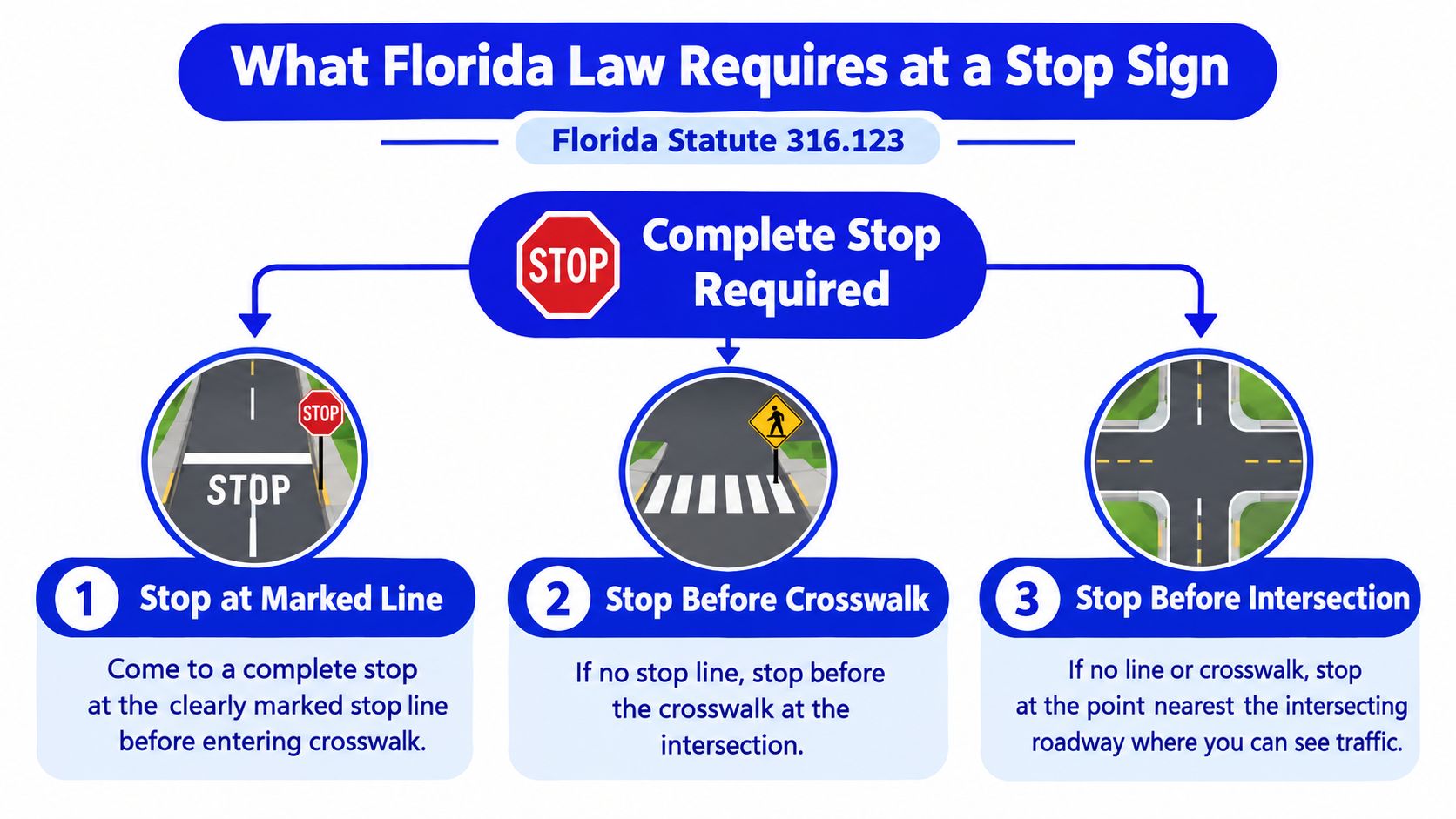
The stopping sequence matters
Think of the intersection as a series of legally significant points:
Marked stop line: Bring the vehicle to a complete stop before the line. Stopping beyond it may create a factual dispute about whether you stopped at the required location.
Crosswalk: If there's no marked stop line, stop before the crosswalk. A driver who stops only after entering the pedestrian area may not have complied with the statute.
Nearest visible point: If neither marking exists, stop at the nearest point to the intersecting roadway where you can see approaching traffic safely.
Stopping is only part of the duty. After stopping, you must yield to vehicles already in the intersection and to vehicles approaching closely enough to create an immediate hazard. A citation can therefore involve both the completeness and location of the stop and the safety of the subsequent entry.
What a defense should examine
A strategic review focuses on the actual intersection, not just the officer's conclusion. The relevant questions include whether the stop line or crosswalk was visible, where your vehicle stopped, whether the officer had a clear view, and whether another vehicle created an immediate hazard.
You can also review the practical difference between stopping completely and making a rolling stop in this Florida stop-sign rule guide. The details matter because a stop-sign allegation is tied to observable facts, roadway markings, traffic conditions, and the language used in the citation.
How Much You Really Pay for a Stop Sign Violation Fine in Florida
You pay more than the number printed on the citation. Florida generally treats a stop-sign moving violation as a noncriminal traffic infraction with a $60 base fine, but county court costs, surcharges, and administrative fees can raise the immediate bill to roughly $150 to $275. Florida's statutory framework sets the foundation, while local assessments determine much of what you owe. Review this Florida traffic-ticket cost resource before deciding that paying is the cheapest option.
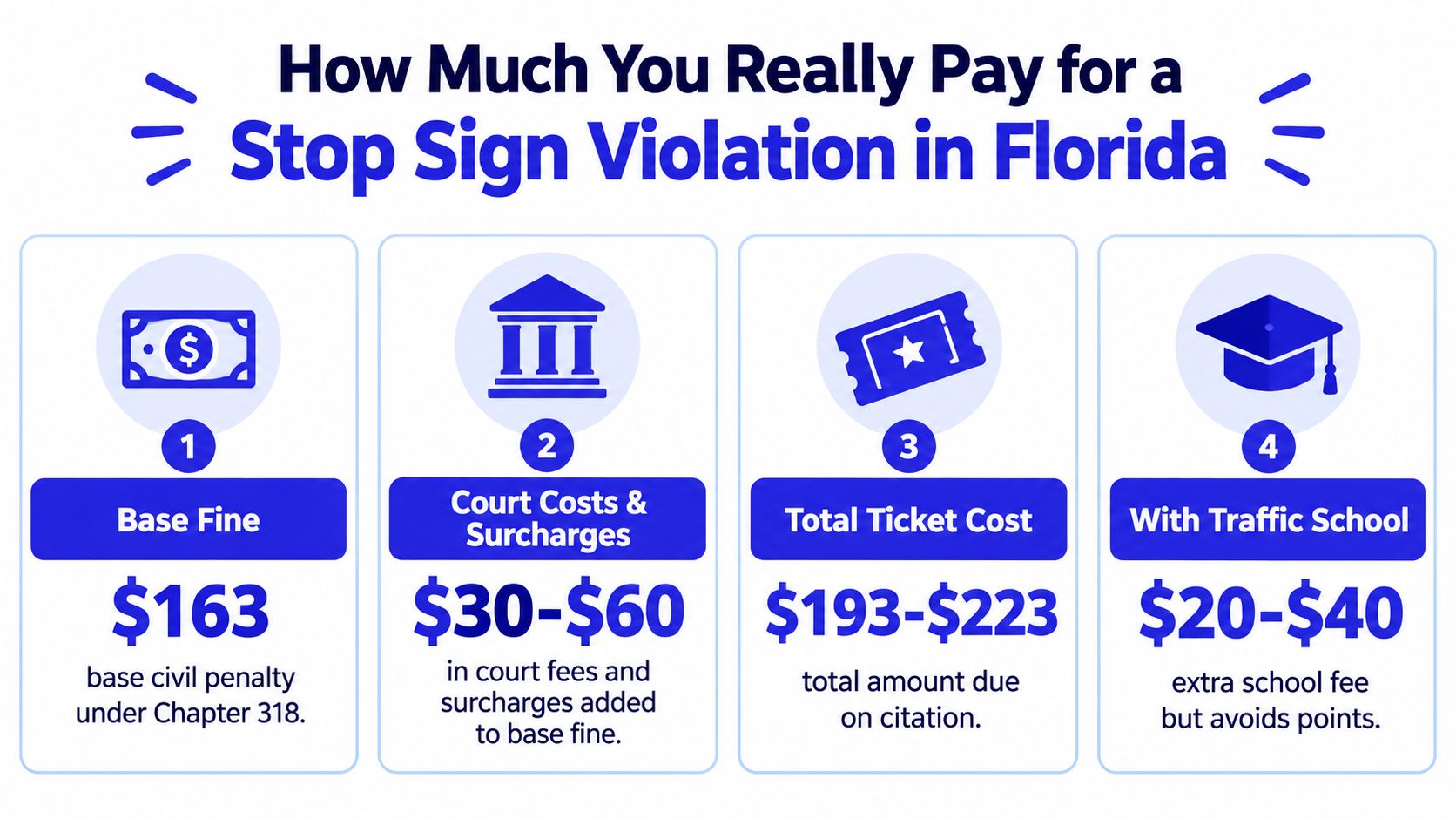
Separate the statutory fine from the final bill
Florida's Chapter 318 uses a statutory fine structure for traffic infractions. For some stop-related signal violations, Chapter 318 lists a $158 base civil penalty, showing that the amount depends on the specific violation and statutory classification. The applicable framework appears in Florida Statute 318.18.
The citation's legal description, your county's schedule, and required assessments can all affect the final amount. Read the statute listed on the citation and follow its payment instructions. Do not assume one statewide headline number applies to every stop-sign allegation.
Other jurisdictions show the same cost pattern. Public examples include totals of $99 in one Missouri municipal schedule, $118 in another, $183 in Oklahoma City, about $178 in a Louisiana schedule, and about $238 in California after add-ons. Those figures are not Florida rules, so they should not guide your payment decision. They do show why the base fine rarely answers the question. In Florida, mandatory additions can materially increase the amount due.
The fine is usually the smallest cost
Your immediate payment is only the first financial consequence. A conviction can also create points, affect your driving record, and contribute to insurance increases that continue beyond the court transaction. That long-term exposure can dwarf the original penalty.
Paying a ticket may feel efficient, but it can surrender your best opportunity to pursue No Points. Before sending money to the clerk, compare the full cost of accepting the citation with the cost of a defense strategy built around protecting your record. A direct attorney review gives you a case-specific assessment. A ticket mill usually gives you a process and a form response.
Ask the right question: what will this citation cost after court processing, a conviction, and the record consequences? The base fine is only the entry point.
Points on Your License and What They Trigger Next
A stop-sign conviction can add 3 points to your Florida driving record for a first moving-violation offense. That point becomes part of a history Florida reviews when later violations occur. Repeat offenses can bring more points and stronger licensing consequences, so the Florida stop-sign points guide deserves a careful review before you accept the citation.
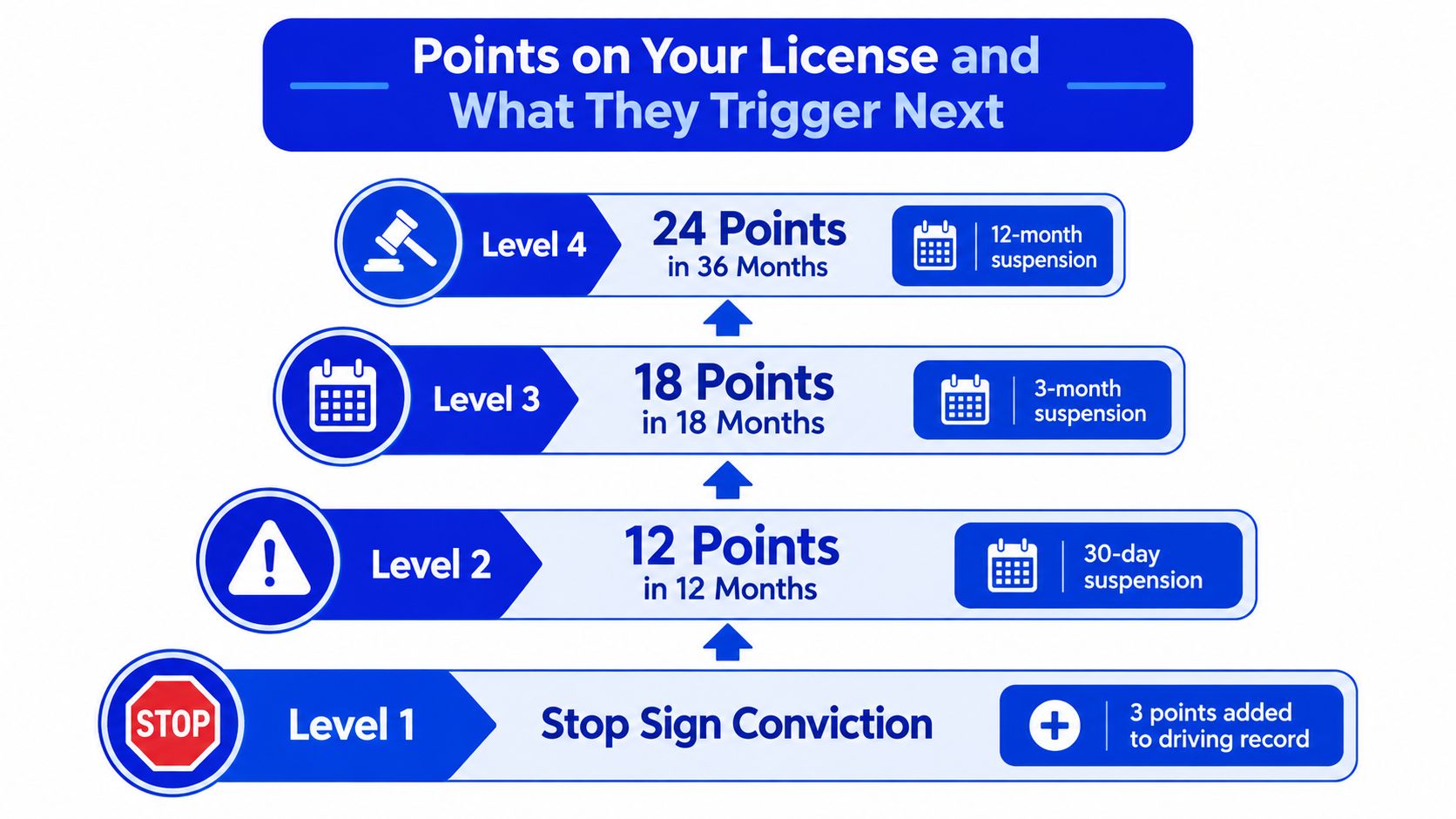
A point is a record event, not a receipt line
Paying the stop sign violation fine may close the court balance, but it does not erase the conviction's record effect. The point can matter when authorities assess later violations, and insurers may review the conviction when setting risk.
Florida can suspend a license after accumulating 12 points within 12 months. A new point is therefore more serious when your record already contains moving violations or unresolved matters. Check your current record before deciding that payment is harmless.
What to do before accepting points
Count your existing points: Determine whether this conviction could bring you near the 12-point suspension threshold or affect your eligibility to drive.
Check the timing: Review when prior points were added. Florida's point rules can make a 30-day point accumulation limit relevant to your exposure.
Test the stop-sign facts: Record where you stopped, whether the sign or pavement markings were visible, traffic conditions, and what the officer could observe.
Choose a record-focused response: Compare paying, traffic school, and a defense strategy based on whether the outcome adds points. A direct attorney review can address the facts and pursue dismissal, reduction, or No Points when the available options support it.
License protection: A quick payment can create a larger licensing problem later.
The fine is only the starting cost. Court consequences and points can threaten your driving privilege, while a conviction may affect insurance later. Before paying, ask what outcome protects your record, not merely what closes the citation. Direct access to a lawyer gives you a case-specific assessment. A ticket mill typically gives you a process and a form response.
Insurance Hikes and the Long Tail Cost You Do Not See on the Ticket
The most expensive part of a stop-sign conviction may arrive after the citation is closed. One widely cited estimate says insurance premiums can rise by as much as 19% after a stop-sign conviction. Consumer insurance guidance on stop-sign tickets also notes that a conviction can remain on a record for up to 3 years, while insurance effects may persist for years.
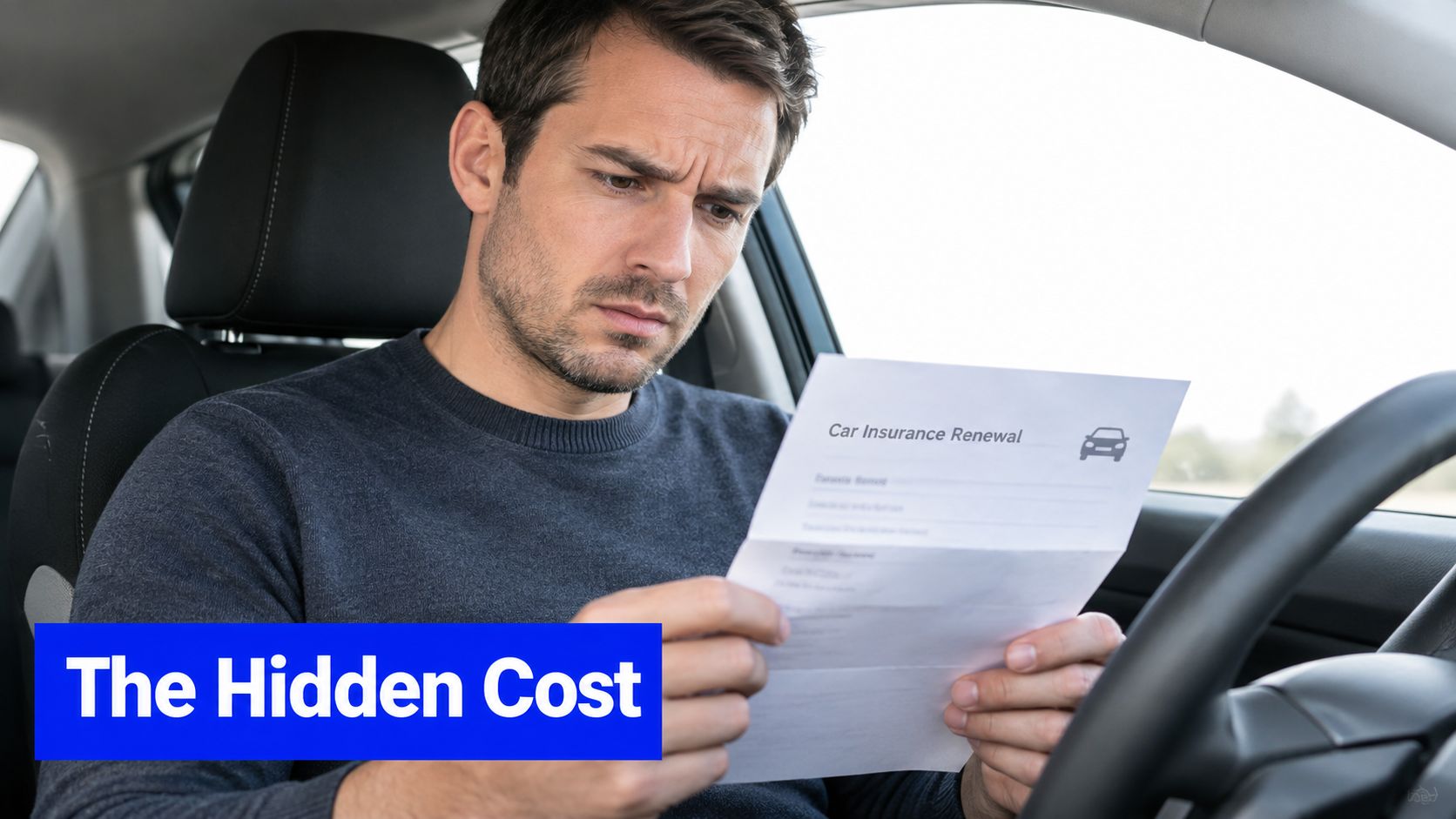
The renewal bill changes the calculation
A one-time citation balance is easy to see. A premium increase is harder to notice because it can appear at renewal and continue through later policy periods. If you carry a higher premium for years, the cumulative cost can exceed the original ticket by a wide margin.
That risk is especially serious if your record already contains moving violations. Insurers don't evaluate the stop-sign conviction in isolation. They may consider the broader driving history, and a new conviction can reinforce an existing risk profile.
Why avoiding points deserves priority
Drivers often focus on the immediate payment because the court deadline is clear. The insurance consequences are less visible, but they can affect your household budget long after the citation disappears from your dashboard.
A successful traffic defense doesn't guarantee a particular result, and no lawyer can promise an insurance decision. But seeking a resolution that avoids points is a rational way to address the risk before it reaches your insurer. You can also review general strategies in this guide to lowering insurance rates.
Financial reality: Treat the stop sign violation fine as the first cost, not the complete cost.
If you're near a licensing threshold or have prior citations, don't make a payment decision based only on the amount printed on the ticket. Have the citation and your record reviewed while meaningful options may still be available.
Your Options to Fight the Ticket and Pursue No Points
You generally have two practical paths after receiving a Florida stop-sign ticket. You can pay and accept the resulting conviction, or you can contest the citation and pursue a strategic outcome that may include dismissal, reduced penalties, or withholding of points when legally available.
The choice should reflect your record, the facts, your deadline, and the consequences you're willing to accept. A ticket mill or automated app may route your matter through middlemen, corporate answering services, or chatbots. That model can leave you without direct access to the lawyer handling your case.
Paying versus contesting
Factor | Paying the Fine | Contesting With Strategic Defense |
|---|---|---|
Immediate effort | Usually straightforward, but you must follow the payment instructions and deadline | Requires timely review, authorization, and case preparation |
Record impact | Accepts the citation's conviction consequences | Seeks an outcome that protects the record, subject to the facts and court result |
Points | May result in the applicable points for the moving violation | Pursues dismissal, reduction, or a no-points resolution when available |
Insurance risk | Leaves a conviction available for insurer review | Attempts to prevent or limit the record event that may affect underwriting |
Court involvement | You handle the payment process yourself | Counsel manages the legal response and court strategy |
Communication | Often limited to the clerk or service portal | A lawyer-led firm can provide direct phone or text access to your attorney |
What contesting should look like
A responsible defense begins with the citation, not a sales script. Counsel should examine the alleged statute, roadway markings, officer observations, procedural requirements, and your driving history. The defense strategy should then target the outcome that protects your license and minimizes long-term exposure.
Ticket Shield, PLLC describes a lawyer-led model in which clients communicate directly with their attorney by phone or text. The firm reports that over 99% of its clients never appear in court, and it serves Florida traffic matters statewide. Those are service details to evaluate alongside the firm's scope, fee arrangement, and communication process.
You should ask who will answer your questions, who will appear or negotiate for you, what outcome the representation seeks, and what costs are included. Don't assume an automated status page is equivalent to speaking with the attorney responsible for your defense.
Make the decision before the deadline
Waiting can reduce your choices. Gather the citation, identify the response date, preserve any dashcam or phone records, and speak with counsel before paying. The objective is not to fight reflexively. It's to make an informed decision that gives you a meaningful opportunity to pursue No Points.
Protect Your Record Today With Ticket Shield
A stop-sign citation deserves a defense decision, not an automatic payment. The fine may be the smallest part of the financial exposure once Florida court assessments, points, record consequences, and potential insurance increases enter the calculation.
You should also demand clear communication. A lawyer-led defense gives you a direct point of contact for questions about the citation, the available strategy, and the outcome being pursued. That's different from an automated app that sends generic updates or a ticket mill that places layers of staff between you and the attorney.
Ticket Shield, PLLC offers Florida traffic defense with direct attorney communication by phone or text. The firm states that it serves all 67 Florida counties and handles traffic citations through a lawyer-led process designed to address the legal and record consequences of the charge.
Take these steps now
Locate your citation: Confirm the statute, county, court, and deadline.
Avoid an automatic admission: Don't pay before you understand the record and insurance implications.
Prepare your facts: Note the stop-line location, crosswalk, visibility, traffic, weather, and officer interaction while they're fresh.
Request a case review: Ask what outcome the defense seeks and whether the strategy is directed toward No Points.
Your driving privilege is worth protecting before a simple stop-sign allegation becomes part of a larger record problem. A direct lawyer conversation can help you weigh the ticket, your history, and the available path with facts instead of guesswork.
Visit Ticket Shield, PLLC for a free consultation about your Florida stop-sign violation fine and a lawyer-led defense focused on protecting your record. Speak directly with your attorney by phone or text, and pursue the ultimate goal of achieving “No Points” on your license.