Speeding Ticket Defensive Driving in Florida: Your Guide
Learn how speeding ticket defensive driving works in Florida, from eligibility and points to insurance impact and when to hire a lawyer for the best outcome.

The blue lights are in your mirror. The officer walks back to the patrol car, and you're left holding a Florida speeding citation that may look like a simple bill. Your first instinct is probably to pay it, forget it, and move on.
That instinct can cost more than the fine. In Florida, the decision you make after a speeding ticket can affect your license, driving record, and insurance treatment. Speeding ticket defensive driving isn't just a course-selection question. You have three paths, traffic school, attorney representation, or paying outright, and each produces a different legal and financial result.
Table of Contents
The Moment You Get Pulled Over and What Comes Next
The citation is in your hand, and you may dispute the listed speed, location, or measurement. The payment website can wait. Paying immediately may close off the chance to challenge the evidence or pursue a better resolution.
Treat the deadline on the citation as a decision point, not a suggestion. Payment is usually the fastest administrative route, but it generally accepts the ticket's consequences. The fine is only one part of the decision. Points, insurance treatment, and your driving record may matter longer.
Florida treats speeding as a safety issue, not merely paperwork. The World Health Organization's road traffic injury guidance reports that a 1% increase in mean speed produces a 4% increase in fatal crash risk and a 3% increase in serious crash risk. That context explains why a routine-looking citation can still create meaningful licensing consequences.
Practical rule: Do not pay a Florida speeding citation until you know whether payment will create points or eliminate an option you may need.
Your three choices
Before the deadline, compare three routes:
Traffic school: If you qualify and the court approves the election, a Basic Driver Improvement course may prevent points from posting. It does not necessarily erase the citation or prevent insurance consequences.
Attorney representation: A traffic lawyer can review the citation, examine the evidence, and seek dismissal, reduction, or another result that fits your record.
Paying outright: This resolves the administrative requirement quickly, but it usually accepts the ticket instead of challenging it.
Choose based on the stakes. A driver with no prior points and a minor violation may consider an approved course. A driver with existing points, a commercial license, or a speed allegation above the ordinary civil range should get legal advice before selecting an option.
The Florida traffic stop guide from Ticket Shield explains why the steps after the roadside stop can matter as much as the conversation with the officer. Make your choice before payment turns a strategic decision into a completed citation.
What Defensive Driving Actually Means for a Speeding Ticket
After a Florida officer issues a speeding citation, “defensive driving” can mean two different things. Treating both meanings as interchangeable is how drivers choose the wrong response.
As a driving practice, defensive driving means scanning ahead, adjusting speed for traffic and weather, anticipating lane changes, and leaving space for another driver's mistake. A safe driver responds to road conditions, not just the number on the dashboard.
For a ticket, defensive driving usually refers to a court-approved Florida Basic Driver Improvement, or BDI, course. The course is a legal compliance option tied to the citation. It may affect whether points are assessed, but completing it does not by itself challenge the officer's account or prove that the citation is defective.
What the BDI course does
Florida law permits an eligible driver to elect a driver improvement course under section 318.14(9), Florida Statutes, subject to statutory limits and court approval. The course commonly takes 4 hours. Finishing the class does not guarantee that the court will accept the election.
The course addresses the citation procedurally. If properly elected and approved, it can support withholding adjudication and preventing points from posting to your license. That outcome is different from proving an officer made a mistake, disputing the alleged speed, or showing that the speed-measurement evidence is unreliable.
A course can also reinforce safer driving habits, which may reduce the chance of another violation. That benefit concerns future driving. The legal election concerns the current ticket, and you must evaluate them separately.
Review Ticket Shield's guide to traffic violator school for a practical explanation of the Florida course option. Then verify the election requirements with the clerk or a Florida traffic attorney before you choose traffic school, attorney representation, or payment.
A completed course may protect an eligible driver from points. It does not turn a disputed citation into a dismissal.
How Florida Speeding Statutes Stack Points Against You
The speed alleged on your citation can determine whether you face three points, four points, or a more serious charge. Do not treat every speeding ticket as interchangeable.
Florida assigns 4 points for speeding more than 15 mph over the lawful or posted speed. Accumulating 12 points within 12 months results in a 30-day suspension, according to the Florida DHSMV point suspension guidance. Your existing record matters before you choose traffic school, attorney representation, or payment.
Florida's Chapter 316 also requires a speed that is reasonable and prudent under the conditions. Section 316.183 lists default maximum speeds of 30 mph in business or residence districts and 55 mph elsewhere, subject to lawful changes and local authority. Review the Florida statute governing reasonable and prudent speed before assuming the posted number settles every legal issue.
Point exposure by allegation
Violation | Points | Statute |
|---|---|---|
Speeding 15 mph or less over the lawful or posted speed | 3 | Florida point schedule and Chapter 316 |
Speeding more than 15 mph over the lawful or posted speed | 4 | Florida point schedule and Chapter 316 |
A conviction adds to your driving record and can move you closer to a suspension threshold. A speeding violation connected to a crash may bring harsher consequences. A high-speed allegation may also fall outside the ordinary civil-citation process.
Florida separately prohibits dangerous excessive speeding under section 316.1922. Driving 50 mph or more over the limit, or driving 100 mph or more in a manner that threatens safety or interferes with other vehicles, can qualify. A first conviction may carry up to 30 days in jail or a $500 fine. A later conviction may carry up to 90 days in jail or a $1,000 fine. A repeat offense within 5 years can require license revocation for at least 180 days. See the Florida dangerous excessive speeding statute.
Check your record before selecting a response. The Florida license-points record guide can help you connect the alleged speed with your current point exposure and decide whether traffic school, a lawyer, or payment best protects your license.
Who Qualifies for a Florida Traffic School Diversion
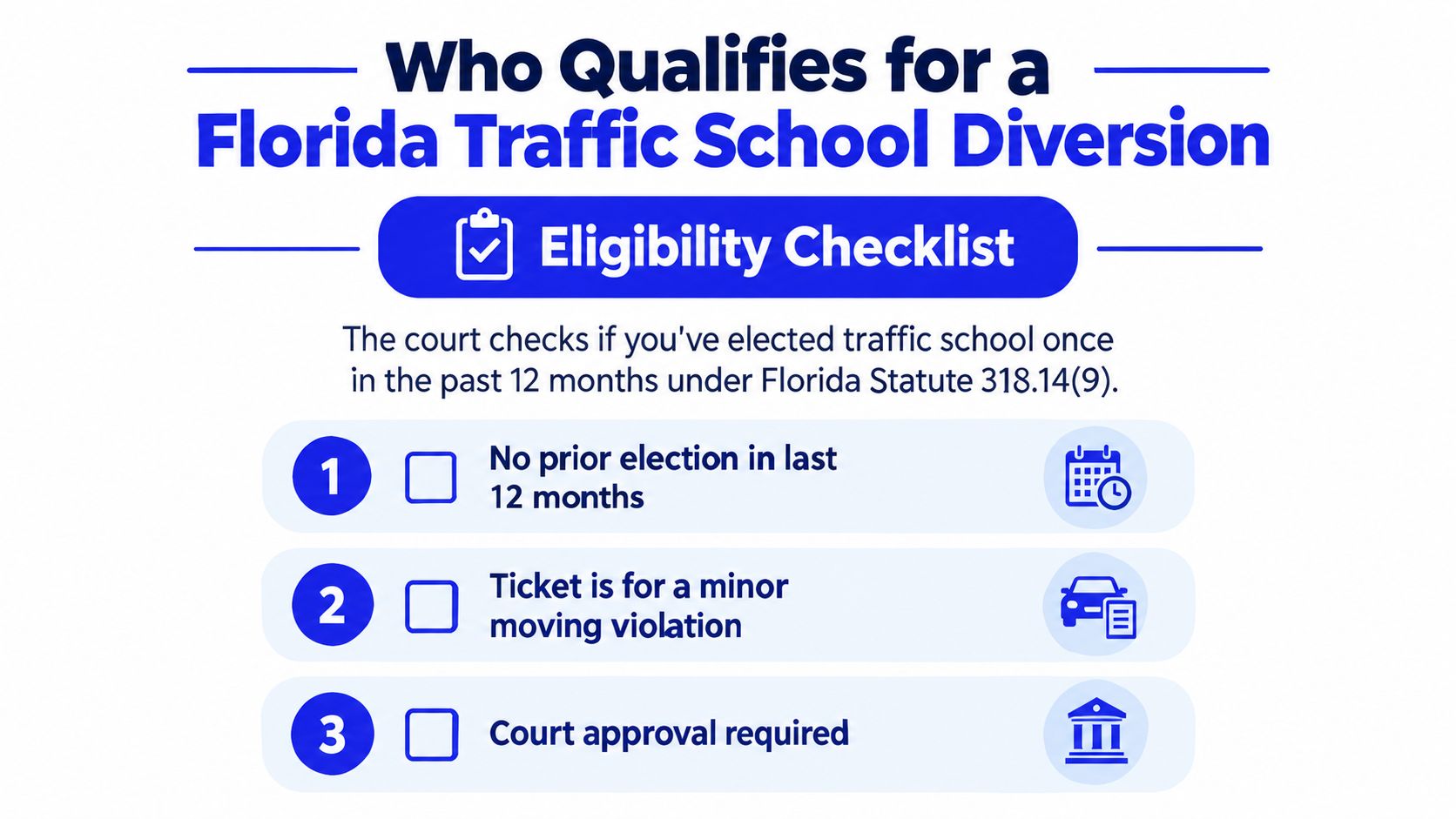
Getting a speeding ticket does not automatically make traffic school available. Florida limits how often you may elect the option, and the court must accept that election. Registering for a course before confirming eligibility can leave you with an unresolved citation and fewer choices.
Under section 318.14(9), Florida Statutes, the election is generally limited to once in a 12-month period. If you elected traffic school during the preceding 12 months, you may not qualify again. Commercial driver license holders and drivers operating commercially face additional restrictions. A CDL driver should not assume a BDI course will produce the same result as it would for a noncommercial driver.
The eligibility questions
Check each point before you enroll:
Prior election: Have you used the Florida traffic-school election within the past 12 months?
Violation type: Is the citation a qualifying noncriminal moving violation, such as ordinary speeding?
License status: Do you hold a commercial license or operate commercially?
Court approval: Has the court accepted your election, rather than merely allowing course registration?
The option generally does not cover criminal offenses such as reckless driving, leaving the scene, or violations outside the eligible civil-citation process. A clerk may process your paperwork without deciding whether every legal requirement has been satisfied. Ask for confirmation instead of treating administrative processing as approval.
The process must be completed correctly
If you qualify, you typically must elect the course, pay the required election fee, complete an approved BDI course, and submit proof of completion to the clerk. Confirm that the court reports the disposition properly to the Florida Department of Highway Safety and Motor Vehicles.
The common mistake is registering online first. If the court rejects your election, you may learn about the problem only after the deadline passes or the citation is resolved by default. That can eliminate the traffic-school path and leave attorney representation or payment as your remaining options.
Confirm the election, deadline, and reporting requirements in writing whenever possible. Do not confuse course enrollment with court approval.
Why a Defensive Driving Course Does Not Erase the Ticket
A Florida BDI course can prevent points from posting in an eligible case, but it doesn't erase the citation. Under section 318.14(9), the court may withhold adjudication instead of dismissing the ticket or finding that it never occurred.
That distinction matters when an insurer reviews your driving history. A carrier may treat a withheld speeding event differently from a dismissal, and the result can vary by policy and underwriting rules. No points does not guarantee no insurance impact.
What changes and what stays
Outcome | Before BDI | After BDI |
|---|---|---|
Citation exists | Pending or unresolved | Remains as a non-adjudicated event when properly accepted |
License points | Not yet posted | Points may be prevented from posting |
Conviction status | Not yet determined | Adjudication may be withheld, not dismissed |
Insurance review | Carrier evaluates the eventual disposition | Carrier may still see and rate the event |
Driving record | Awaiting court reporting | Reflects the court's reported non-adjudicated disposition |
The earlier point table shows the points a speeding conviction can create. A BDI election addresses that points consequence in an eligible case. It does not give you the same record result as winning a dismissal through a legal defense.
That difference should guide your decision. Traffic school is a defined compliance option. Attorney representation gives you a chance to challenge the citation, seek dismissal, or pursue a reduction before accepting a non-adjudicated outcome. Paying the fine can leave the conviction and related points consequences in place, depending on how the case is resolved.
Confirm how your insurer treats a withheld adjudication before choosing the course. Then compare that risk with your driving record, existing points, and the strength of the officer's evidence. If the ticket could affect your license or future premiums, do not treat course completion as the same result as erasing the ticket.
Traffic School vs a Traffic Lawyer in Florida
You have three choices after a Florida speeding ticket: elect traffic school, hire a lawyer, or pay the citation. Choose based on points, insurance exposure, and the value of your driving record, not on which option feels easiest today.
Traffic school is a compliance option. A traffic lawyer provides a defense. A BDI election can fit a driver with a clean record, an eligible civil speeding violation, and no strong basis to dispute the citation. Representation is the better choice when existing points threaten your license, the alleged speed is high, the facts are disputed, or a CDL is involved.
Factor | Florida Traffic School, BDI | Traffic Lawyer |
|---|---|---|
Primary purpose | Prevent points in an eligible case | Seek dismissal, reduction, or another negotiated result |
Court appearance | Often not required if accepted | Attorney may appear and handle the case |
Driver's time | Course completion required | Consultation and document review begin the process |
Record result | May leave a non-adjudicated citation | Dismissal may avoid a conviction event |
Evidence challenge | Does not test the officer's proof | Can examine speed measurement, pacing, signs, procedure, and testimony |
Best fit | Lower-stakes ticket and clean record | Existing points, high alleged speed, CDL concerns, or disputed facts |
Traffic school buys a defined compliance result if you qualify. It does not buy a defense. A lawyer buys an opportunity to challenge the citation, pursue dismissal, negotiate a reduction, or protect your record through litigation. Paying can leave the conviction and related points consequences in place, depending on the resolution.
Do not judge the decision by the immediate price. Compare the consequences of each path with the risks to your license, insurance, and future driving record. The WHO road-safety publication reports that speeding-related crashes accounted for 28% of all fatal crashes in 2020, with 11,258 fatalities, or 29% of total traffic deaths that year. Those figures explain why Florida treats speeding enforcement seriously, but they do not determine your defense.
Before choosing by habit, review Ticket Shield's comparison of paying a ticket and hiring a lawyer. Then match the option to your eligibility, record, and willingness to challenge the officer's evidence.
Why a Lawyer-Led Defense Beats the Ticket Mills
Automated apps and high-volume ticket services often make the process sound effortless. You upload the citation, pay a fee, and wait. That model may be convenient, but convenience isn't the same as case preparation.
A lawyer-led defense treats your citation as an individual evidentiary problem. Your attorney can review the citation, investigate the officer's training and equipment records, examine radar or LIDAR calibration materials when relevant, and identify inconsistencies in the alleged speed or location.

Preparation changes the available options
A real attorney can challenge pacing accuracy, question sign visibility, identify procedural defects, and cross-examine the citing officer when the case reaches a hearing. The lawyer may also negotiate a reduced charge or another disposition that protects your points, depending on the facts and the court.
That work requires a person who knows your case. If the court moves the date, the evidence changes, or you receive a notice from the clerk, direct communication by phone or text is more useful than an automated chatbot directing you to a generic status page.
Ticket Shield, PLLC offers lawyer-led Florida traffic defense with direct attorney communication by phone or text, rather than relying on corporate answering services or middlemen. Its lawyers handle speeding citations and can evaluate whether a course election, negotiated result, or contested hearing fits the record.
Watch this short explanation before deciding whether a processing service is enough for your situation.
The local-lawyer comparison from Ticket Shield explains why courtroom readiness and direct access matter. You shouldn't pay for a service without knowing whether a licensed attorney will prepare and handle your case.
Protect Your License With the Right Next Step
The first 48 hours after a Florida speeding ticket should produce a decision, not a panic payment. Read the citation carefully. Mark the court date, listed speed, alleged speed, location, statute, signature, and response deadline.
Start with the allegation and your current record. Florida assigns 4 points for speeding more than 15 mph over the lawful or posted speed. A higher alleged speed can therefore create greater exposure, especially if existing points place you near the 12-point threshold within 12 months described earlier by the Florida DHSMV.

Use a short decision checklist
Read every line of the citation. Confirm the statute, speed, location, signature, and deadline.
Review your license record. Check existing points, prior course elections, and any suspension concern.
Compare all three paths. Review an eligible BDI course, payment, and attorney representation before choosing.
Check insurance exposure. Ask your carrier how it treats a withheld speeding event compared with a dismissal.
Preserve disputed facts. Record the weather, traffic, lane position, signs, and events before those details fade.
Get advice before paying. Payment can eliminate strategies that might protect your record.
A BDI course fits a qualified driver whose exposure is limited and whose record can absorb the result. Payment works only when you understand the points, insurance consequences, and effect on your driving history. It is the wrong default for a driver with existing points, a commercial license, a high-speed allegation, or serious doubts about the officer's evidence.
Choose traffic school when it addresses the risk. Choose a lawyer when the record, license, or insurance stakes justify a defense. Do not treat defensive driving as a checkbox. It is one path in a strategic decision among course election, attorney representation, and payment.
Ticket Shield, PLLC offers a free consultation for drivers evaluating speeding ticket defensive driving, payment, or lawyer representation. The goal is to protect your license and pursue No Points on your record whenever the facts and law allow it.
Visit Ticket Shield, PLLC for a free consultation about your Florida speeding ticket. Speak directly with a lawyer-led defense team about your options, with the ultimate goal of achieving “No Points” on your license.