Florida Traffic Violator School: A Driver's Defense Guide
Should you elect traffic violator school in Florida? Understand the rules, costs, and impact on points before you decide. Get a protective legal analysis.

Traffic school can protect you, but it's often the wrong first move. In Florida, it may help you avoid points, yet you still face deadlines, costs, and record consequences. Before you elect it, get legal advice aimed at dismissal, not just damage control.
Most drivers get the same bad advice after a ticket. “Just take traffic school.”
That advice is incomplete. Sometimes it costs you more. Sometimes it burns one of your limited options. Sometimes it locks you into a weaker result than you could have fought for. If your goal is No Points, lower long-term insurance exposure, and the strongest possible record protection, you need to treat traffic violator school as a strategy choice, not a reflex.
I've seen too many drivers assume the easy path is the smart path. It isn't. Florida traffic law under Chapter 316 is full of technical rules, court deadlines, and hidden trade-offs. A citation under provisions like F.S. 316.187 or a school zone issue under F.S. 316.1896 can look routine on paper and still carry consequences that matter months later.
If you're already thinking about electing school, read this first. Then compare that option against a direct defense strategy like traffic ticket deferral guidance.
Table of Contents
Is Electing Traffic School Your Best Move
No. Not automatically. Traffic violator school in Florida is often a fallback, not your best defense. It may keep points off this ticket, but you still face costs, deadlines, and a record of the stop. If dismissal is possible, school is a concession.
Drivers usually choose school because they want the problem over with. I understand that. You're busy, irritated, and trying to protect your license and insurance. But fast decisions after a citation often become expensive decisions later.
Florida's traffic school option sounds simple because the sales pitch is simple. Avoid points. Move on. That's only part of the story. You may still pay the ticket. You may still spend time completing the course. You may still leave a paper trail tied to the stop. And if your case had defenses, you may have given them up too soon.
Practical rule: If a ticket can be challenged, dismissal is stronger than education after the fact.
That's the mindset you should bring to any Chapter 316 citation. Don't let convenience push you into a weaker outcome.
What Is Florida Traffic Violator School
Florida traffic violator school is formally the Basic Driver Improvement course, often called BDI. It is not a magic eraser. It is a state-approved educational option used to resolve certain basic traffic citations under Florida procedure.
According to Florida BDI course rules and deadlines, Florida's Traffic Violator School, officially known as the Basic Driver Improvement (BDI) course, is a state-approved 4-hour online program. Since online traffic school was first introduced in 1996, this BDI course has become standard for resolving basic traffic citations across all 67 Florida counties. Drivers must complete the course within 60 to 90 days from the date of their citation and submit a completion certificate to the county clerk's office.
That gives you the legal framework. It also gives you the first warning. This is a deadline-driven court process, not a casual online class you can get around to whenever you want.
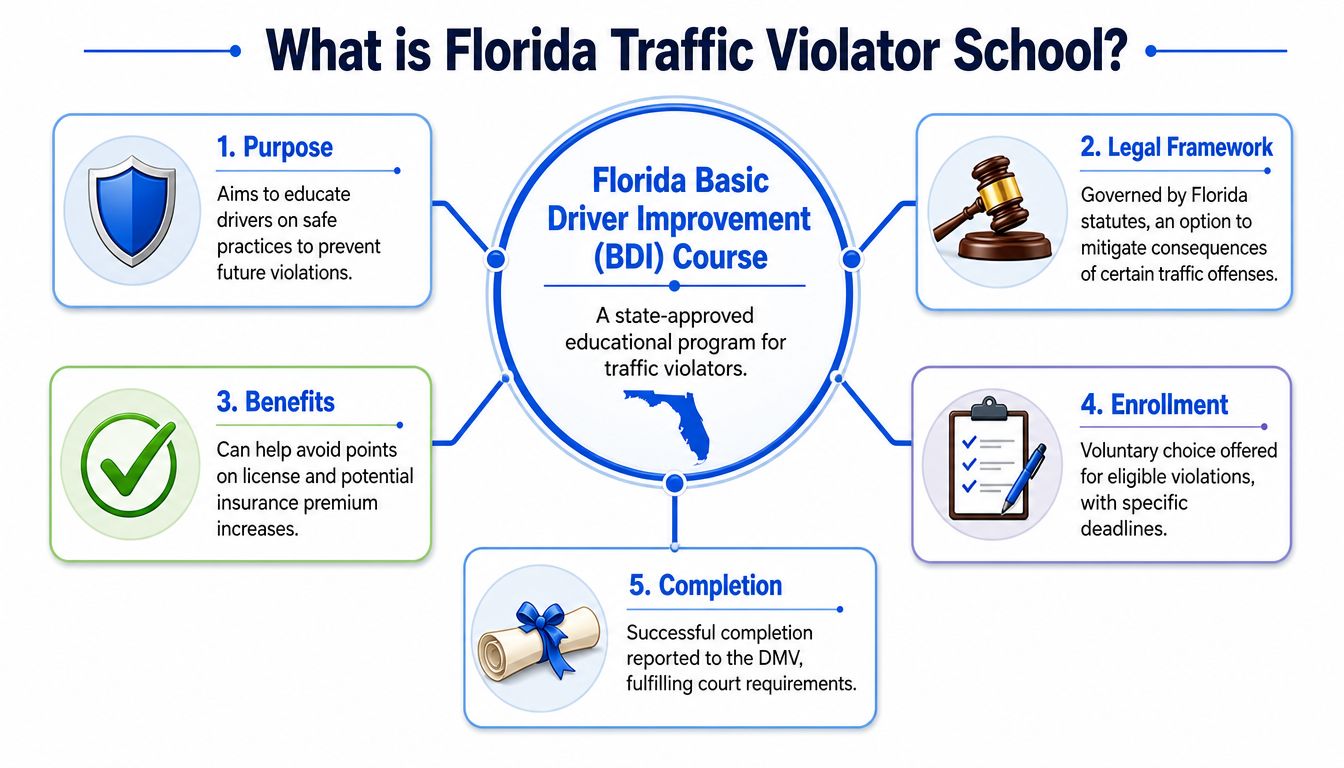
How the BDI course actually works
The BDI course exists to help eligible drivers address a minor moving violation in a way that can reduce direct penalties tied to points. In practical terms, it's a structured way to satisfy a court-related requirement while trying to limit the damage from one ticket.
In Fort Lauderdale, that decision often lands in the orbit of the Broward County Judicial Complex. By the time many drivers ask whether school is “worth it,” the true question is narrower. Are you eligible, on time, and making the right strategic choice for your record?
If you want a plain-English overview of course logistics, this guide to an online traffic course Florida can help you understand how these programs are commonly presented to drivers.
What the court expects from you
The state approves the course, but the court expects compliance. That means:
Finish on time: Your completion window is tied to the citation and clerk instructions.
Use an approved program: Florida requires state-approved content and reporting structure.
Submit proof properly: Your certificate must get to the clerk's office in the way your county requires.
The BDI course is a legal tool. Use it like one. Don't treat it like a consumer app purchase.
That distinction matters. A court process has consequences when you miss a step. A missed form, a missed deadline, or a bad assumption can turn a manageable ticket into a bigger problem.
Who Qualifies for Traffic School in Florida
Many drivers often make preventable mistakes. They assume traffic violator school is broadly available because it's commonly offered. Availability isn't the same as eligibility.
Florida allows the BDI route for many basic moving violations, but not every ticket, not every driver, and not every situation. Courts also expect strict compliance with election procedures. If you guess wrong, you can lose time and money while still ending up with the original problem.
Why drivers get this wrong
The clerk's system doesn't protect you from strategic mistakes. It processes elections. That's different.
A driver might be technically able to elect school and still make the wrong call because the citation had defenses, because the county has specific filing expectations, or because the driver is using school to solve the wrong problem. If your real concern is employment, insurance underwriting, or preserving every future option, eligibility alone isn't enough.
A few categories deserve extra caution:
Drivers with work-related exposure: If you drive for income, even a routine citation can create pressure beyond points.
Drivers with prior traffic history: Repeated incidents can make “just take school” a weak long-term plan.
Drivers facing anything more serious than a basic moving violation: School may not be the central issue at all.
Immediate steps to take
Read the citation carefully: Look for the statute charged, hearing instructions, and payment or election deadlines.
Check the county procedure: Florida is statewide, but clerks can impose their own filing mechanics and provider requirements.
Ask whether the ticket is defensible: A weak ticket should be fought, not managed.
Protect your future options: Don't spend a strategic remedy on a citation that could have been dismissed.
Document everything: Save confirmations, screenshots, receipts, and any clerk communication.
If you're relying on an automated app or a ticket mill, you may never talk to the lawyer making the decision, or there may not be one making it at all.
That's not good enough when a traffic case affects your license, your job, or your insurance profile.
The True Cost of Electing Traffic School
Traffic school is marketed as value-driven. That's only true if you ignore the full ledger.
Florida's BDI course can help in the right case. But the hidden problem is simple. You don't elect traffic school to erase the ticket. You elect it to reduce part of the fallout while still carrying other costs. For many drivers, that's a weak trade.
According to Florida traffic school fine and point details, taking Florida's Traffic Violator School (BDI course) can result in an 18% fine reduction on some civil penalties and avoids points for the current violation, but these outcomes are not guaranteed for all citations and require strict compliance with court procedures. The program is designed to fulfill court-ordered mandates but doesn't eliminate the base fine.
That sentence matters more than the marketing around traffic school. It tells you the key truth. The base fine doesn't disappear.
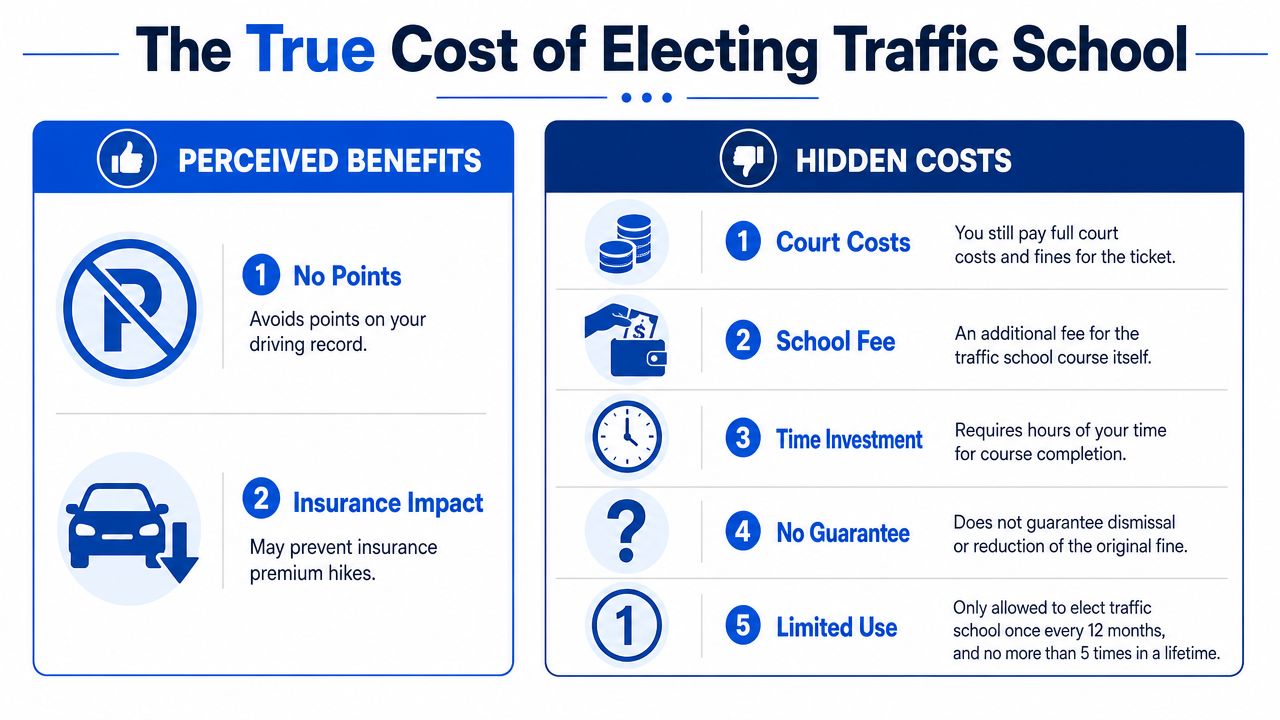
What you still pay
Most drivers focus on the course itself. That's the smallest part of the analysis.
Your real cost can include the ticket payment obligations, court-related assessments, your own time, and the strategic cost of choosing management over defense. If you want a broader view of those court-related expenses, review this breakdown of traffic ticket court cost considerations.
Here's the cleaner comparison:
Issue | Traffic school election | Fighting the ticket |
|---|---|---|
Immediate convenience | Often easier upfront | Requires legal review |
Base fine exposure | Still remains | May be challenged |
Time burden | You complete the course | Attorney can handle much of the process |
Final goal | Avoid points on this violation | Seek reduction or dismissal |
Why point avoidance can be a weak bargain
Avoiding points is useful. It just isn't the same as winning.
If you still pay the fine, still comply with a course, and still carry a documented event tied to the stop, you've bought damage control. Sometimes that's necessary. Sometimes it's the right move. But too many drivers accept that outcome before asking whether the citation was beatable.
Financial reality: A point avoided can still be an expensive result if you paid money and gave up leverage to get there.
That's where legal advice changes the analysis. A dismissal target is stronger because it attacks the citation itself. Traffic school usually accepts the ticket as the starting point and tries to soften the landing.
How Traffic School Affects Your Record and Insurance
The phrase “no points” confuses people. It sounds cleaner than it is.
When drivers elect traffic violator school, they often assume the ticket somehow disappears. That is not how you should think about it. The better way to frame it is this: school may help you avoid points for the current violation, but that does not automatically mean the event becomes invisible for every real-world purpose.
No points is not the same as no problem
Insurance companies and other decision-makers don't think like drivers do. Drivers hear “no points” and relax. Insurance systems look at broader driving history, underwriting signals, and patterns.
You don't need scare tactics to understand the risk. You just need clarity. A ticket handled through school is still not the same thing as a clean dismissal. If your concern is future renewals, employer review, gig platform screening, or preserving a stronger record, traffic school can leave you short of the result you actually wanted.
That's why drivers asking how to protect their record should also look at alternatives to course election, including options discussed in this guide on removing points without traffic school.
Why dismissal is the better target
Dismissal attacks the accusation. Traffic school manages the consequences.
That difference matters because a strategic defense can sometimes do more than protect against points. It can protect your time, reduce administrative hassle, and put you in a stronger position if another issue arises later. If your case is weak for the officer, traffic school may be the wrong answer from the start.
A traffic stop can be routine. The consequences of choosing the wrong response aren't.
Drivers who depend on a clean history should think past the immediate relief. The smarter question isn't “Can I take school?” It's “Why should I settle for school if the ticket can be beaten?”
Why an Attorney Is Your Strongest Defense
A lawyer doesn't just process your citation. A lawyer evaluates whether the citation should stand at all.
That's the core difference between legal defense and traffic school. School assumes the ticket remains the center of the case. A defense lawyer looks at the statute charged, the officer's basis, the court's posture, procedural defects, mitigation value, and whether dismissal or reduction is available. That is a stronger posture from the first day.
For many Florida drivers, that difference is practical. You want this handled. You don't want to chase clerk instructions, guess about eligibility, or sit through a course if the case could have been challenged directly.
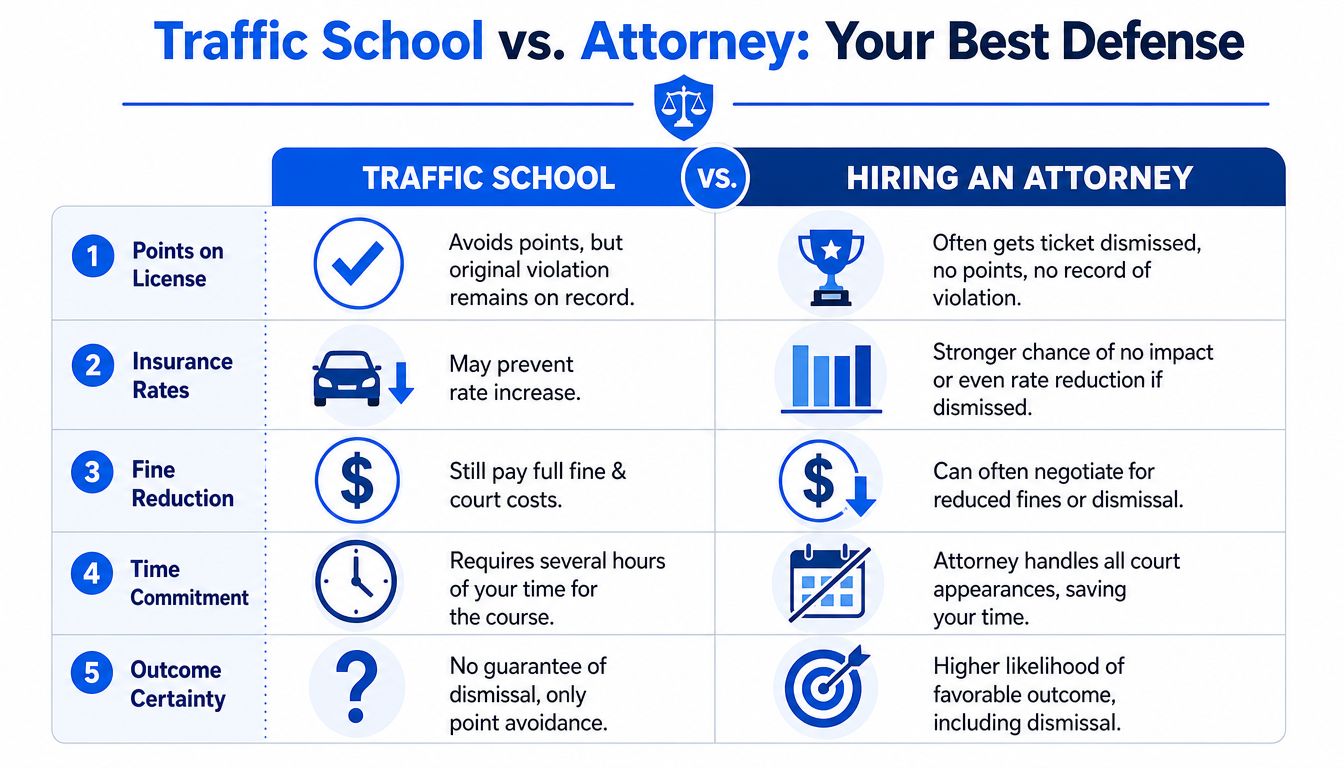
When traffic school is already a weaker option
Some cases prove the point immediately. Reckless driving is the clearest example.
Under Florida reckless driving BDI consequences, if you are convicted of reckless driving under F.S. 316.192(1), the Florida DHSMV automatically mandates completion of a state-approved Basic Driver Improvement (BDI) course, and your license will be canceled until you finish it within 90 days of notice.
That should change how you think about traffic school. In a serious case, school isn't your defense. It can become a consequence after conviction. If you're anywhere near that kind of exposure, waiting to “just take traffic school” is not protective. It's passive.
This is especially true in places like Tampa, where cases move through the Edgecomb Courthouse and local practice matters. Serious traffic charges require early legal strategy, not after-the-fact compliance.
A good place to compare your defense options is this overview of Florida traffic ticket lawyers.
Here's the practical breakdown:
Minor citation with possible defenses: An attorney may push for a better outcome than school.
Repeat driver with record concerns: School may preserve one issue but leave the larger pattern untouched.
Serious charge under Chapter 316: Legal defense comes first. Education requirements may come later, if at all.
Here's a visual explanation of why that distinction matters in real cases.
Why direct attorney access matters
Many drivers often find themselves in a difficult spot. They hire a service that feels legal but functions like a pipeline. Intake person. Payment processor. Automated status updates. Maybe a chatbot. Maybe a non-lawyer middleman. Maybe nobody who knows your case until the last minute.
That isn't defense. That's volume handling.
You should be able to speak directly with your attorney by phone or text. You should know someone is reviewing the citation, the statute, the court, and the strategic downside of every option. Automated apps and ticket mills don't give you that level of protection. They give you convenience. Convenience is not the same as advocacy.
The right legal strategy starts with a person who can say yes, no, or not yet, and explain why.
If your goal is No Points, then don't stop at a remedy designed only to avoid points on one ticket. Push for the stronger result.
Florida Traffic School FAQs
Drivers usually ask the wrong first question. They ask, “Can I take traffic school?” The better questions are narrower and more urgent.
Can you miss the deadline and fix it later
Sometimes a court may allow relief, but you should never count on that. Traffic school in Florida is deadline-driven. If you wait too long, you can lose the option and be forced to deal with the citation on worse terms.
Your safest move is immediate review of the citation, county instructions, and election deadline. If there's any confusion, get legal advice before you submit anything.
What about school zone camera citations
Statutory detail matters. Under Florida Statute 316.1896 school zone timing limits, Florida Statute 316.1896 strictly limits automated school zone enforcement to specific windows: 30 minutes before through 30 minutes after breakfast programs or school sessions, meaning citations issued outside these 60-minute buffers are legally invalid.
That's exactly why automated advice fails drivers. A system may tell you to pay or comply. A lawyer asks whether the citation was valid in the first place.
Is traffic school enough for serious charges
No. Not if the charge carries larger license or conviction consequences. Traffic school can be a component in some cases, but it is not a substitute for defense when the stakes rise.
If you're trying to protect your driving history, this guide on getting a ticket off your record is a better place to start than a rushed school election.
If you want the strongest path to No Points, don't hand your case to an app, a chatbot, or a middleman. Visit Ticket Shield, PLLC for a free consultation and speak directly with a Florida traffic attorney who can fight for dismissal, protect your license, and keep the ticket from doing lasting damage.