How to Get a Ticket Off Your Record: A Florida Driver's Guide
Need to know how to get a ticket off your record in Florida? See what avoids points, what stays, and when expungement is actually possible.
Getting a traffic ticket in Florida, whether in busy Miami-Dade or elsewhere, can be frustrating, but knowing how to get a ticket off your record starts with one simple action: making a decision. You have three choices—pay the fine, go to traffic school, or fight the citation—and you must choose one within 30 days to avoid more serious problems, like a suspended license.
Attorney Advertisement. Office in Broward. The information contained in this blog post does not create an attorney-client relationship. Submitting information via our forms does not create an attorney-client relationship.
Your First Move After Getting a Florida Traffic Ticket
The moments after an officer hands you a ticket are often filled with frustration and questions. Whether you were cited on a hectic Broward County highway or a quiet street, that piece of paper is a legal notice with a firm deadline.
Ignoring it is not an option. Your first job is to take a breath, read the citation carefully, and understand exactly what you’re facing.
This flowchart lays out the three main paths you can take. It’s a simple visual guide to a critical decision.
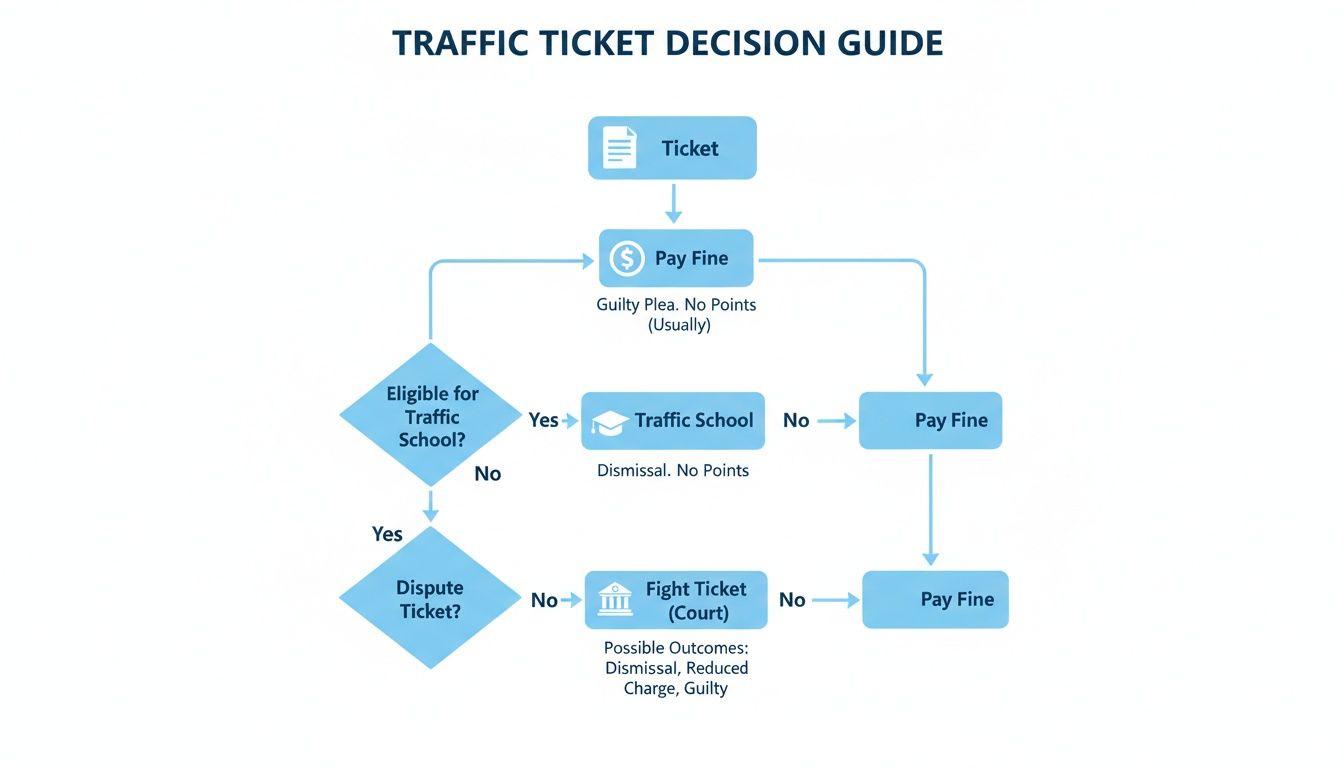
Paying the ticket is the quickest way to be done with it, but it is also the only path that results in a conviction and points on your record. The other two options, traffic school and fighting the ticket, offer a chance to avoid that outcome.
How We Evaluated the Ways to Get a Ticket Off Your Record in Florida
This guide focuses on factors that change outcomes for Florida drivers, not generic “best option” advice. Useful comparison points include whether an option prevents points, whether it still leaves a conviction or disposition, who is legally eligible, the actual cost after fines and course fees, time burden, the risk of appearing in court, and long-term effects on your driving history.
That framework matters because Florida’s options solve different problems. Paying closes the case fast, but usually at the cost of a conviction. Basic Driver Improvement can be a strong fit for an eligible civil citation because Florida says a driver who elects an approved course can receive a withhold and avoid points, subject to the state’s limits on use and eligibility under its driver improvement school rules. Contesting the citation creates the only path to a full dismissal on many ordinary tickets. Sealing or expungement is a different category altogether and usually matters only for eligible criminal traffic cases, not standard moving violations.
In practice, the biggest point of confusion is that people use one phrase to describe two different goals: stopping a new ticket from landing as a conviction, and trying to remove an old item later. Those are not the same project in Florida. A strategy is a poor fit if it solves the wrong problem—for example, electing traffic school after you are ineligible, or spending time on expungement research for a civil speeding ticket that Florida law does not allow you to seal or expunge.
Your Three Immediate Options for a Florida Traffic Ticket
The choice you make in that first 30-day window will directly impact your driving record and, almost certainly, your insurance premiums. Each option comes with its own set of pros and cons, so let’s break them down.
Option | What It Means | Impact on Your Record | Best For |
|---|---|---|---|
1. Pay the Fine | You're admitting guilt. Case closed. | Points are added to your license. The conviction goes on your record. | Someone who doesn't mind the points or insurance hike and just wants it over with quickly. |
2. Elect Traffic School | You plead no contest and agree to take a driver improvement course. | Adjudication is withheld, meaning no conviction and no points go on your record. | Eligible drivers with a good record who want to protect it from points without going to court. |
3. Contest the Ticket | You plead "not guilty" and challenge the citation in court. | You have a chance for a full dismissal (no fine, no points) or a reduced charge. | Anyone who believes the ticket was issued in error or wants to seek the best possible outcome. |
Making a smart decision here is all about weighing the short-term convenience against the long-term consequences.
Why That 30-Day Clock Is Everything
Let me be clear: letting that 30-day window close without taking action is a significant mistake. If you fail to respond, the court can find you guilty by default, add points to your record, and suspend your driver's license for "Failure to Comply."
Getting your license reinstated involves paying the original fine plus late fees and reinstatement costs.
The single biggest mistake a driver can make is missing the 30-day deadline. It turns a manageable problem into a much more expensive and complicated one, often resulting in a suspended license without the driver even knowing it.
Before you make any move, it’s wise to get the full picture of your driving history. We've got a detailed article that shows you how to check your Florida driving record. Knowing what's on your record helps you determine if you're eligible for options like traffic school and informs the best strategy for your specific case. Past results do not guarantee future outcomes.
Strategies to Keep a Ticket Off Your Driving Record
The most useful way to approach this in Florida is to separate three very different situations: before a conviction happens, after a civil ticket has already been resolved, and criminal traffic cases. In our experience, readers often assume all three can be handled with the same cleanup tool. They cannot.

1. Before a Conviction: Prevent It From Hitting Your Record
If your ticket is still open, this is the stage where you have the most control. For an ordinary Florida civil traffic citation, “getting it off your record” usually means preventing a conviction from being entered in the first place.
You generally have two practical ways to do that:
Contest the citation. A dismissal keeps the ticket from becoming a conviction.
Elect Basic Driver Improvement (BDI), if eligible. Florida explains that approved driver improvement elections can result in a withhold of adjudication so points are not assessed, subject to statutory limits and exclusions in the state’s driver improvement school guidance.
That distinction matters. Paying a ticket usually resolves the case by conviction. Electing BDI is different from paying and moving on because it is designed to avoid points on an eligible citation when the court withholds adjudication. Fighting the case is different again because it aims for dismissal or a negotiated outcome that may protect the record better than a straight payment.
2. After Conviction: You Usually Cannot Erase a Standard Civil Ticket
Once a normal civil moving violation has already been paid or adjudicated, Florida does not offer a general erase button for that ticket, and many online sources give bad advice on the matter. A paid speeding ticket is not something most drivers can later delete from the driving history through a cleanup filing.
What you can do at this stage is limit the damage going forward. First, confirm exactly what is on your motor vehicle record through official channels. Second, watch your point total closely. Florida’s point system creates escalating suspension risk: 12 points in 12 months can trigger a 30-day suspension, 18 points in 18 months can lead to a three-month suspension, and 24 points in 36 months can bring a one-year suspension. Florida also states that points remain on the record for at least five years from the date of conviction under its points and suspensions rules.
That timeline is why old tickets can keep affecting drivers longer than they expect, even when the immediate fine felt minor.
3. For Criminal Traffic Matters Only: Sealing or Expungement May Be Possible
Criminal traffic cases operate under a different set of rules. If the charge was criminal rather than civil, and the case ended favorably, sealing or expungement may be available. That possibility depends on the offense category, the final disposition, and whether you are legally disqualified.

The cleanest examples are charges that were dismissed, dropped, or ended in acquittal. Even then, eligibility is controlled by Florida law and FDLE procedure, not by the fact that the charge was traffic-related. A DUI, for example, is in a barred category and is not something to approach as a routine expungement candidate under Florida’s court-ordered sealing and expunction process.
What “Keeping a Ticket Off Your Record” Usually Means in Florida
For most Florida drivers, this phrase does not mean deleting a paid civil ticket months later. It usually means making the right decision within the original deadline so the citation never lands as a point-bearing conviction. I think this is the single most important clarification in the article, because it changes what action makes sense. If the case is open, focus on prevention. If the case is already closed as a civil infraction, shift to record review, point management, and insurance planning rather than chasing a removal remedy that does not exist.
For readers considering alternative outcomes, you can also review how traffic ticket deferral programs work.
How Long It Takes for Your Driving Record to Clear in Florida
There is no single Florida timeline that applies to every ticket. What “clear” means depends on whether you are talking about points, the public driving history, insurance underwriting, or an eligible criminal case that might later be sealed or expunged.
Points, Convictions, and Lookback Periods Are Different Things
Florida itself is clear on one part of the timeline: points remain on the driving record for at least five years from the date of conviction under the state’s point suspension guidance. That does not mean every insurer will treat the ticket the same way for that entire period, and it does not mean the underlying record entry vanishes on the same schedule.
In practical terms:
Around 3 years: many drivers think in three-year windows because insurers often focus heavily on recent violations.
Around 5 years: Florida’s own point-record timeline matters for suspension exposure and official record review.
Around 7 years or longer: some insurers, employers, or specialty underwriting reviews may look back further depending on the issue and the purpose of the record pull.
I would not make a strategy decision based on a generic “it drops off in three years” assumption. The better move is to verify what the state record shows now and then ask how that affects insurance, employment, or CDL consequences in your situation.
The Record Status Determines Whether Traffic School Still Helps
Traffic school is most useful while the citation is still open and you are eligible to elect it. Florida’s driver improvement school page makes clear that this option is tied to eligible cases and election limits. Once a civil ticket has already been resolved by conviction, traffic school is usually not a tool for retroactively scrubbing that record entry.
That is why checking status early matters so much. If the ticket is still pending, you may still be choosing between payment, BDI, or contesting. If it has already closed, your questions become very different.
Review Your Florida Driving Record Before You Choose a Strategy
A statewide article should start with the statewide record, because that tells you what problem you are solving. Before you decide whether to pay, elect traffic school, contest the case, or explore expungement, confirm what appears on your Florida record and whether the ticket is still pending.
Where to Check Your Florida Record
Florida drivers can obtain or review their record through official Department of Highway Safety and Motor Vehicles channels, including the state’s driving record services. That is the starting point if you need to confirm points, dispositions, suspensions, or whether an older case still appears the way you think it does.
We recommend checking the state record before making assumptions based on memory, insurance paperwork, or what a county clerk site seems to show. In our review of Florida ticket outcomes, people are often reacting to the ticket they just received without realizing a prior citation already changed the risk analysis.
Why the Timeline Matters in Real Life
Drivers often hear mixed answers about whether something stays on the record for three years, five years, seven years, or forever. Usually, those answers are talking about different systems.
Official Florida point exposure: tied to the state’s own point rules and suspension thresholds.
Insurance pricing: may focus heavily on recent years, but underwriting practices can vary.
Public record or court record visibility: depends on the case type and disposition.
Criminal record relief: only applies in eligible criminal matters and follows a separate sealing or expungement process.
A brief Miami-Dade example helps illustrate the rule without changing the statewide answer: a county clerk portal may show case activity and deadlines, but the driver’s statewide exposure still depends on what DHSMV records and whether points were assessed, withheld, or the case was dismissed.
Why Record Status Changes the Best Option
If your record shows no recent BDI election and the new citation is still within the response period, traffic school may still be useful. If your record shows multiple recent points and the next conviction could push you toward suspension thresholds, contesting the ticket may deserve more attention. If the record issue comes from a dismissed criminal traffic case, then sealing or expungement may be the right lane instead.
For a step-by-step internal guide, see how to check your Florida driving record. If your issue involves a camera ticket, you can also learn more about how red-light tickets get dismissed in Miami-Dade as a local example of how a specific defense theory can affect the record outcome.
Why Hiring a Traffic Ticket Attorney Makes Sense
When you get a ticket, the first question that probably comes to mind is, "Is it worth hiring a lawyer for this?" It's a fair question. While you can handle a ticket on your own, the value of bringing in a professional goes beyond just having someone appear in court for you. It's about having someone with experience identify opportunities you might not see on your own.
An attorney who focuses on traffic law knows the details that can affect a case. They understand the rules of evidence, the procedural steps required for a citation to be valid, and the specific legal arguments that get a hearing officer's attention in places like Broward County. Our practice focuses on traffic and DUI defense across Florida, so this is the world we operate in every day.
That focus turns a simple speeding ticket from a foregone conclusion into a legal document full of potential issues. Was the radar calibrated correctly? Was there a mistake on the citation itself? These are the kinds of technicalities that can lead to a case being dismissed.
Going Beyond Simple Convenience
For many busy people—or for drivers who got a ticket while visiting from out of state—the biggest relief is not having to use a vacation day sitting in a courthouse. A lawyer can appear on your behalf, saving you the travel, missed work, and stress of trying to figure out where to go and what to do.
But the strategic advantage is where the greatest value lies. An attorney isn't just a stand-in; they're your advocate, preparing a defense and negotiating from a position of experience.
Our goal is to protect your license and record. We handle the paperwork, court appearances, and legal arguments so you can focus on your life. Past results do not guarantee future outcomes.
This becomes critical when you're in a more serious situation, where your ability to drive or even your freedom is on the line.
When Legal Representation Is Most Crucial
While an attorney can help with almost any ticket, some situations have much higher stakes where professional help is almost a necessity. If you're in one of these situations, the potential consequences are too severe to handle alone.
Commercial Driver's License (CDL) Holders: For a professional truck driver, even a minor moving violation can threaten their career. CDL holders are held to a much higher standard and typically cannot elect traffic school to have points disappear.
Facing License Suspension: If you already have points on your record, the next ticket could trigger an automatic license suspension.
Charged with a Criminal Traffic Offense: Citations for Reckless Driving, Leaving the Scene of an Accident, or DUI are crimes, not simple infractions. A conviction can mean a permanent criminal record, probation, and potential jail time.
You Have a Poor Driving Record: If your record isn't clean, a prosecutor is less likely to offer a favorable deal to someone representing themselves. An attorney adds credibility to the negotiation.
For a deeper dive into whether your specific ticket calls for legal help, check out our detailed guide on when you need a lawyer for a traffic ticket.
The Expungement Factor
Fighting the immediate ticket is one thing, but keeping your record clean for the long haul is another. In Florida, that long-haul strategy only applies to a narrow slice of traffic-related cases. The more serious the allegation, the more important it is to know whether you are dealing with a civil ticket, a criminal traffic case, or a charge category that Florida law bars from sealing or expungement altogether. If you have seen broader “clean slate” discussions from other states, they can be helpful for contrast, but they do not change Florida eligibility rules; one example is Michigan’s Clean Slate overview.
Ultimately, hiring an attorney is an investment. You're investing in protecting your driving record, your insurance rates, and your time. It shifts the dynamic from a stressful solo battle into a managed legal strategy aimed at achieving the best possible result.
Sealing or Expunging Traffic Offenses in Florida
Many drivers use the word “expunge” when they really mean “make this stop hurting me.” In Florida, those are very different ideas. Traffic school can prevent points on an eligible open case. A dismissal can keep a citation from ending in conviction. Sealing or expungement, by contrast, is a formal legal remedy for eligible records—and it usually does not apply to standard civil moving violations.

What Readers Usually Mean by “Expunging a Driving Record” in Florida
Usually, they mean one of four things:
stopping points from being assessed on a new citation
getting a case dismissed before conviction
reducing the practical insurance damage from an older ticket
removing a criminal traffic case from public view through sealing or expungement
Only the last item is actual sealing or expungement. The others are different tools. A withhold of adjudication through traffic school is not an expungement. A paid civil ticket does not become expungeable just because time passed. And there is no general point-reduction filing that wipes convictions off a Florida driving history after the fact.
Florida Eligibility Framework
Here is the practical breakdown:
Civil moving violations: usually not sealable or expungeable. That includes ordinary tickets such as speeding, red-light violations, careless driving, and failure to yield.
Criminal traffic offenses with favorable outcomes: may qualify if the charge was dismissed, dropped, no actioned, or ended in acquittal, and the applicant meets the other statutory conditions.
Barred offenses: some offenses are excluded by law even if the case did not end in conviction. DUI is the clearest example and is not eligible under Florida’s expunction and sealing framework.
Florida courts and FDLE both make the process distinction clear: sealing and expunction are governed by statute and require a formal eligibility review, including a Certificate of Eligibility process through FDLE under the agency’s seal and expunge procedures. For a broader terminology primer showing how record-clearing terms differ from state to state, see the National Conference of State Legislatures’ state-by-state record clearing terminology guide.
Common Disqualifiers in Florida
Even for criminal traffic matters, several issues can block relief:
A prior adjudication of guilt for a criminal offense can disqualify you from sealing or expunging a later case.
An ineligible charge category can bar the remedy even if the case ended favorably.
A case that resulted in conviction or adjudication is often not eligible for expunction and may not qualify for sealing depending on the exact outcome and charge.
A prior sealing or expunction history can limit what is still available.
In practice, the question is not just “Was this dismissed?” It is also “What exactly was charged, and do you have any statutory disqualifiers?” That is where many quick online summaries fall apart.
Civil Infractions vs. Criminal Traffic Offenses
Most tickets people want removed are civil infractions, not crimes. That matters because Florida’s record-clearing statutes are not designed as a cleanup tool for ordinary moving violations. If the case was a routine speeding ticket handled as a civil citation, the better analysis is whether you could have avoided the conviction at the front end—not whether you can expunge it later.
If the case involved reckless driving, driving while license suspended, leaving the scene, or another criminal allegation, then sealing or expungement analysis becomes much more relevant. For statute-level detail, Florida’s court system summarizes the sealing and expungement process, and our own guide on Florida's traffic ticket expungement laws goes deeper into traffic-specific examples.
Common Questions About Florida Traffic Tickets
Drivers across Florida tend to have the same questions after getting a ticket. The answers are often straightforward, but they carry significant weight for your driving record and finances. Understanding these key points can help you make a smarter decision when that 30-day clock starts ticking.
How long does it take for your driving record to clear in Florida?
It depends on what you mean by “clear.” Florida says points remain on the record for at least five years from the date of conviction under its point suspension rules. Insurance companies may focus most heavily on the most recent few years, but that is not the same thing as the state deleting the entry. A civil traffic conviction can continue to appear on the driving history even after the immediate insurance sting fades. An eligible criminal case, if sealed or expunged, follows a separate legal timeline entirely.
Is there any way to clean your driving record?
Yes, but only in the sense that Florida offers ways to prevent new damage and narrow ways to clear eligible criminal records. If a civil ticket is still open, contesting it or electing BDI may keep points off or avoid a conviction depending on the outcome and your eligibility under Florida’s driver improvement school rules. If a standard civil moving violation has already been paid and closed, there is generally no later expungement-style remedy that erases it from the driving history. For criminal traffic matters only, sealing or expungement may be possible if the statutory conditions are met.
What disqualifies you from expungement in Florida?
Common disqualifiers include a prior adjudication of guilt for a criminal offense, a charge in a barred category, or a case outcome that does not meet Florida’s eligibility rules. DUI is one of the clearest examples of an offense category that Florida does not allow to be sealed or expunged through the normal process described by FDLE. Because eligibility turns on both the charge and the disposition, this is one area where the exact paperwork matters.
Do I have to go to court if I hire an attorney?
This is one of the biggest reliefs for our clients. In the vast majority of cases for non-criminal traffic infractions, you do not have to appear in court. Florida law permits your attorney to appear on your behalf. This is a significant advantage for anyone with a busy schedule, especially if you were ticketed in a county far from home—like getting cited in Orange County while you live in Miami.
An attorney can manage every step of the case for you:
Filing the "not guilty" plea on time.
Requesting and reviewing all evidence.
Appearing at all required court hearings.
Negotiating with the hearing officer or state attorney.
This process saves you the time, stress, and expense of going to court yourself. Our goal is to protect your license and your record by handling the entire legal process from start to finish. You can focus on your life while we work to achieve the best possible outcome. Past results do not guarantee future outcomes.
Trying to make sense of Florida's traffic laws can be a headache, but you don't have to figure it out alone. The team at Ticket Shield, PLLC is here to walk you through your options and fight for your record. For a free consultation, visit us at https://www.ticketshield.com.