A Guide to Florida Traffic Ticket Expungement
Learn how traffic ticket expungement in Florida works. Understand which criminal traffic offenses qualify and the steps to clear your record for good.

Got a traffic ticket in Florida? The first question that probably pops into your head is, "Can I get this off my record?" People throw around the term traffic ticket expungement, making it sound like a magic eraser for any driving mistake.
But here’s the hard truth: for the vast majority of common traffic tickets—like speeding or running a red light—expungement is not an option. That’s because these are considered civil infractions, not criminal offenses, and that one distinction changes everything.
The Critical Difference Between Civil and Criminal Traffic Violations

When an officer hands you a ticket, it’s easy to get tunnel vision, focusing only on the fine and the points. But the single most important detail is how Florida law classifies the violation. Getting this right from the start is the key to protecting your driving record.
Think of it like this: a regular civil traffic ticket is like a late fee from the library. You made an error, there's a penalty, you address it or contest it, and then you move on. It’s an inconvenience, but it doesn't leave a permanent stain on your reputation.
A criminal traffic violation, however, is more like a failing grade on your permanent school transcript. It follows you everywhere, showing up on background checks and potentially impacting your chances at a new job or apartment. Expungement is the legal process designed to erase that permanent mark, but it only applies to certain criminal charges.
What Is a Civil Infraction?
The everyday tickets that Florida drivers get are almost always civil infractions. They are non-criminal by nature and are handled through a much simpler, more administrative process.
Common Examples: Speeding, running a stop sign, improper lane changes, and expired tags.
Consequences: Fines, court costs, and points on your driving record.
Resolution: You can pay the ticket (which is an admission of guilt), elect to attend traffic school to keep points off your record, or engage an attorney to contest the ticket in court.
Since these aren't criminal cases, the entire concept of expungement just doesn't apply. The goal is to contest the ticket from the get-go to prevent a conviction from ever hitting your record in the first place.
Understanding Criminal Traffic Offenses
Criminal traffic offenses are in a completely different league. They are treated as misdemeanor or felony crimes because they pose a much greater threat to public safety.
A conviction for a criminal traffic offense does more than just add points to your license; it creates a public criminal record that can impact you for years. Our goal is to protect your license and record from these lasting consequences.
Common Examples: Reckless Driving, Driving While License Suspended (DWLS), Leaving the Scene of an Accident, and Driving Under the Influence (DUI).
Consequences: Potential jail time, significant fines, license suspension or revocation, and a permanent criminal record.
Resolution: These require a formal court process. If you're convicted, the only way to potentially clear it is through expungement, and only if the specific charge is eligible under Florida's strict laws.
To help you see the difference clearly, here’s a quick breakdown of how these violations stack up.
Florida Traffic Offenses at a Glance
Violation Type | Example | Can It Be Expunged? | Primary Goal |
|---|---|---|---|
Non-Criminal Infraction | Speeding 15 mph over the limit | No, expungement is not an option. | Contest the ticket to avoid a conviction and points. |
Criminal Traffic Offense | Reckless Driving | Yes, if you meet all eligibility criteria. | Contest the charge to avoid a criminal record. |
This table shows why the initial classification of your ticket is so important—it dictates the entire strategy for protecting your record.
The long-term impact of any traffic violation is significant. A ticket isn’t just about the fine; a conviction can affect your record and may cause insurance premiums to rise for several years. The stakes are high, especially when you consider a University of Michigan Law School study found that less than 10% of Americans eligible for expungement actually finish the process, leaving millions with a criminal record they could have cleared.
To get a better handle on just how long these marks can follow you, it helps to understand how long traffic tickets stay on your record in Florida.
Which Offenses Qualify for Expungement
Not all traffic violations are created equal, and understanding the difference is the first step to knowing your options. While common civil infractions like speeding are completely off the table for expungement, Florida law carves out a path for certain criminal traffic offenses.
These are the violations serious enough to create a lasting criminal record, and clearing them is the whole point of the traffic ticket expungement process.
The fundamental rule is straightforward: only criminal charges are potentially eligible for expungement. This means if your violation was classified as a misdemeanor or a felony, you might have an opportunity to clear it. These aren't just simple driving mistakes; the law sees them as actions that put public safety at risk, which is why they carry the weight of a criminal charge.
Common Criminal Traffic Offenses That May Qualify
Several specific criminal traffic charges in Florida could be eligible for expungement, as long as you meet all the other legal hurdles. Let's walk through some of the most common ones.
Reckless Driving: This isn't just a case of aggressive driving. It’s legally defined as operating a vehicle with a "willful or wanton disregard for the safety of persons or property." A reckless driving conviction is a criminal offense that can impact future opportunities.
Driving While License Suspended (DWLS): If you're caught driving on a suspended, revoked, or canceled license, you're facing a criminal charge. A DWLS conviction, especially if you had knowledge of the suspension, creates a criminal record.
Leaving the Scene of an Accident: Also known as a hit-and-run, this is a serious criminal offense, particularly if someone was injured. Because it’s a criminal charge, it's a potential candidate for expungement under the right circumstances.
No Valid Driver's License: Driving without ever having been issued a valid license is treated as a misdemeanor in Florida. This makes it another offense that may qualify to be cleared from your record.
These charges create real-world barriers. A criminal record can appear during background checks for jobs, apartment applications, and even professional licenses, making it critical to explore every legal option available. To get a better handle on one of the most common charges, you can learn more about whether reckless driving can be expunged in our detailed guide.
To make it easier to see what might and might not qualify, we've put together a quick comparison table. This breaks down some of the most common criminal traffic offenses and their general eligibility for expungement here in Florida.
Eligibility for Criminal Traffic Offense Expungement
Criminal Traffic Offense | General Description | Typically Eligible for Expungement? | Key Considerations |
|---|---|---|---|
Reckless Driving | Driving with a "willful or wanton disregard" for safety. | Yes | Eligibility depends heavily on the case outcome (dismissal, acquittal) and the person's prior criminal history. A conviction can make it more difficult. |
Driving While License Suspended (DWLS) | Operating a vehicle with a suspended, revoked, or canceled license. | Yes | Similar to reckless driving, eligibility hinges on the final disposition of the case and whether you have other convictions. |
Leaving the Scene of an Accident | Failing to stop and render aid or provide information after a crash. | Yes | The severity (property damage vs. injury/death) plays a huge role. Serious felony hit-and-runs are much less likely to qualify. |
No Valid Driver's License | Driving without ever having been issued a valid license. | Yes | As a misdemeanor, it generally qualifies if the case was dismissed or adjudication was withheld and other criteria are met. |
Driving Under the Influence (DUI) | Driving while impaired by alcohol or drugs. | No, if convicted. | A DUI conviction is specifically barred from expungement by Florida law. Only a dismissed or acquitted DUI charge may be eligible. |
This table provides a general overview, but it's important to remember that every case is unique. The specific details of your charge and your personal history will ultimately determine if you can successfully obtain an expungement.
What About DUI Charges?
Driving Under the Influence (DUI) is one of the most severe criminal traffic offenses, and it has its own special set of rules when it comes to expungement in Florida.
The law is clear on this: if you were convicted of DUI in Florida, you cannot have that conviction expunged. A DUI conviction remains on your record.
However, there's a narrow exception. If your DUI charge was dismissed, dropped (nolle prosequi), or you were acquitted at trial, you may be able to have the arrest record for that charge expunged. This is a critical difference—you aren't erasing a conviction, but rather the public record of the arrest itself. This can still be a significant benefit, as it removes the charge from appearing on most background checks. Sorting this out requires careful legal guidance to make sure you qualify.
The power of clearing a criminal record is hard to overstate. Just look at Michigan, where traffic offenses make up an incredible 50% of all criminal cases. When the state's Clean Slate laws went into effect, over one million residents had old convictions automatically sealed. The results were life-changing; a 2020 University of Michigan study found that people who had their records expunged saw their wages jump by an average of 23% within just one year. You can discover more insights about these transformative laws on Safe & Just Michigan. It’s a powerful example of what a clean slate can do.
Your Expungement Journey in Miami-Dade County
It’s one thing to read about Florida’s expungement laws, but it’s another to see how it all plays out in the real world. To make this process tangible, let’s walk through the actual steps you’d take to seek an expungement right here in Miami-Dade County. This is where the legal theory becomes a clear, step-by-step action plan.
Think of the expungement process as a series of legal filings and reviews that have to happen in a specific order. It’s like building a house—you can’t put up the walls before you’ve poured the foundation. Each step must be completed correctly for the whole thing to work, and one misstep can cause major delays or even result in your entire case being thrown out.
Step 1: Securing Your Certificate of Eligibility
Before you can even get in front of a Miami-Dade County judge, you need the state’s permission. The whole journey kicks off with an application to the Florida Department of Law Enforcement (FDLE) for a Certificate of Eligibility.
This certificate is a key component of the expungement process. It’s the FDLE’s official confirmation that after a review of your statewide criminal history, you appear to meet the basic requirements to have your record cleared.
To obtain it, you’ll need to:
Fill out the official application form with 100% accuracy.
Get a full set of fingerprints taken by an authorized law enforcement agency.
Have your signature on the application notarized.
Mail the application to the FDLE with the required processing fee.
This first step is absolutely critical. The FDLE will review your entire criminal history in Florida. If you have any other convictions or have already sealed or expunged a record before, they will almost certainly deny your application. A single error on the form can halt your journey before it even gets started.
Step 2: Filing the Petition in Miami-Dade County
Once you have that Certificate of Eligibility in hand, the action moves from the state level down to the local courts. Now, you’re ready to file a formal Petition to Expunge with the Miami-Dade Clerk of Courts. This isn’t just one form; it’s a package of legal documents that have to be prepared and filed correctly.
Typically, your filing package will include:
The Petition to Expunge: This is the main legal document where you officially ask the court to order the expungement.
The Signed Affidavit: You must sign a sworn statement, under penalty of perjury, confirming that you meet all the legal requirements.
The Certificate of Eligibility: The original, approved certificate you received from the FDLE must be included.
The Proposed Order: This is a draft of the final order you want the judge to sign, which will officially grant the expungement.
Filing these documents officially opens your case with the Eleventh Judicial Circuit Court in Miami-Dade County. The Clerk then processes all the paperwork, setting the stage for the final review.
This infographic shows the simplified flow of how an offense is assessed for the expungement process.
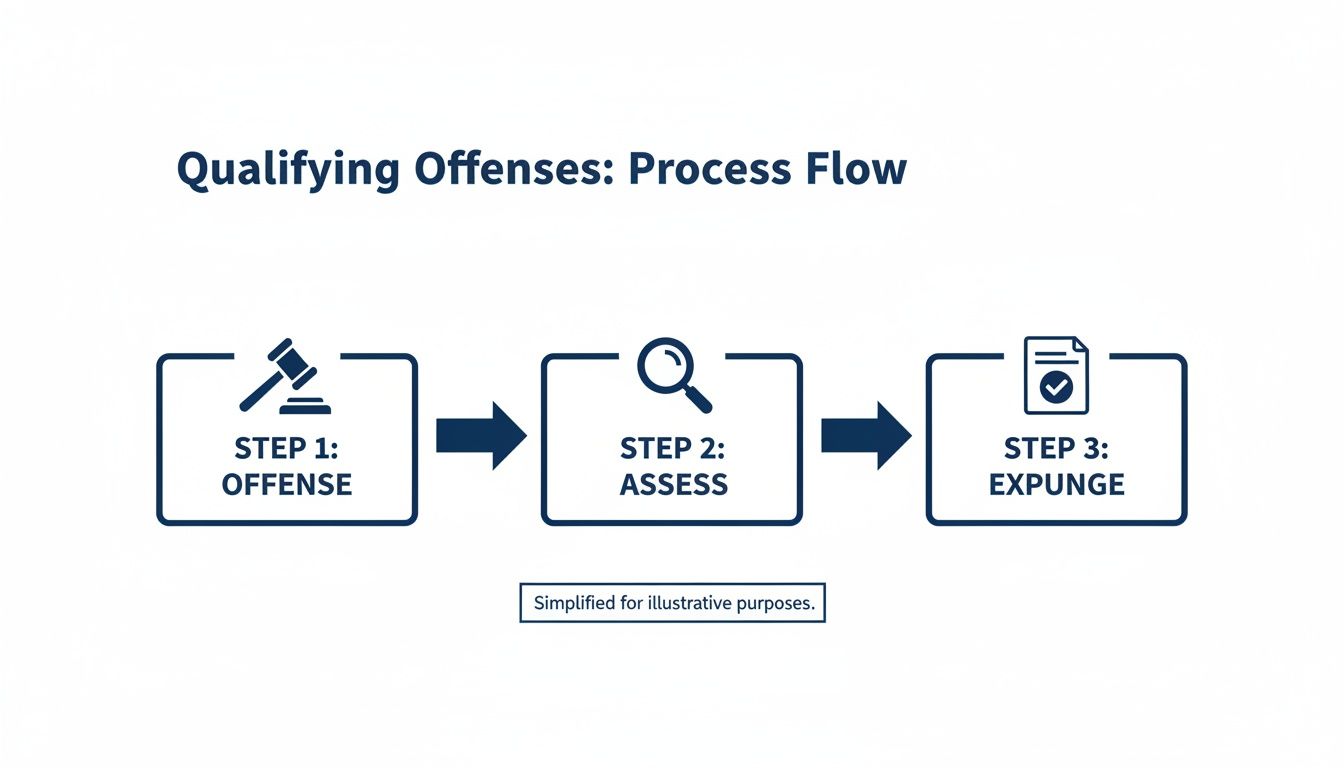
As the visual shows, the journey from offense to expungement requires a careful assessment phase—which is exactly what the FDLE and court process is all about.
Step 3: The Final Review and Judicial Order
After your petition is filed, it gets sent over to the State Attorney's Office for Miami-Dade County. The prosecutor’s office reviews your case file to see if they have any legal reason to object to the expungement. If they don’t find any issues, they’ll sign off on it.
Finally, the whole package lands on a judge's desk. The judge gives it one last look, making sure every legal box has been checked and there are no compelling reasons to deny your request. If everything is in order, the judge will sign the Order to Expunge.
This signed order is the finish line. It’s a legal command telling various government agencies—from the police department that arrested you to the Clerk of Courts—to physically destroy or wipe clean all official records related to your criminal traffic charge.
This is how a past mistake is officially removed from public view, giving you a fresh start. The process is meticulous and does not forgive errors, which is why having legal counsel that knows the ins and outs of Miami-Dade’s procedures can be beneficial.
After it's all done, it’s a smart move to verify the outcome by learning how to check your driving record to make sure the charge is truly gone. Our firm can handle this entire journey for our clients, protecting their records every step of the way.
The Real-World Impact of a Clean Record
So, what does a successful traffic ticket expungement actually mean for your day-to-day life? Once you get past the legal paperwork and the judge’s signature, clearing a criminal traffic offense is really about taking back control of your story and removing the invisible roadblocks that can quietly steer your future. It’s the tangible, positive change that makes the whole process worth it.
When a judge signs an Order to Expunge, the law essentially agrees to treat the incident as if it never happened. That’s a powerful legal reset. For most practical purposes—like filling out applications for jobs, apartments, or loans—you can legally state the arrest never occurred. This one benefit can open doors that were previously shut.
Restoring Your Career and Peace of Mind
Think about a commercial truck driver right here in Florida. Their entire career rides on having a clean driving record. A past conviction for something serious like Reckless Driving can be a constant source of concern, appearing on mandatory background checks and potentially removing them from consideration for better-paying jobs or new contracts.
A successful expungement changes all of that. It means:
Renewed Job Prospects: That driver can now confidently apply for new positions without the fear of an old mistake resurfacing and costing them an opportunity.
Insurance Relief: While insurance companies have their own methods for setting rates, getting a criminal conviction off your record can have a positive influence on future premiums over time.
Professional Standing: For any career that requires a state license or a security clearance, a clean record is often a non-negotiable requirement.
But this isn't just about jobs. Imagine a parent who wants to volunteer at their child's school or coach a youth sports team. Many of these roles now require a background check. An expungement can provide peace of mind, ensuring a past mistake doesn't prevent them from being fully involved in their family and community.
A clean record is more than just a legal status; it's a tool for personal and professional freedom. It allows you to present yourself based on who you are today, not who you were in a past moment.
The Broader Picture of a Positive Reputation
While we're focused on the legal side of things, the basic principle is universal: a positive reputation opens doors. Your public record is a huge part of that reputation. A civil traffic ticket might just be a minor issue, but a criminal conviction can create a lasting negative shadow that follows you both online and off.
This idea goes far beyond the courthouse. You can learn more about the importance of maintaining a strong reputation and see how it shapes perceptions in all kinds of situations. Getting an expungement is a proactive step toward managing and polishing your personal reputation where it truly counts.
Ultimately, expunging a criminal traffic offense is about more than just clearing a name in some government database. It's about restoring your ability to pursue your goals without the weight of a past mistake holding you back. Just as it's important to understand how to remove points from your driving record for civil tickets, it’s even more critical to address criminal records that carry a much deeper and longer-lasting impact.
Sealing vs Expunging Records Explained
When people talk about clearing a criminal record in Florida, they often use the terms "sealing" and "expunging" interchangeably. They are not the same. They are two completely different legal paths with very different results, and understanding that distinction is the first step in any conversation about a traffic ticket expungement.
The easiest way to understand it is with an analogy. Think of your criminal record as a file in a huge public library.
Sealing a record is like having the librarian take that file, lock it in a secure vault, and remove it from the public card catalog. The file is still there, but the general public can’t see it anymore.
Expunging a record is like having that file physically destroyed. The file, and every public mention of it, is removed.
This difference has massive real-world consequences, especially when it comes to who can still see that information after the process is done.
The Practical Difference of a Sealed Record
When a criminal traffic offense is sealed, it’s hidden from public view. This means a standard background check from a potential landlord, a private employer, or a curious neighbor will come back clean. For most day-to-day purposes, a sealed record provides the fresh start you’re looking for.
But that "locked vault" isn't completely impenetrable. A specific list of government and law enforcement agencies can still access it under certain circumstances.
These agencies include:
The criminal justice system (police, prosecutors, judges) if you get arrested or charged with another crime.
The Florida Bar if you’re applying to become an attorney.
The Department of Education if you’re trying to get a job in a school.
Certain state agencies when you apply for specific professional licenses.
Sealing provides a powerful shield for your privacy, but it’s not total erasure of the record. The event is hidden, not erased.
The Power of a True Expungement
An expungement takes things a giant leap further. It’s the legal equivalent of permanent deletion. When a judge orders a record expunged, government agencies are legally required to physically destroy all paper files and wipe all electronic data related to that charge.
A successful expungement allows you to legally deny that the arrest ever happened, except in a few very specific situations. It is the most complete form of record-clearing available under Florida law.
After an expungement, the list of who can see the record shrinks almost to nothing. While law enforcement might be able to see that a record was expunged, they typically can't see what the original charge was. This makes expungement the gold standard for anyone seeking a truly clean slate.
Choosing the Right Path for Your Situation
So, which one is for you? The answer isn't a matter of preference; it’s determined entirely by the facts of your case. Florida law has very strict rules for who qualifies for either option.
As a general rule, you might be eligible to have a record sealed if the court withheld adjudication of guilt (meaning you weren’t formally convicted). You might be eligible for an expungement if the charges against you were dropped, dismissed, or you were found not guilty at trial. And importantly, you can typically only seal or expunge one eligible offense in your entire lifetime.
Figuring this out is a complex legal determination. Your eligibility is based on the precise outcome of your criminal traffic case and your prior history. An experienced attorney can pull your record, determine which path—if any—you qualify for, and guide you through the correct legal process to clear your name. Our practice focuses on traffic and DUI defense, and our goal is to protect your license and record. Past results do not guarantee future outcomes.
How a Traffic Law Firm Can Help You
Trying to make sense of Florida's traffic laws on your own can be a difficult process. Whether you're holding a simple civil ticket or facing a serious criminal charge, the path forward is rarely clear. This is where a traffic law firm can assist, acting as your guide and advocate to protect your rights, your license, and your future.
Our strategy is tailored to the specifics of your case. For civil infractions like speeding, the goal is prevention. An effective defense is aimed at getting the ticket dismissed entirely. This approach stops points and convictions from ever hitting your driving record, which is a much better outcome than trying to clean up the mess later.
But for criminal traffic violations, the stakes are much higher. You're not just dealing with a fine; you're seeking to prevent a permanent criminal record from impacting your life. An experienced legal team can build a strong defense against the charge or, when the situation calls for it, guide you through the complex traffic ticket expungement process.
Our Approach to Protecting Your Record
Our practice focuses on Florida traffic law, and we handle matters across all 67 counties. Our mission is simple: protect your license and your record.
We’ve designed our services to take the legal burden off your shoulders:
Case Analysis: We review the details of your ticket or charge to pinpoint the strongest possible defense strategy.
Court Representation: Our attorneys appear in court on your behalf. In the vast majority of our cases, our clients do not have to go to court.
Negotiation and Litigation: We manage communications with the court and prosecutors, working for dismissals, reduced charges, or other favorable resolutions.
Expungement Guidance: For qualifying criminal offenses, we can handle the entire multi-step expungement process, from the FDLE application to the final court order.
Modern traffic law firms may also use advanced tools to work smarter. For example, an AI Agent for Legal Traffic Ticket Analysis can help break down the specific details of a case for a clearer picture.
Why Legal Counsel Is Crucial
Deciding whether you need a lawyer is a big decision. While some people think about handling a ticket themselves, it’s important to understand the long-term consequences of that choice. To help you weigh your options, we've put together a detailed guide explaining if you need a lawyer for a traffic ticket.
At Ticket Shield, our practice is focused on traffic and DUI defense. If you're dealing with a traffic issue, we invite you to call for a free, confidential consultation to talk about your case.
Attorney Advertisement. Office in Broward. Submitting information via our forms does not create an attorney-client relationship. Past results do not guarantee future outcomes.
We Answer Your Questions About Expungement
When it comes to clearing your record, the legal jargon can be confusing. Let's cut through the noise and get straight to the questions Florida drivers ask us most often about traffic ticket expungement.
Can I Expunge a Speeding Ticket in Florida?
This is a common question, and the answer is almost always no. A standard speeding ticket is a civil infraction, not a criminal charge, so the expungement process doesn't apply to it. Think of expungement as a tool reserved for qualifying criminal traffic violations only.
Trying to expunge a civil ticket is like trying to use a car key to open your front door—it's just the wrong tool for the job. The strategy for a speeding ticket is to contest it from day one to keep the points and the conviction off your record in the first place.
How Long Does the Expungement Process Take?
There’s no single answer here. The timeline can stretch from a few months to much longer, depending on the county and the complexity of your case. It’s a multi-step journey that starts with getting a Certificate of Eligibility from the Florida Department of Law Enforcement (FDLE) and ends with getting a final order signed by a judge.
Our firm is there every step of the way, working to move the process forward as efficiently as possible for our clients.
Past results do not guarantee future outcomes. While we strive for an efficient process, the timeline is ultimately in the hands of government agencies and the court system. Our goal is to navigate this maze correctly to protect your license and record.
What Happens If My Expungement Petition Is Denied?
A denial can be a setback, but it’s not always the end of the road. The first step is to figure out exactly why it was denied. The reason could be anything from a simple clerical error on the paperwork to a more fundamental issue with your eligibility.
An experienced attorney can review the court's decision, advise you on whether the problem can be fixed for a refile or an appeal, and map out the best path forward.
At Ticket Shield, we are committed to helping Florida drivers protect their records. Whether you need to contest a new civil ticket or look into options for an old criminal traffic offense, our team is ready to help. For a free, confidential consultation, get in touch with us today.