Speeding Ticket Attorney Florida: Protect Your License In
Looking for a speeding ticket attorney Florida? Learn costs, defenses, county differences, and how to avoid points and insurance hikes.

You're on the side of the road, then at the kitchen table, staring at a Florida speeding ticket and wondering whether this is just a fine you can pay and forget. It isn't. In Florida, a speeding citation can become a license-point problem, an insurance problem, and a suspension problem, all from one stop, which is exactly why a speeding ticket attorney Florida drivers trust should treat it like a real legal threat, not paperwork. Under Florida's speeding framework, the numbers are unforgiving, and once that citation is filed, the clock starts running on your options. Florida's driver-license point suspension rules are the kind of thing most drivers never think about until they're already in trouble.
Table of Contents
Why a Florida Speeding Ticket Is a Bigger Problem Than It Looks
Beyond the Fine: What a Speeding Conviction Actually Costs in Florida
Why a Florida Speeding Ticket Is a Bigger Problem Than It Looks
The stop feels routine until it doesn't. A trooper flashes the lights on I-75, you pull over, and five minutes later you're holding a citation that looks small enough to ignore. That's the trap. A Florida speeding ticket is not just a bill, it's a legal event that can follow you into the DMV system, your insurance file, and your work life.
The ticket is more than a fine
Florida's speeding laws sit inside Chapter 316, including Florida Statute 316.187, and the citation can turn into points that show up on your driving record after the case is processed. That matters because Florida's point system can lead to suspension at 12 points in 12 months, 18 points in 18 months, or 24 points in 36 months (FLHSMV point suspension rules). If you already have prior moving violations, one more ticket may not be “minor” at all.
Practical rule: never decide a speeding case based only on the fine printed on the citation.
The legal reality is harsher than the roadside conversation. Florida Highway Safety and Motor Vehicles' reporting dashboard shows that Florida issued over 3 million traffic citations statewide in 2024, with 15.33% written by the Florida Highway Patrol (FHSMV crash and citation reports). That volume tells you something important, speeding defense is a major part of Florida traffic law, not a niche favor for unlucky drivers.
What you're really facing after the stop
Once the citation is entered, the consequences can stack quickly. Insurance can react, points can post, and if your license is already at risk, the wrong plea can make things worse. For drivers who depend on a clean record, especially commuters, parents, and commercial drivers, the problem is not the ticket itself. It's the chain reaction that follows.
If you're sitting at the kitchen table with a citation in front of you, the questions are simple. Can this be fought? Can the recorded speed be reduced? Can you keep points off your license? The rest of this guide answers those questions plainly and shows what a lawyer does to protect you.
What Florida Law Says About Speeding Tickets
Florida treats speeding cases differently based on the statute, the measured speed, and where the stop happened. If you pay first and ask questions later, you give up options you may still have.
The statutes that control your case
Florida Statute 316.187 sets the baseline duty to drive at a reasonable and prudent speed, and Florida Statute 318.18 controls how speeding citations are fined and processed. Florida also uses posted-limit rules in 316.183, so the number written on the ticket, and whether the stop fits the law, shapes how the case is handled. If the speed reading is off, or the stop was not handled correctly, the citation can often be challenged on the facts.
The fine schedule in Florida Statute 318.18 is specific. A speeding citation can carry a warning for 1–5 mph over the limit, then fines of $25 for 6–9 mph over, $100 for 10–14 mph over, $150 for 15–19 mph over, $175 for 20–29 mph over, and $250 for 30 mph or more over the limit. In a posted school zone, even up to 5 mph over can trigger a $50 fine (Florida speeding-ticket framework).
Points are the part most drivers miss
Florida's point schedule is where the pressure starts. Ordinary speeding generally adds 3 points, speeding over 50 mph above the limit adds 4 points, and speeding that causes a crash adds 6 points (Florida point schedule). That point hit can trigger suspension risk if you already have other violations on your record. Under Florida's statute structure, exceeding the speed limit by more than 50 mph is also treated as a moving violation under Chapter 316 (Florida Statutes 316.187).
School-zone tickets deserve separate attention. Florida Statute 316.1895 tightens the rules around posted school-zone speed and timing, and those cases are cited as moving violations under Chapter 318 (Florida Statute 316.1895). If your ticket came from a school zone, handle it as a higher-stakes case from the start.
The practical takeaway is simple. The court cares about the recorded violation, the points, and the record that follows you. County courthouses also matter. Some judges and clerks are more open to reductions, diversion, or negotiated outcomes than others, and that local culture can change how a speeding case gets resolved.
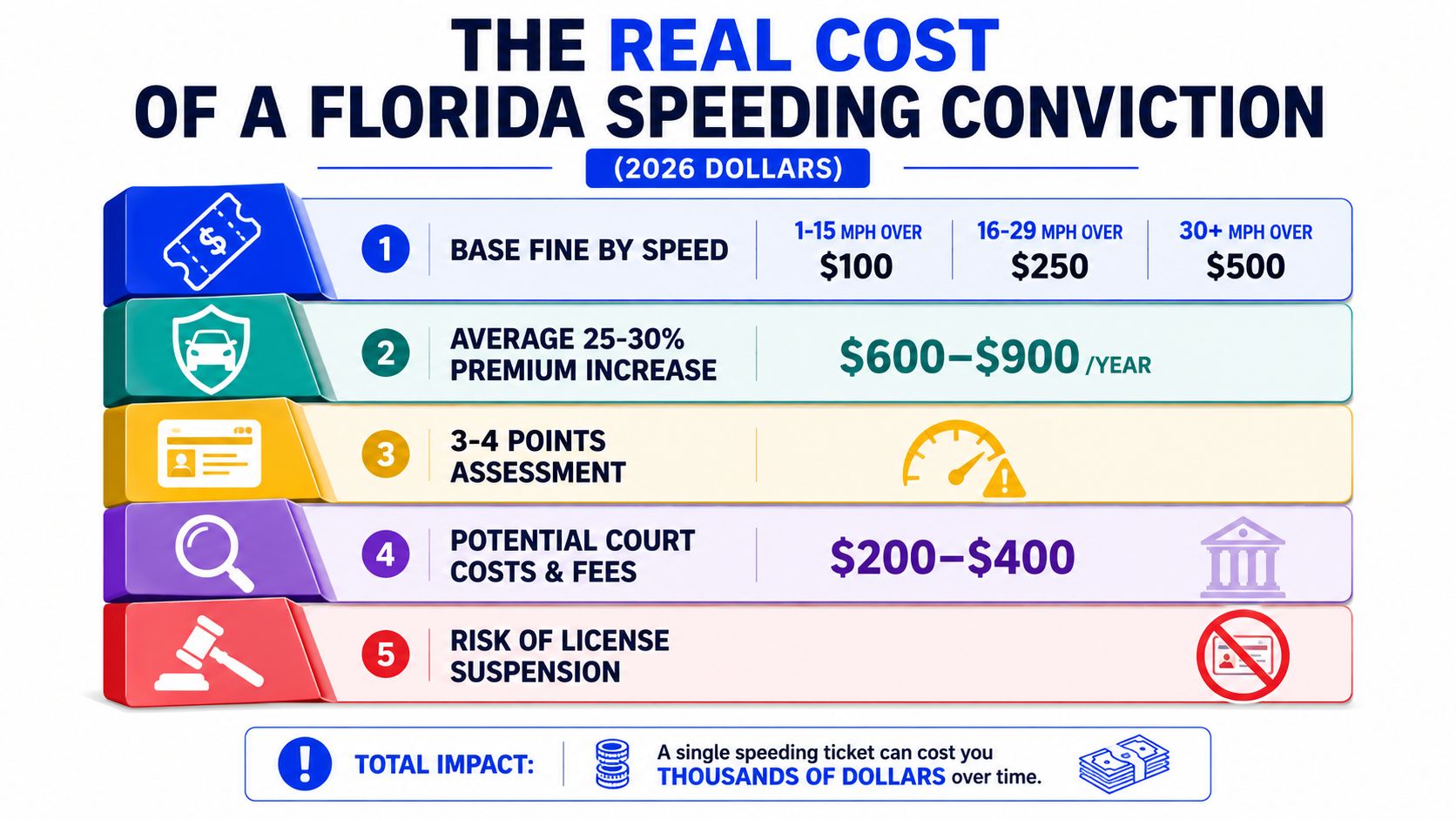
Beyond the Fine: What a Speeding Conviction Actually Costs in Florida
The ticket amount is the smallest number on the page. The bill shows up after conviction, when points hit your record and insurance treats you like a bigger risk. In a Florida traffic courtroom, that is where one citation turns into a long, expensive problem.
Insurance and points do most of the damage
Insurance is where the pain starts. A Florida speeding fine breakdown shows why drivers should care about more than the ticket amount. Florida reporting tied to citation data references an analysis showing drivers with no infractions averaged $2,694 for car insurance, while drivers with a speeding ticket averaged $3,553, a difference of $859 or about 32% higher (FHSMV citation reporting page references insurance analysis). Another Florida insurance study found that after a single speeding ticket, average annual full coverage rose to $4,221 and minimum coverage to $1,422, increases of 18% and 21% (FHSMV citation reporting page references insurance analysis).
That is the part drivers feel for months. You may pay the fine once, but the conviction can keep costing you every time your policy renews. If you already have violations on your record, the added points can push you closer to suspension with little warning.
A simple example shows the tradeoff
Take a routine case like 16 mph over. On paper, paying looks easy. In practice, paying can mean accepting the fine, the points, and the insurance hit that follows. Fighting the citation may cost more upfront in legal fees, but the point is to avoid a larger hit to your record and premium.
County courthouse culture matters too. Some judges and clerks are more open to reductions, diversion, or negotiated outcomes than others, and that local attitude can change how a speeding case ends in places like Miami-Dade, Hillsborough, Orange, Duval, or smaller inland counties. A driver who walks into the wrong courthouse with the wrong approach can pay more than the ticket, especially if the case is handled casually.
If you drive for work, the stakes rise again. A conviction on the wrong speeding charge can complicate job duties, court appearances can cost wages, and time spent dealing with the case is time you do not get back. For a lot of Florida drivers, the question is simple. Can you afford the conviction, or do you need to fight it now?
How a Florida Speeding Ticket Attorney Actually Defends You
A real speeding defense is not a mail-it-and-hope operation. It starts with the facts, then moves into the evidence, then into the county court where the outcome is either protected or lost. If you hire the right lawyer, the work is targeted and practical, not generic.
What competent representation looks like
The first step is a review of the citation itself. The attorney checks the alleged speed, the location, the agency, and the timing so the case can be evaluated properly. Then the lawyer requests records tied to the stop, including radar or lidar calibration logs, certification documents, and any available dashcam or body-camera material.
After that comes discovery and motion practice. If the speed-measuring device was not properly certified, if the stop has a factual problem, or if the evidence is unreliable, the lawyer can file motions to suppress or challenge the state's proof. The goal is simple, reduce the recorded speed category, secure a withhold of adjudication, or push the case to a result that keeps points off your record.
Why lawyer-led service matters
A real Florida traffic lawyer appears in the case, files substantive motions, and deals with the courthouse directly. A ticket mill often takes a flat fee, mails a plea, and never puts a lawyer in front of the judge. That difference matters because the court sees the case differently when an attorney shows up, knows the county practice, and pushes for a better disposition.
Ticket Shield, PLLC is one lawyer-led option that handles Florida speeding cases by phone or text, so the driver can speak directly with counsel instead of getting routed through middlemen or automated chat systems. That direct access matters when you need answers fast and the citation is already on the clock.
A lawyer's job is to create an advantage before the hearing deadline closes. If you wait too long, you may lose the chance to contest key issues, and once the election window closes, your options narrow fast. The safe move is to get the citation reviewed immediately and decide whether to fight, negotiate, or preserve a no-points outcome.
If the first call doesn't involve the actual citation facts, you're not getting a real evaluation yet.
How lawyers dismiss traffic tickets is a useful topic to understand because dismissal is never automatic. It depends on the evidence, the hearing posture, and the county court's handling of the file.
County by County Differences Across Florida Courthouses
Florida traffic court is not uniform in practice, even though the statute is statewide. County culture matters, and a lawyer who knows the local courthouse can often steer a case toward a better result than an out-of-area lawyer who treats every court the same. That is where the practical value of local experience shows up.
Different counties, different pressure points
In Miami-Dade, the docket is heavy and plea bargaining is part of the rhythm. Court costs commonly land in the $150 to $300 range, and the courthouse often moves with a high-volume mindset. In Broward, the dockets move fast in Fort Lauderdale, and school-zone enforcement gets taken seriously, which makes a clean record more valuable than casual drivers expect.
Palm Beach can be more receptive to traffic school on borderline speeds, while Hillsborough often requires personal attorney appearance for many hearings, which can make a lawyer's local presence matter more. Orange has room for diversion-style outcomes on first-time 9-over cases, and Duval is often more receptive to formal contests than simple plea reductions. Those patterns are not theoretical, they shape the way cases get resolved.
Why courthouse culture changes the math
Local prosecutor policy, clerk filing practices, and judicial temperament change the cost-benefit analysis. A lawyer who regularly appears in the same county knows which arguments get traction, which records matter, and which proposals are realistic. That can be the difference between a resolution that keeps points off your license and one that ruins the economics of just paying the ticket.
Traffic ticket lawyer in Broward County is a good example of why county-specific strategy matters, because Broward is not handled the same way as Palm Beach or Duval. The same alleged speed can lead to different negotiation posture depending on the courthouse, the judge, and the prosecutor's local habits.
Bottom line: in Florida traffic court, local knowledge is not a slogan. It's a case advantage.
If you're out of county, or you just moved to Florida, that gap gets even bigger. A lawyer who knows the courthouse can sometimes secure a no-point withhold where a generic filing service would leave you with a conviction and a record.
How to Choose the Right Speeding Ticket Attorney in Florida
Not every lawyer who says they handle traffic tickets is built for your case. You need someone who knows Florida traffic court, knows the county where your ticket was issued, and can explain the result they're trying to get before you pay a fee.
Seven things you should demand
Florida Bar membership in good standing. You want an actual licensed lawyer, not a runner or a call-center intermediary.
County-specific traffic court experience. A lawyer who works your courthouse regularly understands local practice.
Personal appearance when needed. If the case calls for it, the attorney should be willing to show up and argue.
Transparent flat-fee pricing. Court costs should be itemized, not hidden.
A realistic plan for a withhold of adjudication. That is the kind of outcome that can keep points off your record.
Fast communication. If they can't respond within one business day, that's a warning sign.
A written scope of representation. You should know exactly what the lawyer is doing and what is excluded.
The right lawyer talks plainly about the citation, the county, and the likely outcomes. The wrong one talks only about convenience.
Red flags you should walk away from
A lawyer who quotes a price before reviewing the ticket is guessing. A lawyer who guarantees dismissal is overpromising. A non-attorney who plans to “appear” for you is not the same thing as a lawyer defending the case. And if someone pushes you to plead before discovery is reviewed, they're asking you to give up your position too early.
Traffic ticket attorney reviews can help you spot patterns in communication and service, but the citation itself still matters more than marketing. Bring the ticket, your license, and your insurance card to the first consultation so the lawyer can give you a real answer instead of a sales pitch.
Your Next Step Toward No Points on Your License
If you want the honest goal in a Florida speeding case, it's No Points. That means no automatic insurance sting from a conviction, no added pressure toward the 12-point suspension threshold, and no needless damage to a record you may need for work or family life. The right answer usually starts with a quick review before the deadline runs.
Get the citation number, the alleged speed, the issuing agency, the court location, and the county before you call. Ask the lawyer what outcome makes sense in that specific courthouse, whether a withhold is realistic, and whether they will appear personally if needed. If the answer sounds vague, keep looking.
A free consultation should be direct. You should hear what the defense options are, what the deadlines are, and what fee agreement covers before you pay anything. Don't wait until the hearing clock runs out and your choices shrink.
Ticket Shield, PLLC offers Florida speeding ticket defense built to protect your license, your record, and your insurance from the damage of a conviction. Visit Ticket Shield, PLLC for a free consultation and push for the outcome that matters most, No Points on your license.