
Speeding in Construction Zone: Florida Defense 2026
Speeding in construction zone - Fined for speeding in a construction zone in Florida? Learn about doubled fines, points, & how an attorney protects your

You saw the lights in your mirror. Orange barrels were up. The road looked half-finished, half-empty, and now you're holding a Florida work zone ticket wondering whether this is just an expensive annoyance.
It isn't.
A construction zone speeding citation can hit harder than a normal ticket. It can put points on your license, raise your insurance, and create problems fast if you drive for work. If you're thinking about paying it and moving on, stop. That decision usually helps the state, not you.
Table of Contents
Your Florida Construction Zone Speeding Ticket Guide
TL;DR: Yes, speeding in a Florida construction zone is serious. Paying the ticket can mean doubled fines, points, and insurance damage. Fight it early. Florida treats work zone speeding as a safety threat, not a routine citation.
You don't get pulled over in a construction zone and walk away with a harmless warning in most cases. Once the officer writes that citation, you're dealing with a traffic case that can affect your driving record long after the stop is over.
Florida drivers often underestimate this ticket because the road may have looked quiet. That's a mistake. Law enforcement and the courts treat speeding in construction zone cases aggressively because the risks are real. Nationwide, work zone fatalities increased by 50% between 2013 and 2023, with over 898 deaths recorded in 2023 alone, and 60% of highway contractors reported work zone crashes in the past year, with speeding identified as a primary cause, according to the Associated General Contractors of America survey report.
Practical rule: If you've already started looking at payment options, stop and review your Florida speeding ticket options first.
The state sees this as a public safety issue. You need to see it as a record-protection issue. If you act quickly, you may still have room to challenge the citation instead of accepting the damage.
What Legally Defines Speeding in a Florida Work Zone
Many drivers say the same thing after the stop. “There were no workers out there.” That may feel like a strong defense. By itself, it usually isn't.
Florida law focuses on the designated work zone, the posted reduced speed limit, and the official signage. Under Florida Statute § 316.187, fines for speeding in a designated construction zone are automatically doubled, and that enhanced penalty is triggered by the presence of official signs and a reduced speed limit, not by whether you saw a worker standing next to the lane at that exact moment. You can read the statute directly in the Florida Legislature's text of § 316.187.
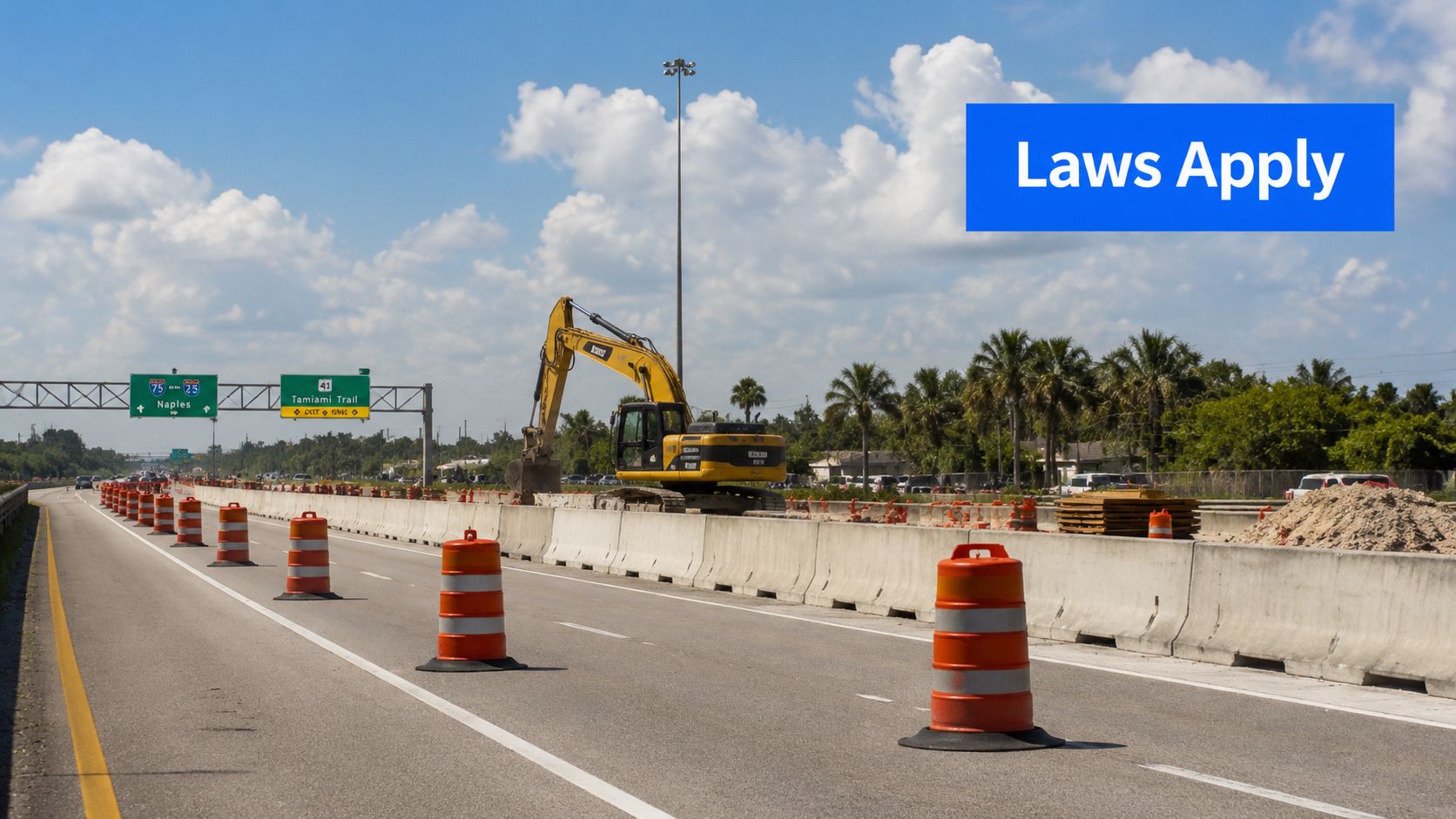
Does an empty work zone still count
Yes, it can.
If the zone is properly marked and the reduced speed posting is active, the officer doesn't need to prove you personally saw workers. That's where drivers get burned. They assume “empty road” means “bad ticket.” The statute doesn't work that way.
That doesn't mean every ticket is valid. It means the defense has to be smarter than repeating that the road looked empty.
A work zone ticket often turns on details the driver never had a chance to inspect during the stop.
What Florida law actually cares about
Florida's broader traffic statutes under Chapter 316, including § 316.183 and § 316.187, give the state the framework to enforce reduced speeds in special hazard areas. In plain English, the court will care about questions like these:
Were official signs posted: If the reduced speed wasn't properly posted, that matters.
Was the zone designated: A real work zone is not just cones scattered on a shoulder.
Did the officer cite the right location and condition: Errors on the citation and report can matter.
Was the reduced speed enforceable where you were clocked: Entry point and sign placement can become critical.
If you need a plain-English breakdown of how posted speeds become legally enforceable, review the concept of a prima facie speed limit in Florida.
The key point is simple. “No workers present” is not a complete defense. It's one fact. A real defense looks at signage, designation, enforcement location, and whether the state can prove the citation fits the statute.
Why Are Construction Zone Speeding Penalties So High
When this ticket lands in Hillsborough County, the consequences aren't theoretical. They're enforced in real courtrooms like the Edgecomb Courthouse in Tampa every day. Judges there see drivers who thought a work zone citation was just another speeding ticket, then learn too late that Florida treats it differently.
What the money risk looks like
Florida law under Chapter 316, especially § 316.187, allows work zone speeding penalties to hit harder than ordinary speeding penalties because the fine structure is enhanced in designated construction zones. Here's the practical comparison.
Florida Speeding Penalties: Standard vs. Construction Zone | Standard Fine (Approx.) | Construction Zone Fine (Doubled) | License Points |
|---|---|---|---|
1 to 5 MPH over | Qualitatively lower | Qualitatively higher because the statute doubles the fine in a designated work zone | Points may apply |
6 to 9 MPH over | Qualitatively lower | Qualitatively higher because the statute doubles the fine in a designated work zone | Points may apply |
10 to 14 MPH over | Qualitatively lower | Qualitatively higher because the statute doubles the fine in a designated work zone | Points may apply |
15 to 19 MPH over | Qualitatively lower | Qualitatively higher because the statute doubles the fine in a designated work zone | Points may apply |
20 MPH or more over | Qualitatively severe | Qualitatively more severe in a construction zone | Points and added exposure become more serious |
I'm keeping that table qualitative for one reason. The exact county assessment, court costs, and offense coding can affect the final amount, but the legal message is fixed. A work zone ticket costs more and can do more damage.
If you run a contracting business or drive around active job sites, it also helps to understand the broader risk environment around road work and liability. A practical primer on specialized construction insurance gives useful context for how construction-related exposure is evaluated outside the ticket itself.
Why the law comes down so hard
The reason is physics, not politics.
The Federal Highway Administration explains the danger as the “sudden proximity” effect. When drivers fail to decelerate into a work zone, reaction time to hazards like lane shifts or workers is critically compromised, increasing the likelihood of a fatal rear-end collision, according to the FHWA work zone law enforcement guide.
Construction zones create compressed decision-making. Lanes move. Shoulders disappear. Equipment sits close to traffic. Drivers don't have the usual margin for error.
What judges and prosecutors see
They don't see an empty stretch of road the way you remember it. They see a designated safety corridor where the state warned drivers to slow down.
That's why paying the ticket is usually the wrong move. You're not resolving a minor inconvenience. You're admitting guilt to an enhanced-speed enforcement allegation.
If the court record shows a work zone speeding conviction, insurance companies and employers won't care that the road felt empty to you.
What Evidence Will the State Use to Prove My Guilt
The state doesn't walk into court guessing. The officer usually arrives with a basic proof package already in place, and if you aren't prepared to challenge it, that evidence often goes unanswered.
What the officer will bring into court
In a typical speeding in construction zone case, the state may rely on several kinds of evidence:
Radar or lidar reading: The officer may testify that a speed-measuring device recorded your speed.
Pacing: Sometimes the officer says they matched your speed with the patrol vehicle.
Visual estimation: Officers are allowed to testify about what they observed, especially when combined with another method.
Sworn testimony about signage: The officer may testify that official work zone signs and reduced speed postings were present.
The citation and notes: The ticket itself, location details, lane conditions, and driving observations all help build the state's version.
Device maintenance or calibration records: If speed equipment was used, the prosecution may rely on records showing the device was in working order.
A straightforward explanation of speed detection tools can help you understand what the officer may claim with radar evidence. This guide on how radar speed guns work is a useful starting point.
Why that matters before your hearing date
Drivers often focus only on whether they were “really speeding.” Court is narrower than that. The judge looks at whether the state can prove the charged violation using competent evidence.
That means your defense cannot be casual. If the officer says the signs were up, the zone was active, and your speed was confirmed by a device, you need a response that attacks proof, procedure, or legal sufficiency.
The state only needs enough admissible evidence to support the citation. You need a strategy strong enough to test every part of that evidence.
That's why waiting until the last minute is dangerous. The earlier the case gets reviewed, the more room there is to spot weak points in the officer's proof.
What Are Common Defenses Against a Work Zone Ticket
A ticket is an accusation. It is not a conviction. Good defense work starts by forcing the state to prove every required part of the case instead of assuming the officer got everything right.
Where a real defense usually starts
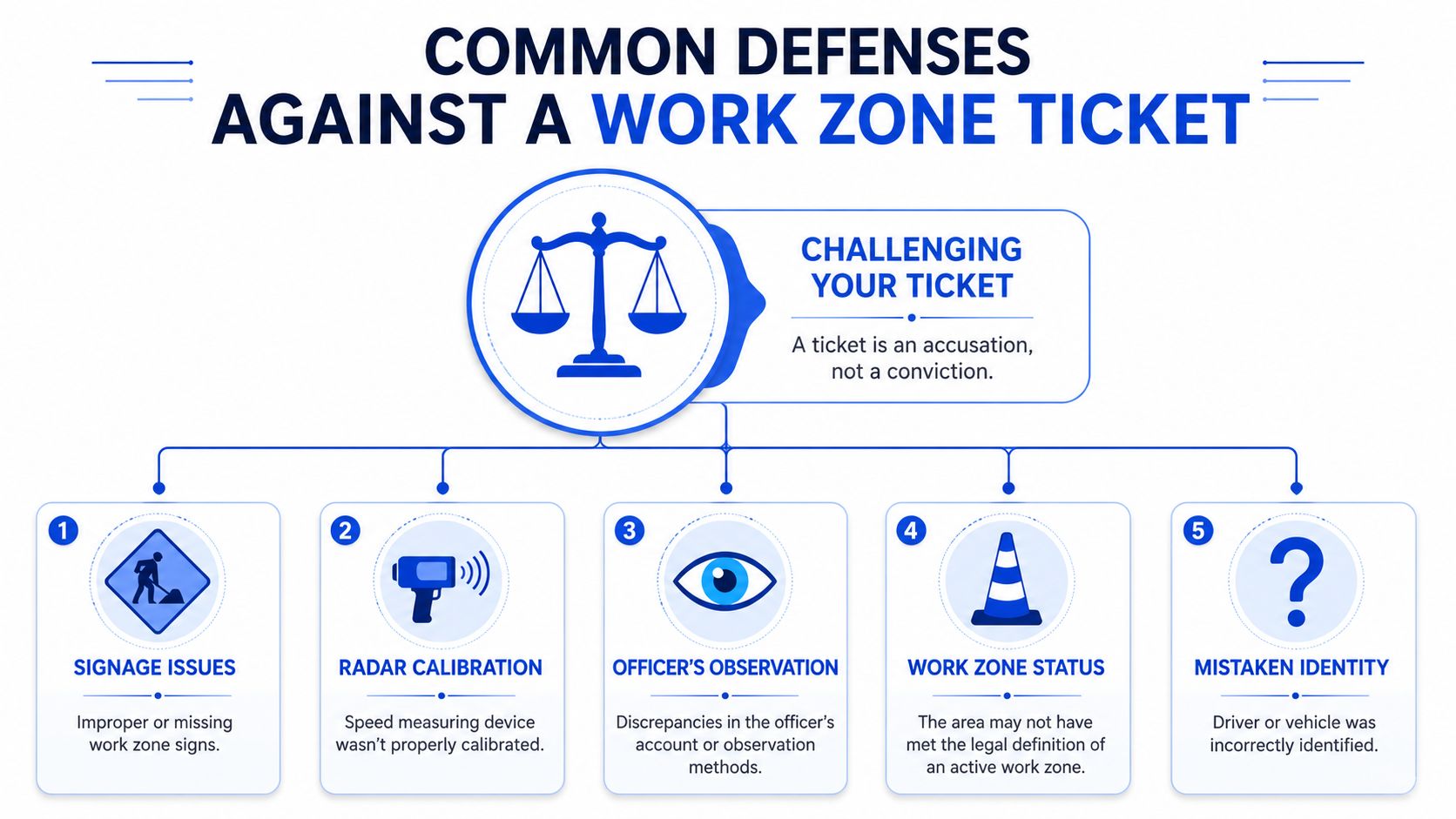
A lawyer reviewing a work zone citation will often examine issues like these:
Signage problems
If the reduced speed signs were missing, blocked, confusing, or placed incorrectly, that can matter. In a work zone case, signage isn't background detail. It's central to enforcement.
Speed measurement problems
Radar and lidar cases depend on proper use. If the device wasn't properly maintained, tested, or operated, the reading may be less reliable than the citation suggests.
Officer report issues
Officers make mistakes. Times get written down wrong. Lane details get mixed up. Locations can be vague. Those errors don't automatically win the case, but they can create an advantage.
Work zone status disputes
Some locations look like work zones without meeting the legal requirements for enhanced enforcement. Cones alone don't prove everything the state needs.
Identification issues
In heavier traffic, especially at night, officers can misidentify the vehicle they meant to stop or clock.
Why no workers present usually isn't enough by itself
Drivers fixate on that fact because it feels unfair. Sometimes it helps. Standing alone, it often doesn't.
A stronger defense asks better questions:
Was the reduced speed posting active and visible
Was the alleged speed measured reliably
Did the officer stop the correct vehicle
Did the cited location match the enforceable work zone area
Did the state preserve what it needs to prove the charge
That is how traffic defense works. Not excuses. Not anger. Not “I didn't think it counted.” Precision wins these cases.
What Should I Do Immediately After Getting This Ticket
The first day matters. The first week matters more. Small mistakes after the stop can lock you into a worse outcome.
This visual checklist is a good starting point.
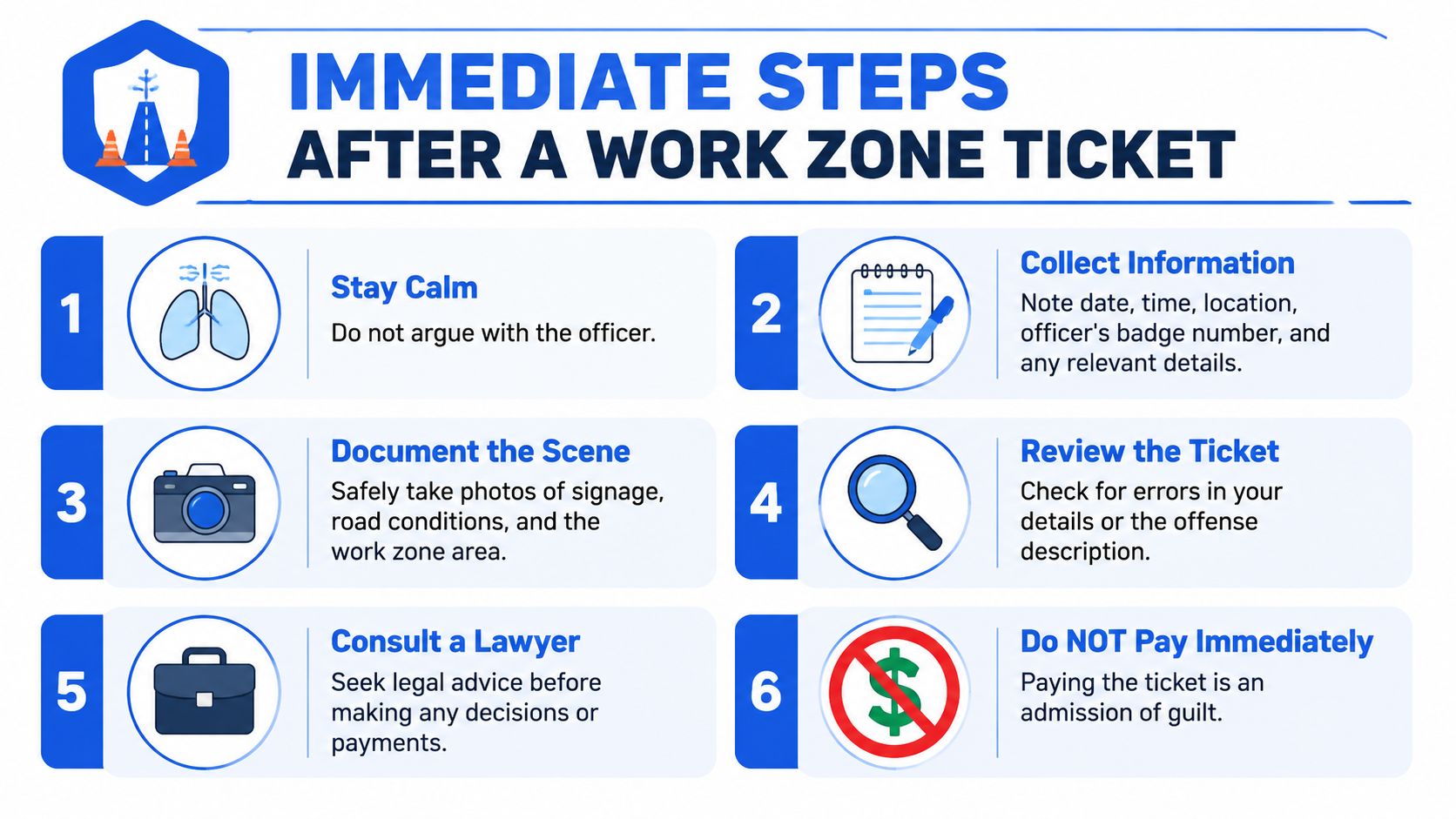
Immediate Steps to Take
Stay calm: Don't argue with the officer on the roadside. You won't win the case there.
Read the citation carefully: Check the charge, date, location, and response deadline.
Document the scene: If it's safe, return later and photograph the signs, lane layout, and overall zone conditions.
Write down what you remember: Traffic flow, weather, time of day, worker visibility, and where the officer was positioned can all matter.
Preserve your timeline: Save GPS history, dashcam footage, text receipts, or work logs if they help place you accurately.
Get legal guidance before making a decision: Review practical next steps in this guide on what to do when you get a ticket.
A short video can also help you reset before taking action.
What you should not do
Don't pay immediately: Paying the ticket is usually an admission of guilt.
Don't assume the officer will miss court: Many drivers gamble on that and lose.
Don't rely on memory alone: Conditions blur fast. Write things down while they're fresh.
Don't ignore the deadline: Missing it can take options off the table.
If this citation came out of Orange County, the Orange County Courthouse is not the place to show up unprepared and hope for mercy. Preparation beats hope every time.
Why Do I Need a Lawyer Instead of a Ticket App
You get pulled over on an empty stretch of road at night. No crews in sight. No cones moving. No one working. You assume common sense will matter.
In Florida, the wording of the statute matters more.
That is why construction zone tickets are dangerous to hand off to an app or a high-volume ticket mill. The winning issue is often not whether the road looked active to you. The issue is whether the state can prove the zone was legally marked, whether the citation matches the location, and whether the officer's account holds up under scrutiny. A software workflow will not spot those openings the way a lawyer will.
Apps organize information. Lawyers attack weak cases.
An app can collect your citation, send updates, and route your file. It cannot read a work zone case the way a defense lawyer does. It cannot test whether the sign placement was legally sufficient, whether the officer clocked the right vehicle, whether the location description is sloppy, or whether the charge overreaches based on the facts.

That difference matters even more in the empty-road scenario. Drivers say the same thing every week: there were no workers present, so the ticket should disappear. Sometimes that fact helps. Sometimes it does not. Florida courts do not dismiss citations because the road felt inactive. You need someone who knows when that fact supports a real defense, when it only helps in negotiation, and when focusing on it will distract from a stronger attack on the state's proof.
If you want a side-by-side explanation of personalized representation versus software handling, read this breakdown of why choosing a local lawyer over ticket apps can change the outcome.
A lawyer gives you judgment. Ticket mills give you volume.
Volume services survive by moving files fast. Your case gets treated like everyone else's. That is a problem because work zone tickets are rarely won by generic handling. They are won by decisions. What should be challenged first. What should be left alone. Whether to push for dismissal, press for amendment, or protect the record through a negotiated result.
That judgment matters if your livelihood depends on a clean record. Gig drivers, commercial drivers, and anyone with employer insurance screening do not have room for careless handling. As noted in Ticket Shield's Florida driver guidance, a single moving violation can create immediate problems far beyond the fine.
You should also be careful with any service that hides the lawyer behind intake staff, chatbots, or layers of non-lawyer communication. Direct attorney access matters. Local court knowledge matters too. If your case is in Miami-Dade, what happens at the Richard E. Gerstein Justice Building depends on courtroom habits, prosecutor discretion, and timing. An app does not know that. A lawyer who works these cases does.
If your goal is No Points, hire a lawyer who starts there and builds the strategy around it.
How Can I Protect My Record and Avoid Points
Start with the right mindset. This ticket is beatable in some cases, reducible in others, and dangerous in all of them if you handle it casually.
Paying the citation usually means you accept the violation. That can mean points, insurance trouble, and a permanent record issue that follows you much longer than the construction zone itself. If you hold a commercial job, drive for a platform, or wish to keep your record clean, that's too much to hand over without a fight.
Your job right now is simple:
Protect your license
Protect your insurance
Protect your driving record
Act before the deadline closes off options
This is not the moment for delay. It's also not the moment for guesswork. A strategic response can challenge the state's proof, seek a reduction, or pursue a result that avoids points.
If you've been cited for speeding in construction zone conditions in Florida, treat it like a real legal problem. Because it is.
If you want a lawyer-led defense instead of an automated app or ticket mill, talk to Ticket Shield, PLLC. You'll speak directly with your attorney by phone or text, not a middleman or chatbot. Get a free consultation and fight for the outcome that matters most. No Points. Visit TicketShield.com now.
