What Is a Prima Facie Speed Limit in Florida?
Discover what is prima facie speed limit, how it applies in Florida, key examples, and what it means for penalties.
A prima facie speed limit is a speed that is only presumed to be illegal, not automatic. Found in Florida Statute § 316.189, it allows you to prove your speed was safe for the conditions. This is not an automatic conviction; it's a fight you can win.
A traffic ticket for violating a prima facie speed limit is an accusation. It is not a final judgment. It is the officer's opinion that your speed was unsafe for the conditions. You have the right to challenge this opinion.
This charge is governed by Florida Statute § 316.189. It is often used on unmarked residential or business roads. Paying the ticket is a full admission of guilt. This guarantees points on your license and an insurance hike. You must fight it.
At Ticket Shield, PLLC, you work directly with a real traffic attorney. You get your lawyer's direct phone number. You can call or text them. We are not an automated app or a ticket mill using middlemen and chatbots. We build a strategic, personalized defense to protect your record from day one.
What Are the Two Types of Speeding Tickets?
When an officer writes you a speeding ticket in Florida, it falls into one of two legal categories. Understanding the difference is critical to your defense. One is an automatic violation. The other is an accusation you must challenge.
Most drivers believe going one mile per hour over the limit is illegal. This is true for absolute speed limits, like on I-95 or in a school zone. If the sign says 70 MPH, then 71 MPH is a violation. The defense focuses on the officer’s measurement method.
But a prima facie speed limit is different. This is your chance to fight back.
What Does "Prima Facie" Mean for Your Ticket?
"Prima facie" is Latin for "at first sight." In traffic law, it means your speed is only presumed to be illegal. It is not conclusive proof. You have a legal right to argue that your speed was, in fact, safe and sensible for the conditions.
This is what it means for you:
The Officer's Burden: The officer must do more than claim you exceeded the unposted limit (usually 30 MPH in residential or business areas). They must prove your speed was actually unsafe for the specific time and place.
Your Opportunity: This is your opening. You can present evidence showing your speed was safe. Perhaps the weather was clear, traffic was nonexistent, and visibility was perfect.
This diagram explains the difference between a speed that is presumed illegal versus one that is automatically illegal.
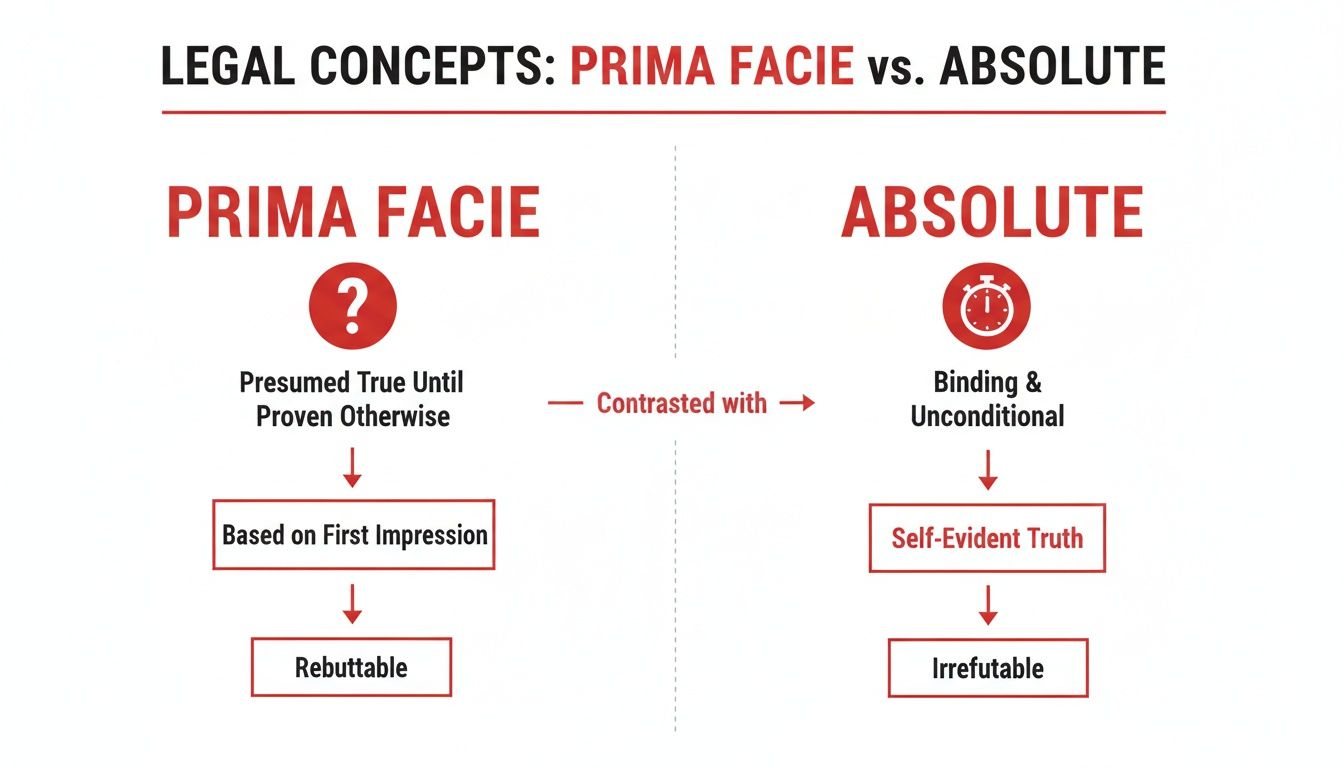
This distinction is the entire foundation of a winning defense. A prima facie ticket starts a legal argument. An absolute ticket tries to end it.
How Do Prima Facie and Absolute Speed Limits Compare?
Understanding this table is the first step in knowing your fight. One is about facts and conditions. The other is just about a number.
Legal Standard | Prima Facie Speed Limit | Absolute Speed Limit |
|---|---|---|
What it means | Your speed is presumed unsafe. This is rebuttable. You can and should argue against it. | Your speed is automatically illegal if it exceeds the posted limit. This is irrefutable. |
The Officer's Job | Must prove your speed was unreasonable for the specific conditions at that moment. | Must only prove you exceeded the posted numerical limit (e.g., 71 in a 70 MPH zone). |
Your Defense | Argue your speed was safe and prudent given the circumstances (good weather, no traffic, etc.). | Argue the officer’s measurement was flawed (e.g., radar error, mistaken identity). |
Common Locations | Unmarked residential streets, business districts, and roads without posted speed limit signs. | Highways, interstates, school zones, and any road with a posted speed limit sign. |
Fighting a prima facie ticket is about proving your judgment as a driver was sound. Courts from the Broward County Judicial Complex to your local traffic division recognize this critical difference.
At Ticket Shield, our attorneys speak with you directly—no chatbots or call centers. We start building this exact defense from day one. We know how to expose the weaknesses in an officer's subjective assessment to protect you from points, fines, and insurance hikes. Do not accept an officer's opinion as fact.
How Does Florida Law Define Prima Facie Speeding?
The flashing lights appear. You are on a street with no speed limit sign. You get a ticket for going "too fast for conditions." What does this mean? Understanding Florida’s prima facie speed limit is your most important defense.
In legal terms, "prima facie" means "at first sight." For a speeding ticket, it means the officer only has surface-level evidence that you might have been driving unsafely. This is not conclusive proof of guilt. A prima facie ticket is an accusation based on an officer's opinion. You must challenge it.
What is the "Reasonable and Prudent" Standard?
This rule is defined in Florida Statute § 316.189. This law sets a default speed limit of 30 MPH for business and residential areas without a posted sign.
Crucial Point: The 30 MPH limit is not absolute. The law requires your speed to be "reasonable and prudent" for the exact conditions on the road. The ticket is the officer's claim that your speed was not reasonable.
The legal fight starts here. Was your speed genuinely unsafe, or were you driving appropriately for the situation? For drivers ticketed near the Edgecomb Courthouse in Tampa, proving your speed was reasonable is the key to winning.
An experienced lawyer knows how to dismantle an officer's subjective assessment. We are not an automated app or a chatbot. You talk directly to your lawyer by phone or text. A personalized defense is the only way to get real results.
What Factors Determine a "Reasonable" Speed?
The court must consider the whole picture. A speed of 38 MPH in a 30 MPH prima facie zone could be safe in one scenario and dangerous in another.
A judge will consider these factors:
Road Conditions: Was the road dry and clear? Or was it wet, covered in leaves, or in poor repair?
Traffic Volume: Were you the only car? Or was traffic heavy?
Visibility: Was it a clear day? Or was it foggy, raining, or dark?
Potential Hazards: Were there pedestrians, cyclists, or children nearby? Were there parked cars creating blind spots?
A ticket is only an accusation. If the officer claims your speed was unreasonable, they must prove it in court with specific facts. Simply stating you were driving over 30 MPH is not enough. This is vital, as the legal view on how speeding counts as negligence often depends on whether the speed was "reasonable" for the conditions.
Your defense is built by proving your speed was reasonable. This is why you need a strategic, lawyer-led firm, not a ticket mill. We know how to cross-examine the citing officer and expose weak spots in their argument. For a deeper look at the laws we use, see our overview of Florida state traffic laws.
How Does an Officer Prove a Prima Facie Violation?
When an officer gives you a prima facie speeding ticket, their job has just started. It is not enough to clock you over 30 MPH on a residential road. To get a conviction, the officer must prove your speed was unsafe for the specific conditions at that moment. This is where we attack their case.
The entire legal battle hinges on this point. The officer's opinion is not law. They must provide concrete facts to a judge, especially in a busy courtroom like the Richard E. Gerstein Justice Building in Miami. A number on a radar gun is not enough.
What Must an Officer Prove in Court?
To prove you violated the "reasonable and prudent" standard, the officer's testimony must be detailed. It must show exactly why your speed created a hazard. "It was unsafe" is not enough.
Our experienced attorneys know what the state must prove. We cross-examine the officer on these critical details:
Road Conditions: Was the road wet or covered in debris? A smooth, dry road supports a higher safe speed.
Traffic Volume: Were other cars present? Was traffic congested or the road empty?
Visibility: Was it raining or foggy? Was there sun glare? Clear visibility weakens the officer's claim.
Potential Hazards: Were there pedestrians, cyclists, or children? Were cars parked on the street creating blind spots?
If the officer cannot recall or did not document these factors, their case weakens.
What is the Question That Wins Cases?
We force the court to answer one simple question: Was your speed genuinely unsafe?
Imagine you are ticketed for driving 38 MPH on a wide, straight residential street. It is a clear, dry morning. There is no other traffic. There are no pedestrians. The road is in perfect condition.
Was your speed truly unreasonable? The officer wrote the ticket, but their subjective opinion does not make you guilty. This is the opening we use to build a powerful defense for you.
We challenge the officer's assessment by showing the conditions did not require a slower speed. We hold them accountable to the high standard of proof required by law.
How Do We Challenge the Officer's Word?
The officer's testimony is their primary weapon. But they also must provide evidence for their speed measurement. You may be interested in our guide on how to beat a laser speeding ticket in Florida, which details the technical evidence we demand.
For any speed measurement device—radar or laser—the state must produce:
Calibration Records: Proof the device was certified as accurate before and after the officer's shift.
Operator Certification: Evidence the officer was properly trained to use that specific device.
Failure to produce these documents can get the speed reading thrown out. This is not a defense you can get from an automated app or a ticket mill. It requires a real attorney who can file legal motions and argue evidence before a judge.
At Ticket Shield, PLLC, you speak directly with your attorney. You will have their direct phone number and can text them. This direct communication is essential for building a strategic, personalized defense designed to protect your driving record.
What Are the Penalties for a Prima Facie Speeding Ticket?
The true cost of a prima facie speeding ticket is far more than the fine. Many drivers just pay it, not realizing they are admitting guilt. That one decision triggers consequences that will cost you for years. You are not just paying a fee; you are accepting a conviction.

Do not underestimate the damage. The penalties are tough. They impact your finances, your driving record, and your career. This is not a situation to take lightly or entrust to an automated app.
What is the Immediate Financial Cost?
The first penalty is financial. A conviction under Florida Statute § 316.189 brings several costs.
The Base Fine: The amount depends on how fast you were driving over the presumed 30 MPH limit. It can be several hundred dollars.
Court Costs: You will be hit with significant court costs and administrative fees that can easily double the fine.
Traffic School Election: Electing traffic school to avoid points has its own fees and requires hours of your time.
These upfront costs are only the beginning. The long-term consequences are worse.
What is the Hidden Cost That Lasts for Years?
The most expensive penalty is the spike in your auto insurance premiums. This is not a one-time fee. It is a financial drain that can last for three to five years.
Crucial Impact: A single speeding conviction on your Florida record can raise your insurance rates by 20-30% or more. This can cost you thousands of extra dollars over the life of the conviction.
Insurance companies see a speeding conviction as a sign of risk. When your policy renews, you will see the surcharge. The cost of hiring a dedicated attorney from Ticket Shield is a strategic investment to prevent this devastating financial hit.
How Does a Ticket Affect Your License and Career?
A conviction adds points to your Florida driving record. Understanding how many points a speeding ticket carries is critical. A speeding conviction adds 3 to 4 points to your license. Accumulating too many points leads to suspension.
For some professionals, the stakes are even higher:
CDL Holders: A single conviction can put your commercial driver's license—and your livelihood—in jeopardy.
Rideshare Drivers: A conviction can get you deactivated from Uber and Lyft.
Military Personnel: A conviction can create complications with security clearances and career advancement.
At Ticket Shield, PLLC, our primary goal is always a "No Points" outcome. We fight to get your case dismissed or reduced to a non-moving violation that carries no points and is not reported to your insurance. You will speak directly with your attorney, ensuring you get the personalized, aggressive defense you need.
How Do We Fight These Tickets in Court?
An officer’s opinion is not a conviction. It is an accusation you have the right to challenge. Our attorneys regularly defend drivers in Florida courts, from the Broward County Judicial Complex to local courthouses across the state. We know how to dismantle a prima facie speeding case.
This is not a job for an automated app or a ticket mill. We build a real defense based on your case. You will speak directly with your attorney by phone or text. This ensures we have every detail needed to prove your driving was safe and lawful.
How Do We Attack the "Reasonable and Prudent" Standard?
The best defense is to attack the officer's main claim. The state must prove your speed was not "reasonable and prudent." Our job is to prove it was.
We build this defense with facts:
Road & Weather Conditions: We use clear weather and dry roads to show there were no environmental risks.
Traffic Volume: We demonstrate that traffic was light or nonexistent, making the collision risk low.
Time of Day: Driving 38 MPH at 2:00 PM on a quiet Tuesday is different from doing it at 8:00 AM surrounded by school buses.
Absence of Hazards: We clarify there were no pedestrians, cyclists, or construction zones requiring a slower speed.
An officer’s vague feeling of you driving "too fast" falls apart against a logical, fact-based argument. This is the personalized defense you get from a real lawyer, not a chatbot.
How Do We Challenge the Officer's Evidence?
The officer is the state's only witness. Their story must be credible and specific. Our attorneys know what questions to ask to expose weaknesses in their testimony.
The officer may handle hundreds of stops a month. By the time your case goes to court, their memory of the specific details will have faded. We use this to your advantage.
If the officer cannot recall the exact details needed to prove your speed was unsafe, their case weakens. A simple "I don't recall" can create the reasonable doubt needed for a dismissal. We do not let them get away with generalizations.
How Do We Verify the Speed Measurement Device?
The state must prove the speed they accuse you of. That proof relies on their radar or LIDAR (laser) gun. We never accept that number at face value.
We file legal motions demanding the state produce key documents:
Calibration Logs: Proof the device was tested for accuracy before and after the officer's shift.
Maintenance Records: We look for any history of malfunctions.
Officer's Certification: We ensure the officer was properly trained to operate the device.
A single procedural error or a missing document can get the speed reading thrown out. When the speed evidence is gone, the state’s case often collapses.
What Immediate Steps Should You Take After Getting a Ticket?
Do not pay the ticket. Paying is an admission of guilt. It guarantees points and an insurance hike. Instead, take photos of the scene and contact a real traffic attorney at Ticket Shield. Do not use faceless apps. Talk to a lawyer who will personally handle your case.
The moments after an officer hands you a ticket are critical. What you do next can be the difference between a clean record and years of higher insurance premiums. Follow these steps.
Immediate Steps to Take:
Step 1: Do Not Pay the Ticket. Paying the fine is the worst mistake you can make. It is a full admission of guilt. You accept the conviction, the points on your license, and the insurance hike. Do not surrender your right to fight.
Step 2: Document the Scene Immediately. Your memory is evidence, but it fades. Before you drive away, safely document everything. Take photos of the road, the conditions, and the absence of any speed limit signs. This is essential for a prima facie defense.
Step 3: Avoid Impersonal Apps and Ticket Mills. Do not entrust your driving record to an automated app or a ticket mill. These services use chatbots and middlemen. You will likely never speak to a real attorney. At Ticket Shield, PLLC, you get your attorney's direct cell phone number. You can call or text your lawyer personally.
Step 4: Contact Ticket Shield Immediately. The legal system has strict deadlines. If you wait, you can lose your right to fight the ticket. Your chance to challenge a prima facie speed violation is time-sensitive. You must act fast. Learn more in our guide on what to do when you get a ticket in our complete guide.
A ticket is an accusation, not a conviction. Knowing all your rights is your best defense. A good understanding of other Florida traffic laws like the Move Over Law is also crucial.
Frequently Asked Questions
Do I have to appear in court for my speeding ticket?
No. For over 99% of the traffic tickets we handle, our clients never step into a courthouse. You do not have to take a day off work or face a judge at the Orange County Courthouse in Orlando. Your Ticket Shield attorney appears in court on your behalf. This saves you significant time and stress.
Can a prima facie speeding ticket be dismissed?
Yes. A prima facie ticket is an accusation, not a conviction. The officer must prove their case. Our attorneys are experienced at challenging their evidence and showing that your speed was safe for the conditions. While no lawyer can guarantee an outcome, our goal is always a complete dismissal.
Is it worth fighting a ticket if I was speeding?
Yes. Paying the fine is pleading guilty. It guarantees points, a fine, and an insurance rate hike for years. Fighting the ticket opens the door to a much better outcome, like a dismissal or a reduction to a non-moving violation with no points. Our cost-effective flat fee is a strategic investment to protect you from years of higher insurance premiums.
Ticket Shield, PLLC is a lawyer-led firm, not a faceless app. Visit TicketShield.com for a free consultation. Our goal is a "No Points" outcome.