What Is a Speeding Ticket in Florida and What Happens Next
Wondering what is a speeding ticket in Florida? This guide breaks down the fines, points, and your legal options to protect your driving record.
That slip of paper the officer hands you is a lot more than just a bill. It’s a formal legal notice—an official accusation that you’ve committed a civil traffic infraction. Once that ticket is in your hand, a strict 30-day clock starts ticking, and the decisions you make in that window are critical to protecting your driving record.
What a Speeding Ticket Really Means for You
Think of the Florida Uniform Traffic Citation less like a fine and more like the opening statement in a legal case against you. This single document contains every crucial detail of the alleged violation, and it’s the foundation for any court proceedings that might follow. Knowing how to read it is the first step toward making a smart decision.
It might feel like a minor headache, but law enforcement takes speeding seriously for one simple reason: public safety. In 2023, speeding was a contributing factor in a staggering 29% of all traffic fatalities across the country, resulting in 11,775 deaths. That statistic, detailed in national motor vehicle safety reports, is exactly why officers are so vigilant. You can read the full analysis on national traffic safety here.
Key Information on Your Florida Ticket
Every field on that ticket has a purpose. From the officer's handwritten notes to the court information, these details can be important if you decide to contest the citation. Paying close attention to them right from the start can make a difference.
The Florida Uniform Traffic Citation is the official document that kicks off the entire legal process. Understanding the key fields on it is essential for you and your attorney to build a solid defense.
Information Field | What It Represents | Why It's Critical |
|---|---|---|
Citation Number | The unique ID for your case in the court system. | This is how your ticket is tracked. Without it, you can't pay, contest, or find your case information. |
Officer’s Information | The name, badge number, and agency of the issuing officer. | Essential for legal challenges, as it identifies who must appear in court and whose testimony is central to the case. |
Your Information | Your name, address, and driver’s license number. | Accuracy is key. Any mistake here could be a potential point of defense or cause administrative headaches later. |
Violation Details | The specific statute you allegedly violated, plus the date, time, and location. | The "what, where, and when" of the accusation. These facts are the core of what a prosecutor must prove. |
Court Information | The county court handling your case and your response deadline. | Missing this deadline can lead to an automatic license suspension. It dictates your entire timeline. |
Think of this table as your decoder ring for the citation. Each piece of information is a potential building block for your defense strategy, so make sure you understand what you're looking at before you make your next move.
This is an attorney advertisement. The information provided does not constitute legal advice. Submitting information through our forms does not create an attorney-client relationship. Our goal is to protect your license and driving record. Past results do not guarantee future outcomes. Office in Broward.
How Florida Law Treats Different Levels of Speeding
In Florida, not all speeding tickets are created equal. The state uses a tiered system, which means the consequences—fines, DMV points, and other headaches—get worse the faster you were allegedly going. A minor slip-up is handled very differently from a high-speed violation, so it’s critical to know exactly where your ticket falls on that scale.
The logic is simple: the faster you go, the greater the risk, and the harsher the penalty. This escalating structure is laid out in the Florida Statutes to hit high-risk driving behavior the hardest. What might be a simple fine for going 8 mph over the limit becomes a much bigger problem at 28 mph over.
Fines and Penalties by Speeding Bracket
Florida law spells out the consequences for each speeding bracket. The two things that hit you right away are the fine and the points added to your driver's license.
While the exact fine can vary from one county to another thanks to local surcharges, the base amounts are set by the state. More importantly, every conviction adds points to your driving record. Those points are what lead to higher insurance premiums and, eventually, a suspended license.
Understanding the points system is fundamental. Even a single ticket can start a chain reaction that impacts your driving privileges and finances for years. Our goal is to protect your record from these long-term consequences.
The stakes climb quickly as the speed increases. For example:
6 to 9 MPH Over: This is the lowest tier, usually resulting in a smaller fine and 3 DMV points.
10 to 14 MPH Over: The penalties tick up, but it’s still a standard civil infraction worth 3 points.
15 to 29 MPH Over: Now we’re in a more serious bracket. This carries a heavier fine and jumps to 4 DMV points.
Here’s a quick overview of how the fines and points typically break down. Keep in mind that fines can vary based on the county where you received the ticket.
Florida Speeding Fines and DMV Point System
MPH Over Speed Limit | DMV Points Assessed | Typical Fine Range |
|---|---|---|
6–9 mph | 3 | $120–$150 |
10–14 mph | 3 | $200–$225 |
15–29 mph | 4 | $250–$300 |
30+ mph | 4 | $350–$500+ |
50+ mph | 4 | $1,000+ |
As you can see, the financial hit grows fast, but the points are what can cause real long-term damage to your driving record. For a detailed breakdown of how points can accumulate, check out our complete guide to the Florida traffic ticket point system.
When Speeding Becomes a Mandatory Court Appearance
The game changes completely once you're accused of driving 30 mph or more over the posted speed limit. While it's still technically a civil infraction, it comes with a mandatory court appearance. You can't just pay this one online and move on.
At this level, you’re looking at:
A much higher fine, which is set by the judge.
4 DMV points slapped on your license.
A requirement for you or your attorney to show up in court.
If you don't show up for a mandatory court date, your driver’s license will be suspended. Period. It gets even more serious if you’re caught going 50 mph or more over the limit—a second offense like that can lead to a one-year license revocation.
The reason Florida's penalties are so strict is simple: public safety.
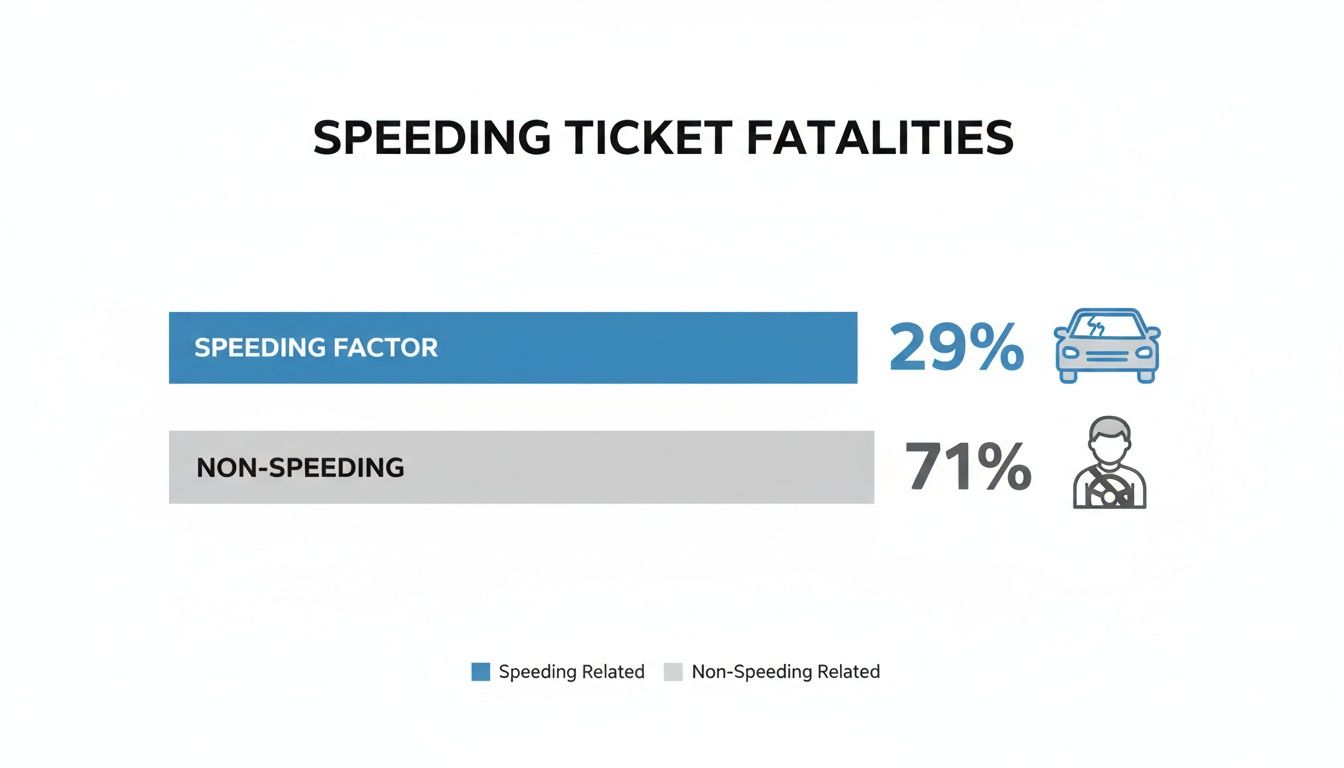
This data makes it clear. With nearly a third of all traffic fatalities involving speed, law enforcement and the courts treat every ticket as a serious matter.
The Long-Term Costs of a Speeding Conviction
That fine printed on your speeding ticket? That's just the tip of the iceberg. It’s the upfront cost, sure, but the real financial story starts after you pay it. Many drivers think paying the citation is the easiest and cheapest way out, but that payment is an admission of guilt.
Once you admit guilt, you trigger a whole series of hidden costs that can follow you for years. The real pain of a speeding conviction isn't immediate; it's a slow burn that quietly drains your budget in ways you probably never saw coming.
Simply paying the ticket means you've been convicted, and that conviction goes right onto your driving record. This is where the Florida Department of Highway Safety and Motor Vehicles (DHSMV) steps in and adds points to your license, kicking off a domino effect.
How Points Lead to License Suspension
Florida’s driver's license system is all about points. Every traffic conviction adds a few more to your total, and if you rack up too many in a short period, the DHSMV will automatically suspend your driving privileges. No questions asked.
The thresholds are surprisingly strict:
12 points within a 12-month period gets you a 30-day suspension.
18 points within an 18-month period leads to a 3-month suspension.
24 points within a 36-month period triggers a 1-year suspension.
Think about it: a single speeding ticket can be worth 3 to 4 points. It only takes a couple of mistakes over a year or two before you’ve lost your license. For anyone who depends on their car to get to work, school, or just live their life, a suspension is a massive problem that goes far beyond the original fines. You can learn more about how long traffic tickets stay on your record and keep costing you.
The single biggest financial consequence of a speeding conviction is almost always the hike in your auto insurance premiums. Insurers see a speeding ticket as proof of risky behavior, and they don't hesitate to adjust your rates accordingly.
The True Cost of Increased Insurance Premiums
After a speeding conviction shows up on your record, your insurance company will likely reclassify you as a higher-risk driver when your policy comes up for renewal. That little change can make your premiums jump—often by hundreds or even thousands of dollars over the next three to five years.
For example, a single conviction could easily raise your annual premium by 20% or more, depending on who your insurer is and what your driving history looks like.
When you multiply that increase over several years, the total cost blows the original ticket fine out of the water. A $250 ticket can easily snowball into $1,500 or more in extra insurance payments. This ongoing financial drain is exactly why fighting the ticket can be a practical decision. Our goal is to protect your license and your record to help you sidestep these escalating long-term costs.
Attorney Advertisement: This post is for informational purposes only and does not constitute legal advice. Past results do not guarantee future outcomes. Office in Broward.
Navigating Your Three Legal Options

When an officer hands you a Florida speeding ticket, a 30-day window opens up for you to make a critical decision. What you do in that month will directly shape your driving record, your insurance rates, and maybe even your ability to drive at all. Understanding the three legal paths you can take is the first step toward making a smart choice that protects your best interests.
Each option comes with its own set of pros and cons. What might seem like the easiest way out can often be the most expensive in the long run. Let's break down what each choice really means for you.
Option 1: Pay the Ticket
Paying the fine often feels like the fastest way to put the ticket behind you. But it's vital to understand that paying the ticket is a legal admission of guilt. You're officially convicted of the traffic violation, and the consequences kick in automatically. There's no turning back.
This choice means two big hits:
DMV Points on Your License: The Florida DHSMV will add the corresponding points to your license, pushing you closer to a potential suspension.
Higher Insurance Premiums: Your insurance company will see the conviction on your record and will almost certainly raise your rates for the next three to five years.
While it gets the ticket off your desk quickly, this path offers zero chance to protect your record. It’s the simplest choice but often the costliest over time.
Option 2: Elect Traffic School
For drivers who are eligible, choosing to attend a Basic Driver Improvement (BDI) course, or "traffic school," can feel like a decent middle ground. If you qualify and complete the course, you can stop points from being added to your license for that ticket. It's a valuable tool for keeping your record clean.
But traffic school comes with some important strings attached:
Strict Eligibility Rules: You can only use this option five times in your entire life and no more than once every 12 months.
You Still Pay: You're on the hook for the full fine of the ticket plus the separate cost of the traffic school course itself.
It’s Not a Dismissal: The ticket still shows up on your driving record as an "adjudication withheld." Some insurance companies might still see that and factor it into your rates anyway.
Option 3: Contest the Ticket in Court
Your third option is to plead not guilty and fight the ticket in court. This is the only path that gives you a chance to have the citation dismissed, which could result in no points, no conviction, and no fine. When you contest a ticket, the burden of proof is on the state, and a traffic attorney can challenge the evidence the officer presents.
Speeding tickets aren't just a nuisance; they're part of a bigger public safety effort. Enforcing speed limits is a proven way to cut down on traffic fatalities, especially as our roads get more crowded. A citation flags behavior that reduces a driver's reaction time and vehicle control, and you can discover more insights about these traffic trends at INRIX.com.
Going to court requires a clear strategy. Our goal is to protect your license and record by managing this entire process for you. To learn more about the specific steps involved, see our comprehensive guide on how to fight a speeding ticket in Florida. Handling a case the right way can help you dodge the long-term fallout of a conviction.
Special Rules for CDL and Out-of-State Drivers
A speeding ticket is an expensive headache for any driver, but for some, the stakes are dramatically higher. If you hold a Commercial Driver's License (CDL) or you're just visiting Florida from another state, that piece of paper is far more than a simple fine. It can put your career on the line or follow you hundreds of miles back home.
A regular driver might get the option to attend traffic school and keep their record clean. But for professional drivers and out-of-state visitors, the rulebook is much stricter and the consequences hit a lot harder. Understanding these unique challenges is the first step toward building a defense that actually works.
The High Stakes for CDL Holders
For a commercial driver, that CDL isn't just a license—it's their livelihood. Federal regulations recognize this, which is why they impose much tougher standards for traffic violations, even when the driver is in their personal vehicle. A speeding conviction that’s a minor annoyance for a typical driver can trigger a career-ending chain of events for a CDL holder.
These drivers face a completely different reality:
No Easy Way Out: The option to elect traffic school to keep points off your license is off the table for most violations when you have a CDL.
Your Job is on the Line: A conviction can lead directly to the suspension or disqualification of a CDL, making it impossible to work as a professional driver.
Big Brother is Watching: The Federal Motor Carrier Safety Administration (FMCSA) tracks every single violation nationwide. A Florida ticket doesn't stay in Florida; it goes straight onto your permanent federal record.
A conviction for going just 15 mph or more over the speed limit is labeled a "serious violation" under federal law. Get two of those in three years, and you could face a CDL disqualification. Your career could be on the line. Our practice focuses on protecting the licenses of commercial drivers facing these exact situations. You can learn more in our guide to handling CDL speeding tickets in Florida.
How a Florida Ticket Follows Out-of-State Drivers
It’s a common mistake visitors make. They get a ticket in Florida and figure it won't matter once they cross the state line. Unfortunately, that ticket will almost certainly follow them home.
Thanks to an agreement called the Driver License Compact (DLC), most states have a system for sharing traffic violation data. Think of it as a nationwide tattletale network for DMVs.
When Florida reports your ticket, your home state’s DMV gets the notification and usually treats the violation as if it happened right in your own backyard.
This means you can expect:
Points to be added to your license according to your home state's rules.
Your insurance company back home to get the news, likely leading to a premium increase.
A potential license suspension if the new points push you over your state's legal limit.
A Florida ticket doesn't stay in Florida. It travels with you, bringing all the same long-term financial pain and administrative headaches as a ticket you'd get down the street from your house. Whether you’re a professional trucker or a tourist, getting professional guidance is a smart move.
Attorney Advertisement: This post is for informational purposes only and does not create an attorney-client relationship. Our goal is to protect your license and record. Past results do not guarantee future outcomes. Office in Broward.
How a Traffic Defense Attorney Can Help You

Fighting a speeding ticket can feel overwhelming, like you're up against a system designed for you to lose. The good news is, you don't have to go through it alone. When you hire a law firm that focuses on traffic defense, you're handing the entire problem over to a professional.
From the moment you decide to fight back, our job is to take the weight off your shoulders. We manage every legal detail, from paperwork to court dates, with one clear goal: protecting your license and your record.
Navigating the Legal System for You
One of the biggest reliefs for our clients is knowing that someone with experience is handling all the communication and, most importantly, the court appearances. For most civil traffic tickets in Florida, we can stand in for you. This often means our clients never have to miss a day of work or disrupt their lives to show up for a hearing.
This hands-off experience for you includes our team:
Challenging the Evidence: We meticulously review every detail of the citation, looking for procedural errors or inaccuracies that can get a case dismissed.
Negotiating with Prosecutors: Our attorneys have working relationships with prosecutors across the state, which can be beneficial when negotiating for reduced charges or outcomes that keep points off your license.
Arguing Your Case in Court: If your case goes to a hearing, we’re the ones presenting the legal arguments and working to achieve a favorable result.
Our practice focuses on addressing the long-term impact of a ticket. We work to get dismissals, avoid points, and reduce fines to keep your driving record clean and your insurance premiums from skyrocketing. Past results do not guarantee future outcomes.
Achieving a Better Outcome
While no one can ever guarantee a specific result, having professional representation puts you in a much stronger position. Our experience with Florida traffic law allows us to build a defense tailored to the specific facts of your case. To get a better handle on the legal world, you might find it helpful to understand the general distinctions between an attorney and a lawyer.
Whether it’s questioning the officer’s speed measurement method or spotting a critical mistake on the ticket, our objective is to find the most effective path to a favorable outcome for you.
Attorney Advertisement. Past results do not guarantee future outcomes. Office in Broward.
Frequently Asked Questions About Florida Speeding Tickets
It’s completely normal to have questions swirling after getting a ticket. To wrap things up, here are some quick, straightforward answers to the most common things drivers ask us.
Do I Have to Appear in Court for My Speeding Ticket?
For most standard speeding tickets, you or your attorney have to take action within 30 days, but you don't always have to show up in person. In fact, when you hire an attorney, they can almost always appear in court on your behalf, saving you a trip to the courthouse.
However, if you're cited for a very high speed (usually 30 mph or more over the limit), the ticket comes with a mandatory court appearance. In those cases, you or your lawyer must be present.
What Happens If I Ignore a Speeding Ticket?
Ignoring a ticket is one of the worst things you can do. Failing to respond within that 30-day window triggers some serious consequences, including the suspension of your driver's license.
On top of that, you’ll get hit with extra late fees and administrative costs. It's critical to address the citation by choosing one of your legal options before that deadline hits.
How Long Do Points from a Speeding Ticket Stay on My Record?
In Florida, the points from a ticket can affect you for a while. Your insurance company will typically use that violation to set your rates for at least three to five years, which can mean paying hundreds or even thousands more in premiums.
The DMV also uses those points to track your driving habits. If you rack up too many in a certain timeframe—like 12 points in 12 months—they will suspend your license.
Dealing with a Florida traffic ticket can be confusing, but you don't have to handle it alone. For a free consultation to discuss your case and protect your driving record, contact the team at Ticket Shield, PLLC today. Our goal is to protect your license and record. Past results do not guarantee future outcomes. Submitting information through our forms does not create an attorney-client relationship. Office in Broward. https://www.ticketshield.com