Florida's Pretrial Release Conditions What You Must Know
Arrested in Florida? Understand the pretrial release conditions the court can impose, like bail, curfews, and monitoring. Learn how to protect your rights now.

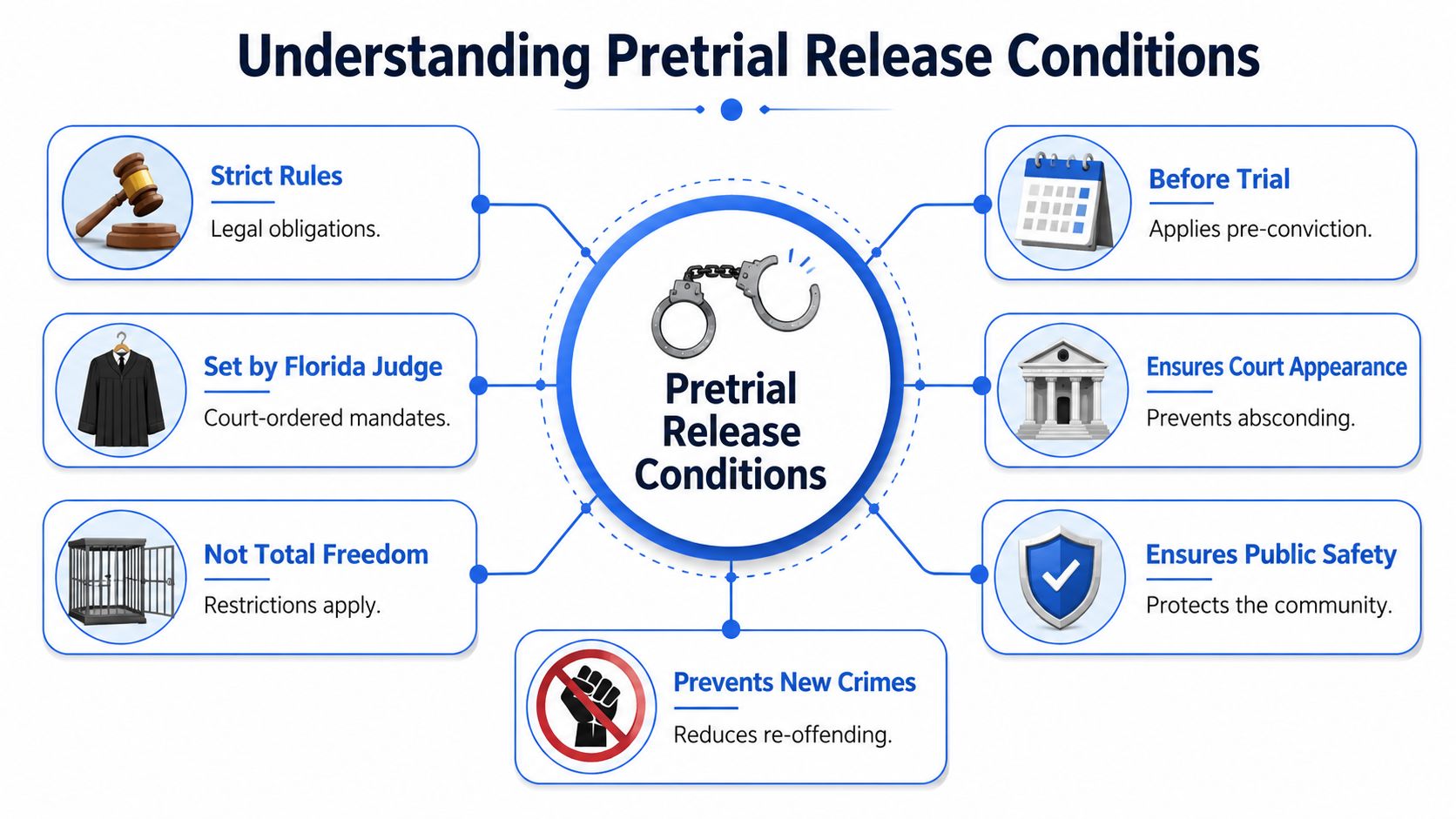
TL;DR: Being released from jail before your trial isn't total freedom. Pretrial release conditions are strict rules set by a Florida judge that you must follow to stay out of jail. Violating them can put you right back in custody.
You were just arrested. You're home, but you don't feel free. You're staring at paperwork, trying to figure out what the judge ordered, what happens next, and how one mistake could send you back into jail.
That's the right instinct. Take this seriously.
Pretrial release conditions control your life the moment you walk out. They can affect where you go, who you speak to, whether you can drive, whether you can work late, and whether one missed hearing turns into a new arrest. In Florida, a serious traffic-related arrest often puts you into this system fast, especially when the charge involves alleged impaired driving under Florida Statute 316.193.
Table of Contents
What Exactly Are Pretrial Release Conditions
Pretrial release conditions are court orders that apply while your criminal case is pending. They aren't advice. They aren't suggestions. They are the rules attached to your freedom.
If you were arrested in Florida for a DUI or another serious traffic-related offense, the judge may release you before trial, but only under conditions. Those conditions exist because the court wants two things. It wants you back in court, and it wants to limit what the court sees as risk while the case is open.
Why these orders matter immediately
The extent of this system is often unappreciated. In U.S. jails, 69% of people held in city and county facilities are being held pretrial, and more than 400,000 people are detained pretrial nationwide at any given time, according to the Prison Policy Initiative's pretrial detention research.
That should tell you two things. First, you are not alone. Second, the system won't slow down just because you're scared or confused.
Practical rule: The day you're released is the day you start protecting yourself. Read every line of your release order before you do anything else.
Sometimes clients think release means the hard part is over. It isn't. You're now in the compliance stage, and that's where people get hurt by sloppy assumptions.
What the court is trying to control
The judge may require you to appear for hearings, avoid new arrests, stay away from certain people, submit to testing, remain in a set location, or follow supervision rules. Those conditions can be broad or narrow. Either way, they are enforceable.
For traffic-related cases, the court's concern often begins with the allegation itself. If the arrest involves Florida Statute 316.193, the judge may treat the case as one involving public safety, substance use, and courtroom reliability all at once. That's why conditions can arrive fast and hit hard.
Here's the most straightforward way to look at it:
Your bond isn't the whole story. Paying money or being released on recognizance doesn't erase the other rules.
Your paperwork controls your movement. If the order says no travel, curfew, no contact, or testing, your opinion about fairness doesn't matter.
Your case strategy starts here. Early decisions affect later outcomes, including whether you can qualify for something like a pretrial diversion program if your facts and county allow it.
What Conditions Will the Court Impose on Me
The answer depends on the charge, the judge, your history, and how the hearing was handled. Some conditions are routine. Others can cut deep into your work, home life, and ability to function.
Don't assume "standard" means harmless.
The common conditions that change daily life
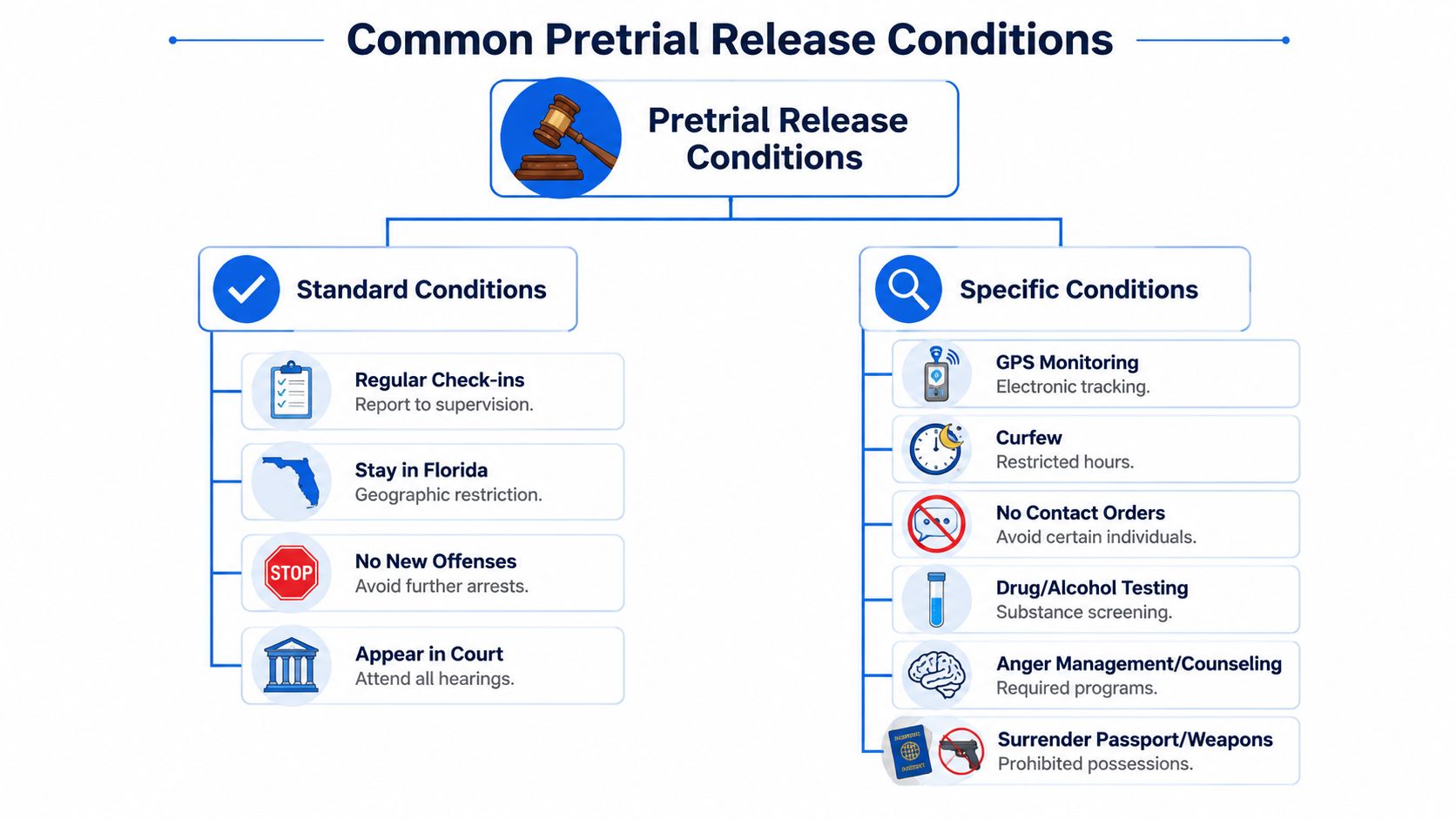
A Florida court may impose conditions like these:
Release on recognizance. You're released based on your promise to return. That sounds simple, but missing court can destroy that privilege fast.
Monetary bond. You or someone on your behalf posts money to secure release. To understand what happens to bail money, read this guide.
Travel restrictions. The order may keep you inside a county, a judicial circuit, or the state. That can affect trucking routes, delivery work, family travel, and business trips.
No-contact orders. The judge may bar you from contacting an alleged victim, witness, passenger, or co-defendant. In real life, that can mean you can't go home, can't call, and can't send messages through friends.
Curfew. If your job runs late, this can become a trap unless it's modified.
Drug or alcohol testing. Even if the arrest involved a traffic offense, the court may order screening or sobriety monitoring.
Electronic monitoring. GPS or house arrest can control where you sleep, work, shop, and travel.
Weapon restrictions. You may be ordered to surrender firearms or avoid possessing them during the case.
Reporting requirements. Some people must check in with pretrial services on a schedule and follow every reporting rule exactly.
Why one-size-fits-all conditions are a problem
Courts sometimes use blanket conditions, meaning the same package gets imposed on everyone charged with a certain type of offense. That approach is lazy, and it can be damaging.
A federal analysis discussing pretrial release science explains that blanket conditions impose the same controls on an entire charged group without a judicial determination of each person's actual circumstances. That analysis favors individualized conditions specific to the person in front of the court, not a generic template, as described in this federal discussion of individualized versus blanket release conditions.
If the judge ordered conditions that don't fit your actual risk, your lawyer should attack that problem quickly.
A condition can be legal and still be unnecessary. A curfew may wreck your employment. GPS fees may create financial pressure you can't carry. A no-contact order may block access to your own property or children. That's why you need to read your order as a list of practical burdens, not just legal labels.
Here is the daily-life test:
Condition | What it means for you |
|---|---|
Curfew | Your work hours and family obligations may need court approval |
GPS monitoring | Every trip can be reviewed and every deviation can create trouble |
No-contact order | One text message can become a violation issue |
Testing | You need reliable transportation and strict scheduling |
Travel restriction | Leaving Florida without permission can trigger immediate consequences |
How Does a Florida Judge Decide My Conditions
The first serious decision often happens fast. In Miami, that may happen at the Richard E. Gerstein Justice Building. You may still be exhausted, worried, and not thinking clearly while the court decides how much freedom you get.
That is exactly why early lawyering matters.
What happens at first appearance
At first appearance, the judge reviews the charge, the probable cause paperwork, and the release question. In a traffic-related criminal case, the nature of the allegation matters. A DUI allegation under Florida Statute 316.193 can push the court toward restrictions aimed at appearance, sobriety, and public safety.
The court also looks at factors that usually include:
Community ties
Work history
Prior criminal or traffic-related record
Past missed court dates
Any allegation suggesting danger or instability
Practical signs that you will or won't follow orders
If you don't know what the next court stage looks like, review what happens at an arraignment hearing now, not later.
What your lawyer should argue
Many jurisdictions use a Release Conditions Matrix, which is designed to match a person's failure-to-appear and new-criminal-activity risk scores to a release level. The central principle is the least-restrictive conditions necessary, as explained in this guide to the Release Conditions Matrix.
That principle matters because judges often receive incomplete pictures of real people.
Your lawyer's job is to supply the missing facts. Stable job. Family support. Residence. Medical needs. Childcare duties. Transportation limits. Why a curfew hurts employment. Why broad travel restrictions don't fit. Why supervision can be narrowed without creating risk.
Early court hearings are short. The record your lawyer builds has to be sharp, human, and credible.
The judge doesn't live your life. Your lawyer has to put your life in front of the court in a way the judge can act on.
What Happens If I Violate My Pretrial Release
You can lose your release faster than you got it. That's the truth.
Some violations are obvious, like picking up a new charge. Others are stupidly easy to stumble into, like contacting the wrong person, missing a testing appointment, or showing up late because you misunderstood a reporting instruction.
The violations that trap people
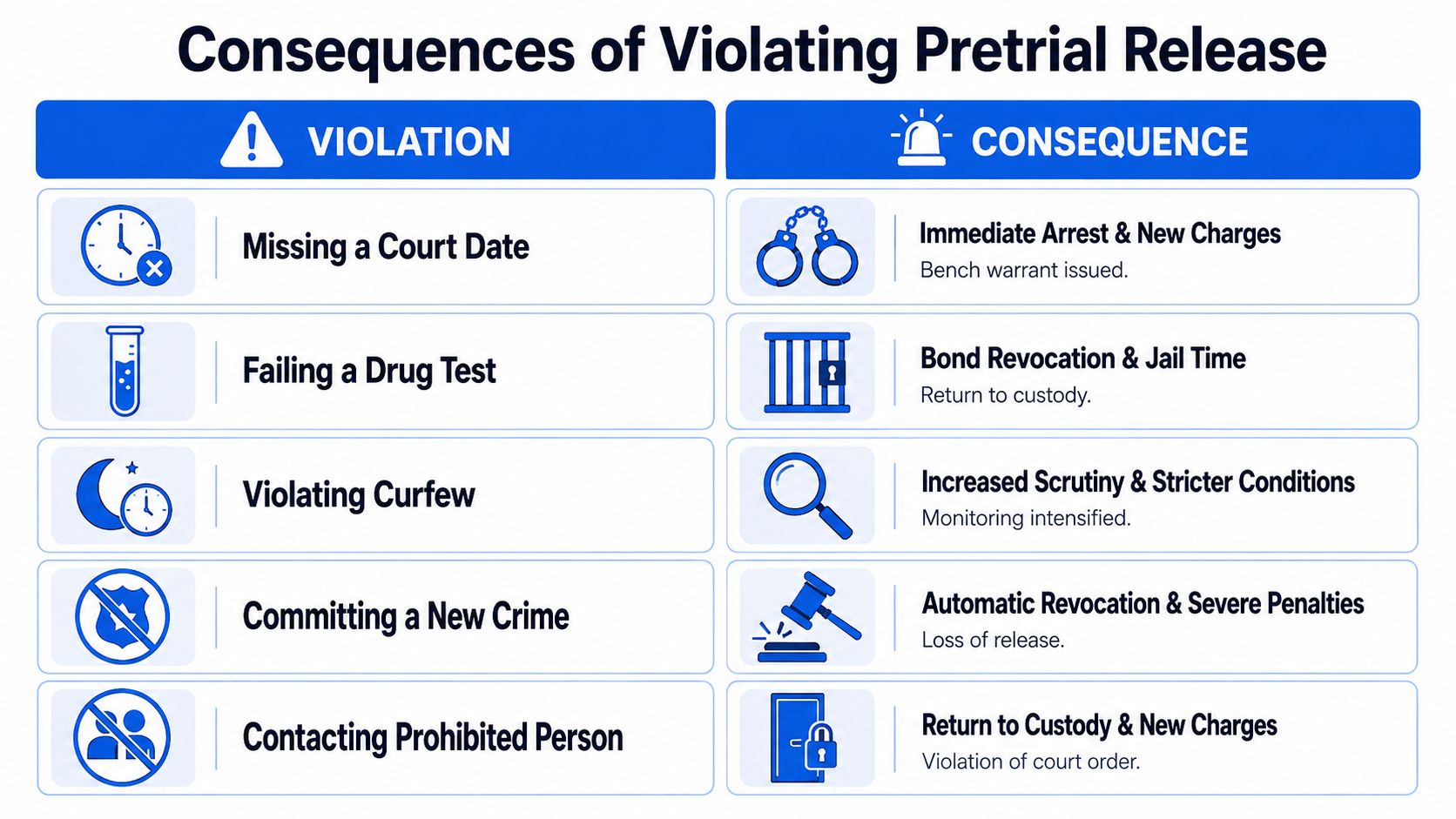
These are common ways people put themselves back in danger:
Missing court. This is one of the fastest ways to trigger a warrant. If you've already missed one, read what happens if you miss a court date immediately.
Failing to report. If pretrial services told you to check in, test, or verify something, you don't get to freelance.
Breaking curfew by "just a little." Judges don't reward excuses that sound casual.
Talking to a prohibited person. One apology text can create a new crisis.
Using alcohol or drugs when testing is ordered. Hope is not a defense.
Leaving an approved area. If the order limits your travel, the order controls.
A short explanation from a defense lawyer can help you understand how courts treat release violations in practice:
Why technical violations are dangerous
Federal data found that defendants received an average of about nine conditions on pretrial release, and the relationship between piling on conditions and better outcomes was weak. The same study found no significant relationship between more conditions and lower new-crime or missed-court rates, while more conditions were associated with a higher probability of revocation. That analysis appears in this SSRN study on pretrial release conditions and outcomes.
That matters because not every violation involves a new crime. Some are technical failures inside a maze of rules.
More rules don't always create more safety. Sometimes they create more ways for you to fail.
If the judge believes you violated release, you may be arrested again, brought back before the court, and face harsher conditions or loss of release altogether. Treat every requirement as if your freedom depends on it, because it does.
Can My Attorney Get My Conditions Changed
Yes. A bad release order is not always the final word.
If the conditions are too broad, too expensive, or impossible to follow without wrecking your job or family obligations, your attorney can ask the court to modify them. That usually happens through a motion focused on the facts the judge needs to see.
When modification makes sense
Modification is often worth pursuing when:
Your curfew conflicts with work. Shift workers, drivers, bartenders, and hospitality employees run into this constantly.
Your travel restriction blocks employment. Some jobs require movement across county lines or statewide travel.
Your monitoring costs are crushing you. Financial pressure can become a compliance risk.
A no-contact order is overbroad. Sometimes it needs exceptions for property exchange, childcare, or other tightly managed contact.
Your testing schedule is unrealistic. The court may need a more workable structure.
A continuance can also matter if your lawyer needs time to gather records, employer letters, or other proof that supports a modification request. If you need that concept explained, read this guide on a continuance in court.
What your lawyer needs from you
Your lawyer can't fix what you hide.
Bring your release paperwork. Bring your work schedule. Bring proof of residence. Bring names, dates, screenshots, childcare issues, medical needs, and transportation realities. If a condition is hurting you, document the harm in a way the court can understand.
The strongest modification requests are concrete. Not "this is hard." More like "my shift ends after curfew, my supervisor will verify it, and I have followed every other condition."
What Should I Do Immediately After Being Released
Your first day out matters. Sloppy starts create preventable violations.
Don't rely on memory. Don't trust verbal summaries from stressed relatives. Your paperwork is the only version that counts.
Immediate Steps to Take
Read the release order line by line. Look for court dates, reporting instructions, travel limits, no-contact terms, testing rules, and any requirement to surrender items.
Calendar everything twice. Put every hearing, check-in, and testing date in your phone and on paper.
Save every document. Keep bond papers, booking documents, property receipts, and release instructions in one folder.
Stop contacting risky people. If there's any chance a person is covered by a no-contact order, don't call, text, message, tag, or ask someone else to reach out.
Fix your transportation now. If you need rides for court, testing, or reporting, line them up before the first deadline.
Write down what happened at arrest. Your memory is freshest now. Include timeline, officer statements, witnesses, medical issues, and anything related to driving, testing, or roadside procedures under Chapter 316, especially if the case involves 316.193.
Tell your employer only what is necessary. You may need scheduling support, but don't overshare without legal guidance.
Questions you should ask your lawyer
Take these questions into your first serious call:
What exactly am I prohibited from doing right now
Do I have any travel restriction inside Florida
Can I contact family members who were near the incident
Do I need to test, report, or appear before the next hearing
Which condition is the highest violation risk in my case
Should we move to modify any condition immediately
What documents should I gather this week
Confusion is dangerous. If a condition is unclear, get an answer before you act.
Why You Need a Lawyer Not an App
This stage of a criminal case is active, not passive. You need someone who can intervene.
An automated service can't stand up in court. A chatbot can't call the prosecutor. A generic intake platform can't argue that your curfew should be narrowed because your job requires late shifts, or that your no-contact order needs a lawful exception for family logistics.
A real lawyer does active protection
A real lawyer reads the order and spots problems. A real lawyer gathers records before the next hearing. A real lawyer files the motion, makes the argument, and pushes for narrower conditions based on your actual life.
That matters because pretrial law and release practice can shift fast. Illinois's Pretrial Fairness Act took effect in September 2023 and eliminated cash bail there. In the three months after implementation, statewide pretrial jail bookings fell from 50,122 to 41,373, rather than the 44,330 researchers expected, and average daily pretrial jail population dropped from 14,167 to roughly 12,200, according to this analysis of the short-term impact of the Pretrial Fairness Act. Laws and strategies move. A human lawyer stays current.
If you're curious how technology can support legal work behind the scenes, tools like AI tools for legal professionals can help lawyers organize documents and review materials faster. That's useful. But support tools are not substitutes for legal judgment, courtroom advocacy, or direct attorney access when your freedom is on the line.
Why automated services fail at this stage
Automated services are reactive. They wait for forms. They sort information. They send reminders.
That's not enough when:
A judge imposed conditions that don't fit your facts
You need a motion filed quickly
A misunderstanding could trigger revocation
Your job, license, or family life is being squeezed by a bad order
You need strategic advice by phone or text from an actual lawyer
You don't need a digital buffer between you and your defense. You need direct answers, fast decisions, and someone who treats release conditions like the emergency they are.
If you're facing DUI or serious traffic-related charges in Florida, get direct help from a real attorney at Ticket Shield, PLLC. You can speak with your lawyer by phone or text, not a middleman or chatbot. Visit TicketShield.com for a free consultation and fight for the No Points outcome.