What Happens to Bail Money in Florida Explained
Confused about what happens to bail money in Florida after an arrest? Our guide explains how bail works, when you get it back, and when it's forfeited.
When you get arrested in Florida, one of the first and most stressful questions is almost always about bail. What happens to that money? Does it just disappear into the system? The short answer is: it depends entirely on how you pay it and whether the defendant shows up for all their court dates.
If you pay the full cash bail directly to the court, that money is designed to be refunded once the case is over, minus any court fees or fines.
Understanding Bail Money as a Security Deposit
The easiest way to think about posting bail is to compare it to a security deposit on an apartment. You give the landlord a chunk of money as a promise that you'll follow the lease and won't trash the place. If you hold up your end of the deal, you get that deposit back when you move out.
Bail money works on the exact same principle. It’s not a punishment or a pre-paid fine. It's a financial guarantee—an insurance policy for the court—to make sure the defendant comes back for every required hearing. As long as they do, the money is returned once the case concludes. This system is all about securing cooperation.
Cash Bail vs. Bail Bond: A Key Distinction
Now, here's where things get tricky. The path your money takes changes completely if you use a bail bondsman.
When you go through a bondsman, you don't pay the full bail amount. Instead, you pay them a non-refundable fee, which in Florida is typically 10% of the total bail. This fee is the bondsman's payment for putting up the full bail amount on your behalf and taking on all the risk. That 10% is their earned income—it is never coming back to you, no matter what happens in the case. Making sure you understand all parts of the legal journey, including what to expect in traffic court, is a critical part of the process.
To make it crystal clear, let's break down the fundamental difference.
Cash Bail vs. Bail Bond Fee At a Glance
This table gives you a quick snapshot of where your money goes in each scenario. It's the most important financial distinction to understand when making a decision.
Bail Type | Who You Pay | Is It Refundable? | Key Condition for Refund |
|---|---|---|---|
Cash Bail | The Court | Yes, minus court fees & fines | Defendant attends all court dates |
Bail Bond | Bail Bondsman | No, the 10% fee is non-refundable | Not applicable; the fee is earned upon release |
This isn't just a minor detail; it's a critical financial fork in the road. Especially when dealing with the court system in a major area like Miami-Dade County, knowing exactly where your money is going upfront can save you from some very costly surprises down the line.
The Two Paths for Bail Money: Refund or Forfeiture
Once bail is posted, that money is essentially held in limbo. Its final destination depends entirely on one thing: the defendant's actions. It can either come back to you or be lost forever.
Understanding these two very different outcomes is crucial for anyone who has a financial stake in the bail process.
The path to getting your money back is simple, at least in theory. The defendant must show up to every single court date, no exceptions. If they do that, the process of returning your cash bail begins once the case is over.
Path One: The Refund Process in Palm Beach County
Let's walk through a common scenario here in Palm Beach County. Imagine a family member is arrested for a serious traffic offense, and you post a $2,500 cash bail directly with the court clerk.
As long as your family member shows up for every required hearing, the court keeps its end of the bargain.
After the case is officially closed—whether it’s dismissed, ends in a plea deal, or goes to trial—the clerk's office will start the refund process. One key thing to remember is that the court will first deduct any fines, fees, or restitution ordered by the judge. So, if the final judgment includes $500 in fines, you’ll get a check for $2,000. The timeline for receiving that check can vary, but you can typically expect it to take anywhere from several weeks to a few months.
This flowchart breaks down the simple decision that determines where the money goes.
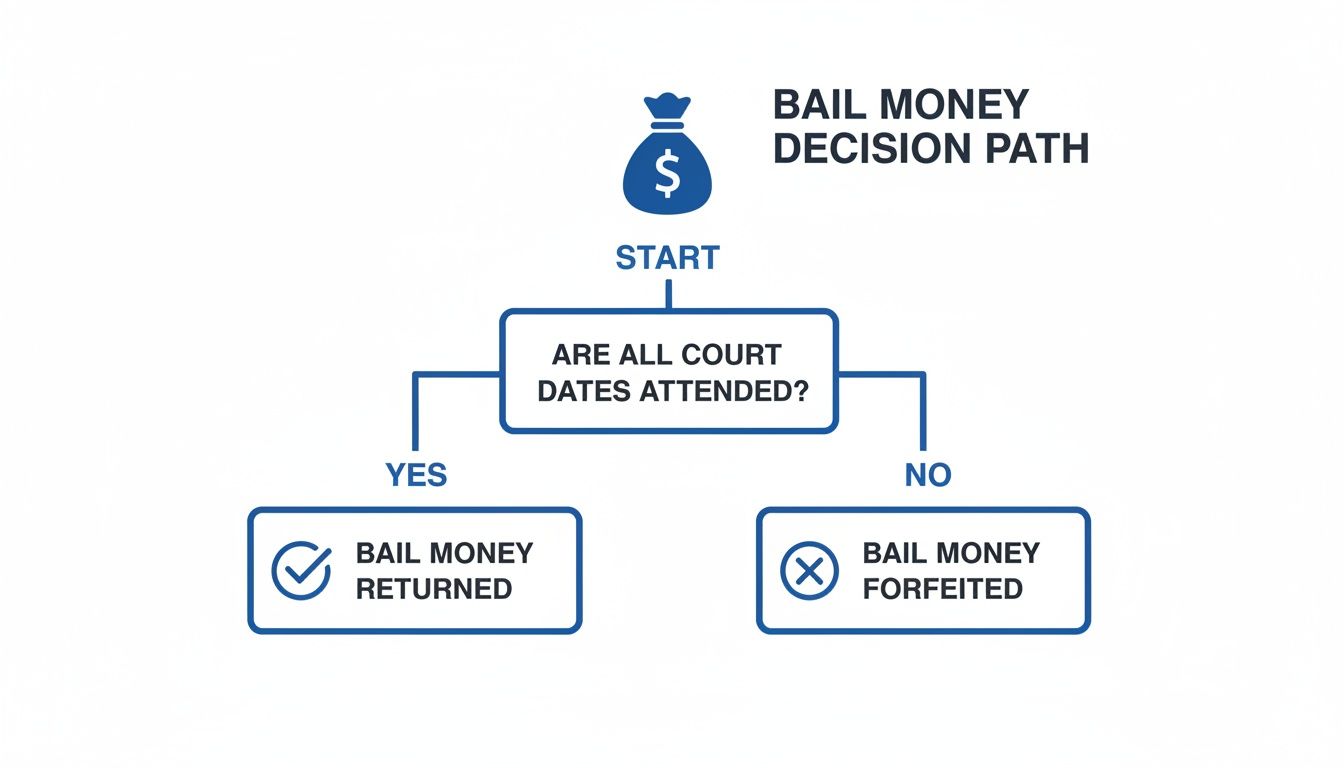
As you can see, it all comes down to whether or not the defendant appears in court.
Path Two: The Forfeiture Process
The second path is much more painful—and it leads to the total loss of your money. This happens if the defendant fails to appear (often called an "FTA") for a scheduled court date. When they miss a hearing, the judge will immediately issue a warrant for their arrest and order the bail to be forfeited.
Once bail is forfeited, the cash you posted is gone for good. It's transferred to the county to help fund the court system, and there is no way to get it back.
The situation is just as serious if you used a bail bondsman. Their 10% fee is always non-refundable, no matter what happens in the case. If the defendant skips court, the bondsman is on the hook for the full bail amount. They will then use every legal tool they have to collect that money from the person who cosigned and guaranteed the bond.
A major question people have is whether they Do you get bail money back, and the answer always circles back to the defendant's compliance and the final outcome of the case. It’s also important to understand how different resolutions, like what happens if you plead guilty, can affect your financial stake.
Navigating the Florida Bail Process Step by Step
The bail process can feel like a maze, especially when you're already dealing with the stress of an arrest. But if you break it down, there’s a clear sequence of events that unfolds, starting from the moment a judge sets bail to the day the case is finally closed.
Understanding this roadmap is the key to knowing what happens to your money and making informed decisions along the way. In Florida, that journey starts with a critical court hearing.
Step 1: The First Appearance Hearing
Within 24 hours of an arrest in Florida, the defendant must be brought before a judge for their First Appearance hearing. In places like Broward County, this is the first real checkpoint. The judge will officially state the charges and, most importantly, decide on the conditions for release—including setting the bail amount.
This hearing is a pivotal moment. The judge doesn't just pull a number out of thin air; they weigh the seriousness of the charge, the defendant’s past record, and their connections to the community. This is where the financial reality of the case first takes shape.
Step 2: The Decision – Cash or Bond
Once the bail amount is set, the defendant and their family have a big decision to make. Do you pay the full amount in cash directly to the court, or do you hire a bail bondsman? As we covered, paying with cash means that money is yours to get back (minus fees) as long as you follow the rules.
But if the bail is high, coming up with all that cash isn't realistic for most people. That's where a bondsman comes in. You'll pay them a non-refundable fee, which in Florida is typically 10% of the total bail. It’s important to get familiar with how bail bonds work in Florida, because this choice has a huge impact on your finances down the road.
Step 3: Adhering to Release Conditions
Posting bail isn't just about the money. It's a promise, backed by that cash, that the defendant will follow a strict set of rules while the case is ongoing.
Violating any of these conditions can mean bail is revoked and the money is forfeited—gone for good. Some of the most common requirements include:
Mandatory Court Appearances: This is the big one. You cannot miss a single court date.
No-Contact Orders: Staying away from alleged victims or co-defendants is often required.
Travel Restrictions: The defendant may be ordered to stay within the county or the state of Florida.
The legal system has a lot of moving parts after an arrest. It’s crucial to understand the full picture of what happens after a DUI arrest, as the bail conditions are just one piece of the puzzle.
Step 4: Case Conclusion and Financial Resolution
The final chapter for your bail money doesn't happen until the case is completely over—whether that means a dismissal, a plea deal, or a verdict at trial.
At the conclusion of the case, the court determines the final fate of the bail money. This is the moment where the initial promise is either fulfilled or broken, directly impacting your finances.
If you paid cash bail and met every single condition, the court starts the process of refunding your money. They will, however, deduct any court costs or fines you owe. If you used a bail bondsman, their job is done. Your contract with them is finished, but that initial 10% fee is theirs to keep.
When Bail Money Is Forfeited and What Happens Next
The entire bail system is built on a single promise: the defendant will show up for their court dates. When that promise is broken, a swift and severe chain reaction kicks off, and the consequences go far beyond just losing the money you put up. A missed court date triggers the forfeiture of your bail money and sets a series of serious legal problems in motion.
This isn't just some minor administrative hiccup; it's a serious breach of the agreement made with the court. The moment a defendant fails to appear, the judge will almost certainly issue a bench warrant for their immediate arrest. At the same time, the court starts the formal process of seizing the bail money, a process known as forfeiture.
The Financial Fallout of a Missed Court Date
When bail money is forfeited, it doesn't just vanish into thin air. That money is absorbed directly by the county, helping to fund the local justice system. Forfeited bail can be used to cover administrative costs, pay down fines, or even go toward victim restitution funds. It happens more often than you'd think, and data on pretrial detention shows how these funds can become a significant part of local justice budgets when bail is either unaffordable or forfeited. You can get a broader view of how this works nationally by reading about bail in the United States on Wikipedia.
If you paid the full cash amount yourself, that entire sum is gone for good. If you used a bail bondsman, the situation gets even more stressful for the person who co-signed the bond agreement.
Once a defendant absconds, the bail bond company is legally on the hook to pay the full bond amount to the court. They will then use every legal tool at their disposal to get that money back from the co-signer, which can mean seizing collateral or even filing a civil lawsuit to collect the debt.
To put it plainly, the consequences of a defendant skipping court are severe and immediate. We can break down the cascading effects like this:
Consequences of Failing to Appear in Court
Immediate Consequence | Financial Impact | Legal Ramification |
|---|---|---|
Bench Warrant Issued | A warrant is issued for the defendant's immediate arrest by law enforcement. | Defendant becomes a fugitive from justice. |
Bail is Forfeited | The full bail amount is seized by the court. If a bond was used, the co-signer is now liable for the full amount. | The original bail agreement is nullified. |
New Charges Filed | The defendant is now facing an additional criminal charge for "Failure to Appear." | This new charge comes with its own set of penalties, including more fines and potential jail time. |
As you can see, what starts as one legal problem quickly snowballs into several, each with its own set of damaging outcomes.
The Ripple Effect of Forfeiture
The consequences keep spreading. Missing court can lead to entirely new criminal charges. In Florida, "Failure to Appear" is a crime in and of itself, which can lead to additional fines, probation, or even jail time—all on top of whatever penalties the original charge carried.
For those who went through a bail bondsman, another person now gets involved: a bail recovery agent, better known as a bounty hunter. These agents are hired by the bond company to track down and apprehend the defendant. Their only goal is to get the defendant back into custody so the bond company doesn't have to pay the full bond amount to the court.
Failing to show up for court is an expensive mistake with compounding consequences. A missed court date can escalate a minor issue into a major legal and financial disaster. The initial loss of the bail money is often just the beginning of a much more complicated and stressful legal journey.
Attorney Advertisement. Office in Broward. Past results do not guarantee future outcomes. Our goal is to protect your license and record.
How Legal Counsel Can Help Protect Your Financial Stake
Trying to get through the bail system on your own is a huge financial gamble. Bringing in a knowledgeable Florida attorney isn't just about fighting the charges—it's a strategic move to safeguard the money you've put on the line. At the end of the day, the goal is simple: avoid forfeiture. And that’s where experienced legal counsel can be invaluable.
Think of your lawyer as your organizational backstop. They’re the ones tracking every critical date, filing the right motions, and communicating with the court for you. This dramatically lowers the risk of an accidental missed court date, which is hands down the most common reason bail money disappears for good.
Preventing Forfeiture Through Proactive Representation
One of the biggest jobs an attorney has is making sure you stay on the right side of all court orders and release conditions. It’s surprisingly easy to misunderstand a single requirement, which can lead to a violation and the instant forfeiture of your bail.
For many traffic-related offenses here in Florida, a Ticket Shield attorney can often show up in court for you. This is a massive advantage. It nearly wipes out the possibility of missing a court date because of work, a sudden illness, or just a simple scheduling mix-up. Our practice focuses on handling these appearances efficiently, letting you get on with your life while we manage the legal side.
By handling court communications and appearances, an attorney serves as a crucial line of defense for your financial stake. Their involvement is a direct investment in preventing the total loss of your bail money.
Arguing for a Better Financial Outcome from the Start
An attorney's value shows up right at the very first court hearing. During that initial appearance, a skilled lawyer can make compelling arguments to the judge for a much more favorable bail situation.
This can look like a couple of things:
Arguing for a Bail Reduction: Your lawyer can present evidence of your ties to the community, your job, and your low flight risk to convince the judge to set a lower, more manageable bail amount.
Requesting Release on Recognizance (ROR): They can advocate for your release based on just a written promise to appear, which would mean you don't have to post any money at all.
Successfully arguing for a lower bail or ROR can save you thousands of dollars right out of the gate. It means you don’t have to pay a non-refundable bond fee or have your own cash tied up with the court for months. Knowing all the procedural moves, like understanding how to ask for a continuance in court, is just one piece of a complete defense strategy.
Ultimately, getting a lawyer involved early is a proactive step toward protecting both your freedom and your finances.
Frequently Asked Questions About Florida Bail Money
When you're dealing with the stress of getting someone out of jail, the financial side of things can be confusing. Here are some straightforward answers to the questions we hear most often about what happens to bail money in Florida.
How Long Does It Take to Get Bail Money Back?
While every Florida county has its own procedures, the refund process for a cash bail generally kicks off within a few weeks after the case is officially closed. "Closed" means everything is done—all court dates are finished, and any fines or fees the judge ordered have been paid in full.
From that point, you can expect it to take anywhere from 30 to 90 days for the county clerk's office to process all the paperwork and mail a refund check. The check is sent to the person who originally posted the money.
If Charges Are Dropped, Can I Get the Bondsman Fee Back?
No, you can't. The fee you pay a bail bondsman—usually 10% in Florida—is their non-refundable payment for getting the defendant out of jail. It’s considered earned the second that person is released from custody.
Think of it this way: The bondsman's fee is payment for the service and the massive financial risk they take by guaranteeing the full bail amount to the court. The outcome of the case, whether the charges are dropped or go to trial, doesn't change the fact that they provided that service.
What Are My Options If I Cannot Afford Bail?
If the full cash bail amount is just too high to pay out of pocket, you still have a couple of solid options to secure a release.
Hire a Bail Bondsman: This is the most common route. You pay a bondsman their non-refundable fee (that 10% of the total bail), and they post the entire amount on your behalf.
Retain an Attorney: A skilled defense attorney can go to court for you and argue for a bail reduction at a hearing. They can also push for the defendant to be released on their own recognizance (ROR), which is a written promise to show up for court that doesn't require any money to be posted at all.
Attorney Advertisement. Office in Broward.
At Ticket Shield, PLLC, we handle criminal traffic matters across Florida. If you're dealing with a bail situation tied to a traffic crime, our team is here to help protect your rights and your finances. Don't try to navigate this complicated process by yourself. Contact us 24/7 for a free, confidential consultation to talk about your case. Submitting information via our forms does not create an attorney-client relationship. Past results do not guarantee future outcomes.