Continuance in Court: Florida Case Strategy & Rules
Need a continuance in court for a Florida traffic or DUI case? Learn the grounds, pros, and cons to protect your record. Contact Ticket Shield in 2026.

TL;DR: Yes, a continuance in court can move your Florida traffic or DUI date, but it isn't automatic. Used correctly, it buys critical defense time. Used badly, it can weaken your case fast. If you're facing court, treat the request as strategy, not paperwork.
You opened the notice, saw the date, and felt your stomach drop. Maybe your summons points you toward the Richard E. Gerstein Justice Building in Miami. Maybe you're already thinking about missed work, license trouble, insurance damage, or what happens if you walk into court unprepared.
That court date matters. But it is not always fixed.
A continuance in court is often the first serious strategic move in a Florida traffic or DUI case. It can give your defense room to breathe. It can also backfire if you file the wrong request, miss a procedural step, or ask for time without a legally sound reason. That mistake can force you into court before your case is ready.
If you've been charged under Florida Statute 316.193 for DUI, or another Chapter 316 offense, timing matters almost as much as facts.
Table of Contents
Why Your Court Date Is Not Set in Stone
A lot of drivers make the same mistake. They treat the court date on the summons like it's untouchable. It isn't. It's the court's current setting, not necessarily the right setting for your defense.
If you've just received a notice to appear, read it carefully and understand what it means before you do anything else. This guide on what a notice to appear in court means in Florida is a good place to start.
A continuance is not about ducking responsibility. It's about refusing to walk into a hearing blind. If you need time to hire counsel, secure records, review video, or deal with a legitimate emergency, asking for a delay may be the smartest move available.
Why drivers get into trouble here
Most bad outcomes start with a casual approach. Drivers call the clerk, assume a phone call is enough, or plan to explain everything to the judge at the last minute. That's risky.
A continuance request is a formal legal move. Judges expect a proper basis, proper timing, and proper filing. If you get denied, your case doesn't pause out of sympathy. It moves forward.
Practical rule: If your defense needs time, ask the right way and ask early. Waiting until the hearing date is how drivers lose control of their cases.
What this means in real life
If your job depends on a clean record, a rushed hearing can cost more than the ticket itself. If you drive for work, hold a professional license, or already have prior issues on your record, you cannot afford sloppy timing.
In Florida traffic and DUI defense, the date on the paper is not the strategy. Preparation is.
What Is a Continuance in Florida Court?
A continuance is a formal request to move a scheduled court date to a later date. Think of it as a strategic timeout. Not a favor. Not an automatic reset. A request.
In Florida traffic court, that request usually comes through a written motion. The judge decides whether your reason is strong enough. That is the key point. You are never entitled to a continuance just because you want one.
One of the clearest statements on this issue is that there is no absolute statutory limit on continuances, but there is also no absolute right to one, and the decision is solely within the judge's discretion, as explained in this judicial discretion overview on continuances.
What a judge is really evaluating
A judge is balancing two things at once:
Your stated need for more time
The court's need to keep cases moving
That's why weak requests fail. “I'm busy.” “I forgot.” “I want more time to think.” Those are not strong reasons.
A good continuance request shows cause. It shows diligence. It shows that the delay serves a real legal purpose.
Court dates move when the reason is legitimate and the request is handled correctly. They don't move because a driver feels overwhelmed.
If you want a clearer picture of what the courtroom process looks like, review this explanation of what to expect in Florida traffic court.
Why this matters more in Chapter 316 cases
Traffic and DUI cases can look minor on paper, but the consequences aren't minor. A conviction under Chapter 316 can affect your driving privilege, insurance, and work. In a DUI case under section 316.193, timing errors can seriously damage your position before the essential defense work even starts.
A continuance in court is simple in concept. It is not simple in execution.
What Are Valid Grounds for a Continuance?
Judges don't grant continuances because a court date is inconvenient. They grant them when the reason is legally respectable and properly presented.

If your case is pending at the Edgecomb Courthouse in Tampa or anywhere else in Florida, the same basic rule applies. You need good cause. You also need proof when proof is available.
Reasons judges usually take seriously
Some reasons carry more weight than others.
You need time to secure counsel
This is one of the strongest grounds. Courts recognize that choosing a lawyer matters. Judicial practice data shows that change of counsel requests generally result in continuances of 30 to 90 days, according to this continuance timing overview.A witness or evidence issue changed the case
If a key witness surfaced late, or important evidence still isn't available, the court may allow time to address it. The same source notes that surprise witness or new evidence situations often warrant a 7 to 30 day delay.A documented medical emergency happened
Courts do not have patience for vague claims. They do respond to real emergencies supported by records. That same judicial practice summary states that medical emergencies can receive postponements from 7 to 60 days.
Reasons that often fail
These are the kinds of arguments that get drivers denied:
Work conflict without detail
Travel plans
General stress
Wanting “more time” with no legal purpose
Last-minute requests that should have been made earlier
A continuance request succeeds when the judge sees necessity, not convenience.
A special issue in DUI-related cases
If alcohol treatment, evaluation, or recovery planning is part of the broader picture in your case, it helps to understand how courts may view compliance and rehab issues. This explanation of court-ordered addiction treatment guidance gives useful background on that side of the process.
The point is simple. A continuance in court must be anchored to a real legal need. If your reason is weak, your request is weak. If your request is weak, your defense may be forced forward before it's ready.
The Strategic Pros and Cons of a Continuance
A continuance can save a case. It can also damage one. Drivers who treat it like routine paperwork usually miss that.
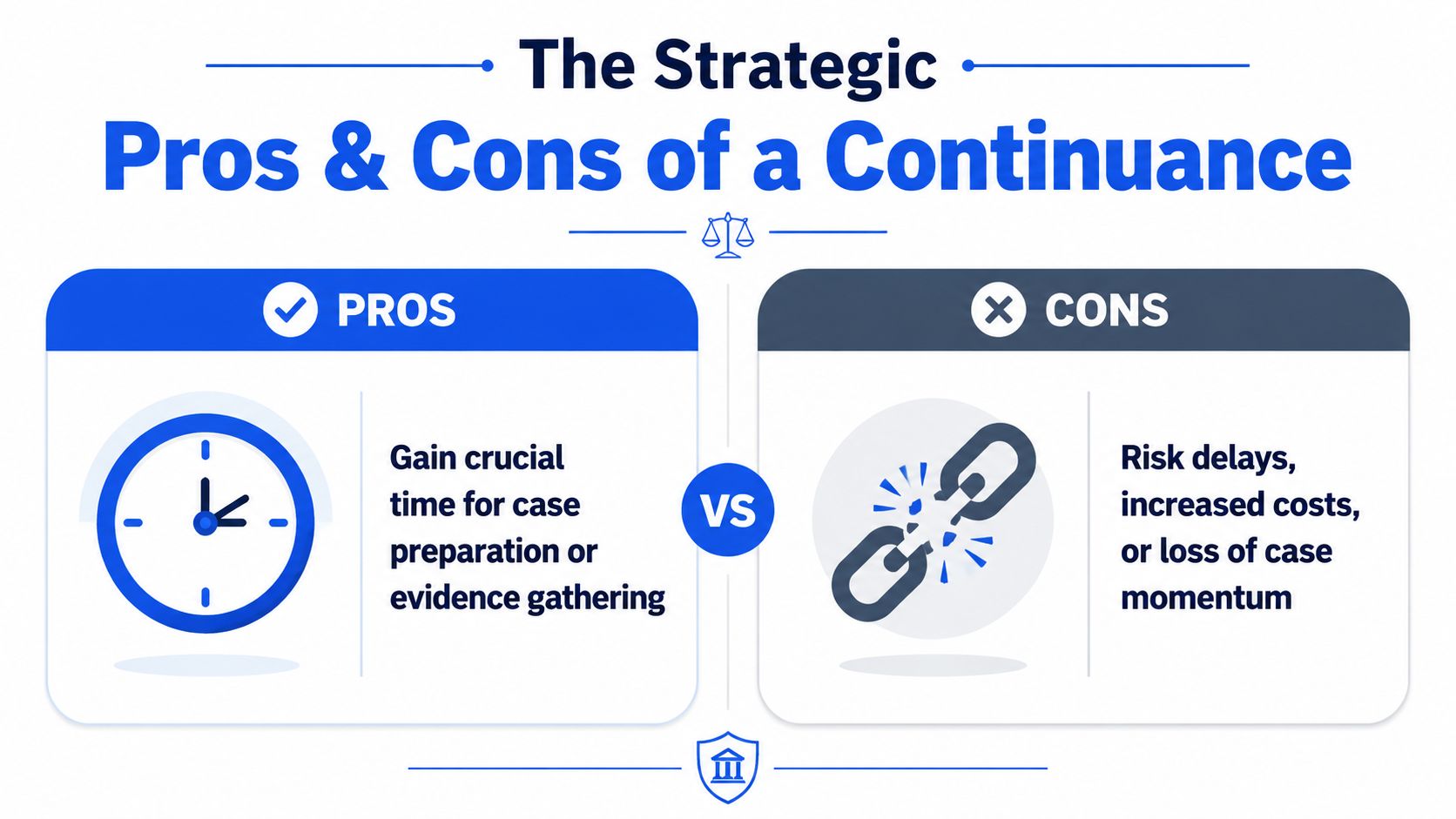
In criminal cases, including Florida DUI and traffic matters, defense motions for continuance succeed 55 to 65 percent of the time when tied to discovery delays or counsel conflicts, based on NCSC continuance policy analyses across 500+ jurisdictions. That should tell you two things. First, continuances can work. Second, they fail often enough that you should not file one casually.
When extra time helps your defense
Time can create an advantage.
A proper delay may give you or your lawyer time to review body camera footage, subpoena records, evaluate officer notes, or address witness problems. In some cases, it also changes the practical posture of the hearing. Rescheduled hearings can create opportunities the defense did not have on the original date.
A continuance can also stop a driver from making a desperate mistake. Pleading too early because you feel trapped is one of the fastest ways to lock in avoidable damage.
Here's the hard truth. A rushed case usually benefits the state, not you.
When a delay can hurt you
There are risks.
One is momentum. If you ask for time and then waste it, you've gained nothing. Another is judicial patience. Judges notice patterns. Weak requests make later requests harder.
There is also the speedy trial issue in criminal matters. You should never assume that asking for a delay is consequence-free. In a DUI prosecution under Florida Statute 316.193, a continuance can affect timing rights and litigation strategy in ways many drivers do not understand.
If you're going to ask for a continuance, make it count. Don't burn that request on a problem that should have been handled earlier.
If you're still deciding whether to fight the case or just resolve it, this breakdown of paying a ticket versus hiring a lawyer helps frame the bigger decision.
Continuance Request DIY vs Ticket Shield Attorney
Factor | Handling It Yourself | Using a Ticket Shield Attorney |
|---|---|---|
Stating good cause | You may describe the problem loosely or incompletely | The request is framed as a legal basis, not a personal excuse |
Timing | Easy to file too late | Deadlines and court setting issues are tracked strategically |
Documents | Missing attachments can sink the motion | Supporting records are gathered and submitted correctly |
Court expectations | You may not know what your judge wants to see | The motion is tailored to actual courtroom practice |
Risk to your case | A denial can leave you unprepared and exposed | The delay is requested as part of a defense plan |
The issue isn't whether you can ask. It's whether you know how to ask without weakening your position.
How Do You Request a Continuance in Florida?
You request a continuance by filing a Motion for Continuance with the court. In many cases, that means a written filing with the clerk, proper notice to the other side, and enough detail to show good cause.

That sounds manageable until you try it. Then the traps start. Wrong county procedure. Missing certificate of service. Bad timing. No supporting documents. No clear explanation. Any of those can derail the request.
If you're trying to understand the self-help version first, this article on legal advice for self-represented continuance requests offers useful perspective on the risks and basics.
Immediate Steps to Take
If your Florida court date is approaching, do these things now:
Read the notice carefully. Confirm the exact court, case number, and hearing date.
Identify your reason. It must be specific, legitimate, and connected to case preparation or a real emergency.
Gather proof. Medical records, scheduling documentation, or evidence-related support may matter.
File before the hearing date. Last-minute filings are harder to win and easier to reject.
Notify the proper parties. Court procedure matters. Informal notice is not enough.
Assume nothing. Until a judge grants the motion, you are still expected to appear.
For Florida-specific guidance, this page on how to ask for a continuance in court is worth reviewing.
Why virtual filing raises the stakes
Florida courts have expanded remote options, and that helps busy drivers. But remote access hasn't made continuances foolproof. It has exposed more mistakes.
According to the verified data, Florida Supreme Court Administrative Order AOSC23-25, extended for 2026, mandates Zoom options for traffic dockets in major counties, but Hillsborough County data from Q1 2026 showed a 28 percent denial rate for virtual motions filed by individuals, often due to unverified emergencies or improper document uploads, as summarized in this discussion of continuances and remote motion issues.
That matters if your case is set near the Orange County Courthouse or Broward County Judicial Complex and you think remote filing makes the process easy. It doesn't. It just changes the failure points.
This short video helps explain the motion side of the process:
A continuance in court is still a legal request. Technology does not forgive bad paperwork.
What Happens After Your Continuance Is Granted?
A granted continuance is not a win by itself. It is an opening.
The court will issue a new date. That new date becomes your next hard deadline. If the continuance was granted so you could hire a lawyer, do it immediately. If it was granted so evidence could be gathered, that work should start at once.
Many drivers squander the advantage in these situations. They relax because the hearing moved. Then the new date arrives, and nothing meaningful has been done.
What you should do with the extra time
Use the reset the way a serious defense uses it:
Lock in counsel quickly
Collect records and evidence
Address witness issues
Review exposure under Chapter 316
Prepare for the next setting, not the last one
If you ignore the new deadline, you may end up in worse shape than before. The judge already gave you time. You usually won't get much sympathy for squandering it.
The real value of a continuance is what you do after the court grants it.
If you're worried about what happens when a court date goes wrong entirely, read this explanation of what happens if you miss a court date. It shows why timing and follow-through matter so much.
If you're facing a Florida traffic or DUI case, don't trust your record to an automated app, a ticket mill, or a chatbot that can't stand beside you in court. Ticket Shield, PLLC is a lawyer-led Florida defense firm where you speak directly to your attorney by phone or text. If your goal is No Points, protect that goal now. Visit TicketShield.com for a free consultation.