Palm Beach County Traffic Ticket: Act in 30 Days
Palm Beach County traffic ticket guidance for 2026: 30-day options, clerk rules, points, late fees, and a path aimed at no points on your license.

A Palm Beach County civil traffic citation generally requires one of four choices within 30 calendar days. Paying the fine is a conviction, with points assessed when the violation carries them.
You may be holding the paper ticket while the clerk's website rejects your citation number. Or you've already paid an overdue balance and still don't know whether you can legally drive. Don't confuse a successful payment with a protected license. Identify the citation, choose the right response, and verify any suspension separately.
Table of Contents
What Your Palm Beach County Traffic Ticket Can Cost You
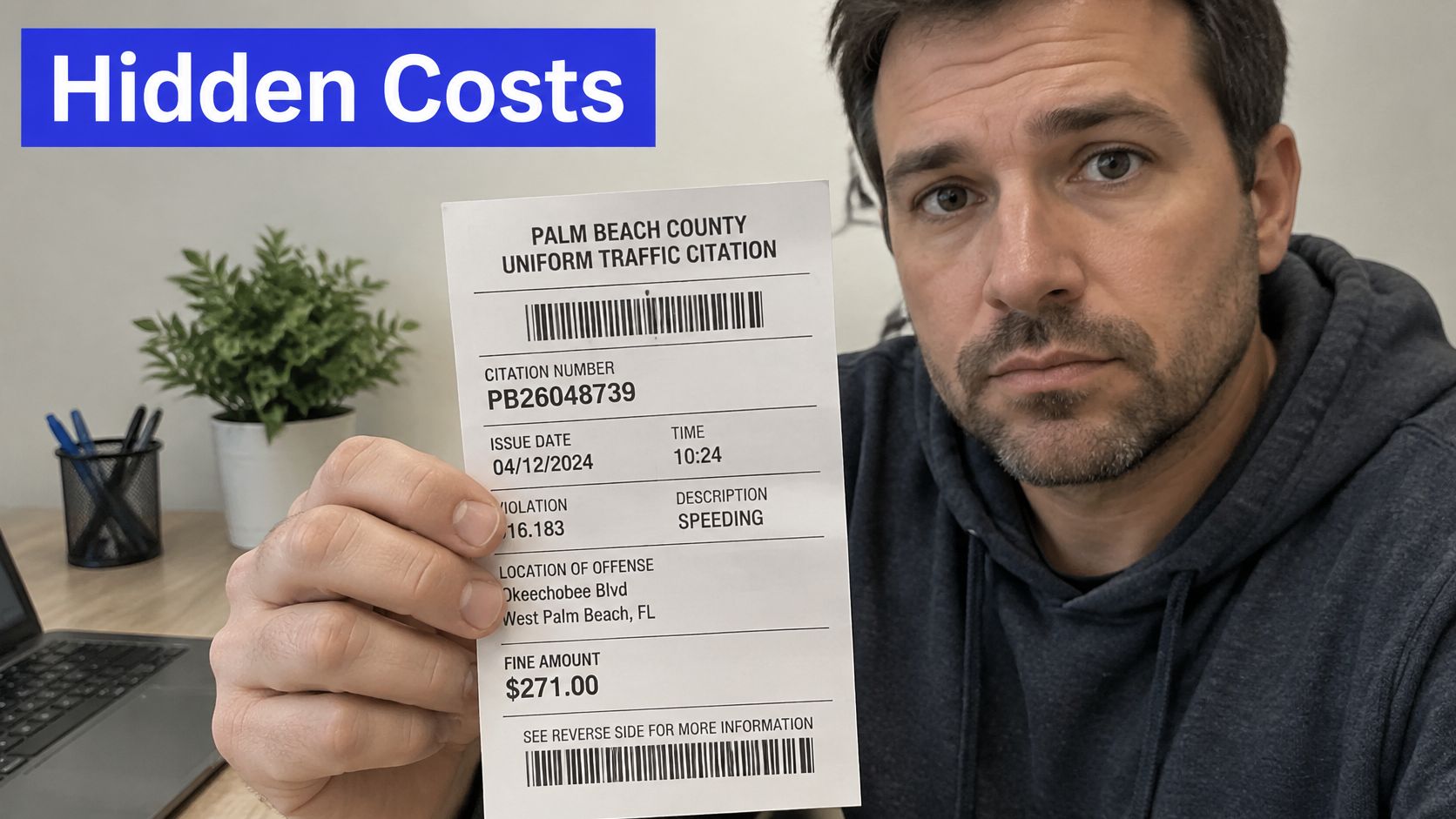
The citation in your hand shows an amount due. It doesn't tell you the full cost of accepting the charge. Before you reach for a credit card, separate the court balance, the driving record, and the license consequence.
The Florida Department of Highway Safety and Motor Vehicles traffic-citation guide states that paying a civil penalty is treated as a conviction, with points assessed when applicable. That makes payment a legal decision, not just an administrative task. A conviction can also matter when an insurer reviews your driving history, though no responsible advisor can promise a particular premium outcome.
Know Which Office Controls the Problem
Different offices perform different jobs. Sending money to one doesn't automatically resolve an obligation controlled by another.
The Palm Beach County Clerk processes your election, payment, and traffic-school notice.
The county court in the Fifteenth Judicial Circuit handles contested county traffic matters and court-directed proceedings.
FLHSMV maintains your licensing record and administers license consequences.
Keep your paper citation, citation number, and every notice together. Don't rely on a reminder or assume that a website lookup tells you everything about the case.
For a broader cost comparison, use our Florida traffic-ticket cost guide before deciding whether immediate payment makes financial sense. If you're also dealing with an insurance lapse, ThriveXDNA's resource to find coverage after an insurance lapse can help you address that separate coverage issue. Insurance shopping does not resolve a citation or reinstate a license.
At Ticket Shield, PLLC, we're a lawyer-led Florida traffic defense firm. We approach your Palm Beach County traffic ticket as a record and license decision first, rather than treating the payment button as the default answer.
Four Responses Due Within 30 Calendar Days
The Palm Beach County Clerk's traffic-ticket instructions generally require you to select a response within 30 calendar days and warn that newly issued citations can take up to five business days to appear online. An unavailable case is not permission to ignore the paper citation.
Your election should match your actual objective. Paying closes a balance through an admission. School is a conditional option for eligible drivers. A no-hearing plea asks the court to resolve the case without a contested hearing. A not-guilty election preserves a contest.
Four Palm Beach County responses inside 30 days
Response | What it means | Timing | Main risk |
|---|---|---|---|
Pay the civil penalty | Conviction; points if the violation carries them | Within 30 calendar days | Points and insurance review |
Elect driver improvement school | Eligible election can withhold adjudication | Elect within 30 days and finish by the court deadline | Missed course can still add points or suspend |
Plead guilty or no contest, no hearing | Admission without a contest | Within 30 calendar days | Conviction and points unless the disposition provides otherwise |
Plead not guilty | Contest before the county court | Within 30 calendar days | No response can suspend the license and send the case toward collections |
Make the Election Before Buying the Course
Enrolling with a course provider is not the same as electing school with the clerk. The administrative steps matter as much as completing the lessons.
If you choose school, confirm eligibility, submit the election, and pay the required citation and election-related charges. Then complete the approved course by the court's deadline. Keep the election confirmation and completion certificate, and confirm that the clerk received the completion.
Don't assume a provider's confirmation email proves the court has updated your case. If the court record still shows an outstanding requirement, contact the clerk with your documents.
Deadline rule: A missing online record doesn't erase the citation in your hand. Preserve your proof and resolve the lookup problem without abandoning the response deadline.
Understand What You're Admitting
A guilty or no-contest plea without a hearing is not a factual defense. You're asking for a disposition without requiring a contested presentation of the allegation. Don't select that route because it sounds less serious than payment.
Likewise, a not-guilty election is not the final outcome. It starts a process that requires you to monitor notices and comply with court instructions. You still need to prepare for the scheduled event.
Use these checks before submitting anything:
Want to contest the allegation? Preserve the hearing route rather than making an inconsistent payment.
Considering school? Verify your license classification and election history first.
Already facing a suspension? Treat license status as a separate issue requiring confirmation.
Unable to find the ticket? Save the failed-lookup details and contact the clerk.
Choosing nothing is the weakest option. The clerk warns that failure to act can lead to suspension and collection referral. Make a deliberate election and retain proof that it was accepted.
Florida Point Totals That Can Suspend You
Your existing record can make an otherwise manageable ticket dangerous. The FLHSMV points and suspensions guide sets suspension thresholds at 12 points within 12 months, 18 points within 18 months, and 24 points within 36 months, and states that conviction points remain on the record for at least five years from disposition.
Don't look only at the new citation. Review the underlying violations, disposition dates, pending cases, and any existing suspension. The age of a record entry and its relevance to a suspension calculation are different questions.
Florida point totals and school limits
Item | Rule | Result |
|---|---|---|
12 points | Within 12 months | 30-day suspension |
18 points | Within 18 months | Three-month suspension |
24 points | Within 36 months | One-year suspension |
Conviction points | From disposition | Stay on the record at least five years |
Ordinary moving violation | Typical assessment for standard speeding and other qualifying violations | 3 points |
More than 50 mph over under 316.183(2), 316.187, or 316.189 | Section 316.1926 moving violation | 4 points under the cited point classification |
Basic driver improvement course | Once every 12 months and eight lifetime elections | Points withheld only if every requirement is met |
Commercial driver license | School election | Cannot be used to avoid points |
The speed classifications in the table require an exact statutory review, not a guess based on the ticket's description. Don't assume every moving violation carries the same assessment.
School Eligibility Is Not Automatic
The FLHSMV driving-record questions guide limits school elections to once within a 12-month period and eight lifetime elections and states that Florida commercial driver-license holders cannot use school to avoid points, even for a citation received in a noncommercial vehicle.
That commercial-license restriction matters even when you were driving your own car. Your license classification doesn't change because you weren't working during the stop.
For eligible noncriminal moving violations, an approved election can result in withheld adjudication and no assessed points when all requirements are satisfied. But eligibility alone doesn't finish the process. Payment, notice to the issuing clerk, and course completion still need attention.
Review the Whole Record Before Choosing
Use our Florida license-suspension point guide to understand what to examine. Bring the actual driving record to your attorney, not a recollection that your last ticket was a while ago.
Your review should include:
Pending citations. A case that hasn't reached disposition may still affect your strategy.
Previous school elections. Confirm the record rather than relying on memory.
License classification. Identify any commercial credential immediately.
Existing restrictions. A separate suspension needs its own resolution.
A clean payment receipt won't explain whether accepting the new violation was wise. Make that assessment before the clerk processes your election.
Chapter 316 Speed Rules Printed on the Ticket
A Palm Beach County speeding citation identifies the statute the officer says you violated. Florida Statute section 316.187 concerns speed limits on state roads. Section 316.183 addresses unlawful speed, and section 316.189 addresses municipal and county speed limits. Read the complete statute and subsection on your citation before deciding what the allegation means. The Florida traffic laws guide provides broader context.
Florida Statute section 316.1926 classifies exceeding the applicable limit by more than 50 miles per hour under sections 316.183(2), 316.187, or 316.189 as a moving violation punishable under Chapter 318. Standard speeding generally carries 3 points; the specified excessive-speed classification carries 4 points, according to Florida's points classification.
The statute and alleged speed matter. A points total alone does not establish whether the citation requires a court appearance or can be paid.
Compare the Allegation With the Citation
A citation alleging seventy-two in a fifty-five zone alleges seventeen over the limit. One alleging one hundred ten in that same zone alleges fifty-five over.
Those allegations are different. The second calls for review of the exact charge and court instructions before you try to pay. Don't infer the full legal exposure from the points number alone.
Record the key details:
Statute. Copy the complete section and subsection.
Speed. Note the alleged speed and posted limit.
Location. Record the road, direction, and nearest relevant intersection.
Court instruction. Check whether the citation requires an appearance.
Description. Compare the written offense with the statute listed.
Preserve Evidence Without Guessing
If you dispute the posted limit, photograph the sign and its location safely. Keep the original files. A close-up without location context may not show which limit applied where the officer says the violation occurred.
If you dispute the alleged speed, tell your attorney what happened without inventing a technical explanation. Review may include the officer's observations, measurement method, supporting records, and whether the reading connects to your vehicle. A disagreement alone is not evidence.
A points classification is only one part of the review. Read the charge and court instruction before deciding what to do.
Citations the Palm Beach Payment Site Will Reject
A failed payment isn't always a website malfunction. The Palm Beach County Clerk's online-payment eligibility page excludes driving-under-suspension citations, proof-of-compliance citations, toll citations, criminal traffic citations, mandatory-court citations, improper-equipment citations, unresolved not-guilty cases, collection cases, and financial-obligation suspensions from ordinary online payment.
Identify the category before trying another card. Repeated payment attempts don't supply missing proof, satisfy a court appearance, or establish that your license is valid.
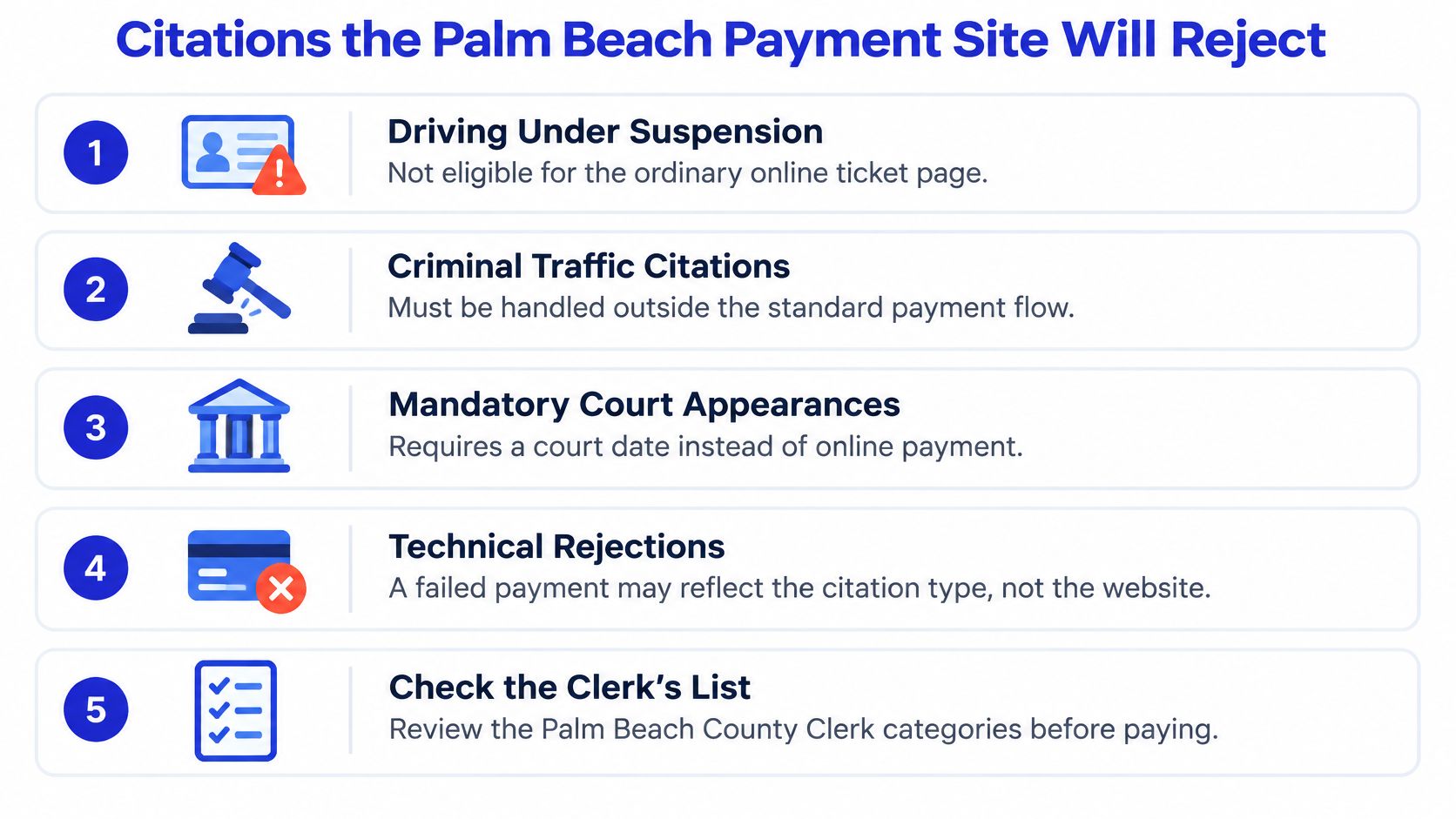
Palm Beach citations the online payment page will not take
Category | Why payment is blocked | Next step |
|---|---|---|
Driving under suspension | Not a simple civil checkout | Clerk or court plus a separate license check |
Proof of compliance | Documents control the case | File the required proof |
Toll citation | Not handled as an ordinary civil ticket payment | Follow the toll instruction on the notice |
Criminal traffic citation | Court process, not civil checkout | Address it in court; don't force a web payment |
Mandatory-court citation | A hearing is required | Court date or counsel, not a prepaid plea |
Improper equipment | Compliance may be the issue | Correct the defect and confirm the required proof process |
Unresolved not-guilty case | A contest is already open | Stay with the court case |
Collection case | Excluded from ordinary online payment | Use the collection path the clerk identifies |
Financial-obligation suspension | Ticket payment may not restore driving | Clear the suspension requirements and verify license status |
Match the Rejection to the Required Action
Start with the citation itself. Look for an offense description, a mandatory-appearance instruction, a compliance requirement, or a reference to another agency. Then compare that information with the clerk's case record.
A proof-of-compliance matter calls for the specific document the court or clerk requires. An equipment matter may require correction and documentation. Don't assume a repair receipt automatically satisfies the case without confirming how to submit it.
For a toll notice, follow the named agency's instructions. For a collection case, ask the clerk which collection process applies and how the court record will reflect compliance.
Preserve Your Open Court Case
If you've entered a not-guilty plea, don't make an unrelated payment attempt to get the matter off your screen. Ask how the payment would affect the pending contest before authorizing it.
A mandatory-court or criminal traffic citation requires attention to the court process. A payment error is not an extension of the appearance requirement.
Newly relocated drivers should be particularly careful about assuming that every Florida citation is a prepaid fine. Florida's classification controls the response, regardless of what you expected when you opened the notice.
Save the rejection message, case number, and any written clerk instructions. Ask which office controls the unresolved requirement. The clerk can explain the case-processing route; FLHSMV controls the license-status question.
Pre-Payment Screen and Where to File
Don't start with checkout. Start with a yes-or-no screening process that tells you where the citation belongs. Keep the ticket beside your driving record and any court notice so you're comparing documents, not assumptions.
Use this screen before submitting a plea, payment, or school election.
Answer Each Question Before You Submit
Is the citation number correct? Compare every character with the paper ticket. If the record isn't available, retain the ticket and contact the clerk rather than abandoning the response.
Are you still within the response window? If yes, choose the appropriate election. If no, use the clerk's past-due procedure and ask about the current case status.
Does the citation require court? If yes, follow the notice and arrange representation or attendance as required. Don't substitute an online payment attempt.
Does the charge or alleged speed require legal review? If the statute, speed, or offense description raises a serious classification question, stop and have an attorney review the actual document.
Is the citation excluded from ordinary online payment? If yes, follow the category-specific route. Don't try to bypass the restriction with another portal.
Are you eligible for the school election? Confirm your election history and license classification. If eligibility is uncertain, resolve that uncertainty before paying for a course.
Could the disposition threaten your license? Review your record, pending matters, and current status. If there's a suspension, identify its specific basis.
Do you have proof of the action you're about to take? Save the accepted election, receipt, filed document, or court confirmation. A draft form is not a completed filing.
Use the Office That Controls Your Task
Your courthouse assignment comes from the notice, not the courthouse closest to your home. Confirm the location and filing instructions before traveling.
Palm Beach County offices by task
Office | Use it for |
|---|---|
Palm Beach County Clerk of the Circuit Court traffic portal | Payment, school election, no-hearing plea |
Main Judicial Center, West Palm Beach | Not-guilty hearings in county traffic cases, as assigned |
North County Courthouse, Palm Beach Gardens | Courtroom named on the notice |
South County Courthouse, Delray Beach | Courtroom named on the notice |
West County Courthouse, Belle Glade | Courtroom named on the notice |
Florida Department of Highway Safety and Motor Vehicles | License status and points |
Bring the citation, photo identification, and any required proof of compliance when appearing in person. Keep copies of what you submit. If you're mailing or electronically filing documents, preserve the transmission or delivery record.
The clerk processes elections and filings but doesn't act as your defense attorney. Questions about whether to admit the charge, contest the facts, or seek a particular disposition require a legal assessment.
Use our Florida traffic-ticket payment guide to understand payment mechanics only after you've decided that payment is the right legal choice. Convenience should come after classification, not before it.
If you've moved since the citation, confirm how the court will send notices and update your contact information through the required process. Missing a notice because you assumed the court had your current address is an avoidable risk.
Late Fees, Collections and License Status
An overdue Palm Beach County traffic ticket requires more than a balance inquiry. You need to establish the case status, select an available resolution, satisfy the documentation requirements, and verify your driving privilege separately.
The Palm Beach County Clerk's past-due ticket instructions state that after 30 days, the required late amount is $23, consisting of a $16 late fee and $7 compliance-letter fee. The clerk also lists a $25 payment-plan setup fee, with continuing monthly payments required until fines and costs are paid.

Establish What Happened After the Deadline
Delinquency, possible suspension, and collection referral are related risks, not proof that every overdue case follows an identical automatic sequence. Ask the clerk what has happened in your case.
Your questions should be specific:
Case status. Is the citation overdue, referred to collections, or subject to another outstanding requirement?
Suspension reporting. Has this case produced a suspension notice or compliance issue?
Available response. Can you pay, establish a plan, elect eligible school, enter a conditional no-contest plea, or request a hearing?
Required documentation. What must be submitted, and how will compliance be recorded?
Don't assume that paying the late amount alone completes an election. Confirm which action the clerk expects in addition to the added charges.
A Payment Plan Needs Active Management
A plan can make the balance manageable, but it creates continuing obligations. Save the agreement and place each due date on your calendar. Confirm how payments are credited and what happens if a payment is missed.
If the case is already in collections, use the process identified for that case. Don't send money through an unrelated payment route and assume someone will reconcile it before the next deadline.
Keep your receipt, confirmation number, and any compliance letter together. If a payment is disputed or doesn't appear in the case record, those documents give you something concrete to submit.
Before you drive: A zero ticket balance is not the same document as confirmation of valid driving privileges.
Verify the License Independently
A financial-obligation suspension may require action beyond paying a particular citation. Identify every outstanding requirement with the agency that controls it. Ask what compliance or reinstatement step remains and how completion will be reflected in the licensing record.
After the clerk posts the payment or other resolution, check your status with FLHSMV. Review the driving record when necessary to understand the basis for a remaining restriction.
If your license still shows suspended, don't drive on the assumption that the system will catch up. Resolve the discrepancy and confirm lawful status first. The objective is not merely to close a balance. It's to restore your ability to drive legally.
How to Contest in the Fifteenth Judicial Circuit
Contest a citation for a reason. The alleged speed may be overstated, the statute may not fit the facts, school may be unavailable, or the proposed conviction may create unacceptable license exposure. A required court appearance also demands a deliberate court strategy, although appearing in court and contesting guilt are separate decisions.

Preserve the Contest and Prepare the Evidence
Keep the original citation. Record the statute, location, alleged conduct, and any appearance instruction. Preserve related notices rather than replacing them with handwritten summaries.
Submit the appropriate election. Use the clerk's required procedure for a not-guilty response. If the case is already overdue, confirm whether and how a hearing request remains available.
Avoid inconsistent action. Don't pay the civil penalty while pursuing a contest without understanding the effect on your plea. Tell your attorney about any payment or election already submitted.
Monitor the court notice. Confirm the courthouse, courtroom, event type, and appearance requirements. Don't assume the hearing will occur where the officer issued the ticket.
Gather narrow, relevant proof. Preserve photographs of disputed signs, location information, and any equipment or compliance documents. Give your attorney originals or clear copies with the context needed to understand them.
Evaluate the available disposition. A hearing is not the only possible resolution. Ask whether an eligible conditional plea or another lawful disposition can protect your record.
The Florida state court system's Summer 2024 publication reports that the Fifteenth Judicial Circuit closed more than 7,698 civil traffic cases from January 2021 through July 2024 through its Civil Traffic Conditional Plea Program. That establishes an actual resolution process, not a guarantee that your case qualifies or will receive a particular result.
Know Who Will Handle the Court Event
At Ticket Shield, PLLC, a licensed attorney handles your case from start to finish. We've handled thousands of Florida traffic cases, and you can communicate directly with your attorney by phone or text.
That distinction matters when a notice changes, a document raises a question, or you need to understand a proposed plea. An automated app can collect information. A chatbot or middleman cannot replace your attorney's explanation of what a disposition means for your record.
Our traffic-ticket defense is designed so clients don't have to go to court. Your attorney must still confirm what the particular case requires. Don't skip an appearance until you've received clear instructions about who will cover it and whether your presence is required.
Judge the Proposed Outcome Carefully
Ask what happens to adjudication, points, fines, costs, and any remaining conditions. Get clear about what you must do after the court event.
A negotiated result is only useful if you understand and satisfy it. Keep the final disposition and confirm that the court record reflects the outcome entered. When license status is involved, verify the licensing record as well.
Request a Case Review Aimed at No Points
A Palm Beach County citation can affect your license, court obligations, and driving record. If the payment site rejects your ticket or your license still shows a financial-obligation suspension after you pay, get the case reviewed before taking another step. Paying a late balance does not by itself confirm that the suspension is cleared.
Put the Citation in an Attorney's Hands
Call (561) 821-6189 to have your case reviewed. Traffic ticket defense attorneys start at $39.99. Ticket Shield, PLLC is a Florida traffic-defense firm that represents drivers statewide, and a licensed attorney handles each case from start to finish.
For local representation information, read this guide to traffic-ticket lawyers in West Palm Beach. You can communicate with your attorney by phone or text, rather than relying on an automated app or a middleman to explain your options.
Send the complete citation and any suspension or court notice. Include details about prior elections, payments, and upcoming appearances so the attorney can assess the case as it stands.
No Points is a goal, not a promised result. Your options depend on the charge, your record, the evidence, and what the court permits.
Call (561) 821-6189 to have your ticket case reviewed and discuss how to fight points, fines, and license risks.