Orlando DUI Defense Lawyer: What to Do First
An Orlando DUI defense lawyer can protect the 10-day license window, challenge testing under Florida law, and fight points and a record. Free consult.

An Orlando DUI arrest starts a separate license case with about 10 days to act, and waiting for your criminal court date doesn't protect your license. You're likely holding release paperwork right now, trying to work out how you'll get to work tomorrow and whether that paper permit is real. It is real, but it's short. Treat this as two cases from the first hour, not one case with a court date later.
Table of Contents
Two Clocks After an Orlando DUI Arrest
You're pulled over in Orlando, arrested, and released with a stack of paperwork you didn't ask for. That paperwork starts two cases that don't share a calendar. One can move quickly and take your driving privilege while the other is still waiting for a courtroom date.
What starts after an Orlando DUI arrest
Track | When the clock starts | What you must do | What is at stake |
|---|---|---|---|
Administrative license case | Arrest and notice, often with a 10-day temporary permit | Request a Bureau of Administrative Reviews hearing before the permit window closes | Suspension tied to unlawful alcohol level, refusal, or prior DUI history |
Criminal prosecution | Charging decision and court dates, separate from the license case | Answer the charge and preserve challenges to the stop, arrest, and testing | Fines, jail exposure, and a criminal record under Florida Statute 316.193 |
Refusal allegation | The refusal after a lawful arrest, alongside any criminal charge | Treat the refusal as its own license issue, not as the same event as a high test result | A license suspension that can exist even without a conviction |
Hardship and device stage | After the applicable suspension rules and any conviction requirements | Complete DUI school and any required proof, then apply to FLHSMV | Restricted driving versus staying off the road |
The License Clock Moves First
The administrative row is your urgent problem. The Florida administrative suspension report describes how drivers may receive a 10-day temporary driving permit and must act quickly on administrative-suspension rights, with that case distinct from the court prosecution. Don't treat those 10 days as thinking time. They're filing time.
That hearing isn't criminal court. It's a Bureau of Administrative Reviews proceeding through the Florida Highway Safety and Motor Vehicles system, and it tests whether the suspension paperwork and evidence support the action. Florida distinguishes suspensions based on unlawful alcohol level, refusal, and prior DUI history, so your notice category changes what counsel attacks first.
Practical rule: A hearing request doesn't guarantee relief. It forces the state to show its statutory requirements and supporting evidence are sufficient.
The Criminal Clock Runs on Court Dates
Your criminal case follows charging, arraignment, and evidence motions. Orange County criminal matters move through the local court system, including the Orange County Courthouse in Orlando. That judge doesn't pause your administrative suspension while discovery is pending, and a continuance in court doesn't extend your permit.
The refusal row needs separate handling. If the state claims you refused testing after a lawful arrest, that allegation can drive a suspension on its own track. A high breath number and a refusal aren't interchangeable facts, and your lawyer shouldn't let the file blur them.
The hardship row comes later. You can't skip ahead to restricted driving on day one just because you need your car for work. Eligibility, school, and any device requirement have their own sequence, and driving before you're authorized creates a new problem on top of the first one.
Write Down Three Facts Today
Before you call anyone, write these where you won't lose them:
Arrest date: The date on the arrest paperwork, not the date you got home.
Permit expiration: The last day your temporary permit authorizes driving.
Test or refusal: Whether the notice alleges a breath or blood result, a refusal, or both.
Those three facts decide what an Orlando DUI defense lawyer files first. Bring them to the first conversation. If you can't answer them, send the paperwork itself and let counsel read the notice language directly.
Florida DUI Penalty Ranges Under Section 316.193
Florida DUI penalty bands under section 316.193
Charge posture | Fine | Jail exposure | Mandatory jail stated |
|---|---|---|---|
First conviction | $500 to $1,000 | Up to 6 months | None stated |
First conviction, BAL 0.15 or higher or minor present | $1,000 to $2,000 | Up to 9 months | None stated beyond the fine increase |
Second conviction | $1,000 to $2,000 | Up to 9 months | At least 10 days if within 5 years, with at least 48 consecutive hours |
Second conviction, BAL 0.15 or higher or minor present | $2,000 to $4,000 | Up to 12 months | At least 10 days if within 5 years, with at least 48 consecutive hours |
Third conviction within 10 years | $2,000 to $5,000 | Up to 5 years in state prison as a third-degree felony | At least 30 days, with at least 48 consecutive hours |
Read Your Row in Three Questions
Don't start with the fine. Start with posture. The FLHSMV summary of Florida DUI administrative suspension laws states that under Florida Statute §316.193, a first DUI conviction generally carries a fine of $500 to $1,000 and up to 6 months in jail, while a second conviction carries a $1,000 to $2,000 fine and up to 9 months in jail.
Question one is whether the state alleges a first, second, or later conviction. Question two is whether it alleges a blood or breath alcohol level of 0.15 or higher or a minor in the vehicle. Question three is whether a prior conviction falls inside the timing window that triggers mandatory jail.
Those answers move you between rows. A first conviction at the standard level sits in the $500 to $1,000 band. Add the 0.15 or higher allegation or a minor, and the first-conviction fine rises to $1,000 to $2,000 and the jail ceiling climbs with it. The same aggravating facts on a second conviction raise the fine to $2,000 to $4,000.
Prior Timing Changes the Jail Floor
Mandatory jail is about the calendar, not just the count of priors. A second DUI within 5 years of a prior conviction requires at least 10 days of imprisonment, with at least 48 hours served consecutively. That means you can't assume a judge can waive the floor because your job or family situation is difficult.
A third DUI within 10 years moves the case into felony territory and requires at least 30 days, again with at least 48 consecutive hours. Your lawyer has to verify the prior conviction dates the state intends to use. A wrong date, an uncounseled prior, or a record that doesn't match you can change which floor applies, and challenging prior convictions is exactly how repeat DUI cases get reduced.
Don't match yourself to the lowest row because it feels less frightening. Match yourself to the row the charging paperwork actually alleges, then make the state prove it.
The Criminal Table Is Only One of Your Two Clocks
Everything in that table belongs to the criminal case under §316.193. It runs on court dates, and it moves slowly. Your license clock doesn't wait for it. By applying for and using a Florida driver license, you're deemed to consent to an approved chemical test after a lawful DUI arrest, and a refusal creates a separate suspension issue that proceeds on its own track regardless of where the criminal case stands.
That's why early review has to cover the arrest timeline, testing procedures, charging decision, and prior-record allegations together. Our guide to first-time DUI penalties in Florida can help you frame questions, but it doesn't replace reading your actual notice. Carry your row from the table into every conversation about negotiation, because a plea that looks acceptable on fines may still leave mandatory jail or a suspension untouched.
The Ten Day License Hearing Window
Treat your temporary permit as a short bridge, not permission to wait for court. You may have about 10 days of driving authority after arrest, and the administrative case runs separately from the criminal prosecution. If you spend that window hoping the court date will sort it out, you'll lose the chance to contest the suspension on time.

Work the Sequence in Order
Read the notice today: Mark the permit expiration in your phone and on paper.
Identify the allegation: Confirm whether it's an unlawful alcohol level, a refusal, or a suspension tied to prior history.
Request the hearing: File for the Bureau of Administrative Reviews hearing before the window closes.
Gather hearing evidence: Collect the stop, arrest, and testing materials the hearing can test.
For first-time DUI clients, we move quickly to request the DMV hearing and prepare challenges to the traffic stop and testing procedures. That speed matters because evidence requests, officer paperwork, and hearing preparation all compete for the same short window. Our overview of the administrative license suspension hearing process outlines what that separate proceeding involves.
Requesting the hearing doesn't guarantee you keep driving. The hearing asks whether the statutory requirements and supporting evidence are sufficient. Counsel prepares from week one as if the state will have to defend the stop, the arrest basis, and the test or refusal allegation with documents, not assumptions.
Protect Your Real Life While Both Cases Run
Use work, school, medical care, and insurance as your decision frame. Tell your lawyer if your job requires driving, if you're the only driver at home, or if a suspension would trigger an employer reporting duty. Those facts don't change the statute, but they change the urgency of hardship planning and the risks you can't afford to take.
If you live out of state or just moved to Florida, verify your Florida driving privilege directly. Don't assume another license answers a Florida suspension. Your privilege to drive in Florida can be suspended even when you're confused about which credential controls, and driving on that assumption can compound the charge.
Orange County context also matters for preparation. Florida Department of Health data for Orange County report 1,523,866 residents and 155 alcohol-confirmed motor-vehicle-crash injuries in one reported year, equivalent to 10.2 injuries per 100,000 residents. Those figures describe injury events, not your guilt or innocence, but they show why Orlando cases can involve crash investigation records, toxicology, and medical documentation that counsel must be ready to test.
Keep every license fact separate from your courthouse dates. Put permit papers in one folder and criminal court notices in another. When you call, say which folder you're reading from.
How Testing and the Stop Get Challenged
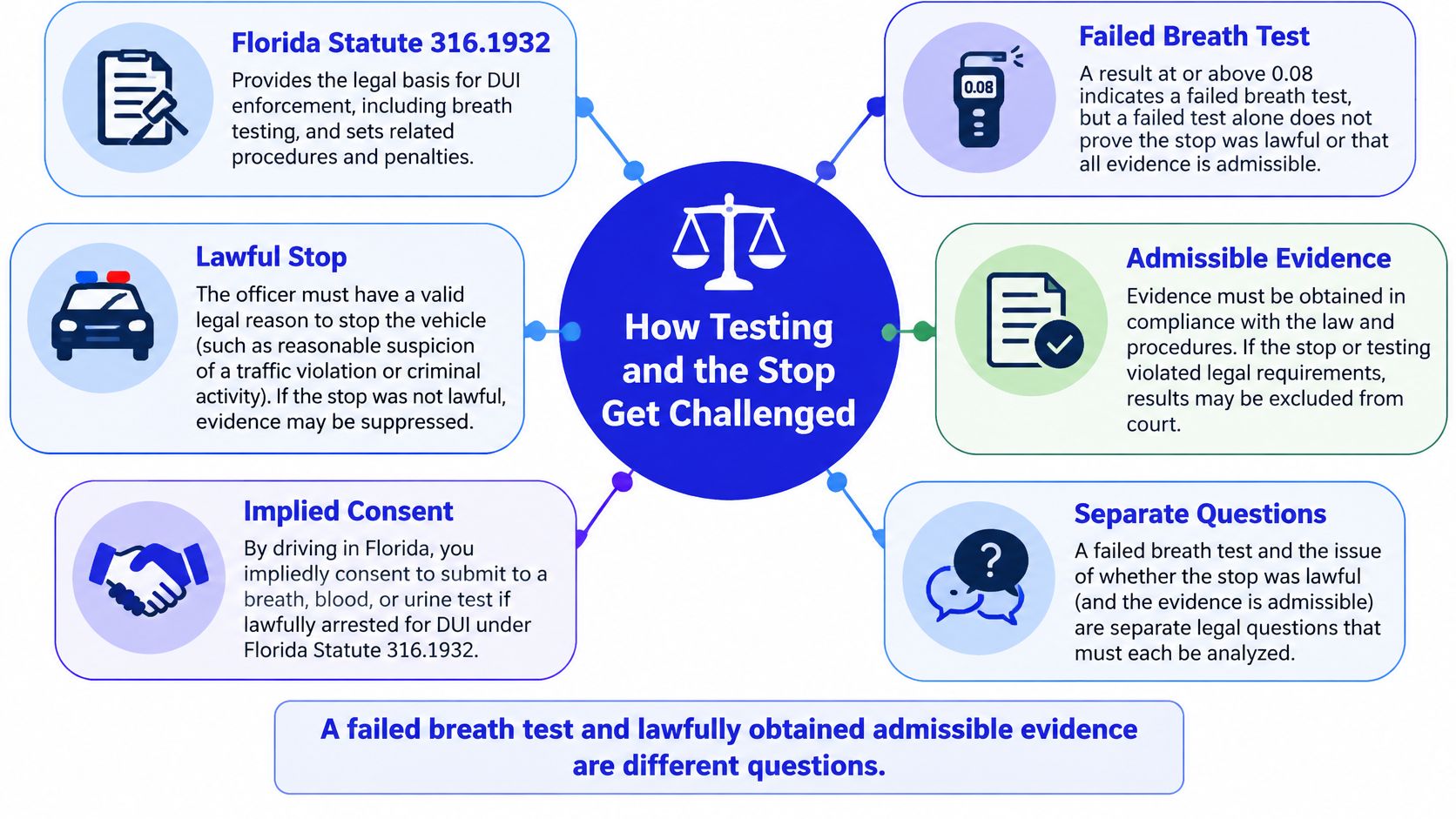
A failed breath test and lawfully obtained admissible evidence are different questions. A number on a printout doesn't answer whether the stop was lawful, whether the arrest was supported, or whether the test followed required procedures. Your defense starts by separating those questions and forcing the state to prove each link.
The concept map below shows how those issues connect in the review order.
What Section 316.1932 Requires
Under Florida Statute §316.1932, implied consent applies when a person lawfully operates a vehicle in the state, but a breath test must be incidental to a lawful arrest and requested by an officer with reasonable cause to believe the person drove or had actual physical control while impaired. If the arrest lacked lawful grounds, or the test wasn't properly connected to that arrest and reasonable-cause determination, the defense may challenge admissibility or evidentiary weight.
That's a cause-and-effect chain. Break an early link and the later result is exposed. An Orlando DUI defense lawyer shouldn't treat the breath result as independently conclusive before testing the legality and sequence that produced it.
Build the File Counsel Actually Reviews
Ask for the complete record early. The file should include body-camera footage, dispatch records, the arrest affidavit, field-sobriety documentation, and the complete breath-test sequence. If a document is missing, that gap itself becomes part of the review.
Driving pattern: What did the officer observe before the stop, and does video match it?
Roadside observations: Do odor, speech, balance, and standardized-test performance support reasonable cause at that moment?
Test foundation: Can the state show an approved instrument, complete operational records, maintenance documentation, and proper operator procedures?
Compare stated observations against the timeline. Officers sometimes write conclusions first and details second. Counsel reads the other way, from the first driving observation forward, and checks whether each escalation was justified when it happened. Our page on breathalyzer test accuracy and challenges explains why instrument and procedure records matter to that analysis.
This video is a useful starting point before you discuss your specific test sequence with counsel.
Negotiation Sits Beside the Evidence Fight
Strong challenges can support negotiation, but they don't guarantee a particular outcome. We negotiate with prosecutors for reductions or dismissals in first-time DUI cases, and for first-time clients we focus on preventing a permanent criminal record and minimizing collateral consequences. That includes employment, licensing, insurance, and background-check concerns you should raise before any plea discussion.
A repeat allegation adds another job. Counsel should challenge the prior-conviction proof rather than assume an enhancement is automatic. The review order stays consistent either way: lawful stop, lawful arrest, reasonable cause, approved test, complete records. If the state can't carry that order cleanly, you have something real to litigate or negotiate from.
From Suspension to a Hardship License
Can you legally drive between arrest, suspension, conviction, hardship eligibility, and device installation? That's the question duration charts usually skip. The answer changes at each stage, and guessing wrong can turn a suspension problem into a new criminal problem.
The checklist below lays out the stage order from arrest to restricted driving.

Ignition interlock periods in Florida DUI cases
Conviction posture | Aggravating fact | Minimum IID period |
|---|---|---|
First conviction | BAL 0.15 or higher, or a minor in the vehicle | At least 6 months |
Second conviction | None stated beyond the second conviction | At least 1 year |
Second conviction | BAL 0.15 or higher, or a minor in the vehicle | At least 2 years |
Four or more convictions | Tied to a hardship license | At least 5 years |
Read the Device Table With the Official Guidance
Florida's official ignition interlock program guidance requires an ignition interlock device for specified DUI convictions, including at least six months for a first conviction involving a BAL of 0.15 or higher or a minor in the vehicle and at least one year for a second conviction. A second conviction with those aggravating factors requires at least two years, and four or more convictions tied to a hardship license require at least five years.
A first conviction generally also requires DUI school and an application to FLHSMV for a possible hardship reinstatement. Later convictions can add restrictions and supervision requirements. Don't treat school enrollment, school completion, and hardship approval as the same event. They're separate proof points.
One Orlando Example in Stage Order
Say you're arrested in Orlando on a first DUI allegation with a claimed 0.15 result. The license hearing decision comes first because your permit window is shortest. DUI school and any required treatment documentation then support the hardship path, and the device, if required after conviction, becomes a prerequisite for restricted driving rather than a courthouse accessory.
We advise first-time DUI clients on completing DUI school and community service efficiently and seek hardship licenses so clients can keep driving to work. Our guide to the Florida hardship license process can help you prepare the documents counsel will ask for.
An interlock device isn't just a sentencing add-on. Noncompliance can jeopardize the driving privilege the device was meant to restore.
Ask before you drive an employer vehicle or a rental. Your restricted privilege and device duty may not travel the way you assume. Finish with a status check: current license status, school proof, device proof, and whether the vehicle you drive is covered.
What Direct Lawyer Contact Changes
You don't need a call center right now. You need a lawyer who can act on the license filing and the criminal charge without making you repeat your permit date to a rotating cast of intake staff. That distinction sounds administrative until your window is closing and nobody can tell you whether your hearing was requested.
This is what a direct consultation with your Orlando DUI defense lawyer should look like.

Lawyer Led Means You Reach the Lawyer
Ticket Shield, PLLC is a lawyer-led Florida firm where a licensed attorney handles your case directly from start to finish. You can speak with that attorney by phone or text. We've handled thousands of Florida traffic cases, and that experience only helps you if the attorney on the file is reachable when a deadline or document question appears.
Contrast that with automated apps and ticket mills. They rely on chatbots, corporate answering services, and middlemen between you and counsel. You upload paperwork, get a generic status message, and wait. In a DUI case, waiting isn't neutral. It can be the difference between a timely hearing request and a closed window.
Three Practical Things Access Changes
Direct contact isn't a luxury feature. It changes daily decisions:
Permit date reported same day: You text a photo of the notice and counsel calculates the filing deadline immediately.
Refusal or number clarified fast: You learn whether the state is alleging a test result, a refusal, or both.
Next date identified correctly: You know whether the upcoming date is administrative, criminal, or a compliance deadline.
Those answers shape whether you drive, what you tell your employer, and what evidence gets requested first. Read our explanation of what a DUI lawyer does at each stage and compare it against any provider who can't give you a written plan for both tracks.
Set Realistic Expectations on Appearances
Don't expect that you'll never appear. Counsel can appear for clients in many Florida traffic cases, but a DUI isn't a routine citation, and a crash involving death or serious bodily injury is a different case entirely. Anyone who promises you'll have no obligations before reading your charge isn't being careful with you.
Judge a provider on three things. Can you reach the attorney directly? Will they move inside the 10-day window? Can they show you a plan covering the hearing, the evidence challenge, and the court case in Orlando? If the answer is vague on any of those, keep looking while you still have time.
No Points Starts Before the Permit Window Closes
Arraignment is not the first deadline. In an Orlando DUI case, the administrative license clock runs on 10 days while the criminal case under Florida Statute 316.193 builds toward court. Have three items ready now: your arrest date, your permit deadline, and your charge paperwork. A missed filing stays missed even if the criminal case is just getting started.
Send the actual notice, not a summary. The wording controls the first move: alleged refusal, breath number, prior suspension, crash involvement. An Orlando DUI defense lawyer reads that language, requests the DMV hearing inside the window, and starts challenges to the stop and testing before the state's version hardens.
At Ticket Shield, PLLC, you speak with your Florida attorney by phone or text, so the notice, deadline, and next filing go straight to counsel. For a first-offense DUI, the work is practical: request the hearing, prepare challenges to the traffic stop and testing procedures, negotiate for a reduction or dismissal when the facts support it, advise on DUI school and community service, and pursue a hardship license so you can keep driving to work.
Don't pay, plead, or drive on assumptions. Protect the license case while the window is open. Protect the criminal case before the state locks in its version. Reach your Ticket Shield attorney by phone or text today and send the notice so the review starts while both clocks still give you options.