Florida Hardship License: A Step-by-Step Guide for Drivers
Learn how to qualify for a Florida hardship license, the documents you need, timelines, and common pitfalls, so you can get back on the road legally.

You're staring at a suspension notice, checking your work schedule, and wondering how you'll get to work, medical appointments, school, or family obligations. Don't start by downloading a generic application. Start by identifying why Florida suspended your license, when the suspension became effective, and what limited driving privilege, if any, the law allows.
A Florida hardship license isn't a normal license restored by request. It's a restricted privilege tied to a documented need. The correct strategy is to work backward from the legal deadline, gather proof that matches the restriction you need, and avoid driving until FLHSMV confirms exactly what you're allowed to do.
Table of Contents
The Moment Your License Is Suspended in Florida
The first mistake is treating every suspension as the same problem. Florida uses different procedures for point-based suspensions, school-related suspensions involving minors, and administrative suspensions tied to compliance issues. Each category can create a different eligibility rule, filing process, or deadline.
Pull out the suspension notice and the official driver record. Confirm the effective date, the stated reason, and any case or citation information. If you can't find the notice, use this guide to check whether your license is suspended in Florida, then obtain the official record before filing anything.
Identify the suspension category first
For a point-based suspension, FLHSMV directs the driver to the local Bureau of Administrative Reviews office. The agency requires proof of an Advanced Driver Improvement course and payment of the reinstatement fee, along with any applicable license fees. The resulting restricted privilege generally covers employment or business driving, not unrestricted personal travel. FLHSMV's point-suspension guidance explains the administrative path and the later process for full reinstatement.
Other suspensions require a different analysis. FLHSMV expressly states that a suspension based on child-support delinquency can't be considered for a hardship license. That rule makes the underlying category decisive. A compelling need to drive won't cure an ineligible suspension.
Florida law also contains a school-attendance pathway for certain minors. Under Florida Statutes §322.091, the minor or parent generally has 15 calendar days after receiving the notice of intent to suspend to request a hardship-waiver hearing. The school official must notify FLHSMV within 24 hours, and the hearing must occur within 30 calendar days after the request.
Practical rule: Don't calculate your filing date from memory. Calculate it from the notice you received and preserve proof of when you received it.
Chapter 316 is Florida's statutory framework for state traffic control and motor-vehicle operation. The Legislature's Chapter 316 index identifies the chapter as Title XXIII's “Motor Vehicles” and “State Uniform Traffic Control.” Your traffic matter should be matched to the specific Chapter 316 provision involved, not treated as though one universal suspension rule applies to every driver.
What the Law Says About Hardship Eligibility
A Florida hardship license is a restricted privilege tied to a documented need, not an automatic restoration. Under Florida Statutes §322.271, you must show a serious hardship, explain how the suspension prevents you from performing a normal business occupation, trade, or employment, and establish that driving is necessary to support you or your family.
The requested privilege must match the transportation you need. A business-purpose restriction may cover commuting, required driving during work, education, church, and medical appointments. An employment-purpose restriction is narrower. It generally covers travel to and from work and driving required by your employer or occupation.
Match your evidence to the privilege
Build your application around specific trips, duties, and deadlines. A statement that you “need a license” gives the hearing officer little to evaluate. Provide an employment schedule, job duties, medical records, school obligations, or a detailed explanation of your family-support responsibilities. Each document should connect your requested driving privilege to the statutory hardship standard.
A hardship approval also carries the conditions attached to your existing license type. It does not remove other licensing requirements or permit trips outside the listed purpose. Read the issued restriction before driving, and keep the approval documents with you.
The process is administrative and individualized. A person whose license has been suspended, canceled, or revoked may request a hearing under the statute. Historically, the process has included a Department of Highway Safety and Motor Vehicles hearing, with legislative analysis describing a hearing within 30 days after a qualifying request. That analysis also identified a $12 hardship-hearing filing fee, separate from reinstatement fees, course costs, and other penalties.
DUI suspensions can follow different eligibility rules and timelines from ordinary suspensions. Identify the suspension category first, then work backward from every statutory deadline, hearing date, and required document. Filing on the wrong timeline can leave a strong hardship explanation unusable.
The hardship license authorizes defined transportation needs. Read its limits before you drive.
Before filing, verify three points:
Eligibility: Confirm that your suspension category can be considered for hardship relief. Child-support-delinquency suspensions are specifically excluded.
Proof: Document the employment, family-support, educational, or medical need that makes restricted driving necessary.
Remaining conditions: Address courses, fees, insurance, additional suspensions, and clearance requirements attached to your record.
For a practical review of the filing requirements, read Florida hardship-license requirements. Eligibility depends on the statute, your suspension category, and proof that fits the privilege you are requesting. Frustration alone will not satisfy that standard.
Suspensions by Category
The suspension category controls the remedy. A point-based suspension, a school-related minor suspension, a child-support-delinquency suspension, and a DUI-related suspension do not follow one universal hardship process. Identify every active sanction before preparing an application, then work backward from the controlling deadline, hearing date, course requirement, and clearance condition.
Overlapping suspensions create the most dangerous filing problem. An approval tied to one sanction may not remove another active suspension, so a restricted privilege may still be unavailable or narrower than expected. Review the complete driver record, match each hold to its legal requirement, and address unresolved sanctions in the same plan. A DUI suspension also requires separate attention because its eligibility rules and timeline can differ from an ordinary point suspension.
A hardship request must connect documented need to the specific driving privilege requested. Employment, family employment, education, or medical need should be supported by records that show why the trip is necessary and why the requested restriction fits that need. A general statement that driving is difficult does not resolve an unaddressed suspension, missing course, unpaid fee, insurance issue, or clearance problem.
Suspension type | First action | Key timing or condition | Driving privilege |
|---|---|---|---|
Point-based suspension | Complete the required Advanced Driver Improvement course and contact the Bureau of Administrative Reviews | Full reinstatement follows expiration of the suspension and payment of required fees | Generally limited to employment or business purposes |
School-related minor suspension | Request the hardship-waiver hearing after receiving the notice | Request generally due within 15 calendar days | Must be tied to employment, family employment, or medical hardship |
Child-support-delinquency suspension | Resolve the underlying compliance issue | Not eligible for hardship consideration under FLHSMV guidance | No hardship privilege through this pathway |
Additional or unresolved suspension | Obtain clearance and identify every active sanction | Timing depends on the separate suspension | One approval may not clear the entire record |
Out-of-state point suspension | Send the required documentation and fee to the Bureau of Motorist Compliance | Allow 10 business days for processing | Depends on record clearance and satisfaction of the underlying requirements |
The limited privilege matters after approval. It generally covers employment or business driving, not unrestricted errands, recreation, or personal travel. Once the suspension period expires, full reinstatement requires the applicable proof and fees through a Florida driver-license service center.
If an arrest or court-related matter is involved, release conditions and bond remain separate issues. Information about Forsyth County bail costs may help with that question, but it does not establish eligibility for a Florida hardship license.
Build the application around the strictest active requirement. Filing a persuasive hardship explanation before completing the controlling course, hearing, fee, or clearance requirement can still produce a denial.
Documents, Forms, and the Filing Sequence
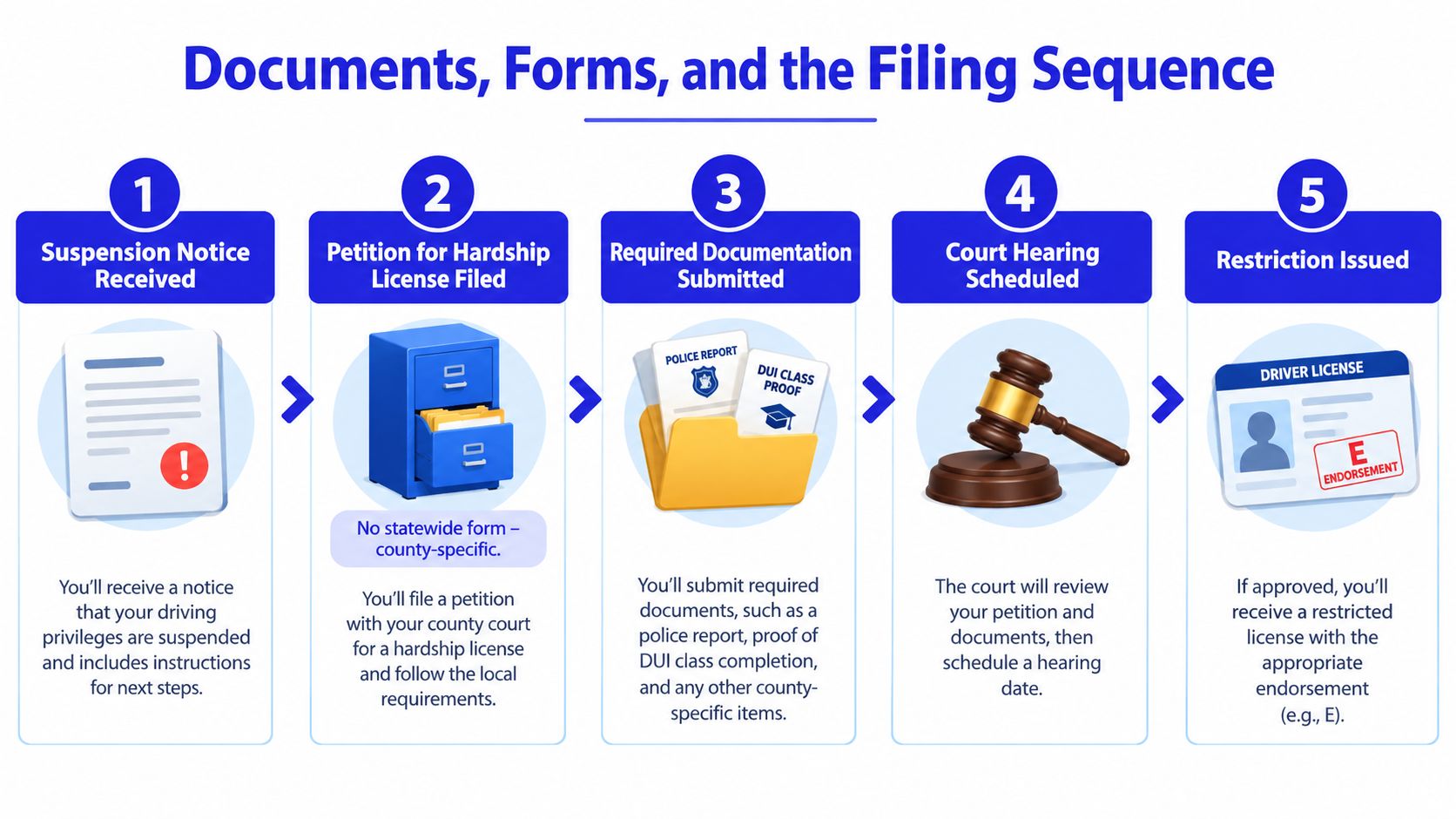
Treat the application as a proof package, not a single form. Begin with the suspension notice and the official driver record. Those documents identify the sanction, reveal additional holds, and show whether the restriction you want matches the category of suspension.
Florida's process can require different documents depending on the case. There isn't one universal hardship form that resolves every situation. Ask the appropriate office which petition or local filing format applies before submitting an incomplete packet.
Build the packet around the legal reason
Gather documents that prove both eligibility and need:
Suspension notice and driver record: Confirm the effective date, suspension type, and any additional sanctions.
Course documentation: Point-based applicants may need proof of completing an Advanced Driver Improvement course.
Identity and license records: Bring the documents requested by the reviewing office and verify that the license record is accurate.
Employment and support proof: Use an employer letter, schedule, job description, pay documentation, or other records that explain why driving is necessary.
Medical, school, or family records: Include only documents that directly support the hardship asserted.
Payment records: Account for the $12 hardship-hearing filing fee and separate reinstatement fees where applicable.
The filing order matters. Obtain the record, classify the suspension, complete any required course, collect supporting proof, request the administrative review, pay the required fees, and confirm the restriction issued. Don't drive merely because you submitted an application. Wait until the privilege is formally granted and read its terms.
For point suspensions, FLHSMV identifies the Bureau of Administrative Reviews as the administrative contact. Out-of-state residents may submit documentation and fees to the Bureau of Motorist Compliance. A local driver-license service center handles later reinstatement after the suspension period expires. Use this Florida hardship-license application guide to organize the sequence before you contact an office.
The video below provides additional process context.
Keep copies of every submission, receipt, notice, and issued restriction. If an office says a document is missing, you'll need to show what you submitted and when.
Common Pitfalls That Get Applications Denied
A genuine transportation need does not guarantee approval. Denials often follow from a mismatch between the suspension record, the evidence submitted, and the limited driving privilege requested. Treat a hardship license as purpose-limited permission, not a general restoration of driving rights.
DUI-related suspensions follow different timelines and requirements from ordinary point or administrative suspensions. Do not apply the ordinary checklist to a DUI case. Identify the controlling deadline first, then work backward to complete the required steps and assemble proof before the review. A separate suspension or unresolved clearance can still block the privilege you seek.

Errors that create avoidable problems
Submitting outdated medical records: Old treatment notes may not show your current condition, appointment schedule, or transportation need. Request records that directly support the hardship you claim.
Using a vague employer letter: “The employee needs a license” is not enough. The letter should identify your job, work location, schedule, duties, and why public transportation or another driver does not solve the problem.
Requesting the wrong restriction type: Business-purpose driving and employment-purpose driving are different. Choose the restriction that matches your actual trips, and make the supporting documents match it.
Treating every suspension as interchangeable: Review the official record for separate suspensions, DUI requirements, and clearances. One approval may not resolve every barrier on your license.
Ignoring the approved privilege's limits: A hardship license may permit specific trips only. Asking for broader use than the record supports can weaken the application and create compliance problems later.
Submit consistent records, focused letters, and a restriction request tied to specific trips. Read every notice carefully, attend the assigned review, and answer questions with the same facts shown in your documents.
Drive only within the restriction issued. A hardship license grants limited permission, not unrestricted driving.
Why a Lawyer-Led Defense Changes the Outcome
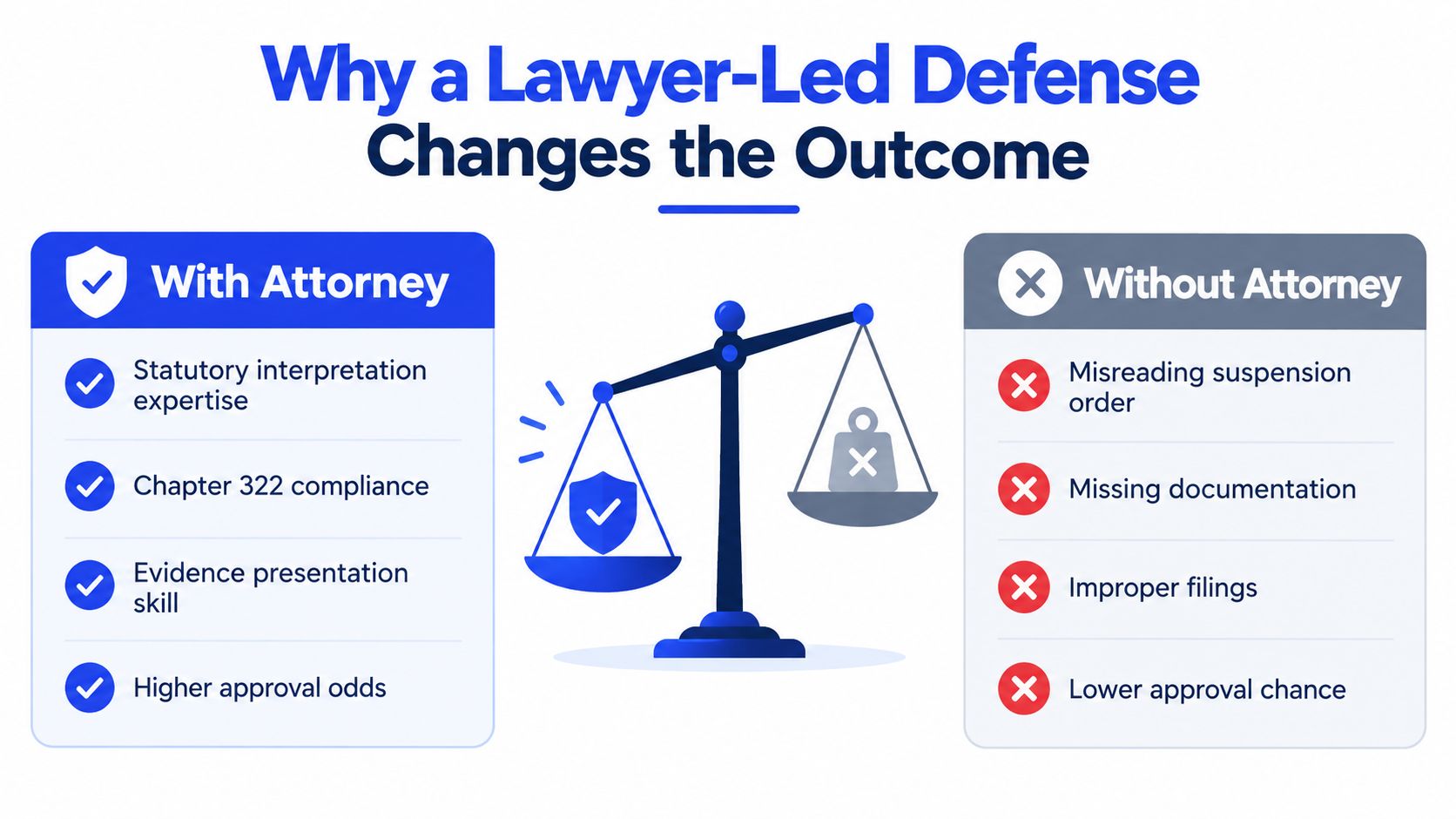
A hardship license is purpose-limited permission, not a general return to driving. A lawyer first determines which suspension controls, what privilege Florida law allows, and whether separate requirements must be completed before filing. That review prevents an application built on the wrong category or deadline.
A self-filer may read one suspension notice and assume it explains the entire record. An attorney compares the notice with the official driving history. For example, the record may show an overlapping suspension, an unresolved clearance, or a separate DUI-related requirement. A hardship application cannot erase those barriers, and DUI timelines must be analyzed separately from ordinary suspension eligibility.
A lawyer changes the evidence, not just the paperwork
Employment proof often fails because it says only that a driver needs a license. A lawyer reframes the evidence around the permitted purpose: job location, required schedule, specific duties, and trips that cannot reasonably be completed by public transportation or another driver. The request then matches the restriction and the facts supporting it.
The same analysis applies to the filing date. If a statutory review period is running, the attorney works backward from that deadline, allowing time to obtain records, complete required steps, correct inconsistencies, and submit the proper request. Filing quickly is not a strategy if the wrong privilege or missing clearance guarantees rejection.
A lawyer can also advise against filing. If the suspension is excluded, a DUI condition remains unresolved, or another approval must come first, submitting an application may waste time and fees. The goal is an application the record and law can support.
For help reviewing a suspended license and the available next step, see Ticket Shield's suspended-license lawyer service. Ticket Shield, PLLC describes a lawyer-led model that allows clients to communicate with an attorney by phone or text, which can matter when a notice changes the record or a deadline approaches.
Take the Next Step Toward Driving Again
You need a controlled plan, not a hopeful guess. Start with the suspension notice and certified driving record. Identify the reason for the suspension, the effective date, every active hold, and the restricted privilege that fits your actual transportation needs.
For your intake call, gather:
The suspension notice and driver record.
Your work schedule and a letter describing required driving.
Medical, school, or family-support documentation.
Course completion or enrollment records when required.
Notices of pending hearings, court dates, or clearance obligations.
Proof of fees or other payments already made.
Within the next 72 hours, request the official record from FLHSMV, identify any required course, and stop driving until you confirm that a valid privilege exists. FLHSMV's guidance makes clear that a pending application isn't the same as an issued restriction. Don't risk turning a manageable licensing problem into a separate criminal matter under Florida law.
Work backward from the deadline
If the suspension involves a minor's school attendance, calendar the 15-calendar-day request period immediately. Preserve the notice and proof of receipt. If the suspension is point-based, confirm the Advanced Driver Improvement requirement and contact the Bureau of Administrative Reviews. If another suspension category applies, identify its separate eligibility rules before you submit a petition.
Your request should answer four questions clearly:
Why was the license suspended?
What legal pathway applies?
What exact driving do you need to perform?
What documents prove that need?
Don't assume a business-purpose restriction allows every personal trip. Don't assume an employment-purpose restriction covers school, medical, or family travel. Don't assume one approval clears unrelated suspensions. Read the written restriction and ask for clarification before you drive.
Submit your records through Ticket Shield's case submission page so an attorney can review the suspension category, deadlines, and available strategy. The purpose of that review is not to sell you a form. It's to determine whether the filing is eligible, what proof is missing, and how to protect your driving record while pursuing relief.
Ticket Shield, PLLC provides direct, lawyer-led help for Florida drivers facing suspended licenses, with communication by phone or text instead of middlemen or automated chatbots. Visit Ticket Shield, PLLC for a free consultation focused on resolving the underlying traffic issue and achieving “No Points” on your license.