Florida Hardship License Requirements: 2026 Guide
Learn the Florida hardship license requirements for 2026. Get step-by-step guidance on eligibility, forms, and reinstatement to get back on the road.

A Florida hardship license may become available after a point suspension of 30 days, three months, or one year, depending on the points and time period involved. It isn't a full license, and you must prove serious hardship, complete required steps, and wait through the applicable suspension period before restricted driving can be approved.
You may be sitting at home right now, looking at a suspension notice and calculating how many workdays you can miss before your job is at risk. You may also be assuming that a job offer, a completed form, or a trip to the local Administrative Reviews Office will solve the problem. That assumption can cost you more time.
A hardship license is not a get-out-of-jail-free card. It is a strictly limited privilege tied to documented employment or business necessity. Under Florida Statute § 322.271, you must show that the suspension creates a serious hardship, prevents you from carrying out normal business, trade, or employment, and makes restricted driving necessary to support you or your family. Florida Statute § 322.271 provides the governing hardship standard.
Florida's traffic-law framework sits within Chapter 316, Florida Statutes, the State Uniform Traffic Control chapter in Title XXIII, Motor Vehicles. That chapter supplies the statutory foundation for traffic-control rules and licensing consequences that can lead to suspension and restricted-driving issues. Chapter 316 of the Florida Statutes should be part of any serious review of a Florida license problem.
Table of Contents
Understanding Florida Statutory Grounds and Point Suspensions
The Hidden Barriers to Approval, Out-of-State and Additional Holds
Why You Need a Strategic Approach to Your Hardship License
A suspension can threaten your job before you ever reach an Administrative Reviews Office. If you respond by rushing in with an incomplete form, a vague explanation, or a general statement that you need to drive, you may turn a real hardship into an avoidable denial. The hearing officer is not deciding whether driving would make life easier. The officer is deciding whether your evidence meets a legal standard.
Under Florida Statute § 322.271, you must show a serious hardship that prevents you from carrying out normal business, trade, or employment and makes restricted driving necessary to support you or your family. Florida Statute § 322.271 provides the governing standard. “I need my car” does not establish that record. Tie the suspension to specific work duties, transportation failures, and the consequences for your household.
Treat the application as a legal case
The Florida Department of Highway Safety and Motor Vehicles and its Administrative Reviews Offices apply eligibility rules to restricted-license requests. Your suspension reason controls the applicable waiting period, review path, and supporting record. Point suspensions require careful attention to the suspension notice and driver record, not assumptions based on memory. Florida's point-suspension guidance is available from FLHSMV.
Build a timeline before filing. Identify the effective suspension date, confirm whether the waiting period has passed, and check whether the state has recorded every required step. Review the record for additional holds, unresolved matters, or out-of-state information that could block issuance. An application can fail before the officer weighs your hardship if the underlying record is incomplete.
Chapter 316, Florida Statutes, the State Uniform Traffic Control chapter in Title XXIII, supplies the statutory foundation for traffic-control rules and licensing consequences. Chapter 316 of the Florida Statutes belongs in any serious review of a Florida license problem.
Practical rule: Do not enter an Administrative Reviews Office with a story and a folder of guesses. Bring a documented eligibility theory, supporting proof, and a plan for every apparent problem in the record.
Ticket Shield, PLLC handles these matters through lawyer-led representation rather than an automated application service. Clients communicate directly with an attorney by phone or text, which can matter when a deadline, prior suspension, conflicting record, or out-of-state hold changes the correct strategy.
The specific compliance gates, including ADI school timing, fees, and related documentation, belong in the next section. Here, keep the priority clear: eligibility must be established before the hardship narrative can succeed. A persuasive hardship explanation cannot cure an unresolved administrative barrier.
Understanding Florida Statutory Grounds and Point Suspensions
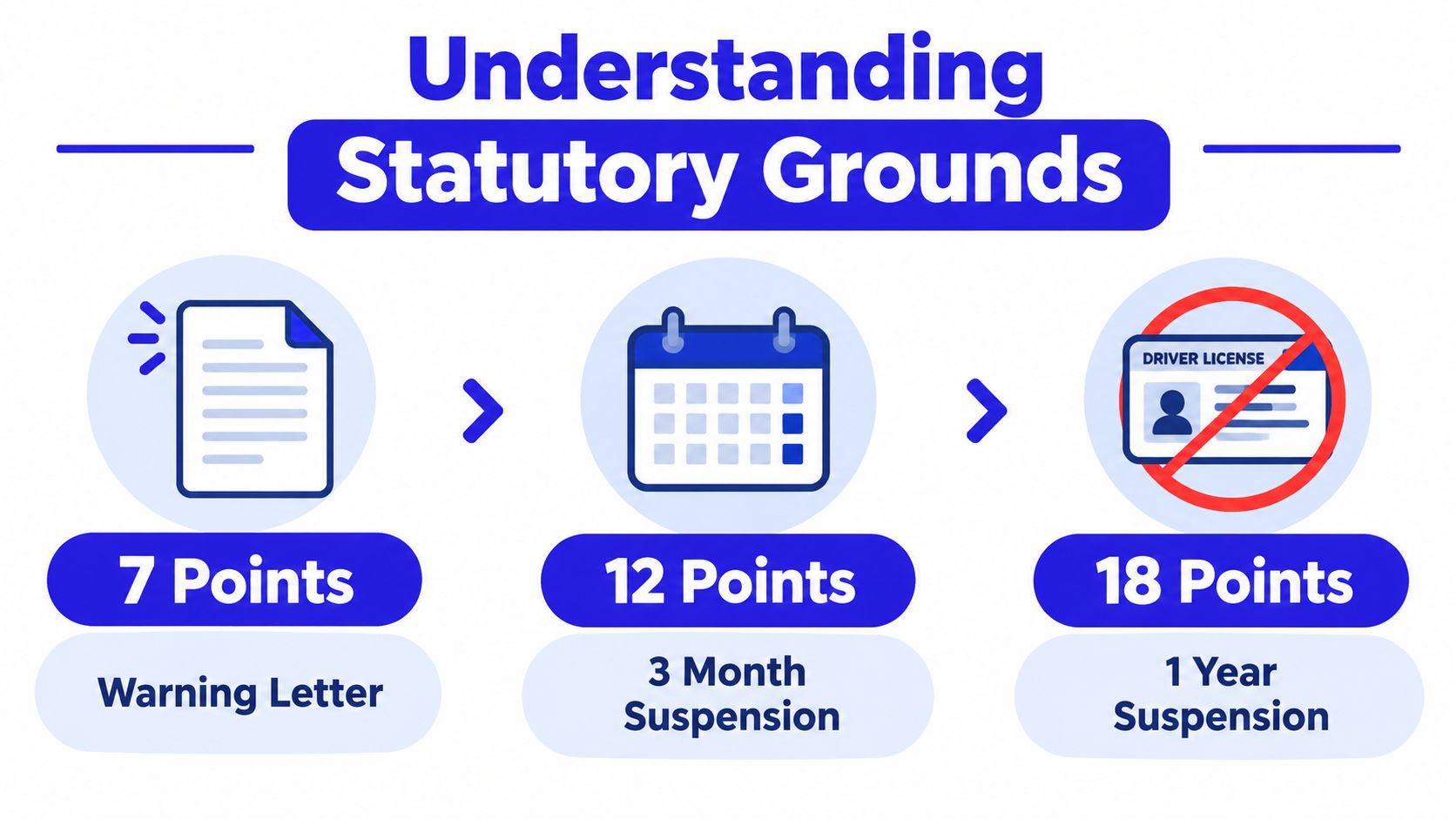
A suspension notice can look straightforward and still produce the wrong hardship-license strategy. Florida's point system measures both the number of convictions and the period in which they accumulate. The statutory thresholds are:
12 points within 12 months: a 30-day suspension.
18 points within 18 months: a three-month suspension.
24 points within 36 months: a one-year suspension.
These thresholds and periods appear in Florida's official point-suspension guidance. Check the suspension notice and your FLHSMV driver record. Do not calculate eligibility from memory or from the dates printed on traffic tickets.
The date problem causes avoidable denials. A driver with 12 points from tickets issued 13 months apart may assume the 30-day rule cannot apply. FLHSMV counts the relevant period from conviction dates, not citation dates alone. If those convictions fall within the statutory window, the suspension can trigger even when the ticket dates appear outside it. One wrong date can send you into the wrong waiting period and application plan.
Why the waiting period controls your plan
The suspension category determines what relief may be available and when you can request it through a local Administrative Reviews Office. Treat the waiting period as a hard planning constraint. Filing before the record supports eligibility wastes time and can create another denial.
A hardship request seeks restricted driving authority, not cancellation of the suspension. Your evidence must connect the requested driving privileges to employment or business needs and address the statutory basis for relief. Vague hardship statements do not fix an incorrect point calculation or an unresolved record issue.
Review Florida driver license points and suspension exposure to identify the likely trigger, then verify every date against the official record. A lawyer-led review can expose timing errors, conviction-date discrepancies, and procedural traps before you submit an application.
Required Forms, Documentation, and ADI Compliance
The paperwork stage is where many applicants lose control of the process. Don't begin by filling out whatever form appears first in a search result. Begin by building a compliance file that proves eligibility, rehabilitation, and necessity.
Your first priority is the ADI school requirement. For many suspension types, Florida requires proof that you completed an Advanced Driver Improvement course before it will issue a hardship license. The course isn't something to handle after approval. It can be a gating condition that keeps you ineligible while the suspension is active. FLHSMV's guidance on other suspensions and revocations confirms the importance of course completion and reinstatement compliance.
Build the file before requesting relief
Organize your records in a way that lets an officer verify each requirement without reconstructing your case. Keep the following together:
Suspension records: Include the notice, effective date, reason for suspension, and any correspondence from FLHSMV.
ADI proof: Obtain completion documentation and confirm that the state can match it to your driver record.
Fee records: Keep proof of payment for the reinstatement fee and any other applicable license fees.
Employment evidence: Use employer letters, schedules, job descriptions, or business records that show why restricted driving is necessary.
Hardship explanation: Describe the specific work or business functions you cannot perform without lawful driving, and explain how that affects your support obligations.
The strongest employment evidence answers practical questions. Where must you drive? Why can't another lawful transportation arrangement solve the problem? What work duties, shifts, or business responsibilities depend on your ability to drive? Don't exaggerate. Inconsistencies can damage credibility.
Forms are only part of the legal showing
A form can identify you, but it won't prove serious hardship by itself. The statutory test requires more than a preference for personal transportation. It focuses on whether the suspension prevents normal business, trade, or employment and whether restricted driving is necessary for proper support.
Check every document for matching names, dates, and explanations before submission. A completed course with no state record, a fee paid under the wrong account, or an employment letter that doesn't explain driving necessity can create an avoidable obstacle. Florida hardship license application guidance can help you identify the administrative pieces, but your facts still need legal analysis.
The Hidden Barriers to Approval, Out-of-State and Additional Holds
A completed ADI course and a persuasive employment letter don't guarantee issuance. Florida's process can involve additional administrative-review checks, including traffic searches for some out-of-state residents during the hearing process. That matters if you recently moved, maintain a license record elsewhere, or have unresolved compliance issues connected to another jurisdiction.
The hidden problem is that applicants often treat the hardship request as a single question: “Can I prove I need to work?” The office may also need to determine whether another barrier prevents reinstatement. Fee compliance, course proof, and record checks can affect whether the restricted credential is issued.

Don't confuse relocation with a clean slate
Moving to Florida doesn't erase an existing licensing problem. If you're newly relocated or hold an out-of-state record, identify every state record and administrative issue before the hearing. Florida's DUI FAQ and administrative-review guidance notes that out-of-state residents may face a traffic search during the process and emphasizes the need to clear applicable reinstatement requirements.
The official material doesn't support the assumption that every applicant must produce a universally clean record. It does support a more careful recommendation: ask what searches and holds apply to your situation before you appear.
Other potential barriers deserve the same treatment. If you suspect an unpaid support obligation, unresolved court matter, insurance issue, or separate administrative hold, verify its status rather than assuming the hardship office will overlook it. A legitimate employment need may not overcome an independent block.
The do-it-yourself approach is attractive because the request appears administrative. The safer approach is to map the entire record first. Florida point-system guidance for out-of-state drivers is a useful starting point for spotting cross-state complications, but a lawyer should review any conflict before you rely on a hearing date.
Restrictions, Denials, and What Happens Next
Approval doesn't restore ordinary driving freedom. Florida describes the restricted license for a point suspension as limited to employment or business purposes only. Treat those words as operating rules, not general advice. Driving for an unrelated personal errand can place your restricted privilege at risk.
Keep a copy of the restriction terms with you and plan routes around the approved purpose. If your work duties change, don't assume the existing privilege automatically expands. Confirm what the credential authorizes before you drive.
Why a job alone isn't enough
A job offer can support a hardship application, but it doesn't prove every required element. The application can still fail if the waiting period hasn't ended, the ADI completion isn't recorded, reinstatement fees remain unpaid, or an additional hold appears during administrative review.
Common failure points include:
Wrong timeline: The applicant applies before the applicable suspension period or eligibility window.
Weak necessity evidence: The applicant states that driving is helpful but doesn't show why restricted driving is necessary for employment or support.
Missing compliance proof: The applicant completed a required step but can't document it in a form the state can verify.
Unresolved record issue: An out-of-state search or separate administrative matter remains open.
Unauthorized driving: The applicant drives outside the limited purpose, creating a new licensing problem.
Read Florida hardship license restrictions before treating approval as the finish line. The privilege is narrow, and careless driving after approval can undermine the relief you worked to obtain.
Choose representation that gives you an accountable lawyer
Automated apps and ticket mills can collect information, but they may not identify the legal difference between a point suspension, a hold, and an incomplete reinstatement record. They also may route you through a chatbot or call center when you need an attorney to assess a deadline or conflicting record.
Ticket Shield's lawyer-led model allows direct communication with an attorney by phone or text. Its Florida practice handles traffic defense and license issues across major judicial centers, including Miami-Dade, Broward, Palm Beach, Hillsborough, Orange, and Duval counties. That kind of direct review is valuable when the application depends on the precise reason for suspension and the evidence supporting your hardship.
Secure Your Freedom, Next Steps and Legal Guidance
You need a controlled process, not another delay. Start by identifying the exact suspension reason and effective date. Then confirm the applicable waiting period, complete the required ADI course when required, verify that FLHSMV has received the completion record, and pay the reinstatement and other applicable fees.
Next, prepare proof that connects restricted driving to employment, business, or family support. Your documents should explain the necessity without exaggeration. Finally, check for out-of-state records and separate administrative holds before you request or attend an Administrative Reviews Office hearing.
Use this final checklist:
Read the suspension notice: Confirm the legal basis and dates.
Verify eligibility: Don't rely on an informal estimate of when you can apply.
Complete ADI compliance: Keep proof and confirm the state can match it to your record.
Document serious hardship: Show how the suspension prevents normal work or business activity.
Clear administrative obstacles: Investigate fees, traffic searches, and other holds.
Obey every restriction: A hardship license is limited, not unrestricted.
If your situation is complicated, get advice before filing. A lawyer can identify whether the record supports restricted relief, whether your evidence addresses the statutory test, and whether a procedural problem needs correction. For direct assistance with a suspended license, review the Florida suspended license lawyer service.
The immediate goal is lawful, limited driving where Florida permits it. The long-term goal is stronger: protect your record, avoid additional points, and work toward “No Points” on your license. Don't gamble that outcome on an incomplete application.
Visit Ticket Shield, PLLC for a free consultation about your Florida hardship license requirements and suspended-license options. You'll speak with a lawyer-led team that provides direct attorney communication by phone or text, with the ultimate goal of protecting your driving privilege and achieving “No Points” on your license.