
What Does a DUI Lawyer Do? Protect Your Future
Facing a DUI? Discover exactly what does a DUI lawyer do to protect your license & future in 2026. From fighting the DMV to challenging evidence, get expert

A Florida DUI lawyer fights on two fronts: your license and your criminal case. In Florida, you have only 10 days to act on the license issue. A real lawyer challenges the stop, the tests, and the evidence, then works to protect your record and future.
You were likely released a few hours ago. Your car may still be impounded. Your phone is full of messages. You're replaying every second of the stop and wondering whether your job, your license, and your record are about to collapse.
Slow down. Then move fast.
A DUI arrest in Florida is serious, but it is not the same as a conviction. If you're asking what does a DUI lawyer do, the answer is simple. A DUI lawyer takes control of a situation that the state is already trying to control for you. That starts immediately, not weeks from now.
In Florida, the first mistake people make is focusing only on court. That's wrong. Your license problem starts first. Your criminal case follows on a separate track. If you don't understand that from day one, you can lose driving privileges before you ever stand in front of a judge at the Richard E. Gerstein Justice Building or any other Florida courthouse.
Table of Contents
What Should You Do Immediately After a DUI Arrest
Panic is normal. Delay is dangerous.
Florida gives you 10 days after arrest to address the administrative license issue. If you miss that window, you can lose your license automatically. That is why the first call should be to a lawyer, not to a friend who “knows someone” and not to an automated app.

Which steps matter in the first 10 days
Take these steps in order:
Read every paper you were given: Your citation, notice of suspension, bond paperwork, and court date all matter. Don't guess what they say.
Protect your license first: The DMV side moves fast. Learn the basic timeline by reviewing what happens after a DUI arrest in Florida.
Stop talking about the case: Don't text details. Don't post online. Don't try to explain yourself to police or prosecutors.
Write down the facts now: Where you were stopped, what the officer said, whether you performed roadside exercises, whether there was video, and whether anyone was with you.
Preserve receipts and records: If you have bar tabs, rideshare records, location history, or medical information that could matter, save them.
Get legal help before the deadline expires: The right lawyer can act on the license issue while also preparing the court defense.
Practical rule: If you wait until your first court date to hire a lawyer, you may already be behind on the part of the case that affects your ability to drive.
Why your license comes first
Many assume the criminal charge is the whole case. It isn't. The state can move against your driving privilege immediately, and that can damage your life faster than the courtroom process. If you drive for work, commute daily, or support family members, this hits hard and hits fast.
Florida DUI law under Chapter 316, especially Statute 316.193, creates criminal exposure. But your driving privilege is also on the line through a separate administrative process. That's why a DUI lawyer's first real job is triage. Protect your ability to function while building the defense that attacks the charge itself.
How Does a DUI Lawyer Challenge the State's Case
A DUI case is not one piece of evidence. It is a chain. Good defense work attacks the chain link by link.
A Florida DUI defense attorney acts as your legal strategist by challenging the stop and the testing methods, including whether the state complied with Florida Statute 316.1934, which defines impairment in terms of whether your “normal faculties” were impaired and also addresses a blood-alcohol level of 0.08 or more grams per 100 milliliters of blood, as discussed in this overview of Florida DUI laws and the role of an attorney.
Was the traffic stop legal
The first question is blunt. Why were you stopped?
An officer needs a legal basis to stop your vehicle. If the stop was weak, exaggerated, or unsupported, your lawyer can attack the foundation of the case. If the stop falls apart, a large part of the evidence may become vulnerable.
The specifics are important. Dashcam footage, bodycam footage, dispatch records, and the officer's report often tell slightly different stories. Those differences matter.
Were the roadside exercises done correctly
Field sobriety exercises are not magic. They are human observations, often performed on the side of the road, under stress, at night, with lights flashing and traffic moving. People with medical conditions, anxiety, fatigue, injuries, or ordinary balance issues can look bad on these exercises even when the state's conclusion is overstated.
A serious lawyer checks:
Issue | Why it matters |
|---|---|
Instructions given by the officer | Bad instructions can corrupt the whole exercise |
Road conditions and lighting | Uneven pavement and poor visibility affect performance |
Medical limitations | Knee, back, ear, or neurological issues can mimic impairment |
Video consistency | Video may contradict the report |
If you want to understand how courts deal with illegally obtained evidence, read about a motion to suppress evidence in Florida DUI cases.
Can the chemical test be trusted
Breath and blood evidence must be examined, not blindly accepted. A lawyer reviews maintenance records, operator issues, procedure, and whether the state followed the rules tied to impairment testing under Florida law.
The machine's number is not the end of the case. It is the beginning of technical scrutiny.
At this point, many drivers finally understand what a DUI lawyer does. The lawyer doesn't just “show up in court.” The lawyer audits the state's evidence for weakness, error, and noncompliance.
What Are Common Motions and Defenses in a DUI Case
Court is not just a trial date on a calendar. Strong DUI defense usually starts before trial with targeted legal attacks.
A DUI lawyer's technical role includes a forensic evidentiary review that looks for procedural and scientific flaws in the prosecution's case, including the legality of the traffic stop under the Fourth Amendment, breath device records, and field sobriety test deviations from accepted guidelines, as outlined in this discussion of the role of DUI lawyers in evidentiary review.
What is a motion to suppress
A Motion to Suppress asks the court to exclude evidence the state obtained unlawfully. If the stop was invalid, if the detention expanded improperly, or if statements or test results were collected in violation of your rights, suppression may strip key evidence out of the case.
That is not a technical game. That is the Constitution doing its job.
Common suppression targets include:
The stop itself: No lawful reason to pull you over.
Statements you made: Statements taken after improper police conduct may be challenged.
Chemical evidence: Breath or blood results can be attacked if procedures were not followed.
Post-stop investigation: A lawful stop can still become an unlawful detention.
What other defenses can matter
Not every defense is dramatic. Many are precise.
Some cases involve weak officer observations. Some involve poor video for the state. Some involve unreliable roadside exercises. Some involve timing and filing problems. In Florida, a lawyer may also examine whether a Motion to Dismiss is available based on the filing deadline under Section 775.15 in the right circumstances, particularly where the charge was not timely filed.
Here is the practical point. Winning doesn't always mean a jury verdict. It can mean evidence excluded, charges reduced, statements kept out, or the prosecution pushed into a weaker position.
For a broader look at litigation strategy, review how to beat a DUI in Florida.
A disciplined DUI defense forces the state to prove every step. If they cut corners, your lawyer should expose it.
What Is the Difference Between Your DMV and Criminal Cases
This is the part many miss, and it causes real damage.
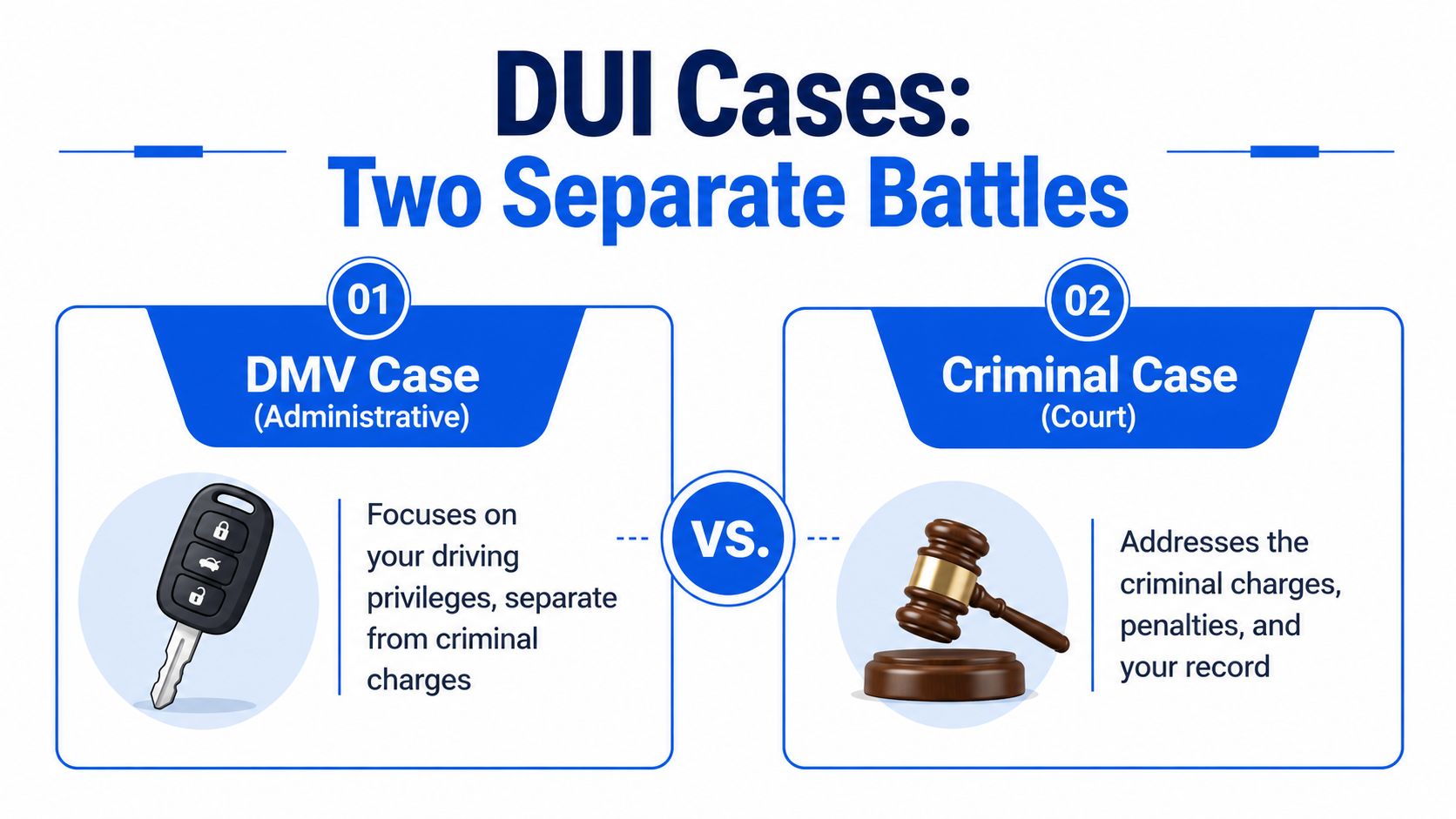
You are not fighting one case. You are fighting two separate battles. The administrative license case often starts before the criminal case is even filed. According to this explanation of the separate DMV and criminal tracks in a DUI case, 70% of new DUI clients are unaware that these are different proceedings with different deadlines, which is why people lose their license even when they later win in criminal court.
What the DMV case is about
The DMV side is administrative. Its focus is your driving privilege.
It does not decide whether you are criminally guilty. It decides whether the state will suspend your license and what options you may have to keep driving lawfully. This is why the early deadline matters so much. If you ignore it, the damage can happen fast.
If you need the procedural details, review the administrative license suspension hearing process.
What the criminal case is about
The criminal case is separate. That is the prosecution in court, often at places like the Richard E. Gerstein Justice Building in Miami. That case deals with guilt, penalties, your record, probation exposure, and other court consequences.
The two tracks can run at the same time, but they do not automatically fix each other.
Case type | Main issue | What's at risk |
|---|---|---|
DMV case | Your driving privilege | Suspension and ability to drive |
Criminal case | The DUI charge itself | Record, penalties, court sanctions |
Win the criminal case and your DMV problem may still exist. These are independent proceedings.
That is the two-case reality. It is the core answer to what does a DUI lawyer do in Florida. A real lawyer manages both tracks at once. An unrepresented driver usually focuses on court, misses the license issue, and pays for that mistake immediately.
How Does a Lawyer Handle Plea Negotiations and Trials
Not every DUI case should go to trial. But every DUI case should be prepared like it might.
That distinction matters. A lawyer who prepares cases for trial negotiates from strength. A lawyer who just moves files along negotiates from habit.

Why trial readiness changes plea talks
A 2024 study found that attorneys handling over 50 DUI cases per month plead out 85% of cases, while trial-focused attorneys handling fewer than 20 per month challenge evidence in 40% of cases, resulting in 25% more dismissals, according to this report on what to ask a DUI attorney before hiring them.
That should change the questions you ask.
Don't ask only, “Can you get me a deal?” Ask how often the lawyer litigates, challenges evidence, and pushes cases toward dismissal instead of quick resolution. There is a major difference between a strategic litigator and a volume-based ticket mill.
What plea negotiations should really look like
Plea negotiations should be based on advantage. Advantage comes from preparation, credibility, and a clear willingness to fight when the facts justify it.
A serious lawyer reviews the file, attacks weak evidence, files motions when appropriate, and only then evaluates whether a negotiated result serves your interests. Sometimes a reduced charge is the right move. Sometimes it isn't.
This short video gives context to how these decisions play out in practice.
If your lawyer cannot explain why a plea is strategically sound, you are not getting advice. You are getting traffic through a system.
How Can an Attorney Help with DUI Sentencing
Even when dismissal doesn't happen, the fight is not over.
Sentencing is where a lawyer can still protect your future, your job, and your ability to move on without the harshest outcome available under Florida law. This matters even more when the state claims an enhanced DUI.
How a lawyer pushes back on enhanced penalties
Under Florida Statute 316.193(4), your attorney should aggressively contest any claim that your blood-alcohol level was 0.15 or higher, because that threshold can trigger a mandatory fine of at least $4,000 and up to 9 months of imprisonment for a first conviction, as explained in this summary of Florida DUI penalty enhancements.
A careful lawyer does more than stand next to you at sentencing. The lawyer can challenge the basis for the enhancement, present your background in the proper light, and argue for a fair outcome rather than the harshest one.
What mitigation actually looks like
Mitigation is practical. It may involve presenting your work history, lack of prior record, family responsibilities, treatment efforts, or compliance steps already taken. Judges are still making decisions about a person, not just reading a charge.
That is why sentencing advocacy matters. A lawyer who treats the case as over once guilt becomes likely is not protecting you. A lawyer who keeps pushing can still reduce the damage.
How Do You Choose the Right Florida DUI Lawyer
After a DUI arrest, ads appear everywhere. Many are built to capture fear, not to provide defense.
You need to know who will handle your case. Will you speak to a lawyer, or to intake staff, a salesperson, or a chatbot? Will the lawyer you hire be the one texting you back and standing with you in court? Those are not small questions.
Which questions should you ask before hiring anyone
Use this checklist:
Who will I speak with after I sign up: If the answer is not “your lawyer,” keep looking.
Who appears in court for me: You want a clear answer, not a vague staffing promise.
How do you communicate: Phone and text access matter when deadlines are tight.
Do you handle both the license issue and the court case: A Florida DUI requires both.
Do you file motions when the facts support them: You want strategy, not file processing.
If you're comparing firms, review a focused guide to DUI attorneys in Florida.
Why direct lawyer access matters
Some firms run like assembly lines. Some newer services lean on automation and scripted intake. That model may be fine for simple administrative tasks. It is not enough for a DUI charge.
For law practices trying to improve responsiveness without sacrificing attorney access, services like an answering service for law firms can help manage calls after hours. But the key issue in your DUI case is who gives legal advice. It should be a lawyer.
At Ticket Shield, PLLC, the model is lawyer-led. Clients communicate directly with their attorney by phone or text. No middlemen. No automated apps pretending to be legal strategy. That matters when your deadline is immediate and your license is on the line.
Conclusion Your Shield in a Complex System
A DUI lawyer does far more than stand next to you in court. The lawyer protects your license, attacks the state's evidence, manages deadlines, files motions, negotiates from strength, and fights to reduce long-term damage to your record and livelihood.
If you were just arrested, don't wait for the system to sort itself out. It won't. You need a real Florida defense strategy, and you need it now.
If you want a lawyer-led defense focused on protecting your record and the No Points goal, visit Ticket Shield, PLLC for a free consultation.
