LIDAR Ticket Defense: How to Fight Laser Speeding Tickets
Master lidar ticket defense in Florida. Learn how laser enforcement works, challenge calibration and operator errors, and protect your license

You just got handed a laser speeding ticket, and the clock started the moment the officer walked back to your car. If you pay it, you're not “taking care of it.” You're admitting it and letting the state use that admission against your license, your record, and your insurance.
In Florida, that is the wrong move. A lidar ticket defense is not about arguing that every laser gun is junk. It's about forcing the state to prove the stop was handled correctly under Florida law, especially under Florida Statute 316.1906 and the related testing rules in Florida Statute 316.1905. That is where real cases are won.
Table of Contents
The Real Cost of a Florida Laser Speeding Ticket
A laser ticket looks small on paper, then it starts working against you in the background. The fine is only the beginning. The bigger damage is the conviction, the point exposure, and the insurance problem that follows a moving violation through your renewal cycle.
Paying it is not a strategy
When you mail in payment, you're choosing the fastest path to a conviction. That choice tells the court there's nothing to fight, and it gives your insurer a clean record to price off of. If you drive for work, commute long distances, or already have prior tickets, that decision can hurt you far longer than the stop itself.
Florida also has serious speed statutes beyond a simple citation. Florida Statute 316.1922 makes dangerous excessive speeding a separate offense when a driver exceeds the speed limit by 50 mph or more, or drives at 100 mph or more in a way that threatens safety or interferes with traffic. That means the difference between handling the ticket now and ignoring it can be a lot bigger than a routine fine.
Practical rule: Never pay a laser speeding ticket until you've looked at the officer's setup, the testing history, and the statutory requirements. Once you pay, you've usually lost the leverage you needed.
You also need to think like a courtroom lawyer, not a traffic-school shopper. A lawyer-led defense can attack the stop, the documentation, the officer's procedure, and the admissibility foundation. An app or ticket mill usually can't do that because it doesn't know the local judge, the prosecutor, or the exact evidentiary pressure points in your county.
If you want to compare what a speeding ticket can cost in Florida, use this guide on Florida speeding fines to understand why a rushed payment is usually the most expensive choice you can make.
How LIDAR Works and Florida Legal Standards
Lidar, or LiDAR, measures speed by sending laser pulses to a vehicle and timing the return. The device calculates distance changes over a short interval, then converts that change into speed. That sounds precise, and in controlled conditions it can be, but precision does not eliminate legal requirements.
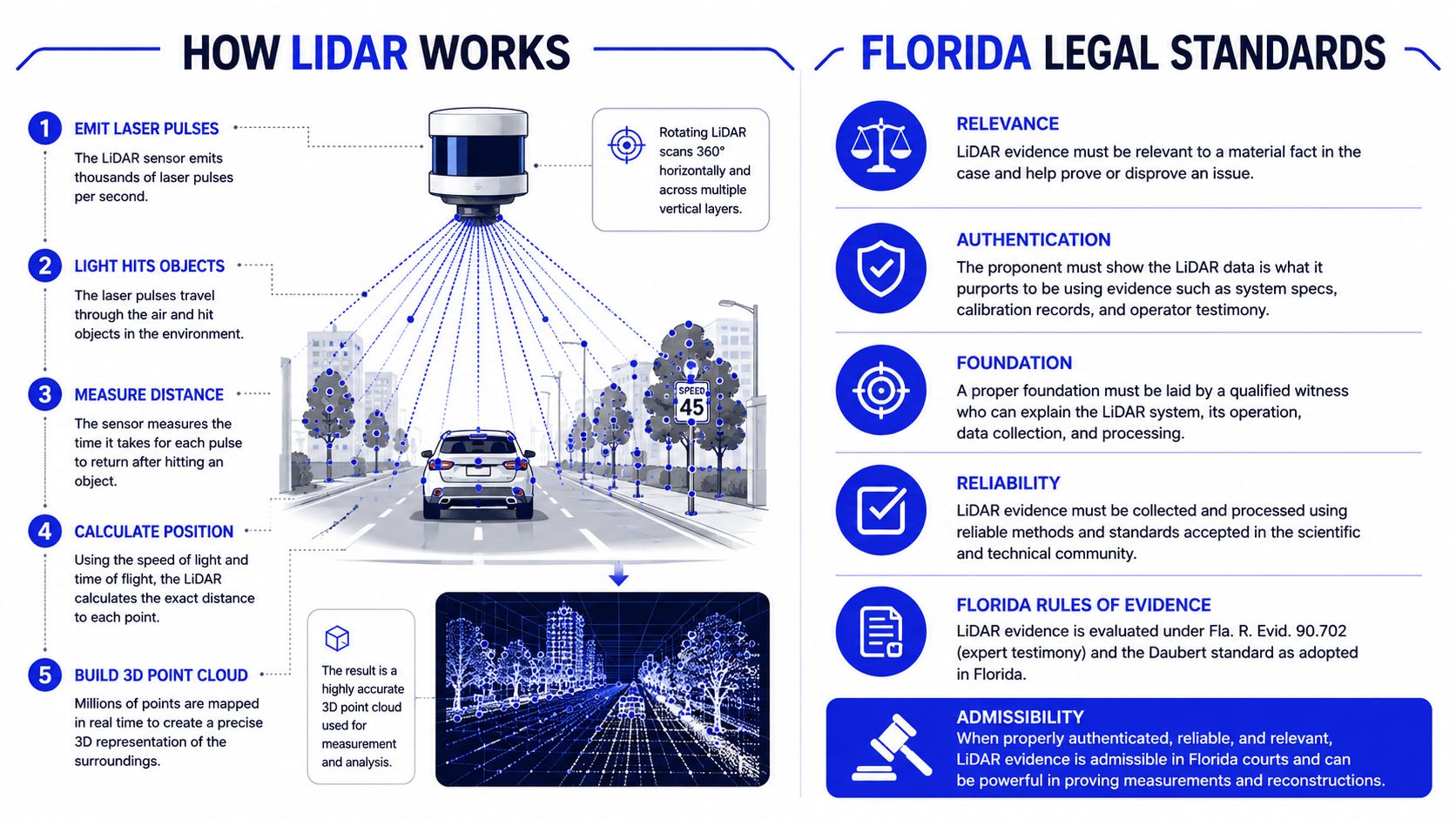
Florida treats lidar as part of the speed evidence framework
Florida's own evidentiary structure matters more than the sales pitch about the device. Florida Statute 316.1906 sets conditions for speed evidence from radar and laser-based systems, and it requires more than an officer saying the number on the screen looked right. The officer must be trained, the vehicle speed must be visually determined independently, and the equipment must be used in compliance with the statute.
Florida also requires the device to be approved and tested for accuracy under Florida Statute 316.1905, with a signed test certificate creating a presumption that the device was working properly. That is not the same as a perfect defense for the state. It just means you need to attack the actual foundation, not the mythology around the technology.
If you're wondering how that foundation gets built in the first place, the best comparison is to radar procedure. This explanation of how radar speed guns work helps show why laser cases turn on different procedural details, even when the ticket looks simple from the outside.
The issue in court is rarely, “Can lidar measure speed?” The real issue is, “Did this officer comply with the rules that make this reading trustworthy enough to admit?”
What the officer has to get right
The state usually leans on training and testing records, but those records only matter if they match the stop. If the operator wasn't certified, didn't independently observe speeding, or used a device that wasn't properly approved or tested, the defense shifts from technology to procedure. That's where Florida law gives you room to fight.
The point is simple. In Florida, a laser ticket isn't automatically bulletproof just because it involves a modern device. It still has to survive the statute, the foundation, and the human mistakes that happen when an officer is working traffic too fast.
Operational Errors and Environmental Vulnerabilities
The weakest laser cases are usually not about the gun. They're about the person holding it, the angle of the shot, and the scene itself. If you want to beat a laser speeding ticket, you need to rebuild the stop from the roadside back to the report.
Geometry matters more than people think
NHTSA training materials say that when the target vehicle is at a significant angle to the lidar position, the measured speed will be less than the true speed because of cosine error. That helps the defense in a very specific way. If the patrol car was offset, parked on a curve, or shooting across lanes, you should be asking whether the reading was biased downward, not upward.
That matters because a clean excessive-speed allegation can look less trustworthy once you map the angle of the shot. If the car was far off-center, the state has to explain why the measurement still makes sense in context. The defense should look at road curvature, lane position, shoulder location, and the officer's line of sight.
The other major error is sweep error, sometimes called pan error. That happens when the operator moves the beam across the vehicle or hood during the measurement. Training sources warn that changing aim points can change the distance calculation over successive samples, which can create a false higher reading.
Target discrimination is not automatic
Lidar can also miss the right car in busy traffic. Reflective surfaces, curves, vehicle motion, and operator instability all make target discrimination harder. If there were multiple cars in the lane cluster, a large truck nearby, or a shiny surface that could have pulled the beam, the reading becomes easier to challenge.
If the officer can't show a steady aim point and a clean target history, the number on the screen is just a number.
You should also care about how the stop was documented. A strong defense asks for the reading history, any notes on the target vehicle, and any video that shows whether the beam stayed on one point for the full measurement interval. If the officer wrote a bare-bones report with no detail, that omission helps you.
For a plain-English breakdown of the fight you're in, this guide on how to beat a speeding ticket in Florida shows why a good defense starts with scene reconstruction, not excuses.

Why the setup has to be clean
Lidar systems rely on pre-enforcement checks, and those checks are where sloppy stops fall apart. NHTSA-style procedures commonly require an internal circuit check, LED segment test, range or chronometer accuracy test, and horizontal and vertical sight-alignment tests before enforcement begins. One published operator manual requires the measured range to match a known distance within ±1 foot (30 cm), which is exactly the kind of detail that exposes weak documentation.
The technical performance specs also matter. The device is designed for small tolerances, with accuracy around +2 km/h and -3 km/h, distance accuracy around ±0.3 m at 90 m, and a long-range capability of at least 300 m York Region technical document. That tells you the machine depends on correct setup and target acquisition, not magic.
The defense point is not that lidar can never work. The point is that a sloppy read, a bad angle, or poor target discipline can break the reliability foundation in your case.
Critical Evidence to Request During Discovery
Discovery is where a weak laser case starts to show its seams. Don't wait for the prosecutor to hand you the important documents out of kindness. Make them produce the records that prove the officer, the device, and the stop all lined up correctly.
Start with the device and the operator
Ask for the device approval record, the calibration history, and the daily test logs for the exact unit used in your case. Under Florida Statute 316.1905, the state is supposed to show that the device was approved and tested for accuracy at least once every 6 months, and a signed test certificate creates a presumption of proper function. That presumption is not the same thing as immunity from challenge.
Then demand the operator's training certificate and any certification tied to laser use. If the officer says they were qualified, the paper trail should prove it. If the training date, device model, or certification level does not match the stop, you have a clean evidentiary problem to press.
Ask for the physical proof, not just the report
The most useful records are the ones that show how the measurement was made. Request the internal circuit check, LED segment test, range test, and both the horizontal and vertical sight-alignment records. If any one of those is missing, incomplete, or unsigned, you have a gap the state will have to explain.
Use this checklist in discovery:
Approval documents: Confirm the exact lidar model was approved for enforcement.
Accuracy certificates: Look for the 6-month testing record required by Florida law.
Operator certification: Make the state prove the officer was trained on that unit.
Pre-use test logs: Request the full daily check sequence, not a summary.
Sight-alignment records: Missing alignment data is a real attack point.
Scene notes: Ask for lane position, traffic density, and aiming details.
Video evidence: If the stop was recorded, it can confirm or destroy the officer's narrative.
Citation packet: Compare the report to the actual device and stop conditions.
The useful part of discovery is not volume. It's contradiction. If the report says one thing and the logs say another, the state has a problem.
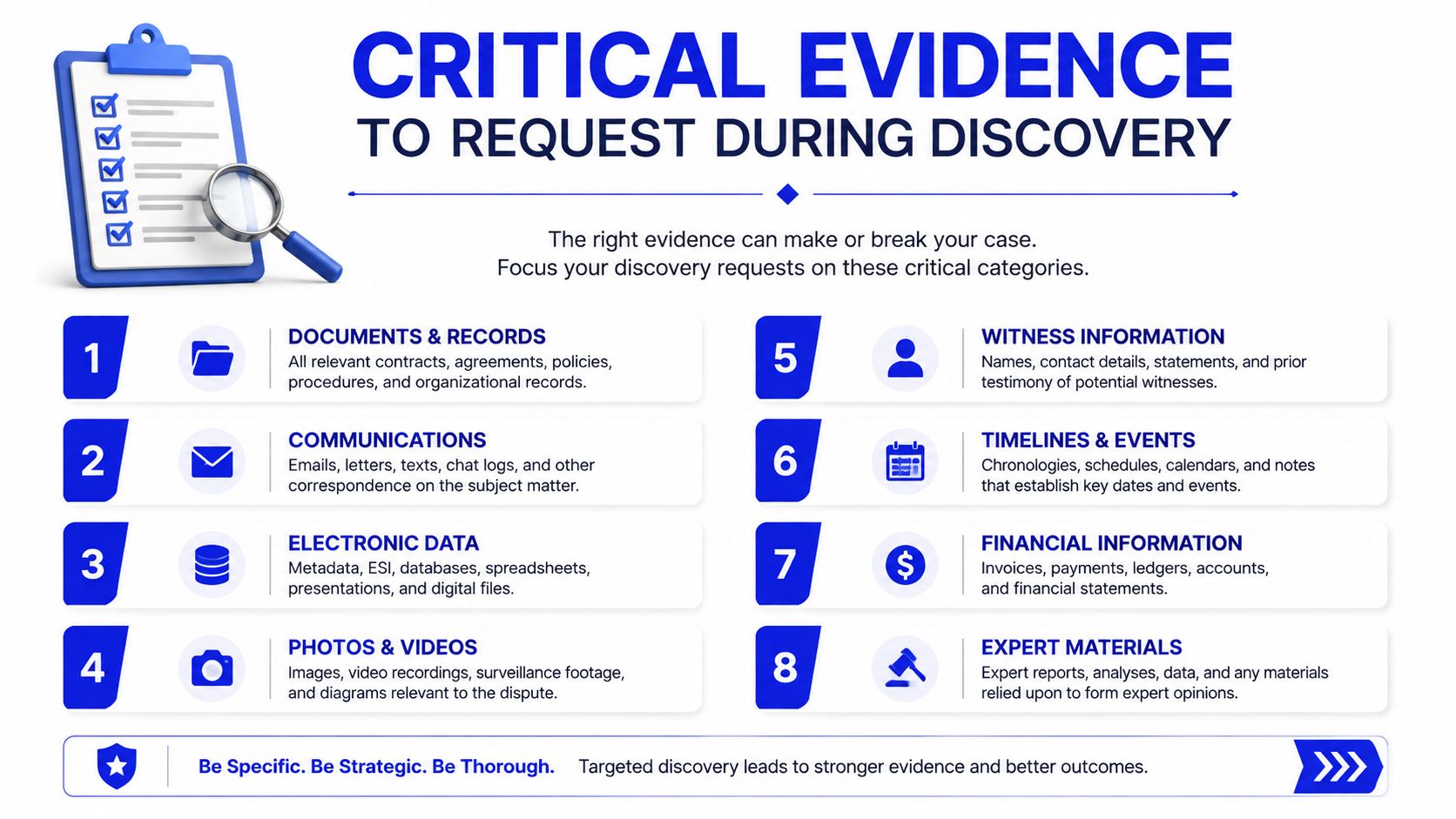
Missing sight-alignment records are not a clerical nuisance. They can undermine the reliability foundation of the whole stop.
Trial Strategies and Negotiation Tactics
Not every lidar case needs a full fight to verdict, but every case needs negotiation power. If you go in unprepared, you give the prosecutor the easy path. If you go in with real defects, you control the conversation.
Strategy | Best Used When | Potential Outcome |
|---|---|---|
Motion to suppress | The officer lacks proper visual estimation, the device logs are incomplete, or the stop was not handled under the statute | The reading may be excluded, or the state may lose leverage |
Discovery pressure | Calibration, training, or sight-alignment records are missing or inconsistent | Better plea terms or a reduction in the charge |
Trial | The facts are bad for the state and the officer's testimony is weak on procedure | Dismissal, acquittal, or a not-guilty result |
Negotiation | The stop has technical flaws, but the state still has some usable evidence | Lower penalty, fewer collateral consequences, or a no-points resolution |
Trial and plea are not the same game
A motion to suppress makes sense when the officer cannot show the independent visual estimate, the device records are thin, or the state cannot prove the statutory foundation. If the reading is legally shaky, don't let the prosecutor pretend it's untouchable. Force them to defend every step.
Negotiation makes sense when the state has a readable report but weak procedure. That is where a good defense lawyer uses the defects to push for a better outcome, especially if the goal is avoiding points. The advantage comes from the prosecutor's risk, not from hoping for sympathy.
If your case involves deeper cross-examination issues, this resource on cross-examination strategies shows why the officer's story has to survive pressure on the stand, not just in the report.
Dangerous speeding changes the stakes
Don't ignore the severity of an extreme-speed case. Florida Statute 316.1922 treats dangerous excessive speeding as a separate offense when the speed reaches the statutory threshold or the driving endangers others. That means the case can move from annoying to serious very quickly.
For ordinary laser tickets, the better play is often to attack the foundation and negotiate from strength. For extreme-speed allegations, the priority is to stop the state from turning a routine traffic matter into something much worse. You do not want to stumble into that outcome because you thought the ticket was just another fine.
Secure Your Defense with Ticket Shield
You need a lawyer who can handle the record, the officer, and the court, not a middleman who forwards your information into a queue. Ticket Shield, PLLC is built for direct communication, so you can speak with your attorney by phone or text instead of chasing a chatbot or waiting on an answering service. That matters when your case turns on a missing log, a bad angle, or a defective stop.
A proper Florida lidar ticket defense depends on details, and local court practice matters across all 67 counties. If your citation can be resolved without points, that should be the goal from day one. If the state's proof is weak, your defense should make that weakness impossible to ignore.
Use this starting point to send your case in now through Ticket Shield's case submission page. The sooner you act, the sooner your defense can start pressuring the state before deadlines close and options disappear.
Visit Ticket Shield, PLLC for a free consultation and get a lawyer-led lidar ticket defense focused on protecting your record, your license, and your goal of No Points. If you were handed a laser speeding ticket in Florida, don't wait, send it in now and let a Florida traffic attorney start fighting for the result you want.