Cross Examination Strategies: A Florida Attorney's Guide
Master attorney-level cross examination strategies for Florida traffic and DUI cases. Learn to challenge evidence and protect your record.

The officer takes the stand, and the room tightens. Your license, your insurance, your job, and your record all hang on what happens next. That's why cross examination strategies matter in a Florida traffic or DUI case. A real lawyer gets to work, not an automated app, not a chat prompt, not a ticket mill with a middleman between you and the attorney who should be fighting for you.
If you were stopped on I-95, pulled over on US-1, or arrested after a roadside investigation, you need control, not noise. You need questions that lock the witness down, records that expose gaps, and a lawyer who knows how Florida traffic law works under Chapter 316. For speeding cases, Florida Statute 316.187 is one of the statutes that often matters right away, and the defense has to treat it like a live issue, not a website form.
Table of Contents
3. The Principle of Exclusion Eliminating Alternative Explanations
4. The Foundation Destruction Method Challenging Evidentiary Basis
5. The Bias Exposure Technique Revealing Officer Motivation and Pattern
6. The Reasonable Doubt Chamber Creating Alternative Theories
1. Impeachment & Independent Contradiction Technique
Start with the record. Judge the officer against it. That is how you take control.
A strong cross starts by comparing the testimony to the pieces that cannot be waved away, the police report, dashcam, bodycam, dispatch logs, radar calibration records, and any independent witness who saw the stop. Florida traffic defense works best when you show the court that the testimony is unreliable because it conflicts with objective proof. You do not have to prove the officer lied. You only have to show the story does not line up.
Practical rule: lock the officer into the timeline first, then hand the judge the contradiction.
In real Florida traffic cases, the difference between a claimed observation and the actual record can be fatal to the state's theory. If the officer says the stop happened at one time, but dispatch logs show a different one, that mismatch matters. If a dashcam shows a full stop at a red light, or radar records do not support the claimed lock-on, the testimony loses force fast.
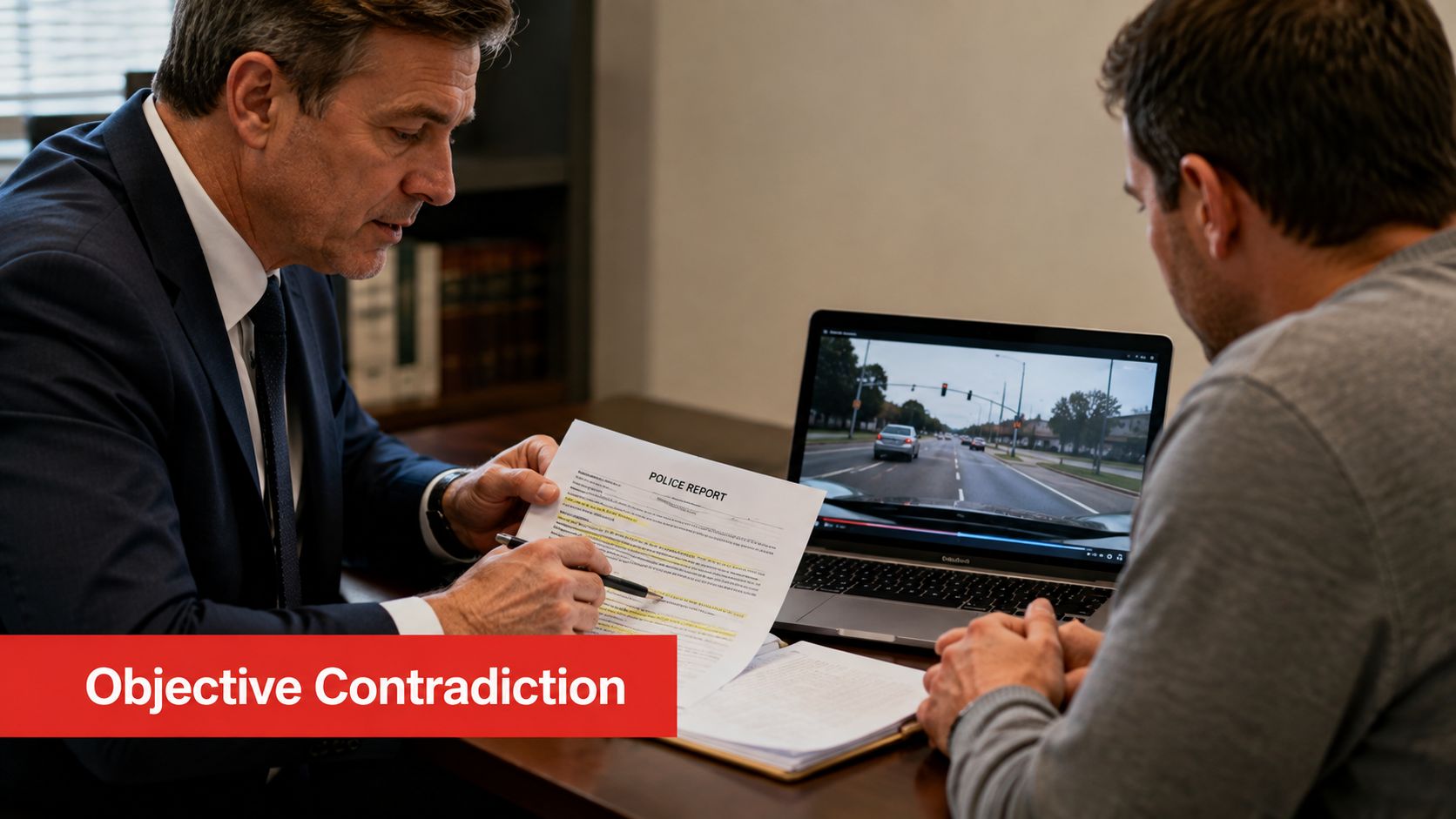
Preserve video requests in writing immediately. Video is often overwritten, and once it's gone, you're left fighting memory instead of evidence.
For a Florida driver, this starts with discovery. Demand the dashcam, bodycam, radar or laser calibration records, and dispatch logs early. Then line them up against the officer's sworn account. A lawyer-led firm like Ticket Shield, PLLC does this directly, by phone or text with your attorney, instead of burying you in a corporate intake maze.
For a Florida driver facing a citation, that direct access matters because preparation changes the whole posture of the case. If the officer testifies one way and the objective record says another, you have an advantage. If you want a plain example of how cases can break down when the state's witness does not show, read what happens when the officer does not appear in traffic court. If you want to understand the room you are walking into, review what to expect in traffic court.
The point is simple. Build the contradiction before trial. Then use cross examination to make the officer own the version that the records can defeat.
Lock the officer to the paper trail
Your questions should be short and specific. Ask about the stop time, the equipment, the exact observation, and the log entry. Then compare every answer to the written record already in your file.
In Florida traffic and DUI court, the officer will try to explain, qualify, or expand every answer. You stop that by forcing yes-or-no commitments on individual facts. One fact. One answer. One line in the transcript. That is how you keep control.
The wording matters. “Correct?” “True or false?” “Yes or no?” Those are not style choices. They are control tools. A question like, “Officer, you did not perform a two-point calibration on your radar unit that morning, correct?” forces the witness to answer the point, not the speech around it.
Practical rule: every question should be narrow enough that the witness cannot turn it into a speech.
A Florida lawyer should draft these questions in writing before court, then say them out loud. That preparation keeps the tone steady and the sequence tight. The Solicitors Regulation Authority says cross questions should be short, clear, and well ordered, generally limited to one issue and founded on evidence [S
2. The Narrow Question Technique Forcing Yes-or-No Answers
Do not let the witness wander. Narrow questions take away escape routes.
In Florida traffic and DUI court, the officer often tries to explain, qualify, or expand every answer. You stop that by forcing yes-or-no commitments on individual facts. One fact. One answer. One line in the transcript. That is how you build control. The American Bar Association's cross-examination coursebook says to use short questions, plain words, leading questions, and to avoid asking one question too many, because cross works best when each question stays on a single fact ABA cross-examination coursebook.
The wording matters. “Correct?” “True or false?” “Yes or no?” Those are not style choices. They are control tools. A question like, “Officer, you did not perform a two-point calibration on your radar unit that morning, correct?” forces the witness to answer the point, not the speech around it.
Practical rule: every question should be narrow enough that the witness cannot turn it into a speech.
A Florida lawyer should draft these questions in writing before court, then say them out loud. That preparation keeps the tone steady and the sequence tight. The Solicitors Regulation Authority says cross questions should be short, clear, and well ordered, generally limited to one issue and founded on evidence SRA guidance on cross examination. That matches how a defense lawyer should handle a traffic officer in front of a judge.
Use this approach on speed cases, red-light cases, and DUI stops. Ask about the posted limit. Ask about whether the officer personally measured the distance. Ask about whether the officer saw lane deviation or assumed impairment from a glance. Then stop. Let the answer sit there.
If the officer refuses to answer yes or no, the court needs to hear that resistance. A lawyer-led practice does not outsource that moment to a bot or a call center. It handles it directly, in court, with someone who knows when to press and when to stop.
The transcript becomes cleaner, the record becomes sharper, and the judge sees a controlled defense instead of a noisy one.
Keep the record tight
The tighter the question, the less room the officer has to escape. That is the whole point. You want admissions, not speeches.
3. The Principle of Exclusion Eliminating Alternative Explanations
Take away every innocent explanation one by one.
This technique works because many traffic observations are not as clean as the citation makes them sound. A car that looked fast may have been coming downhill. A vehicle that drifted may have been dodging a hazard, following traffic flow, or reacting to lane markings that were hard to read. A red-light case may involve obstruction, malfunction, or a legitimate entry into the intersection that the officer did not account for.
The defense job is to eliminate the alternatives in a logical order. Start with procedure. Then move to environment. Then attack the observation itself. That sequence matters because it keeps the court focused on the facts that existed before the officer jumped to a conclusion.
If the road grade was downhill, make that part of the record. If traffic was moving faster than the posted limit, pin that down. If sight lines were blocked, show it with photographs or diagrams. If the officer's equipment was not properly checked, that weakens the claim even more. The same logic applies in DUI stops. Swerving is not automatically impairment. Road hazards, traffic conditions, and lane issues can explain it.
Build the alternative in order
Procedure first: ask whether the officer followed the required steps before making the stop.
Environment second: address weather, lighting, road design, traffic flow, and visual obstructions.
Observation third: force the officer to admit what was seen, not what was assumed.
Document every concession: make sure each answer is captured cleanly for the judge.
Save the strongest point for last: end on the fact that most sharply weakens the state's version.
The best courtroom use of this strategy is simple. You do not argue against the officer's theory. You remove the supports underneath it. That is how reasonable doubt gets built in a Florida traffic case.
A lawyer who handles this well is not improvising. The lawyer is sequencing. That is a major difference from automated tools that only promise “ticket help” and cannot control a witness in court.
4. The Foundation Destruction Method Challenging Evidentiary Basis
If the state cannot lay the foundation, the evidence should not carry the weight it wants.
Florida traffic and DUI cases often turn on equipment, training, and process. That means the defense should attack the foundation with precision. Ask for the training certificates. Ask for the maintenance logs. Ask for the calibration records. Ask for the date-specific paperwork that proves the officer or operator was qualified and the device was functioning properly.
A citation for improper tint is one thing. A reliable measurement is another. An officer's guess is not a substitute for proof. In a speed case, missing radar calibration records can weaken the state's evidence. In a breath case, certification problems can damage the reliability of the result. In all of these situations, the defense should tie the challenge to the record and to the governing Florida authority, including statutes in Chapter 316 like Florida Statute 316.187 when speed is the issue.
Practical rule: if the foundation is missing, make the court stare at the missing piece.
The right move is to request the records early, then use cross examination to ask the officer to produce them or admit they are absent. That creates a clean record for motions and, if needed, appeal. It also puts pressure on the state to explain why the paperwork is incomplete.
What a motion to suppress means in a Florida traffic case matters here because foundation problems often lead straight into suppression arguments. That is where a real lawyer earns the fee, by identifying the gap and turning it into a legal problem instead of a billing note.
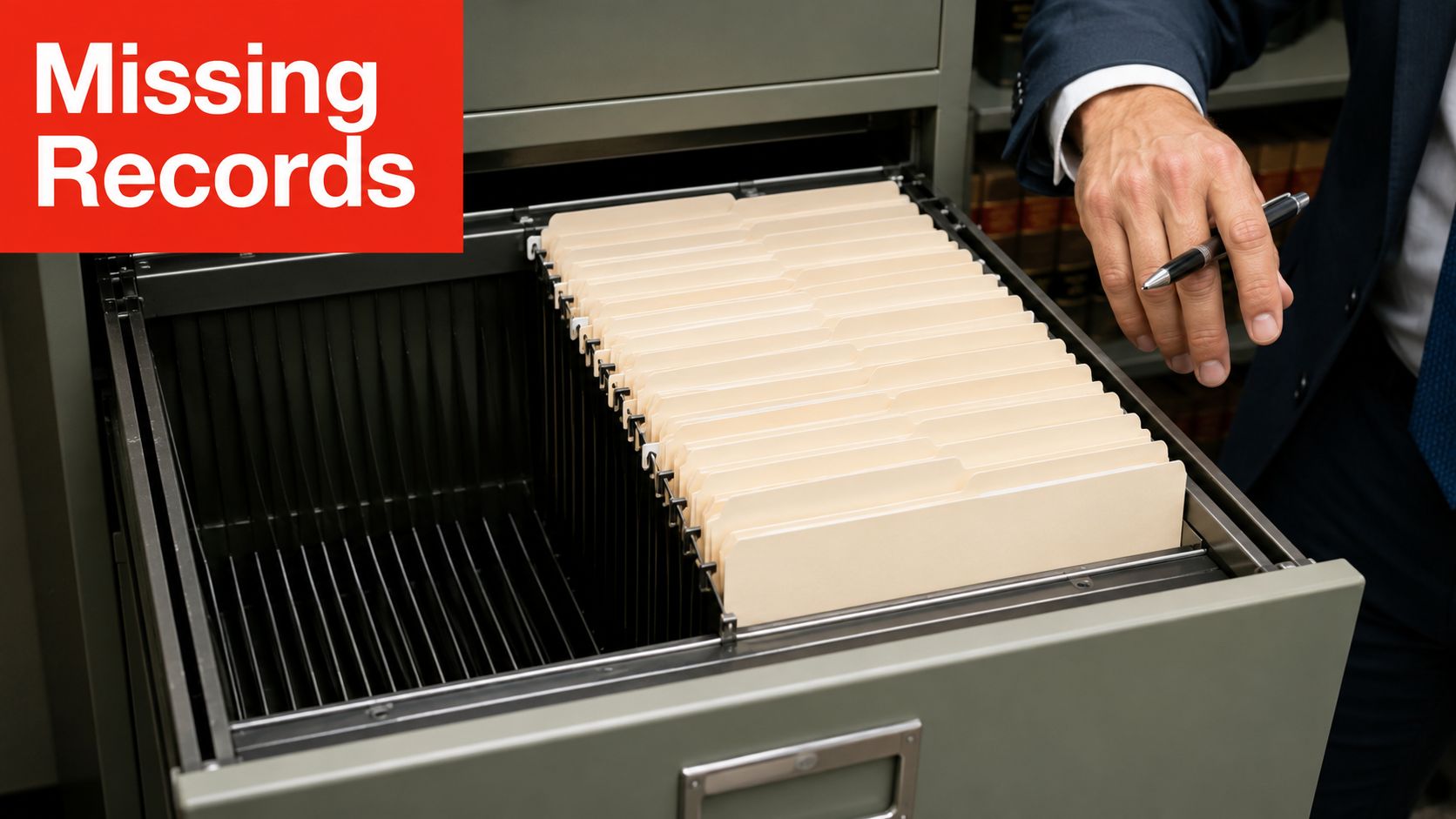
You should think in terms of records, not rhetoric. If the officer cannot produce the foundation, the state has a problem. If the officer produces it late or incompletely, that is still a problem. The court sees the gap, and the defense gains an advantage.
Attack the missing records
Do not chase every side issue. Hit the missing certificate, the missing calibration log, or the missing maintenance entry. Then tie that gap to the specific testimony the state wants the court to trust.
5. The Bias Exposure Technique Revealing Officer Motivation and Pattern
Bias changes credibility. Pattern changes credibility too.
This is not about drama. It is about motive. If the officer's enforcement pattern is unusual, or if the department's priorities push volume over accuracy, cross examination should expose that pressure. The defense can ask for citation histories, prior complaints, shift patterns, and any performance metrics that show how enforcement is being measured. The goal is not to throw random accusations. The goal is to show the court why this witness may have a reason to shade the testimony.
A Florida traffic lawyer should compare the officer's citation activity with peers in the same unit or on the same shift. If the numbers look out of line, that pattern may matter. But use the comparison carefully and only where the record supports it. The court will not reward speculation. It will reward disciplined proof.
The research brief for this topic flags a real gap in generic trial advice. Many guides repeat the same basic lines, stay calm, ask leading questions, keep control, but they do not tell you when to shift from simple control to a documented impeachment sequence when the witness is technically answering but still resisting. That matters because witness behavior is part of strategy, not just wording. Cross examination is sequencing, escalation, and courtroom control.
Do police have ticket quotas in Florida is the kind of issue a driver may want explained plainly, because pattern and motive questions come up fast when enforcement feels aggressive. A firm like Ticket Shield, PLLC is built to have that conversation directly with you, not through a chatbot or an answering layer.
Use bias carefully. The court needs facts, not a speech about “bad cops.”
If you have documented complaints, prior testimony, or unusual citation patterns, those materials belong in your preparation file. They are not there to decorate the brief. They are there to support a precise cross that asks why this witness should be believed on this stop, on this date, in this case.
Follow the numbers only where the record allows it
Do not invent a pattern. Do not guess at motive. Build it from the actual file, the actual history, and the actual record. That is how you make the bias point stick.
6. The Reasonable Doubt Chamber Creating Alternative Theories
Give the court a better explanation.
Cross examination is stronger when it does more than tear down the state's version. You also want a competing, credible theory that fits the facts. In a DUI case, that may mean a medical issue affecting speech or balance. In a speed case, it may mean the driver accelerated to merge safely. In a reckless driving case, it may mean the driver reacted to a tailgating emergency vehicle or another sudden hazard.
The defense should identify that theory early, then use investigation, experts, and corroborating witnesses to support it. If the case involves medical symptoms, the lawyer should gather records and test whether the symptoms really point to impairment. If it involves speed or movement, reconstruction or engineering testimony may help. The key is simplicity. The court needs a story that makes sense quickly.
The Temple University article on opposing experts makes the same basic point in a different context. If exclusion is not possible, narrowing the opinions and attacking the foundation of the expert's conclusions becomes the next step Temple University on confronting the opposing expert. That fits Florida traffic defense well. You want to narrow the state's story until your alternative is the only one that still holds together.
How to fight a traffic ticket in Florida should be handled with that same mindset. Not panic. Not generic denial. A clear theory that explains what the officer saw and why the conclusion was wrong.
Build the competing story early
Start with the client interview: find out what happened before the stop and after it.
Use the right expert if needed: medical, reconstruction, or engineering testimony should support the theory.
Keep the explanation simple: judges and jurors follow the clean story, not the complicated one.
Repeat it in every phase: opening, cross, and closing should all point to the same alternative.
A lawyer-led defense matters because this is not just about filing paperwork. It is about building a theory, testing it, and using it in court. That is where direct attorney access by phone or text becomes a real advantage over automated platforms that cannot adapt in the moment.
7. The Silent Trap and Strategic Concessions
Silence can do more than another question.
A good cross often starts with harmless admissions. The weather was clear. Visibility was good. The officer was on scene. The stop happened on a normal stretch of road. Those small concessions lower resistance and make the witness feel settled. Then the defense turns. That sudden shift, paired with a deliberate pause, can make a damaging fact land harder.
The trick is not to sound theatrical. The trick is to sound calm and controlled. Ask the easy questions first. Let the officer agree. Then move to the point that breaks the state's theory. If the officer has already confirmed the conditions were ordinary, a later photo or record showing an obscured sign, a malfunction, or a conflicting timeline can hit much harder.
Use silence like a lock. Ask the question, let the answer come, and stop talking.
This works because many witnesses try to recover by talking more. When you do not fill the space, they sit with the admission. That is where a lot of the power comes from. The jury or judge hears the answer, not your commentary.
The success of this method depends on preparation. Draft the sequence before trial. Rehearse it. Know exactly where the trap is and what fact comes next. Save the most damaging evidence for after the witness is committed. Then use it cleanly.
The practical advantage in a Florida traffic case is obvious. A real attorney can read the room, adjust the pace, and decide when silence will do more than another question. An automated app cannot do that. It can only prompt. It cannot control the witness, the sequence, or the courtroom moment.
Use silence as a control tool
Do not rush to fill gaps. Do not over-explain. Let the witness sit inside the answer. That pause can do more work than a paragraph of argument.
7-Point Cross-Examination Strategy Comparison
Technique | 🔄 Implementation Complexity | ⚡ Resource Requirements & Speed | ⭐ Expected Outcomes / Effectiveness | 📊 Ideal Use Cases | 💡 Key Advantages / Tips |
|---|---|---|---|---|---|
Impeachment & Independent Contradiction Technique | High, intensive discovery and document comparison | Moderate–High, video, logs, transcription; time-sensitive evidence | ⭐⭐⭐⭐, highly persuasive when objective records exist | Speeding, DUI, red‑light, reckless cases with recordings or logs | 💡 Request dashcam/bodycam/dispatch/calibration immediately; preserve video; lock officer on cross |
The Narrow Question Technique: Forcing Yes-or-No Answers | Medium, careful drafting and courtroom control | Low–Moderate, preparation and transcript access; quick to deploy | ⭐⭐⭐, effective to control evasive witnesses | Cross‑examination on calibration, measurements, procedural facts | 💡 Draft concise yes/no questions, practice pacing, ask judge to direct answers if needed |
The Principle of Exclusion: Eliminating Alternative Explanations | High, systematic elimination of multiple hypotheses | High, site visits, diagrams, witnesses, possible experts | ⭐⭐⭐⭐, persuasive where observation quality is critical | DUI, reckless driving, cases involving sight‑lines or environmental factors | 💡 Identify alternatives early, use diagrams and experts, save strongest exclusion for last |
The Foundation Destruction Method: Challenging Evidentiary Basis | High, discovery-heavy and technical foundation motions | Moderate–High, records, calibration logs, possible equipment experts | ⭐⭐⭐⭐, can result in exclusion/dismissal if foundation missing | Speed/equipment disputes, DUI breath/blood testing, measurement-dependent cases | 💡 Demand training/certificates and calibration records; consider independent equipment expert |
The Bias Exposure Technique: Revealing Officer Motivation and Pattern | Medium–High, requires data collection and comparative analysis | Moderate, citation histories, complaints, statistical comparison | ⭐⭐–⭐⭐⭐, variable; strong when clear patterns exist | Cases where officer shows unusually high citation rates or prior complaints | 💡 Request citation histories, compute per‑shift rates, use comparative stats cautiously |
The Reasonable Doubt Chamber: Creating Alternative Theories | High, builds affirmative, evidence-backed defense | High, experts, medical records, reconstruction, witness corroboration | ⭐⭐⭐⭐, highly effective with credible expert support | DUI, speeding, reckless where plausible non‑criminal explanations exist | 💡 Engage experts early, keep the alternative simple, corroborate with records/witnesses |
The Silent Trap & Strategic Concessions | Medium, precise sequencing and psychological timing | Low–Moderate, careful rehearsal and transcript control | ⭐⭐⭐, subtle, can amplify admissions when executed well | Cross‑examination to lock testimony and reveal contradictions | 💡 Begin with indisputable facts, pause after admissions, maintain neutral tone to avoid alienating judge |
Take Control: Your License Is on the Line
These strategies are not theoretical. They are the tools our experienced attorneys use daily in Florida courtrooms to protect drivers like you. Fighting a ticket is not a DIY project, and you are not just another case number to an automated app. You need a dedicated lawyer you can call or text directly. Protect your record. Avoid points. Visit TicketShield.com now for a free, confidential consultation and let us build the strategic defense you deserve to achieve "No Points" on your license.
Ticket Shield, PLLC gives you direct access to a lawyer-led Florida traffic defense team, not a middleman or automated chatbot. If your case involves speeding, DUI, reckless driving, or another Chapter 316 issue, we'll use real cross examination strategy to fight for your license and your record. Visit Ticket Shield, PLLC and get a free consultation with the attorney who can move your case forward.