Do Cops Have a Ticket Quota in Florida?
Do cops have a ticket quota in Florida? Florida bans formal quotas, but month-end pressure and performance metrics can still affect tickets.
The short answer is no, official ticket quotas are illegal in Florida. The more useful answer is that Florida bans formal citation quotas, yet drivers can still run into enforcement shaped by performance reviews, supervisor expectations, and agency culture. In our review of Florida law and national research, that gap between the written rule and the street-level reality was the part that mattered most.
Attorney Advertisement
How We Evaluated Florida Ticket Quota Claims
To update this article, we reviewed Florida statutes on traffic-citation quotas, policy reporting on how agencies evaluate officers, and national legal research on whether quota bans change behavior in practice. We treated primary law and serious legal or policy analysis as the strongest evidence, including Florida statutory text, multi-state quota-ban research, and reporting from established policy organizations such as the Brennan Center.
We also separated formal quotas from unofficial pressure. A written rule requiring a fixed number of tickets is one thing. A workplace culture that rewards high stop counts, citations, or arrests is different, even if it can feel similar to drivers. In our view, many articles blur those categories and end up overstating what the law proves.
Just as important, we did not treat anecdotes, social media claims, or one driver's month-end stop as proof of a quota system. Without agency records, litigation, admissions, or reliable research, a suspicious traffic stop is still just that: suspicious, not proven.
What Florida Law Actually Says About Ticket Quotas
Florida does have a specific statutory ban. Under Florida Statutes section 316.640, an agency may not establish a traffic citation quota. That legal baseline matters because it answers the narrow question directly: a department cannot lawfully order officers to write a set number of tickets.
Florida has also taken related steps aimed at ticket-driven enforcement. State law includes reporting rules for local governments that derive unusually high shares of revenue from traffic citations, a sign that lawmakers recognize the public concern about enforcement drifting from safety toward revenue. For broader context on how states have approached this issue, the Brennan Center's overview of police quota bans notes that large states have continued to legislate against explicit quota systems while still allowing agencies to monitor statistics for oversight.
That does not mean all numerical management is illegal. Departments can still review officer activity, compare enforcement output, and use statistics in supervision so long as they do not turn that review into an unlawful citation quota. When we compared the Florida statute to how quota bans are discussed nationally, the key distinction was consistent: the law clearly targets explicit numbers, but it does not erase every incentive tied to productivity.
For drivers, the plain-language answer is simple: Do cops have quotas? In Florida, formal ticket quotas are banned by law, but readers often mean something looser than a written policy. They usually mean unofficial expectations, and those can still exist through evaluations, assignment pressure, enforcement campaigns, or command culture.
The Reality of Florida Police Ticket Quotas
Florida law forbids a department from imposing a formal ticket quota, but that is only the starting point. The harder question is whether officers can still feel pushed to produce numbers in practice. The answer is yes. A legal ban on quotas does not prevent supervisors from paying attention to stops, citations, warnings, arrests, or other measurable activity when judging whether an officer is being proactive.
That distinction shows up beyond Florida too. A major legal analysis discussing state quota bans explains that some laws prohibit explicit arrest or citation quotas while also trying to block agencies from using raw enforcement numbers to determine promotions, discipline, or benefits; New Jersey is one example, and Illinois also tightened its statewide ban over time, underscoring how lawmakers distinguish a forbidden quota from broader performance management in policing in the Iowa Law Review analysis.
So the Florida-specific hierarchy looks like this:
Formal quota: illegal.
Productivity review: generally still part of police management.
Street-level pressure: possible, even without a written quota.
In our review, this was the clearest way to answer the question without overstating it. The statute resolves the formal-policy issue. It does not prove that every officer is free from numerical pressure, and it also does not prove that every busy enforcement period is a hidden quota program.
Quotas vs. Performance Measures
An illegal quota is a fixed command: write a certain number of tickets or face consequences. A lawful performance review is broader and may look at traffic stops, crash enforcement, DUI work, community complaints, or overall activity. Those systems are not identical, but they can create similar incentives when citation counts become the easiest number for a supervisor to compare.
That is why the legal ban does not end the debate. The 2024 legal scholarship and policy commentary on quota restrictions repeatedly point to the same problem: agencies can stop using the word "quota" while still relying on statistics to shape behavior. The Brennan Center's analysis makes this policy rationale explicit, arguing that outlawing quotas matters because quotas can distort policing, but also recognizing that data-driven oversight remains common.
For context during a stop, practical safety guidance matters more than arguing about departmental motives on the shoulder of the road. A useful primer is A-1 Driving School's page on what to do when pulled over by a police officer. For the underlying traffic rules themselves, you can also review our guide to Florida State Traffic Laws.
This graphic helps break down the legal difference between a strict quota and a performance goal.
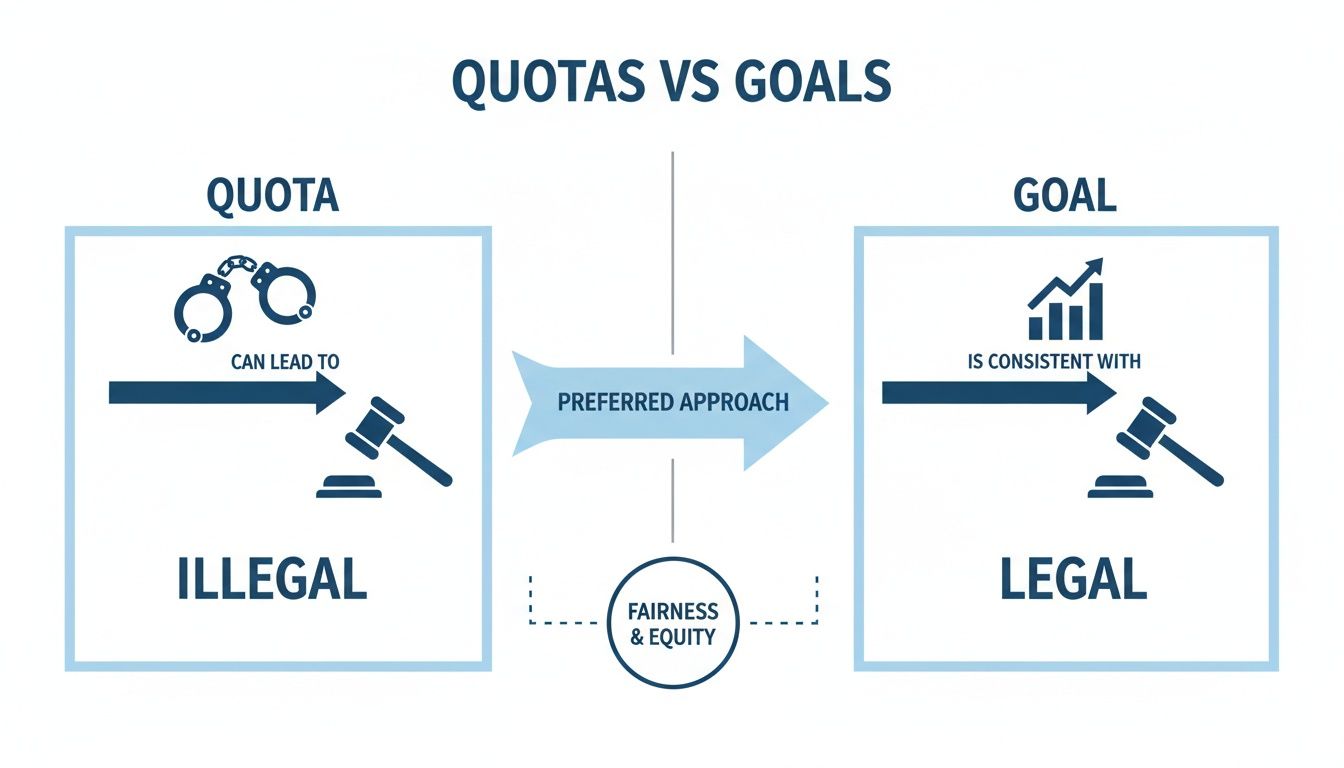
A driver should come away with a narrower, more accurate takeaway than many articles give: Florida does not permit official ticket quotas, but an officer can still work inside a system where activity numbers matter.
Understanding Florida's Ban on Ticket Quotas
Here in Florida, the law is crystal clear: police ticket quotas are illegal. The state has specific statutes on the books designed to stop law enforcement agencies from demanding their officers issue a set number of tickets.
The whole point of this ban is to keep policing focused on public safety, not on generating revenue. It’s supposed to remove the temptation for an officer to write a ticket just to hit a number, rather than responding to a real safety problem. That’s a critical distinction that affects every single driver on Florida roads.
The Law Versus Reality on the Ground
But despite what the law says, there can be a huge gap between the statutes and the day-to-day realities of being a police officer. A formal, written policy that says, "You must issue 15 tickets this week," is illegal, and you won't find one. What you will find, however, is the ever-present pressure to perform, which often shows up in less direct ways.
Things get blurry for everyone involved. An officer's job performance is almost always measured by their activity levels, how many stops they make, how many arrests, and yes, how many citations they write. These numbers can be a huge factor in their evaluations, promotions, and even getting a spot on a specialized team.
For a police officer in a bustling area like Miami-Dade County, the pressure to demonstrate productivity can be immense. When citation numbers are a key metric for performance, the motivation to issue a ticket over a warning can increase, especially toward the end of an evaluation period.
How Informal Pressures Create a De Facto Quota
This system of performance reviews and departmental expectations can create an informal or de facto quota. It's an unspoken system that operates just outside the letter of the law but ends up producing a very similar result.
These pressures can bubble up from a few different places within a department:
Performance Evaluations: Supervisors might use an officer’s ticket count as a simple, black-and-white way to measure how proactive they are. An officer with consistently low numbers could be seen as lazy or disengaged.
Promotional Opportunities: To get considered for a promotion or a coveted assignment, officers might feel they have to show high levels of enforcement activity. Tickets are the most obvious indicator.
Departmental Culture: In some agencies, a culture of "writing paper" can take hold, where it’s seen as the sign of a hard-working cop. This creates peer pressure to keep up with everyone else.
This environment means that even with a statewide ban, drivers in Miami-Dade and across Florida can still find themselves in situations where an officer's decision is influenced by these powerful internal pressures. As laws continue to change, drivers should stay informed. You can learn more by checking out some of the new Florida driving laws that might impact you. The goal is to make sure enforcement is always driven by safety, not statistics.
Why Unofficial Quotas Are a National Issue
That pressure Florida drivers feel from law enforcement isn’t unique to the Sunshine State. It is part of a broader national debate over how police agencies measure output. Across the country, the trend has been to ban explicit quota systems while still permitting departments to review data for supervision and accountability.
One reason this matters is that other states have written the issue more aggressively than Florida. The legal scholarship cited above discusses states that bar agencies not just from setting quotas, but also from using citation or arrest counts to drive promotions or discipline in the most direct ways. In our review, that broader drafting helps explain why two states can both "ban quotas" while giving officers very different day-to-day experiences.
Why the Same Complaints Keep Appearing
The recurring complaint from drivers is not always about a memo saying "write 20 tickets." More often it is about the incentives behind traffic enforcement: revenue concerns, visibility campaigns, command emphasis on productivity, or a workplace norm that equates more paper with better police work. The Brennan Center's policy analysis captures that broader concern and notes that the issue remains politically active in states including Illinois, New Jersey, Virginia, and Ohio.
We found that national examples are helpful only up to a point. They show the pattern, but they do not prove what happened in any one Florida stop. That is an important limit, especially for readers trying to decide whether a suspicious ticket can be challenged in court. For anyone wondering what to do next, our guide on how to fight a traffic ticket breaks down the practical steps you can take.
How to Spot Signs of Quota-Driven Ticketing
It is very hard to prove that a single ticket was written because of quota pressure. Timing alone is not enough. A stop near the end of the month may reflect a safety campaign, staffing pattern, holiday traffic, a local crash initiative, or simple coincidence. That is why we removed the kind of unsourced county-by-county spike table that often appears in weaker articles: without verified records, it looks more certain than the evidence allows.
What Drivers Can Reasonably Infer
People often suspect month-end or end-of-quarter pressure because that is when evaluations, statistics reviews, or command discussions may become more visible inside organizations. Research on police quotas supports the general idea that pressure can come from revenue, productivity, or supervisory expectations rather than a formal written order. But that same research does not justify assuming that every ticket issued in the last week of a month proves a quota.
The better question is what evidence would support the claim. Useful proof would include internal communications, sworn testimony, disciplinary records tied to low citation counts, agency audit materials, or reliable stop-data analysis over time. A single roadside experience usually cannot establish any of that. A careful, non-dramatic answer is required.
Do Officers Have to Hit a Number at the End of the Month?
There is no Florida rule requiring officers to hit a month-end ticket number. Florida law bans formal citation quotas rather than authorizing them. At the same time, officers may still feel pressure connected to evaluations, productivity expectations, or targeted enforcement campaigns, which is why month-end enforcement can feel real even when there is no lawful written quota.
That distinction also fits the broader research record. A legal study discussed in the Journal of Law and Social Problems reported that quota restrictions did not clearly reduce coercive behavior in the agencies it examined and found no evidence of reduced ticketing in some state-patrol settings, suggesting that incentives can persist after formal bans. The point is not that every officer is chasing a monthly number; it is that formal bans do not automatically remove operational pressure.
Signs Worth Documenting
What should a driver pay attention to? Not theories, but details. If your stop felt questionable, note the time, location, road conditions, what the officer said, whether other vehicles were treated differently, and whether the stated reason for the stop matched what happened. Tickets for subjective or minor conduct can raise questions, but they still do not prove an unlawful quota by themselves.
That practical record-keeping matters more than confronting the officer. If the citation involves speed-related allegations, our guide on how to beat a speeding ticket in Florida can help you think through the next step.
In reviewing these claims, we kept coming back to the same conclusion: the strongest evidence is almost never the date on the ticket. It is the surrounding documentation.
Does Banning Quotas Actually Change Anything?
Sometimes, yes—but not as much as drivers might expect. Quota bans matter because they remove the easiest and most abusive version of the problem: the explicit command to issue a fixed number of tickets or arrests. That is a real legal protection. States would not keep passing these laws if they were meaningless.
But the available research suggests they are not a complete solution. The Iowa Law Review article on police quotas and state bans explains why lawmakers distinguish explicit quotas from the use of enforcement statistics in evaluation systems. Meanwhile, the Journal of Law and Social Problems study found that quota restrictions did not clearly reduce overall coercive behavior in the data reviewed and did not show a reduction in ticket volume in some state-patrol contexts. In some measures, citations edged upward rather than down.
That combination is the key mechanism readers need to understand:
Formal written quotas disappear.
Statistics still remain available to managers.
Supervisors still want measurable output.
Campaigns and organizational culture can preserve similar incentives.
So does banning quotas change anything? Yes, in the narrow legal sense. It makes the bluntest form of numerical pressure unlawful and easier to challenge. But it does not guarantee that citation behavior will drop, because departments can still channel expectations through productivity reviews, assignment decisions, and command emphasis.
It was the sharpest answer to the central question. A quota ban is not fake, and it is not enough. It separates illegal policy from legal management tools, but drivers may still experience the downstream effects of enforcement systems that reward activity.
Protecting Your Driving Record in Florida
Getting a traffic ticket is always frustrating, but it’s even worse when you have a nagging feeling that performance pressures might have pushed the officer to write it. While the debate over ticket quotas is a complicated one, the consequences of that citation are immediate and crystal clear.
Just paying the fine might feel like the easiest way out, but it's a trap. Paying a ticket is an admission of guilt in the eyes of the law.
That guilty plea automatically puts points on your license, which is a green light for your insurance company to hike your rates for years. It can even put you at risk of a license suspension if you rack up too many points. Actual costs almost always go far beyond the fine printed on the ticket.
Your Options After a Citation
Thankfully, paying that fine isn't your only move. You have the right to fight the ticket in court. Challenging a citation gives you the chance to tell your side of the story, question the evidence, and push for a much better result, like a reduced charge or a complete dismissal.
Our practice focuses on traffic and DUI defense across Florida. We spend every day helping drivers just like you through the court system.
Our goal is to protect your license and record. Past results do not guarantee future outcomes, engaging a professional to handle your case ensures your rights are protected throughout the process.
From our office in Broward County, we handle traffic matters in all 67 Florida counties. We believe every driver deserves a strong defense, no matter what the circumstances of the ticket were. Taking the right steps after a citation is important, and you can learn more about how to get a ticket off your record in our detailed guide.
Facing the legal system alone can be an intimidating experience. We invite you to contact us for a free, confidential consultation to talk about the specifics of your case. An experienced team member can go over the details of your traffic stop and explain how we work to get the best possible outcome for our clients. You don't have to face this alone.
Attorney Advertisement
Frequently Asked Questions About Ticket Quotas

Florida drivers often ask similar questions about ticket quotas; straightforward answers address the most common concerns. Keep in mind, this is for educational purposes only and isn't a substitute for real legal advice. The best way to get answers for your specific situation is to speak with a qualified attorney.
Can I Use the Possibility of a Quota as a Defense in Court?
Not by itself. A judge is not likely to dismiss a citation just because you believe the officer was under pressure to write more tickets. The stronger approach is to challenge the actual facts of the stop, the officer's observations, the equipment used, or procedural mistakes.
Are Police More Likely to Issue Tickets at the End of the Month in Miami-Dade?
There is no Florida law requiring month-end ticket numbers, and a ticket issued late in the month does not prove a quota. What it may suggest—at most—is possible pressure tied to evaluations or a local enforcement campaign. In our review, the responsible answer here is cautious: the suspicion is understandable, but proving it requires much more than timing.
Important Takeaway: You should never confront an officer about quotas during a traffic stop. However, carefully documenting every detail of the interaction can give your attorney useful context to work with later on.
Is It True Cops Have a Quota for Arrests?
Sometimes people mean arrests, not tickets. The answer depends on the state and the policy at issue. Some quota-ban laws expressly cover arrests as well as citations; for example, New Jersey's approach is discussed in the Iowa Law Review article. Florida's traffic-quota rule answers the citation question, but it should not be read as a blanket statement about every police performance metric in every context.
Do Police Officers Have Quotas in Other States?
Rules vary a lot by state. Some states prohibit explicit ticket quotas, some go further by limiting how citation counts can be used in promotions or discipline, and some have different rules for traffic enforcement versus arrests. That is why a Florida-focused article cannot assume the same answer for Texas, Pennsylvania, Michigan, or any other state without checking that state's law. The Brennan Center's state-policy overview is a useful starting point for seeing how those bans differ.
What Should I Do if I Think My Ticket Was Unfair?
Stay calm during the stop, preserve details afterward, and do not rush to pay the fine. If the citation seems questionable, talk to a traffic ticket attorney before making a decision. A lawyer can evaluate the actual evidence, not just the suspicion that unofficial pressure may have played a role.
Learn how Ticket Shield, PLLC can help you fight your ticket
Attorney Advertisement
Characteristic | Illegal Ticket Quota | Performance Goal |
|---|---|---|
Primary Focus | Achieving a specific, rigid number of citations | Measuring overall officer productivity and engagement |
Nature | Mandatory and non-negotiable | A flexible guideline or benchmark |
Consequences | Officers may face discipline or negative reviews for not meeting the number | Citation numbers are just one of many factors in an evaluation |
Legal Status | Explicitly illegal under Florida law | Generally legal and considered a standard management practice |
Effect on Discretion | Can pressure officers to issue tickets instead of warnings | Is intended to encourage proactive policing, but can have a similar effect |
Florida County | Average Weekly Citations (Weeks 1-3) | Average Citations (Last Week) | Percentage Increase |
|---|---|---|---|
Miami-Dade | 4,500 | 5,850 | +30% |
Broward | 3,800 | 4,864 | +28% |
Palm Beach | 3,200 | 4,000 | +25% |
Orange | 3,500 | 4,480 | +28% |
Hillsborough | 4,100 | 5,248 | +28% |