Impeding Flow of Traffic: Florida Defense 2026
Facing charges for impeding flow of traffic in Florida? Understand F.S. 316.183, penalties, and how our attorneys can help you fight points in 2026.
You opened the envelope, read “impeding traffic,” and probably had the same reaction most drivers do. Seriously? You were trying to drive carefully, not cause a problem. That reaction makes sense.
But this ticket isn't minor. If you just pay it, you're usually accepting the violation instead of forcing the state to prove it. That can put points on your license, affect your record, and create problems that last longer than the stop itself. If you want to understand when it makes sense to fight back, start with this guide on how to fight a traffic ticket in Florida.
Table of Contents
Your Guide to Fighting an Impeding Traffic Ticket
Yes, you can fight an impeding flow of traffic ticket in Florida, and you should. Paying it is usually a guilty plea that can put points on your license. The core issue is whether your slower speed was unreasonable under the conditions.
This charge frustrates drivers because it often feels vague. You weren't racing. You weren't weaving. You may have been dealing with traffic, a hazard, confusion, or a road that didn't feel safe. Then an officer says you were the problem.
That doesn't mean the ticket is solid.
An impeding flow of traffic citation often turns on judgment calls. What looked “too slow” to the officer may have been cautious and lawful. That's exactly why you don't treat this like a parking ticket.
Practical rule: If the charge depends on whether your driving was “reasonable,” the facts matter more than the officer's first impression.
A smart defense starts from one question. Was your speed unreasonable for the conditions, or was it necessary? That distinction can decide the case.
You also need to think beyond the fine. A moving violation can follow you into insurance renewals, work driving requirements, rideshare eligibility, and any situation where a clean record matters. If you drive for work, this gets urgent fast.
What Is Impeding Traffic Under Florida Law?
Florida law does cover slow driving. Under Florida Statute § 316.183, a driver can be cited for operating at such a slow speed as to impede or block the normal and reasonable movement of traffic, unless reduced speed is necessary for safe operation. You can review the statute's language in Florida Statute 316.183.
That wording matters. The statute doesn't say “anyone below the speed limit is guilty.” It also doesn't say every slow driver is breaking the law. The state still has to deal with the phrase “normal and reasonable movement of traffic.” That phrase creates room to challenge the ticket.
Why the officer's judgment matters
The basis for many defenses often lies in this concept. “Normal and reasonable” changes with traffic, visibility, road design, lane movement, and hazards. A driver entering an unfamiliar interchange, reacting to debris, or navigating packed traffic may slow down lawfully even if other drivers are annoyed.
Federal highway guidance explains why officers focus on disruption instead of just speed. Traffic flow is highly sensitive to interruptions, and even one unnecessary slow vehicle can trigger braking or merging reactions that spread congestion well beyond the initial event, as described in FHWA guidance on traffic flow disruption.
That still doesn't hand the officer an automatic win. It means the state will argue your speed disrupted traffic. Your defense is to show why your speed made sense.
At places like Miami's Richard E. Gerstein Justice Building, judges see these subjective traffic arguments all the time. Cases like this are often won or lost on detail, not on the citation label.
Why this charge isn't limited to the left lane
A lot of drivers think impeding flow of traffic means left-lane camping. That's too narrow. Florida's rule is broader. The issue is whether your speed impeded traffic generally, not whether you were only in one particular lane, which is why it helps to understand what counts as a moving violation in Florida.
Slow doesn't equal guilty. Slow without a safety reason is what creates legal risk.
What Are the Penalties for Impeding Traffic in Florida?
Drivers make expensive mistakes. They see a traffic ticket, assume it's manageable, and pay it. That's often the wrong move.
What a conviction does to your record
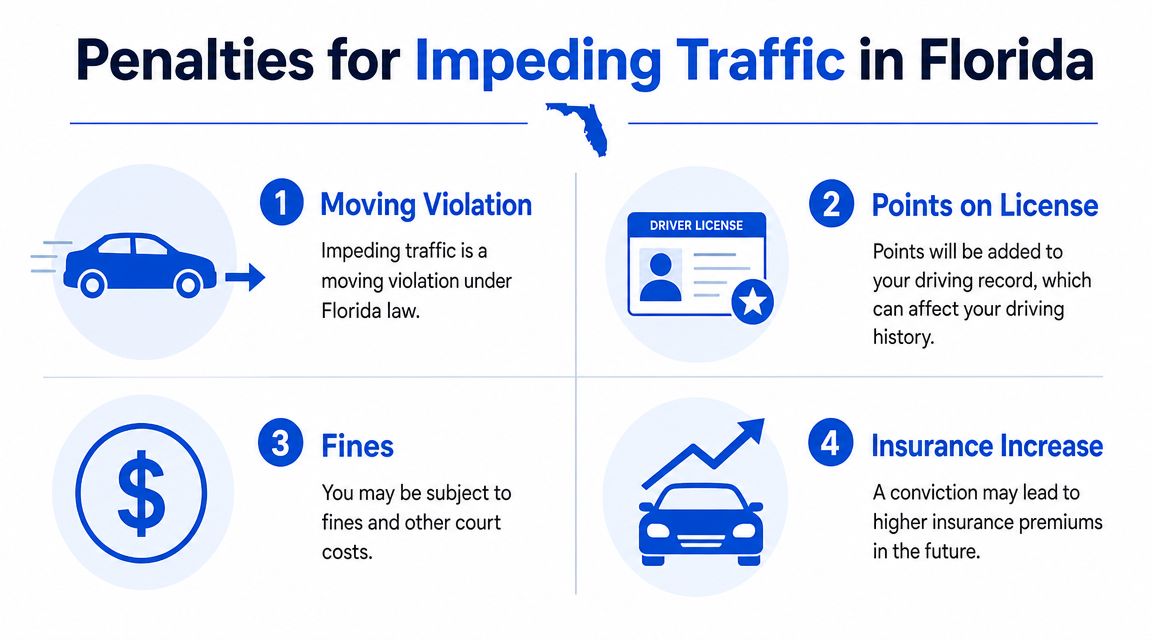
In Florida, a conviction for impeding the flow of traffic is a moving violation that adds 3 points to your license, and 12 points in 12 months results in an automatic 30-day suspension according to the Florida point suspension rules from FLHSMV.
That matters even if this is your first ticket in a while. Points stack. A citation that seems isolated can become the one that pushes your record into dangerous territory. If you're already watching your record, review how the Florida license point system works.
Why paying the ticket is a legal decision
Paying isn't just a convenience choice. It usually closes off your chance to contest what happened. You lose your advantage.
You also lose the chance to challenge weak observations, poor memory, missing context, and the officer's assumptions about the conditions. For an allegation built on whether your speed was “reasonable,” that's a serious surrender.
If the facts are debatable, don't waive the fight before anyone reviews them.
Common Scenarios That Result in a Ticket
Most impeding flow of traffic stops don't start with a dramatic event. They start with an officer deciding that your pace caused a backup, hesitation, or disruption.
Florida's rule isn't only about the left lane. The driver handbook explains that the statute applies to driving at such a slow speed as to impede or block traffic generally, which means it can be enforced in any lane if the speed isn't reasonable for conditions, as stated in the Florida Driver Handbook discussion of slow-speed violations.
Driving slowly in moving traffic
This is the classic stop. Traffic is moving. You're moving much more cautiously. The officer believes other vehicles had to brake, wait, or go around you.
Sometimes the driver is being overly careful. Sometimes the officer ignores what caused that caution. The legal issue is whether your speed was justified, not whether someone behind you got impatient.
Hesitating when conditions looked clear to the officer
These tickets also show up when a driver slows too much near a merge, an unfamiliar turn, a toll area, or a construction transition. The officer may think conditions were clear. You may have seen something different from the driver's seat.
That kind of difference matters in court. The officer usually has a snapshot. You lived the whole sequence.
Mechanical trouble that turned into a traffic stop
A car that won't accelerate normally, stalls, or behaves unpredictably can lead to exactly the kind of slow movement that gets flagged. If you were dealing with a vehicle issue, gather proof immediately. If you're still trying to figure out whether the problem was ignition, battery, or another starting fault, this guide offers practical advice for starting issues that can help you document what was going on.
Another variation is when the officer writes one ticket but the facts also suggest a lane-use complaint. If your stop involved both speed and lane position, it helps to understand improper lane usage in Florida.
How to Build a Defense Against Your Citation
You don't beat this charge with outrage. You beat it with facts.
Use the safe operation exception the right way
The strongest defense in many impeding flow of traffic cases is simple. Your reduced speed was necessary for safe operation.
That can include congestion, roadway hazards, weather, or other real conditions affecting safe travel. The statute itself preserves that exception. The state often has to prove your reduced speed was not necessary.
Your defense gets stronger when you stop speaking in conclusions and start speaking in specifics:
Road hazard: Debris, a disabled vehicle, sudden merging, or a confusing lane pattern.
Traffic conditions: Stop-and-go movement, unstable merging, or vehicles cutting across lanes.
Visibility problems: Rain, glare, standing water, smoke, or another condition reducing clear sight.
Vehicle limitation: A mechanical issue that affected acceleration or safe handling.
The defense isn't “I felt slow was safer.” The defense is “Here is exactly what made that speed necessary.”
Gather proof before it disappears
Start building your case the same day if you can.
Save dashcam footage: Don't assume it's stored forever. Many systems overwrite quickly.
Photograph the location: Capture lane markings, signs, traffic pattern issues, hazards, and shoulder conditions.
Pull weather records: If weather affected visibility or control, preserve that evidence.
Write your timeline: Note where the officer first saw you, what traffic was doing, and why you slowed.
Identify witnesses: Passengers matter. Other drivers can matter too.
Check the citation closely: Errors don't guarantee dismissal, but they can expose carelessness.
A lawyer can use those details to attack the state's narrative and frame a dismissal strategy. If you want to understand what that process can look like, review this breakdown of how to get a traffic ticket dismissed in Florida.
Your Immediate Next Steps and How We Protect You
The first move is the most important one. Do not pay the ticket before a lawyer reviews it.
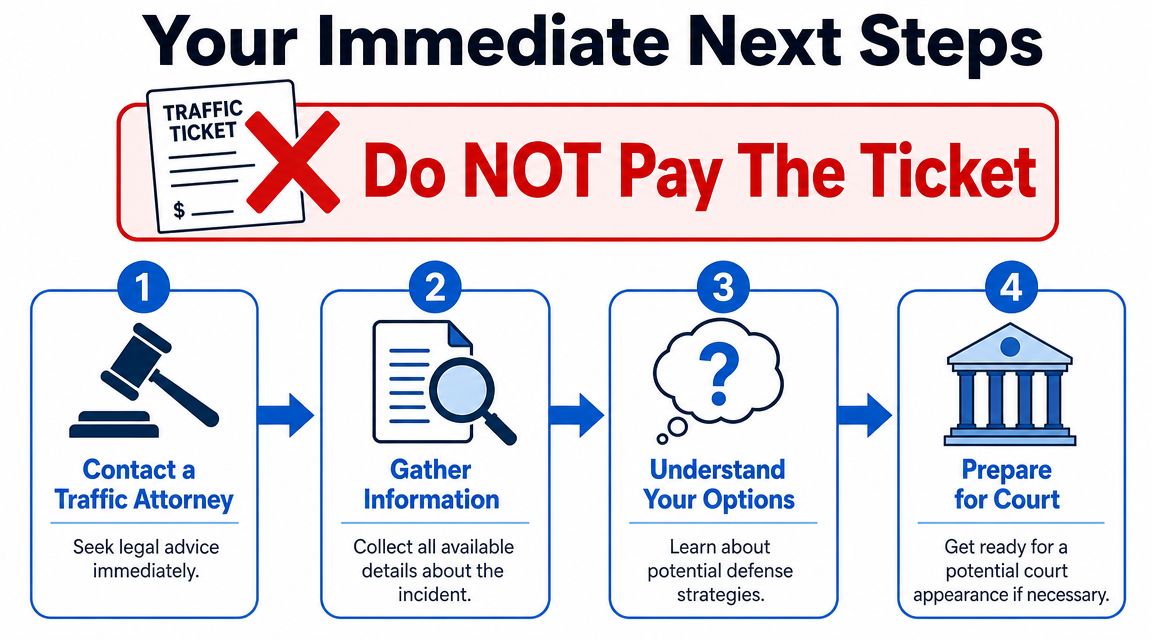
If you pay first, you usually give up the chance to challenge the officer's judgment and the surrounding facts. That is the opposite of protecting your record.
Immediate steps to take
Preserve the ticket and envelope: Dates, location codes, and officer notes matter.
Write down what happened: Do it while the memory is fresh. Include traffic, weather, hazards, and your route.
Save any media: Dashcam clips, phone photos, service invoices, tow records, and repair notes.
Don't explain the case online: Social posts and messages can create problems you don't expect.
Get legal advice quickly: Delay makes evidence harder to find and deadlines easier to miss.
Here's a practical overview of the process many drivers want to understand before they decide whether to contest the ticket:
Why a lawyer-led defense changes the case
A traffic ticket defense should not feel like customer support. You need legal analysis.
That's the difference between a lawyer-led model and automated apps or ticket mills that route you through forms, middlemen, or chatbot-style updates. When the issue is whether your conduct fit the safe-operation exception, the details need legal judgment, not canned responses.
At Ticket Shield, PLLC, drivers communicate directly with their attorney by phone or text. That matters when you need someone to evaluate the stop, identify the strongest defense, and handle the case with the goal of keeping points off your record. In courthouses across Florida, including Orlando's Orange County Courthouse, the advantage goes to the side that shows up with a coherent theory, organized facts, and a strategy.
Your target is clear. Protect the license. Protect the record. Push for a result that avoids points whenever the facts allow it.
Frequently Asked Questions
Can you get this ticket even if you were driving the speed limit?
Yes. The issue isn't only the posted maximum. The issue is whether the officer claims your speed impeded the normal and reasonable movement of traffic under the conditions.
What if you were driving slowly because you were lost?
Being lost doesn't automatically make the citation valid or invalid. It depends on what you did, where you slowed, and whether that slowdown was still necessary for safe operation.
Is heavy traffic a defense?
It can be. Congestion changes what “normal and reasonable” means, and context matters.
Should you just pay it and move on?
No. That's usually the mistake that turns a debatable ticket into a record problem.
If you got cited for impeding flow of traffic in Florida, act now. A strategic defense can protect your license and pursue the outcome you want, which is No Points. Visit Ticket Shield, PLLC for a free consultation.