How to Fight a Traffic Ticket in Florida: A Driver's Guide
Fight Traffic Ticket Florida: Learn your options, build a defense, and protect your driving record with expert guidance. fight traffic ticket florida
That flashing blue and red light in your rearview mirror is a feeling nobody enjoys. But once the officer drives away, leaving you with that little slip of paper, the stress really begins. What you do in the next 30 days will determine everything that follows.
Making a snap decision, like paying the fine just to get it over with, is often a mistake. It might feel like the easiest path, but it’s an immediate admission of guilt that can cost you far more in the long run.
Florida law gives you this critical 30-day window to weigh your options and make a smart, strategic choice. It's not just about the ticket; it's about protecting your driving record and your wallet.
You're at a fork in the road with three distinct paths. This decision tree lays out exactly where each choice leads.
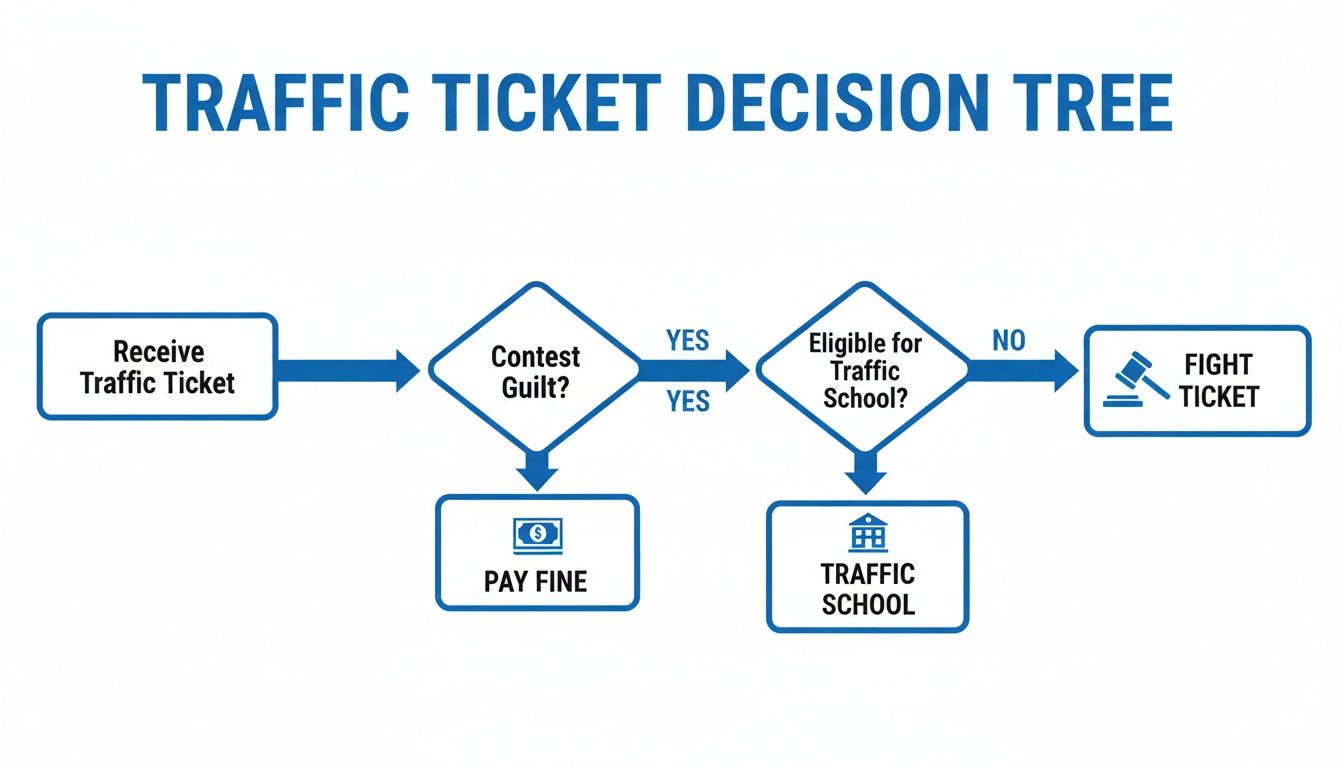
As you can see, only one option gives you a shot at a complete dismissal. Let's break down what each of these choices really means for you.
To simplify your decision, here’s a quick breakdown of your three main choices and what they could mean for your license and insurance down the road.
Your Three Options After Receiving a Florida Traffic Ticket
Action | What It Means | Potential Consequences |
|---|---|---|
Pay the Fine | You are pleading guilty to the violation. It's a conviction. | Points added to your license, potential insurance rate hikes, and a mark on your permanent driving record. |
Elect Traffic School | You can avoid points, but you still pay the full fine plus the course fee. | The violation still appears on your record, and you use up one of your limited chances to elect school. |
Plead Not Guilty | You are exercising your right to challenge the ticket in court. | The only path that offers a chance for a full dismissal—no fine, no points, and no impact on your insurance. |
Thinking through these outcomes is the first step toward making a decision that protects you from long-term financial pain.
Option 1: Just Paying the Fine
Paying the ticket is the same as standing in court and pleading guilty. It’s a fast track to a conviction, and that conviction is what triggers the real consequences.
Once points hit your license, your insurance company will likely notice. A single moving violation can cause your premiums to jump, a penalty you may be paying for years. That "convenience" of paying the fine can quickly add up to hundreds or even thousands of dollars in extra insurance costs.
With Florida's point system, it only takes 12 points in 12 months to have your license suspended.
Key Takeaway: The immediate fine is just the beginning. The long-term cost of increased insurance rates and the risk to your driving privileges often make paying the ticket the most expensive option.
Option 2: Electing Traffic School
If you’re eligible, you can choose to attend a Basic Driver Improvement (BDI) course. This is an option for keeping points off your license and preventing your insurance from going up.
However, it’s not a simple solution. There are strict limits:
You can only elect traffic school once every 12 months.
You’re limited to a total of five times in your entire life.
You still have to pay the full ticket fine plus the cost of the class.
It's a useful tool, but it doesn't make the ticket vanish. The violation is still on your record, and you've used up one of your precious opportunities for avoiding points.
Option 3: Pleading Not Guilty and Fighting the Ticket
Your third choice is to plead not guilty and fight the traffic ticket in Florida court. This is the only route that gives you a chance for a complete dismissal—meaning no fine, no points, and no insurance hike.
Fighting a ticket means you officially tell the clerk of court you intend to contest the citation, which sets up a hearing. Yes, it takes more effort, but it puts the power back in your hands. You get to challenge the evidence, question the officer’s methods, or point out procedural mistakes.
Because the process can feel intimidating, many drivers hire an attorney to handle it all. A lawyer who knows the system can manage everything from filing the plea to appearing in court for you, which is a significant advantage. You can learn more about the benefits by checking out our guide on how to fight a traffic ticket effectively.
How to Navigate the Miami-Dade County Court System
Fighting a ticket in Miami-Dade County means you're stepping into one of the busiest court systems in Florida. The sheer volume of cases creates a unique, fast-paced environment with its own set of local rules and procedures. If you want to fight a traffic ticket in Florida and have a shot at a favorable outcome, you first have to understand this hyper-local landscape.
Unlike smaller counties where you might find more flexibility, the process in Miami-Dade can feel rigid and impersonal if you don't know what you're doing. The moment you decide to plead "not guilty," a specific chain of events is set in motion, and you must follow every step.
Officially Pleading Not Guilty
Your first move is to formally tell the Miami-Dade Clerk of Courts that you're contesting the ticket. You must do this within the 30-day window after the officer handed you the citation. This can usually be handled online, sent in by mail, or done in person.
Pleading not guilty is more than just checking a box. It's you officially rejecting the state's claim and requesting your day in court. This is your right, but it also means you are now formally involved in the county's legal system.
Once your plea is in, the waiting begins. The Clerk of Courts will schedule your hearing and mail a notice to whatever address is on your ticket. It's on you to make sure that address is correct and to keep a close eye on your mail. Missing a court date is a fast track to a suspended license and a stack of extra fees.
What to Expect From Your Court Notice
The notice that arrives in your mailbox is packed with critical information. Pay close attention to:
The date and time of your hearing.
The courthouse location. Miami-Dade has several traffic court locations, so you have to show up at the one assigned to you.
The type of hearing scheduled. This is a detail a lot of people miss, and it’s an important one.
Understanding the type of hearing is key because your first court date might not be the final trial where you argue your case.
A common procedural step in Miami-Dade is scheduling a pretrial conference. This isn't the trial itself but an opportunity for your attorney to speak with the prosecutor or hearing officer to potentially resolve the case without a full trial.
Pretrial Conferences vs. Final Hearings
A pretrial conference is a preliminary meeting. For drivers who hire a lawyer, this is where strategic work can be done. An attorney can negotiate with the state, review the officer's evidence, and identify potential issues in the case. Many tickets can be resolved at this stage, often with a reduced charge or even a full dismissal. If you’re representing yourself, it might just be a chance to talk to a hearing officer.
A final hearing, on the other hand, is the trial. This is where you (or your lawyer) will formally challenge the evidence presented against you. The officer who wrote the ticket will be there to testify, and you'll get the chance to cross-examine them and present your own evidence. It's a much more formal event governed by strict rules of evidence and courtroom procedure. Knowing which hearing you're walking into dictates your entire strategy.
The Advantage of Local Knowledge
Just finding your way around a massive courthouse like the Richard E. Gerstein Justice Building requires a certain level of familiarity. An attorney who is in these Miami-Dade courts frequently understands the local rules, knows the prosecutors and judges, and can anticipate the procedural quirks that can challenge most people. That local insight is valuable. To see how that experience translates into results, you can read about a past case involving a dismissed speeding ticket in Miami-Dade County, FL. Prospective clients may not obtain the same or similar results.
When you hire a firm that handles Miami-Dade traffic defense, you're getting a professional to handle every filing, every deadline, and every court appearance. In fact, many of our clients never have to step foot in a courtroom. We run the entire process for you, letting you get on with your life while we work to protect your driving record. Our job is to make this as painless as possible by putting our experience to work for you.
Building Your Defense Strategy
You don't challenge a Florida traffic ticket by just showing up and hoping the officer doesn't. A defense strategy is built, piece by piece, with solid evidence and a clear plan. Your goal is to fight a traffic ticket in Florida by finding the holes in the state's case and shifting the burden of proof right back where it belongs—on them.
This process starts the second you get that citation. The details are still fresh, so it's the perfect time to document everything you remember about the traffic stop. That initial information becomes the bedrock of your defense.

Gathering Your Core Evidence
Every single detail counts. Think like an investigator and start collecting anything that can either back up your side of the story or cast doubt on what the officer claims to have seen.
Dashcam Footage: This is the gold standard of evidence. Unbiased video can show your actual speed, your position on the road, and the traffic conditions around you.
Photos of the Scene: If you can do it safely, snap pictures of the location where the ticket was issued. Get shots of any relevant traffic signs (or the lack thereof), the condition of the road, and anything that might have obstructed the officer's view.
Witness Information: Were there passengers in your car? Did another driver stop? Get their names and phone numbers. An independent witness who can back you up can be persuasive in court.
This initial evidence collection is your first line of defense. It gives you a tangible record to push back against the officer's report. From here, we can move into a more formal process.
Leveraging the Discovery Process
This is where a defense strategy really starts to take shape. "Discovery" is the formal legal process where your attorney demands to see all the evidence the state has against you. It’s not just about what you have; it’s about what they have and, more importantly, how strong (or weak) it really is.
Through discovery, an attorney can request key items that often form the entire basis of the state's case:
The officer’s sworn report and any handwritten notes.
Calibration and maintenance records for the speed detection device (radar, lidar).
All video and audio from the officer’s body camera and dashcam.
This is where we find potential issues. If the radar gun's certification has expired or the officer’s notes don't match the official report, it creates leverage to seek a case dismissal or negotiate a reduction.
Attorney Advertisement: An experienced legal team can meticulously review discovery materials to find procedural errors or technical flaws that can unravel the prosecution's case. Past results do not guarantee future outcomes, but our goal is to protect your license and record. Office in Broward.
Questioning the State's Evidence
Once all the evidence is out on the table, the real work begins: finding the weaknesses. For the most common tickets, like speeding, the defense usually focuses on attacking the accuracy and reliability of the officer's methods.
Challenging every citation is one way to avoid penalties.
Here are a few common angles we use to challenge the state's evidence:
Officer's Line of Sight: Was the officer's view of your vehicle totally clear? In heavy traffic on roads like the Palmetto Expressway in Miami-Dade, could they have mistaken your car for another one?
Radar/Lidar Operation: Was the speed gun used correctly according to the training manual? Factors like the angle, weather, and distance can all affect accuracy.
Pacing Accuracy: If the officer claims they "paced" you, did they maintain a consistent distance for long enough to get a reliable reading?
A strong defense is all about asking these tough questions and forcing the state to prove every single element of its case.
The Strategic Value of Hiring a Traffic Ticket Attorney
When you're staring at a traffic ticket, the first question that pops into your head is probably, "Is it worth hiring a lawyer for this?" It’s a fair question, and the answer becomes much clearer when you stop thinking of it as an expense and start seeing it as an investment.
You're not just paying a fee; you're investing in protecting your driving record, your time, and your bank account from the long-term fallout of a conviction.
Most people picture fighting a ticket as a day spent waiting in a packed courtroom. With a lawyer, that’s almost never the reality. An experienced attorney takes the entire process off your plate—from filing the not-guilty plea to negotiating with the prosecutor and showing up in court for you. For the majority of our clients, they never have to miss a day of work or even set foot in the courthouse.

Beyond Convenience: The Strategic Advantage
Saving you a trip to court is a huge plus, but the real power of having a lawyer is the strategic edge they bring to the fight. Attorneys who live and breathe Florida traffic defense know the ins and outs of local court procedures, the common holes in the state's evidence, and exactly how to talk to prosecutors.
They spot technical errors that an untrained eye would likely miss.
Was the radar or laser gun properly calibrated and maintained?
Did the officer follow every procedural step during the traffic stop?
Is there a flaw on the citation itself?
These aren't just minor details. Often, they're the very things that can get a ticket dismissed.
Attorney Advertisement: Our firm focuses on traffic and DUI defense across Florida. We handle the complexities of your case with the goal of protecting your license and record. Please note that past results do not guarantee future outcomes. Office in Broward.
An attorney's most powerful tool, however, is often negotiation. They have direct lines to the prosecutor and can argue for a lesser charge—like a non-moving violation that carries no points—or even get the whole thing dismissed before it ever gets to a judge. That kind of insider knowledge of the system is something you simply can't get on your own.
The Financial Logic of Legal Representation
At first glance, paying an attorney seems more expensive than just paying the ticket. This view can be short-sighted. The real cost of a traffic ticket isn't the one-time fine. It's the years of increased insurance premiums that can come after a conviction hits your record.
A single ticket can cause your insurance rates to spike, potentially costing you hundreds or even thousands of extra dollars over the next few years. In contrast, an attorney's fee is a one-time investment aimed at preventing those long-term costs. The goal is simple: avoid the conviction, which keeps points off your license and your insurance rates from increasing.
This is especially true for increasingly common violations. For instance, red light tickets are a major issue for Florida drivers, especially in dense urban areas like Miami-Dade. Ignoring them can lead to doubled fines and license suspensions, making the upfront cost of an attorney a smart financial move.
Ultimately, when you hire a firm to fight a traffic ticket in Florida, you’re paying for experience, strategy, and peace of mind. To get a better feel for whether this is the right move for you, check out our detailed article exploring whether you need a lawyer for a traffic ticket. Our focus is to protect not just your driving record, but your financial stability as well.
Don't Forget the Points: The Real Cost of a Florida Ticket
That fine printed on your ticket? It’s just the beginning. The real, lasting damage comes from the points that get tacked onto your Florida driver's license. The Florida Department of Highway Safety and Motor Vehicles (FLHSMV) uses this system to track your driving behavior, and it’s a system with serious consequences.
When you just pay a ticket for a moving violation, you’re officially pleading guilty. That conviction gives the state the green light to add points to your permanent driving record. Think of them like demerits. Once you collect enough, the consequences can snowball from steep insurance hikes to a full-blown license suspension.
How Points Pile Up on Your Record
The number of points you get depends entirely on how serious the violation is. A minor speeding ticket might only add three points, but a more serious offense can result in six points in a single go. They can add up quickly.
Even one 3-point ticket can be enough for your insurance company to reclassify you as a "high-risk driver." That means you can look forward to rate increases that could stick with you for years. This is why the decision to fight your ticket is so important—it’s about stopping this chain reaction before it even starts.
When Your License Gets Taken Away
The FLHSMV isn’t just counting points for fun; they are actively watching for patterns of risky driving. Accumulate too many points within a certain timeframe, and you will automatically lose your driving privileges.
These suspension thresholds are set in stone:
12 points within a 12-month period = 30-day suspension.
18 points within an 18-month period = 3-month suspension.
24 points within a 36-month period = 1-year suspension.
It’s easier to hit these numbers than you think. Imagine getting two careless driving tickets and one speeding ticket in a single year. That could be enough to get your license suspended, leaving you completely stranded and unable to get to work, school, or anywhere else you need to be.
Attorney Advertisement: Our practice focuses on traffic and DUI defense. The goal is to protect your license from accumulating points that lead to suspension. Please remember that past results do not guarantee future outcomes. Office in Broward.
Below is a quick reference for some of the most common violations. Understanding these numbers is the first step in realizing just how quickly a few bad days on the road can lead to serious consequences.
Florida DMV Points System for Common Violations
A breakdown of points assessed for frequent traffic infractions and the suspension thresholds every Florida driver should know.
Violation Type | Points Assessed | Notes |
|---|---|---|
Speeding (15 mph or less over limit) | 3 points | One of the most common tickets we see. |
Speeding (16 mph or more over limit) | 4 points | A higher-speed violation carries more weight. |
Running a Red Light or Stop Sign | 3 points | A conviction can also impact insurance rates. |
Careless Driving | 3 points | Often cited in minor accidents. |
Leaving Scene of Accident (Property Damage) | 6 points | One of the more serious moving violations. |
Remember, just two or three of these seemingly minor tickets within a year can put you dangerously close to losing your license. That's why every single citation matters.
The Stakes for Commercial Drivers (CDL Holders)
For anyone who drives for a living, the Florida points system is even more unforgiving. A Commercial Driver's License (CDL) is held to a much higher standard, and the consequences for traffic violations are far more severe.
A conviction for certain offenses, like leaving the scene of an accident or committing a felony with a commercial vehicle, can result in an immediate one-year disqualification of your CDL. Even things that seem minor, like an improper lane change or following too closely, are considered "serious" offenses for CDL holders. Getting just two serious violations within three years can lead to a 60-day disqualification; a third will get you a 120-day disqualification.
The bottom line is simple: if you have a CDL, your livelihood is on the line with every single ticket. You can't just elect traffic school to remove points for violations that happen in a commercial vehicle. The only way to protect your career is to fight every citation. You can explore the complexities of this topic further in our detailed guide on the Florida traffic ticket point system.
Common Questions About Fighting Florida Traffic Tickets
Dealing with a traffic ticket can be confusing, so it's normal to have a lot of questions. We get calls about these issues every single day. Here are some straightforward answers to the most common things people ask.
This is for your information and isn't a substitute for legal advice on your specific ticket. Any information submitted via online forms does not create an attorney-client relationship.
Can I Just Ignore a Traffic Ticket?
Absolutely not. Tossing a ticket and hoping it goes away is one of the worst things you can do in Florida. It sets off a domino effect of serious problems.
If you don't respond within that initial 30-day window, the state will move to suspend your driver's license. Driving on a suspended license is a criminal offense, and you'll be staring at even bigger fines and fees to get your driving privileges back. It’s a simple problem that can quickly spiral into an expensive, complicated mess. Always take action.
Is It Cheaper to Just Pay the Fine Instead of Hiring a Lawyer?
This is probably the biggest misconception out there, and it’s based on short-term thinking. While paying the fine might seem cheaper today, the long-term financial damage is often far worse.
When you pay that fine, you’re pleading guilty. That conviction is what triggers the potential pain:
Points on your license: This is the first domino to fall.
Insurance hikes: Your premiums can jump by hundreds or even thousands of dollars over the next three to five years.
Risk of suspension: Every point gets you closer to losing your license.
A lawyer's fee is a one-time investment designed to avoid all of that from happening. Our goal is to avoid the conviction, protecting your driving record and your wallet for years to come.
What if I Received a Ticket From a School Zone Speed Camera in Miami-Dade?
Florida has installed hundreds of automated speed cameras in school zones, and they're issuing citations frequently, particularly in large counties like Miami-Dade. Most drivers are understandably confused about what to do.
The first thing you get in the mail is usually a Notice of Violation (NOV), which isn't an official ticket yet. It's more like an offer to pay a fine before a real citation is issued. Many people feel pressured and just pay it, but you have other options.
Often, a different approach is to wait for the official Uniform Traffic Citation (UTC). Once you get the UTC, you have the formal right to fight it in court. That's where you or your attorney can challenge the evidence, like the camera's calibration and maintenance records.
How Long Will It Take to Resolve My Case?
The timeline really depends on where you got the ticket. In a huge, busy county like Miami-Dade, it could take several months from the day you plead not guilty to get your final court date.
Smaller, less populated counties might move a lot faster. The good news is, when you have an attorney, you don't have to stress about tracking dates or deadlines. We manage the entire schedule and all the court appearances for you, keeping you in the loop every step of the way.
Attorney Advertisement: Our practice focuses on handling traffic matters across Florida. We manage the entire legal process so you don't have to. Please be aware that past results do not guarantee future outcomes. Office in Broward.
Do I Have to Go to Court if I Hire an Attorney?
In the vast majority of cases, our clients never have to step foot in a courthouse. This is one of the biggest benefits of hiring a traffic ticket lawyer. We are legally allowed to go to all required court dates on your behalf.
This saves you from the stress of finding the courtroom, the headache of taking a day off work, and the anxiety of standing in front of a judge. We act as your professional representative, handling all the legal arguments for you.
What Happens if I Have a Commercial Driver’s License (CDL)?
If you're a CDL holder, the stakes are completely different—and much higher. The rules for commercial drivers are incredibly strict. A conviction for even a minor moving violation can put your entire career at risk.
For starters, CDL holders usually can't just elect traffic school to get points waived for a ticket they got in their commercial vehicle. Because your livelihood is on the line, fighting every single ticket isn't just a good idea; it's a necessity. An experienced attorney knows how to protect your CDL from the potential fallout of a conviction. We understand what’s at risk and handle these cases with the seriousness they demand.
Facing a traffic ticket can feel like a heavy weight, but you don't have to carry it alone. At Ticket Shield, PLLC, our team is here to manage the whole process for you, from start to finish. We work to protect your record, keep points off your license, and save you from potential insurance hikes. For a free, no-obligation case review, visit us at https://www.ticketshield.com.