Improper Lane Usage in Florida: A Defense Guide
Cited for improper lane usage in Florida? Learn what FL Statute 316.085 means, the real penalties, and how a lawyer-led defense can protect your record.
You just got pulled over. The officer says you drifted, changed lanes unsafely, or failed to stay in your lane. Your first instinct is to pay it and move on. That's a mistake.
In Florida, an improper lane usage ticket can do more damage than most drivers expect. It can put points on your record, drive up insurance, and create real problems if you drive for Uber, Lyft, or delivery apps, or if you need a clean record for work. The good news is this ticket is often defensible, especially when the officer's opinion doesn't match what Florida law requires.
Table of Contents
What Does an Improper Lane Usage Ticket Really Mean?
An improper lane usage ticket is not just a fine; it's a moving violation that puts points on your license and raises your insurance. You must act decisively to protect your record, as fighting it is often possible and necessary.
If you're treating this like a minor annoyance, stop. Florida officers and courts don't view improper lane usage as harmless. They connect lane movement violations to crash risk, and that drives aggressive enforcement.
That concern isn't random. Lane-change crashes account for a significant share of all crashes, and up to 610,000 are reported to police annually, causing at least 60,000 injuries, according to this review of lane-changing crash risks and NHTSA figures. That's why officers often write these tickets with confidence. They assume lane movement equals unsafe driving.
But your case still turns on proof, not assumption.
Why this ticket matters more than drivers think
The officer writes a short description. You crossed a line. You moved unsafely. You weaved. That sounds simple. In court, it rarely is.
A lane movement case depends on details such as road markings, traffic flow, visibility, your driving pattern, and whether your movement was unsafe. If your vehicle never created a real hazard, the ticket may be weaker than it looks.
Practical rule: If the only evidence is an officer's brief opinion that you “drifted,” you may have defenses worth pressing.
If your stop involved a merge or sideswipe allegation, it also helps to understand how fault is assigned in merge accidents. Fault in a crash setting and guilt on a traffic citation aren't identical, but the same facts often matter. Positioning, signaling, lane control, and driver reaction all become important.
How Does Florida Law Define Improper Lane Usage?
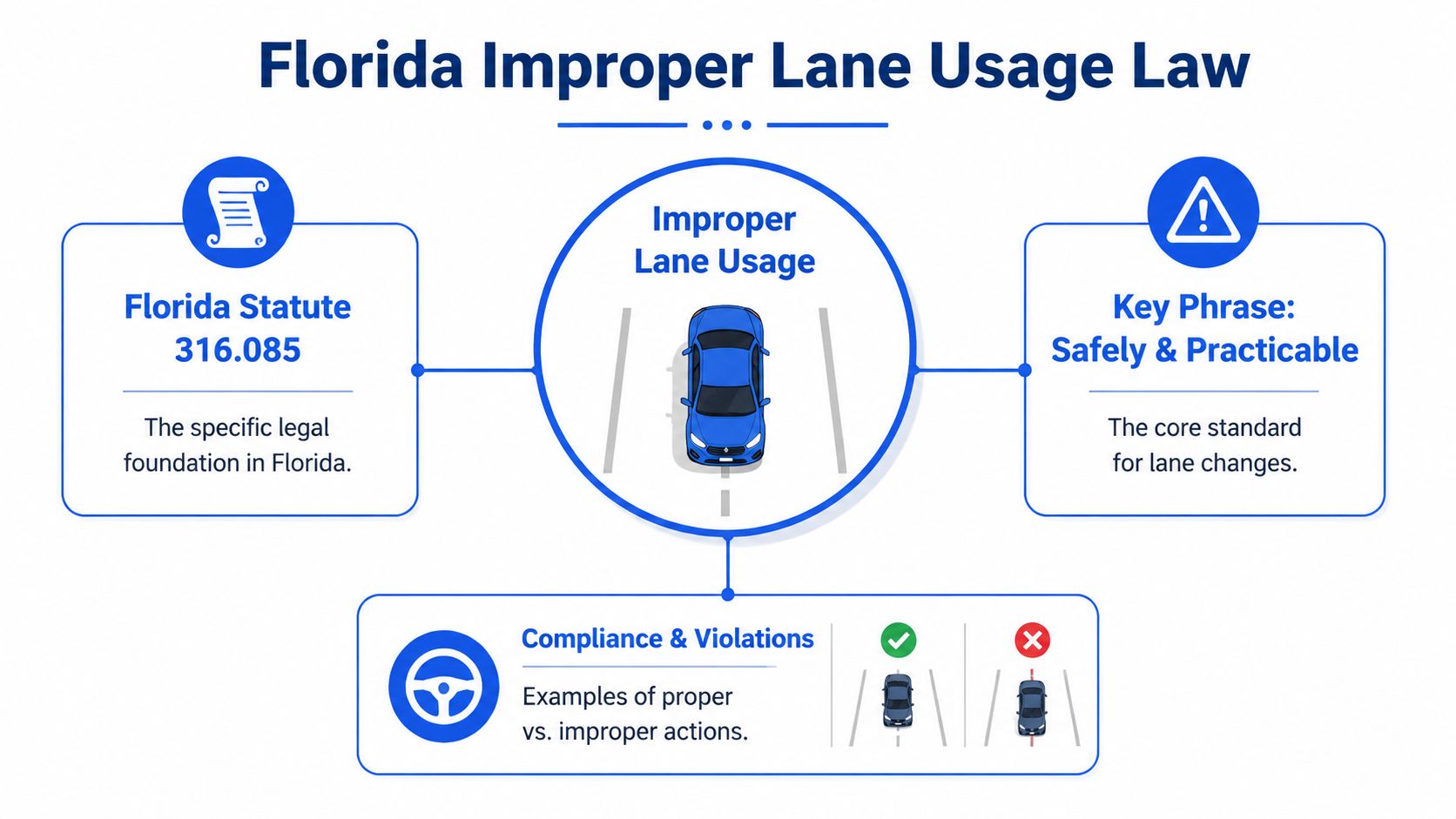
Florida law starts with Florida Statute 316.085. The key phrase is that a driver must stay within a single lane “as nearly as practicable” and move from that lane only when it can be done safely.
That language matters. It gives you room to defend the case.
What the statute actually says
“As nearly as practicable” does not mean perfect. It does not require robotic steering. It recognizes real driving conditions on Florida roads.
Florida Statute 316.085 requires driving as nearly as practicable in one lane, and courts often interpret that narrowly. A violation generally has to come from a driver-controlled act, such as distraction, rather than outside conditions like poor roadway conditions.
That distinction is where many defenses begin.
A pothole, faded lane marking, debris, a sudden need to avoid another vehicle, or a corrective steering input on a crowded highway can matter. The statute does not turn every touch of a lane line into a valid citation.
Why practicable matters
Misunderstandings often arise between officers and drivers. An officer may believe any lane deviation is enough. Florida law is more specific.
Courts have recognized that minor, brief lane contact is not automatically actionable improper lane usage. If your movement was slight, isolated, and corrected safely, the state may not be able to prove a true violation under the statute.
A good defense often starts with one question. Was your movement actually unsafe, or did it just look imperfect for a second?
If you want a related comparison, Tampa left lane accident laws help show how lane rules and practical roadway behavior can diverge. Different lane issues trigger different legal standards, and officers don't always separate them cleanly.
For a closely related Florida traffic issue, this guide on failure to maintain lane in Florida is also useful because many drivers are cited under labels that sound similar but carry different proof problems.
What Are the Penalties for This Violation?
Paying the ticket closes the case fast. It also hands the state a conviction.
At the Edgecomb Courthouse in Tampa, and in courts across Florida, drivers often learn too late that convenience costs more than defense. The fine is only the first problem. The lasting damage usually shows up on your record and in your insurance bill.
Why paying the ticket is usually the wrong move
An improper lane usage citation is a moving violation. That means points exposure and insurance consequences. Once you pay, you usually lose the opportunity to challenge the officer's observations, the roadway conditions, and the legal sufficiency of the citation.
A single moving violation like improper lane usage can trigger insurance premium hikes, with some data suggesting increases of 28% or more. It can also cause immediate trouble for gig drivers and create problems for military personnel who need clean driving records.
That's why this decision is financial, not just legal.
Issue | Why it matters |
|---|---|
Points | Points can affect your record and create future suspension risk if violations stack up |
Insurance | A single conviction can lead to premium increases that outlast the ticket itself |
Employment | Driving-based work can be interrupted quickly when your record changes |
Time | Fixing a preventable conviction later is harder than defending it now |
If you need to understand the broader consequences, review Florida's traffic ticket point system.
Why this hits certain drivers harder
Not every driver absorbs this ticket the same way.
If you drive for an app, one moving violation can trigger account review or worse. If you're military, a blemish on your record can create professional headaches you don't need. If you're a busy commuter, the cost isn't just money. It's time, distraction, and risk.
Here's a short overview that puts the issue in practical terms:
Don't measure this ticket by the amount printed on the citation. Measure it by what it can cost you over time.
What Evidence Is Used in These Cases?
Improper lane usage cases are built on evidence, but not always strong evidence. Many tickets start with one officer's roadside interpretation. That's not the end of the story.

What the officer will rely on
Most cases begin with the citation, the officer's notes, and sworn testimony. If available, the state may also use dash footage from the patrol car or body camera recordings. Sometimes that footage helps the prosecution. Sometimes it exposes a weak stop or vague observations.
If the officer says you were weaving, drifting, or making an unsafe lane movement, your lawyer should test that claim against the actual video, roadway layout, and timing. Words like “unsafe” and “erratic” sound strong. They still need support.
What you should gather now
Your own evidence can change the entire case. Start preserving it immediately.
Dashcam footage: This is often the most useful evidence because it shows lane position, traffic, road hazards, and whether your movement was brief and controlled.
Roadway photos: Take pictures of faded lane markings, construction, debris, potholes, shoulder conditions, and anything else that explains your movement.
Vehicle records: If steering, tires, alignment, or another mechanical issue played a role, get that documented.
Timeline details: Write down where you were, traffic density, weather, and what happened before the stop while your memory is still fresh.
If the stop itself was questionable, a lawyer may also examine suppression issues. This overview of motions to suppress evidence in traffic cases gives you the framework.
The strongest traffic defenses are built early. Video gets overwritten. Memories fade. Road conditions change.
How Can You Defend Against an Improper Lane Usage Ticket?
You defend this ticket by attacking the legal threshold. Not by arguing in general terms that you're a safe driver. Not by hoping the court gives you a break. You win by showing the alleged movement does not satisfy Florida law.
The strongest defense angles under Florida law
One of the strongest arguments is simple. Momentary, minor lane deviations do not automatically qualify as improper lane usage. Courts have recognized that even crossing a broken lane divider twice over a half-mile, or barely entering an adjacent lane, can fall below the legal threshold for actionable unsafe driving, as discussed in this review of Florida improper lane usage case standards.
That matters because many tickets are written for exactly that kind of conduct.
A strong defense may focus on one or more of these themes:
Minor correction, not erratic movement
If your tires touched or crossed a line briefly and you corrected safely, the state may not be able to prove substantial erratic driving.External condition, not driver fault
Faded markings, debris, weather, road defects, or surrounding traffic can explain the movement without proving a driver-controlled violation.Officer subjectivity
Many lane usage stops are based on split-second impressions. If video or physical conditions don't support the description, credibility becomes a real issue.Mechanical explanation
Tire, steering, suspension, or alignment issues can support a non-negligent explanation when documented quickly.
Immediate Steps to Take
If you've just been cited, do these things now.
Save every video file: Download dashcam footage and make a backup before it disappears.
Photograph the scene: Return safely and document lane markings, signage, surface conditions, and any construction or hazards.
Write your account today: Include traffic flow, your speed, the officer's statements, and why you moved.
Do not just pay it: Payment is usually an admission that closes off useful defenses.
Talk to a Florida traffic lawyer quickly: Early review can identify dismissal issues, factual weaknesses, and court options.
For a broader overview of strategy, review how to fight a Florida traffic ticket.
How Does Ticket Shield Provide a Lawyer-Led Defense?
You should be careful about who handles this. A lot of drivers assume all ticket help is the same. It isn't.
Why direct lawyer access matters
Some services operate like intake funnels. You fill out a form. You get routed through support staff. Questions get answered slowly or not at all. In some systems, the process feels more like an automated app than legal representation.
That's the problem.
With Ticket Shield, PLLC, the model is lawyer-led. You communicate directly with your attorney by phone or text. That matters when your case turns on details like roadway conditions, dashcam footage, officer wording, and court strategy. If you want to understand whether hiring counsel makes sense in your case, start with this overview of a Florida traffic ticket attorney.
What a real defense process looks like
A proper defense is straightforward when handled correctly.
First, your case gets reviewed for legal threshold problems under Florida Statute 316.085. The key question is whether the alleged conduct rises to improper lane usage.
Second, the lawyer handles filings, court coordination, and the evidence review. That can include video, photos, roadway conditions, and the officer's narrative.
Third, the focus stays where it belongs. Protecting your license, limiting insurance fallout, and pursuing the outcome every driver wants: No Points.
If you're worried about your record, don't hand this off to a chatbot or a middleman. Put a lawyer on it.
If you were cited for improper lane usage in Florida, act now. A fast review can uncover defenses before evidence disappears and before a simple ticket turns into points and higher insurance. Visit Ticket Shield, PLLC for a free consultation and fight for the No Points result.