
Hardship License Brevard County Florida
Get your hardship license brevard county florida with our 2026 guide. Find step-by-step instructions on eligibility, forms, and fees.

Your license is suspended. To get a hardship license in Brevard County, you must act fast, confirm eligibility, complete required courses, and file the right forms with DHSMV. Mistakes can cost you your right to drive.
The stop is over. The tow truck is gone. Now you're staring at the core problem. You still need to get to work, pick up your kids, keep medical appointments, and protect your record. A suspended license in Brevard County can wreck your routine fast.
Florida does not make this process simple. The hardship license process runs through strict administrative rules, hard deadlines, and hearing officer discretion. Florida Statute 322.271 governs hardship reinstatement, and Chapter 316 still matters because the driving conduct that started this mess often began with an alleged violation under Florida traffic law. If you're dealing with a DUI-related suspension, every choice you make right now matters.
You need a plan. You also need to understand that the state system is not designed to guide you.
Table of Contents
Your License Is Suspended in Brevard County What Now
You leave work in Brevard County, get behind the wheel, and then realize your license is suspended. Now every decision matters. One wrong move can turn a suspension problem into a new criminal charge, a longer loss of driving privileges, and a much harder path back to work, school, or your kids.
If you need a hardship license in Brevard County, Florida, stop treating this like a customer service issue. It is a legal process run by the state on strict terms. Florida requires many drivers seeking hardship reinstatement to complete the 12-hour Advanced Driver Improvement course, get the enrollment verification letter, gather a current driving record and the required application, and file through the proper DHSMV review channel under Florida's hardship reinstatement rules.
Why the process feels harder than it should
Because the system is unforgiving.
The state does not fix your paperwork for you. The hearing officer does not tell you what is missing before denying you. If your suspension involves a DUI arrest, a refusal, prior alcohol history, unpaid obligations, or the wrong course, the process can go sideways fast. Automated services miss those issues every day because they treat every suspension like the same form packet.
A lawyer does not.
A real attorney reviews the reason for the suspension, spots conflicts between the administrative file and the court case, and catches the kind of mistake that gets hardship applications rejected. If you need a broader roadmap, start with this guide on how to reinstate your suspended driver's license.
Immediate steps to take
Stop driving until you know your status: Driving on a suspended license can create a new case and give the state more advantage against you.
Pull your driving record immediately: You need the actual basis for the suspension, not a guess, not a clerk's summary, and not advice from a friend.
Confirm which hardship track applies: DUI-related suspensions, refusals, and other suspensions do not all follow the same path.
Enroll in the correct required course if your case calls for it: Filing before that step is handled can waste time you do not have.
Build the file correctly the first time: Your record, enrollment proof, and application have to match the reason for the suspension and the relief you are requesting.
Ticket Shield's lawyer-guided approach matters here because the state process punishes small errors. Self-represented drivers often file the wrong documents, miss a deadline, or assume the criminal court date controls everything. It does not. In Brevard County, you need someone who knows where the traps are and moves before the state closes another door.
Did You Miss the Critical 10-Day Window
This is the deadline that ruins cases.
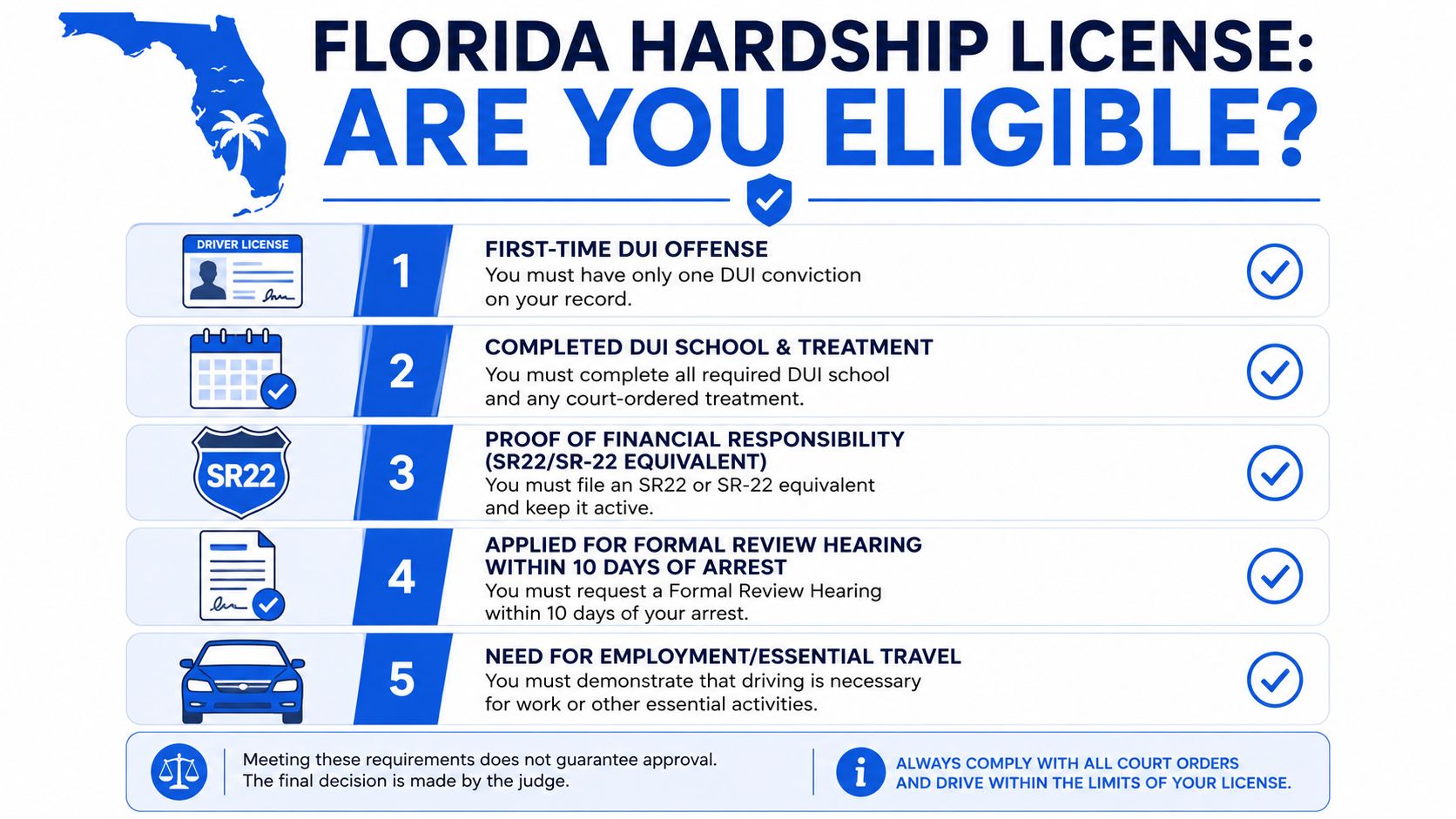
In Brevard County, you must request an administrative DMV hearing within exactly 10 days of your DUI arrest to preserve your right to a hardship license. If you miss that deadline, you forfeit eligibility entirely and face a full suspension without recourse, according to Brevard DUI license restoration guidance.

What that deadline actually controls
Most drivers think the criminal case controls everything. It doesn't. The administrative side moves on its own track, and it moves immediately.
That means your license problem may become far worse before your criminal charge is even resolved. If you fail to act during that short post-arrest window, you don't just lose a procedural option. You may lose the foundation for hardship relief.
The drivers who recover fastest are the ones who treat the administrative deadline as seriously as the arrest itself.
Self-representation often collapses. People call around. They wait for paperwork. They assume the court date is what matters. Then the deadline expires, and the state closes the door.
If your DUI arrest is fresh, read this breakdown of Florida DUI license suspension consequences. Then act. Today.
What to do if the clock is still running
Use this short decision table and stop overthinking it.
Situation | Smart response |
|---|---|
You were arrested days ago | Confirm the arrest date immediately and calculate whether the hearing deadline is still open |
You haven't requested a hearing | Do that before anything else |
You already enrolled in classes but missed the hearing request | Understand that class enrollment does not fix a missed administrative deadline |
You're relying on an automated app | Stop. A generic workflow won't protect a deadline this strict |
Short version. If you're still inside the window, preserve it first. If you're outside it, you need a candid eligibility review, not false comfort.
Are You Eligible for a Florida Hardship License
You need an answer fast, but you need the right answer.
A lot of drivers in Brevard County assume hardship eligibility is simple. It is not. Florida looks at the reason for the suspension, your driving history, and whether you completed the required steps before it gives you limited driving privileges. If you guess wrong, you can burn time, pay for the wrong program, and walk into a denial that was avoidable.
For DUI-related hardship relief, completion of a state-approved DUI program is required, and that local process is described in the Brevard County DUI school requirements.
What type of hardship license are you seeking
Florida does not hand out a general permission slip to drive. The state limits driving to specific purposes, usually work, business, school, church, or necessary household obligations. Hearing officers want proof that the driving request is tied to real need.
That is where many self-filed cases go off track. People describe inconvenience. The state wants necessity.
If you need a plain-English overview of the state rules, start with these hardship license requirements in Florida. Then get your own record reviewed before you file anything.
What eligibility usually turns on
In Brevard County DUI cases, eligibility usually rises or falls on a few specific points:
The actual basis for the suspension: A DUI administrative suspension is handled differently from a points suspension, failure to pay, or another non-DUI issue.
DUI school status: If your case is DUI-related, the state-approved program is part of the hardship process.
Substance abuse evaluation: The DUI school process includes screening for alcohol or drug dependency, and that result can affect what happens next.
Your underlying record: Prior suspensions, prior DUI history, and unresolved requirements can block relief even when you believe you have a good reason to drive.
Your supporting paperwork: Missing records, inconsistent dates, or incomplete arrest documents can stall a case that might otherwise be approved.
Do not spend money or file forms until someone confirms the exact suspension type on your record. That mistake costs people weeks.
This is the difference between an automated service and a lawyer-guided strategy. An app can tell you that hardship licenses exist. It cannot catch a disqualifying record issue, a filing problem, or a mismatch between your suspension code and the relief you are requesting. Ticket Shield can.
Some drivers qualify on paper and still lose ground because they file under the wrong theory. Others are eligible, but only after cleaning up one hidden problem first. If your job, medical care, or family obligations depend on driving, do not trust guesswork. Get a precise eligibility review and make your next move count.
What Documents and Forms Do You Need to File
Paperwork is where drivers lose time they do not have.
In Brevard County, the state will not sort out a sloppy hardship packet for you. If your documents are incomplete, out of order, or tied to the wrong suspension basis, you get delays, resets, or a denial. That is exactly why self-filed cases break down. People grab forms online, miss one record, and walk into a process that gives them no room for error.
Start with the documents that prove who you are and why you are asking for relief. In plain terms, you need your identification, proof of Brevard County or Florida residency, your current driving record, the hardship application form that matches your case, and any supporting records tied to the suspension. If the suspension involves alcohol, drugs, or an arrest package, include every related document you were given, such as the citation, affidavit, report, and test paperwork if it exists. Missing one of those items can stop the file cold.
Do not treat this like a checklist you can finish in any order.
Build the packet the way a hearing officer expects to review it:
Identity and residency records first. Put in your photo ID and proof of address.
Your driving record next. That gives the reviewer the history up front.
Your application form after that. Make sure it is complete, signed, and consistent with the suspension type already on your record.
Course or program proof, if your case requires it. Use the enrollment or completion document that applies to your suspension category.
Any arrest or DUI-related records last. Include the citation, complaint or affidavit, police paperwork, and chemical test documents if they are part of the case.
Order matters because confusion hurts credibility. A hearing officer should be able to pick up your packet and understand it without hunting for missing pages or trying to reconcile conflicting dates.
That is where lawyer-guided preparation beats an automated form service every time. An app can tell you to upload documents. It will not catch that your driving record and application are describing different suspension events, or that your arrest paperwork is incomplete, or that a missing page will force a continuance you cannot afford. Ticket Shield helps you prepare the file around the actual issue on your record, not around a generic template. If you need a practical overview first, review how to apply for a hardship license in Florida.
If your suspension followed a crash, your supporting records need extra care. Dates, agency reports, and related accident details can affect how your file is reviewed and how your timeline is explained. For that part of the picture, read expert accident guidance from CAINE LAW.
Get the packet right before you file it. In this process, a preventable paperwork mistake can cost you weeks of legal driving time.
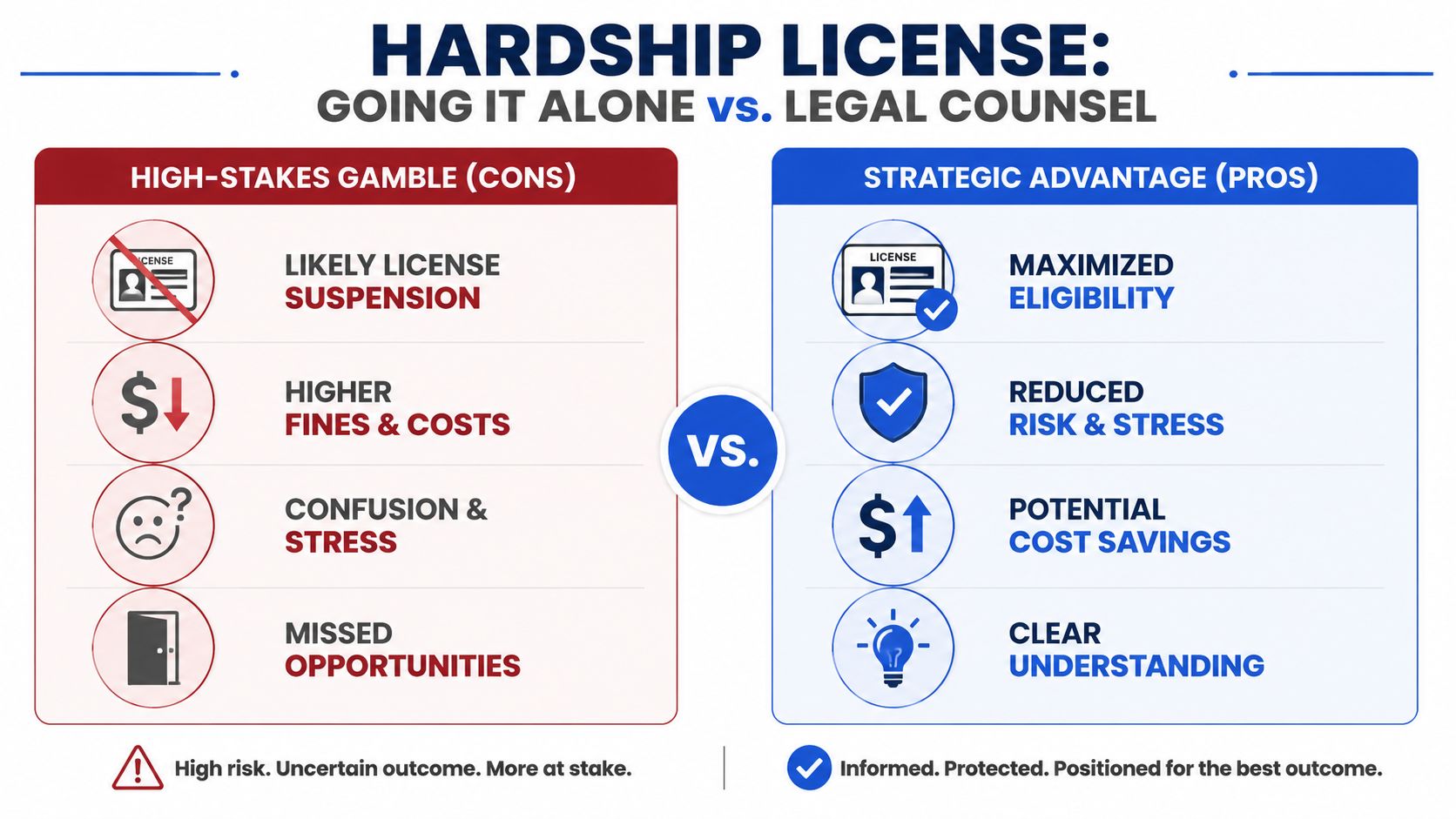
Why Going It Alone Is a High-Stakes Gamble
The biggest mistake isn't the arrest. It's assuming the next part is easy.
A Florida hardship license can be explicitly ineligible for suspensions resulting from a DUI conviction if the case is not challenged administratively. The same guidance explains that only drivers who successfully argue police misconduct or a faulty breathalyzer test at their DMV hearing within the 10-day window can qualify for this limited license to drive to work or school, according to Florida hardship DUI eligibility guidance.
Where self-represented drivers get hurt
People lose these cases in predictable ways.
They miss the deadline. They enroll in the wrong program. They show up with an incomplete packet. They say too much at the hearing. They assume the hearing officer will give practical guidance. They trust an app that only pushes forms and reminders.
None of those things is a strategy.
If your suspension followed an accident as well as a DUI investigation, outside facts may also affect how you present the sequence of events. In that setting, practical resources like expert accident guidance from CAINE LAW can help you understand what information matters early and what mistakes create long-term problems.
You don't need a chatbot. You need someone who can spot the issue you haven't noticed yet.
Why a real lawyer matters more than software
An automated service can collect basic information. It cannot exercise judgment. It cannot challenge weak evidence. It cannot prepare you for questions tied to your record, your need to drive, or the procedural posture of your case.
A lawyer can.
That matters in places where the stakes are real and personal. A hearing tied to Central Florida procedures may affect your ability to keep your job. A misstep tied to a Chapter 316 allegation can spill into insurance, employment, and future exposure. In larger Florida systems, from the Richard E. Gerstein Justice Building in Miami to regional administrative offices serving Brevard drivers, bureaucracy rewards precision, not effort.
Here is the honest comparison:
Going alone | Using legal counsel |
|---|---|
You interpret the record yourself | A lawyer identifies the issue category and likely barriers |
You guess at the right filing path | A lawyer matches the filing path to the suspension type |
You speak without strategy | A lawyer controls the presentation |
You trust generic software prompts | A lawyer applies judgment to facts, timing, and risk |
If your license is already suspended, review what a Florida suspended license lawyer does before you decide to handle this on your own.
Take Control with Ticket Shield Your Next Step
You wake up in Brevard County, realize you still have to get to work, get your kids where they need to go, and deal with a suspended license the state will not fix for you. That is the moment to act. Waiting to feel more prepared is how drivers lose time, miss filing opportunities, and make a bad record harder to clean up.
If you're facing a hardship license in Brevard County, Florida problem, do one thing today. Get a case review with a Florida traffic defense lawyer who handles license suspensions and hardship issues as a daily practice. You need a plan tied to your suspension type, your deadline, and your driving history.

What happens in a free consultation
A good consultation should answer the questions that matter right now.
Can you still request a formal review. Are you eligible for hardship driving. What paperwork is missing. What mistake could get your request denied. What should you say, and what should you stop saying.
Ticket Shield, PLLC focuses on getting those answers fast. You speak with your attorney directly by phone or text, and you get a clear next-step plan instead of vague instructions or generic intake language. That saves time, which matters when the state process is rigid and deadlines do not bend for honest mistakes.
What you should do today
Before you call, gather these items:
Your citation or arrest paperwork
Any notice of suspension from DHSMV
Your driving record, if you have it
Proof of why you need to drive, such as work, school, or family obligations
A written timeline of what happened and when
Then get legal advice before you file anything else. Do not guess at the right form. Do not assume the clerk will explain the strategy. Do not wait for an automated service to sort out a problem that depends on judgment.
Ticket Shield, PLLC gives drivers a direct path through a process that punishes delay and paperwork errors. If your goal is to protect your driving privilege and pursue the best available outcome, visit Ticket Shield, PLLC for a free consultation.
