FSS Failure to Maintain Lane: 2026 Florida Guide
Learn how to handle an FSS failure to maintain lane citation in Florida. Get key tips for your traffic defense in 2026.

Florida's failure to maintain lane violation is governed by Statute 316.089 and typically carries 3 points on your license, while the fine can escalate insurance costs by thousands. Paying without reviewing your options can turn a brief lane dispute into a lasting driving-record problem.
You're holding a citation, replaying the moment in your head, and wondering whether the fastest solution is to pay it. Don't make that decision on fear or convenience. A Florida lane-discipline citation can affect your license, insurance, and ability to drive legally long after the traffic stop ends.
The phrase FSS failure to maintain lane usually refers to an allegation under Florida Statute § 316.089. The facts matter. A momentary drift, unclear markings, an obstruction, an emergency maneuver, or a safe lane change may create defenses that a quick payment destroys.
Table of Contents
Why Paying Your Florida Traffic Ticket Is a Mistake
The patrol lights appear in your mirror. The officer says you crossed or touched a lane line. You receive a citation, and the fine looks like the simplest problem to eliminate. It isn't. Paying can close the case in the government's favor while leaving you to absorb the consequences.
A failure-to-maintain-lane citation is a moving violation. The immediate payment may feel manageable, but the record consequences can last far longer than the stop. Points can contribute to a suspension when a driver accumulates too many, and higher insurance costs can follow.
The paper in your hand carries more risk than the fine
Florida's official citation coding identifies § 316.089 as “Failed to use DESIGNATED LANE/Failed to DRIVE WITHIN” a lane, confirming that the allegation is a recognized lane-keeping violation in the state's traffic system (Florida's official citation coding appendix).
That label doesn't answer the critical question: Did the facts establish a violation? It also doesn't tell you whether the officer observed a deliberate lane departure, a safe movement, or a brief correction caused by roadway conditions.
Practical rule: Don't pay a moving citation until a Florida traffic lawyer has reviewed the charge and its consequences.
A payment may eliminate the court appearance, but it can also remove your opportunity to challenge the observation, preserve evidence, or pursue a resolution that protects your record. Your license is not a convenience. It controls your work, family responsibilities, and freedom to travel.
Understanding Florida Statute 316.089
Florida Statute § 316.089(1) applies when a roadway has two or more clearly marked lanes. The statute requires a vehicle to be driven “as nearly as practicable” within a single lane and prohibits leaving that lane until the driver has first determined the movement can be made safely, as reflected in Florida appellate authority discussing the lane-discipline standard.
That wording matters. The law doesn't demand an impossible degree of precision under every roadway condition. “As nearly as practicable” requires a factual assessment of what happened, including the markings, road layout, visibility, traffic, and reason for the movement.
What the state must establish
The allegation generally turns on several factual questions:
Covered roadway: Did the roadway have two or more clearly marked lanes?
Vehicle position: Did the vehicle fail to remain within a single lane as nearly as practicable?
Safety determination: Did the driver leave the lane without first determining that the movement could be made safely?
Nature of movement: Was the event an unsafe departure, or was it a lawful and safely executed lane change or necessary maneuver?
Florida courts have repeatedly quoted this statutory standard. The violation isn't strict liability in every context. The prosecution still must prove the charged conduct through the evidence surrounding the driving event.
A police officer's observation can be important, but it isn't automatically the end of the analysis. Distance, lighting, traffic, road curvature, line visibility, the officer's position, and the duration of the alleged departure can affect the reliability of the account.
Why the citation alone isn't the whole case
The statutory phrase “as nearly as practicable” gives defense counsel room to examine context rather than accept a conclusion based on a single tire movement. A driver who crossed a line while avoiding a hazard presents a different case from a driver who repeatedly weaved across visible markings.
Florida's broader traffic-law framework also includes § 316.085, titled “Limitations on overtaking, passing, changing lanes and changing course,” which may matter when the citation involves a passing or lane-change maneuver (Florida Statutes Chapter 316). Read the citation carefully. The exact statute and facts determine the defense.
For a plain-language overview of Florida traffic laws, review Florida traffic laws and lane-use rules, then have counsel evaluate your specific citation.
What a Conviction Actually Costs You
The amount printed on your citation is only the first cost. A conviction can add three points to your Florida driving record. Those points can create further trouble if additional violations accumulate or an insurer treats the lane charge as evidence that you pose greater risk behind the wheel.
Insurers can change how they evaluate you without waiting for a crash. A moving violation may affect underwriting decisions and premiums, and the financial consequences can continue long after you pay the citation. Calling the ticket “just a fine” ignores the record you may be accepting.
Lane-position violations also receive attention because roadway departures can cause severe injuries and deaths. NHTSA reported 1.12 million roadway-departure type crashes, representing 19.4% of all crashes, with about 14,844 fatalities (NHTSA crash data). That safety context helps explain why officers investigate lane-position events. It does not prove that every brief movement across a lane marking was unlawful.
Protect your driving record in the right order
Read the citation. Confirm the statute, court information, response instructions, and description of the alleged violation.
Calendar the deadline. Missing the response date can create a separate problem and may trigger additional administrative consequences.
Do not pay first. Payment can close off your opportunity to contest the allegation and may leave you accepting the conviction and its points.
Preserve evidence. Save dashcam footage, photographs, repair records, weather information, and witness names before anything disappears.
Get legal review. A lawyer can compare the officer's account with the statutory elements and determine whether a resolution can protect your record.
Cost Factor | Paying the Ticket | Contesting with Ticket Shield |
|---|---|---|
Immediate decision | Payment closes the matter without a defense review | Counsel reviews the citation and available options |
Driving record | The conviction and associated points may remain | The defense seeks a result that avoids points where legally available |
Insurance exposure | The record may be considered by an insurer | A non-conviction outcome may reduce record-related exposure |
Evidence | You may lose the chance to challenge the allegation | Counsel can identify and preserve relevant evidence |
Court strategy | You handle the consequence alone | A lawyer manages the defense and communicates the legal position |
Paying offers speed, but it can trade a short-term convenience for points, a conviction, and higher insurance exposure. Review the cost of a Florida traffic ticket, then decide only after you understand what payment may put on your record. If protecting your license and premiums matters, speak with counsel before accepting that outcome.
Immediate Steps After Receiving a Citation
The first day matters. Don't ignore the citation, argue with the officer after the stop, or write an explanation admitting fault. Secure the document, identify the deadline, and speak with a Florida traffic lawyer before making a payment or entering a plea.
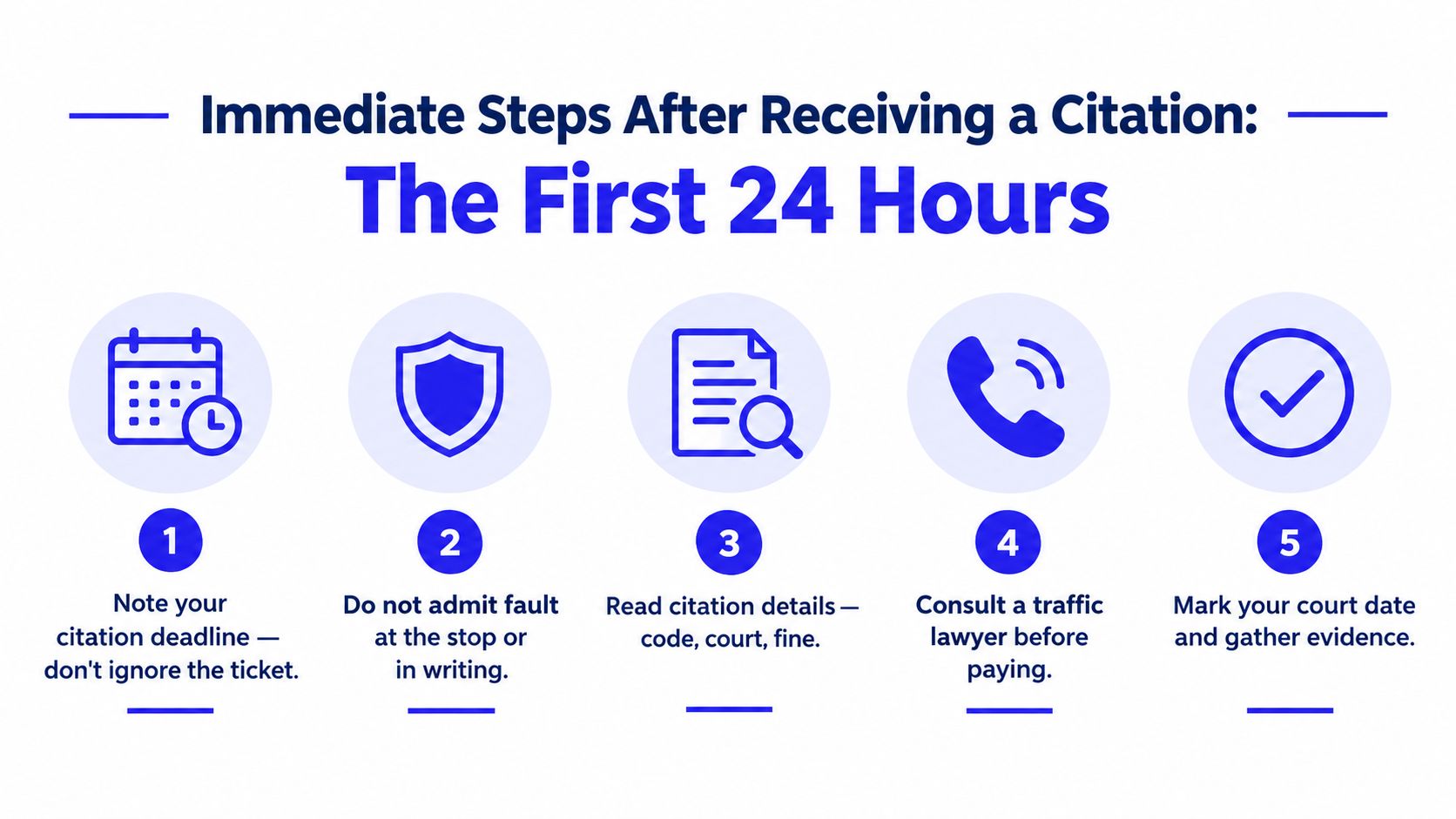
Your first-day checklist
Note the deadline: Put the citation response date and court date in your calendar.
Avoid admissions: Don't admit fault in writing, by message, or in a casual account to anyone evaluating the case.
Read every line: Check the statute code, location, court information, and officer's description for errors or inconsistencies.
Preserve the scene: Save dashcam files immediately. Photograph lane markings, signs, visibility conditions, and roadway defects when it is safe to do so.
Call counsel: Get advice before paying, selecting a disposition, or assuming the charge cannot be challenged.
Florida procedures and deadlines can vary by county and citation type. Waiting until the court date may leave less time to investigate, request available evidence, or correct a misunderstanding about the response process.
The alternatives are not equal. Paying is an irreversible strategic choice for many drivers. Seeking legal advice preserves the ability to make an informed decision.
Decision | What it does immediately | Main risk |
|---|---|---|
Pay without review | Resolves the payment obligation | You may accept the record consequences without a defense |
Ignore the citation | Delays action | The matter can become more difficult and costly to resolve |
Consult a lawyer | Gives you a legal assessment before choosing a response | You must act promptly and provide the citation and facts |
Contest the charge | Places the evidence and statutory elements at issue | The outcome depends on the record and applicable procedure |
Use this Florida traffic-ticket response guide for a practical starting point, then obtain advice based on your actual citation.
Common Defenses Against Lane Discipline Charges
“I didn't mean to swerve” is usually not a complete defense. Intent alone doesn't answer whether the vehicle left the lane when it was practicable to remain within it or whether the movement was unsafe. Strong defenses focus on the statutory facts and the reliability of the evidence.
Roadway and visibility problems
Poorly visible markings can weaken an allegation that depends on a clearly identifiable lane boundary. Curves, glare, rain, construction, worn paint, blocked sightlines, and confusing lane transitions can affect what the driver saw and what the officer could accurately observe.
A lawyer should examine the location rather than rely only on the citation's short description. Photos, video, roadway geometry, and the officer's vantage point may show that the alleged departure was brief, ambiguous, or caused by conditions beyond ordinary lane discipline.
A safe lane change isn't automatically unlawful
Section 316.089 requires the driver to remain in a lane until the movement can be made safely. That language makes the safety of the movement central. A driver who activates a signal, checks traffic, and changes lanes safely presents a different factual situation from a driver who drifts across markings without checking.
Florida's passing rule also requires a driver to return to an authorized lane “as soon as practicable” after overtaking. When a passing maneuver involves a lane for opposite-direction traffic, Florida law requires the driver to return before coming within 200 feet of an approaching vehicle (Florida Senate Chapter 316 text). Those precise rules can matter when the citation arose from passing rather than ordinary travel.
Necessity and vehicle-system evidence
An emergency maneuver to avoid a hazard may explain why a driver crossed a line. The defense still needs evidence, not a vague claim. A sudden obstruction, road defect, or unsafe vehicle beside you should be documented and connected to the timing of the movement.
Technology creates another layer. Lane-departure warning and prevention systems use forward-facing cameras to track markings. Warning systems alert the driver to drift, while prevention systems may resist departure or guide the vehicle back with light braking or small steering corrections (IIHS research on advanced driver-assistance systems). System alerts, disengagements, weather, and marking visibility may help explain an event, but they don't automatically excuse it.
For a defense-oriented discussion of improper lane use, review Florida improper lane usage. The right defense depends on what happened, not on a generic denial.
How Ticket Shield Fights for You
A driver receives a lane citation after an officer sees a brief lateral movement. The driver pays through an automated app, assumes the matter is finished, and later discovers that the record has created a larger insurance and licensing problem. That outcome is avoidable when the driver seeks legal review before accepting the charge.

A lawyer-led defense changes the conversation
Ticket Shield, PLLC describes its service as a Florida lawyer-led defense. Clients can communicate directly with their attorney by phone or text instead of relying on a corporate answering service, middleman, or automated chatbot.
That distinction matters when the defense turns on details such as a faded lane line, a sudden obstruction, a safe lane change, or the officer's viewing angle. An automated intake system can collect information. It can't replace a lawyer's evaluation of the statutory elements and evidence.
The firm states that it serves all 67 Florida counties and works with former prosecutors. It also states that clients generally don't need to appear personally in court in the firm's handled matters, subject to the specific case and applicable procedure. Those are practical features, but they don't guarantee a particular result.
What a focused review should examine
A responsible lawyer should ask:
What exact statute appears on the citation?
How long did the alleged lane departure last?
Were the markings clear and visible?
Was the movement intentional, necessary, or a safe lane change?
Does dashcam or scene evidence support your account?
What outcome protects your license and record under the available procedure?
The lawyer should explain the risks plainly. You need to know whether contesting the charge, pursuing another lawful resolution, or accepting the citation makes sense for your facts. You shouldn't receive a generic answer generated without reading the citation.
Get Your Free Consultation Today
The safest decision is made before payment, not after the points appear on your record. A Florida failure-to-maintain-lane citation can involve the statutory language of § 316.089, the officer's observation, roadway conditions, and the consequences of a conviction. Treating it like a harmless administrative bill is how drivers surrender options they needed.
Your objective should be clear: No Points on your license whenever that result is legally available. No lawyer can promise an outcome before reviewing the citation and evidence, but you can refuse to make the first mistake by paying blindly.
Bring the facts that matter
During a review, provide the citation, your account of the stop, any dashcam footage, photographs of the roadway, witness information, and details about weather or traffic. Don't edit or overwrite video. Don't send a written admission to the court before receiving legal advice.
Direct attorney access is especially important when your concern extends beyond the fine. You may need to protect a commercial driving opportunity, preserve insurance eligibility, avoid a license suspension, or prevent a minor lane allegation from becoming part of a larger record problem. Those concerns deserve a conversation with counsel, not an automated response.
Take action before the deadline
Submit your citation for review through Ticket Shield's case submission page. The firm states that it provides direct phone and text access to attorneys, handles Florida traffic matters statewide, and seeks outcomes that reduce or avoid points where the facts and procedure permit.
Don't wait for the deadline to force the decision. Gather the citation, preserve the evidence, and request a free consultation now. The cost of delay can include lost defenses, added record consequences, and insurance exposure that outlasts the original fine.
Visit Ticket Shield, PLLC for a free consultation about your Florida failure-to-maintain-lane citation. Speak directly with a lawyer, protect your driving privilege, and pursue the goal that matters most, No Points on your license.