
Florida Uniform Boating Citation: A 2026 Defense Guide
Received a Florida Uniform Boating Citation? Don't just pay it. Our defense guide explains your options, deadlines, and how to protect your record. Act now.

A Florida Uniform Boating Citation is not “just a ticket.” It can be a civil infraction or a criminal allegation, and your response in the first 30 days can decide whether this stays manageable or turns into a court problem.
You're probably reading this with the citation next to you. Maybe it came after a routine safety stop. Maybe you thought you'd pay it and move on. That's the mistake.
In Florida, a boating citation can look simple while hiding serious legal exposure. The paper itself doesn't tell the whole story. What matters is the law behind the allegation, the deadline attached to it, and whether you're dealing with a civil matter or something that can put you in criminal court.
Many face difficulties. They treat a Florida Uniform Boating Citation like a parking ticket. It isn't. It's a formal legal instrument issued under Florida Statutes § 327.74, and if you already know Florida traffic law under Chapter 316, you know the same lesson applies. Never assume the form tells you the stakes. The statute does.
Table of Contents
What Is a Florida Uniform Boating Citation
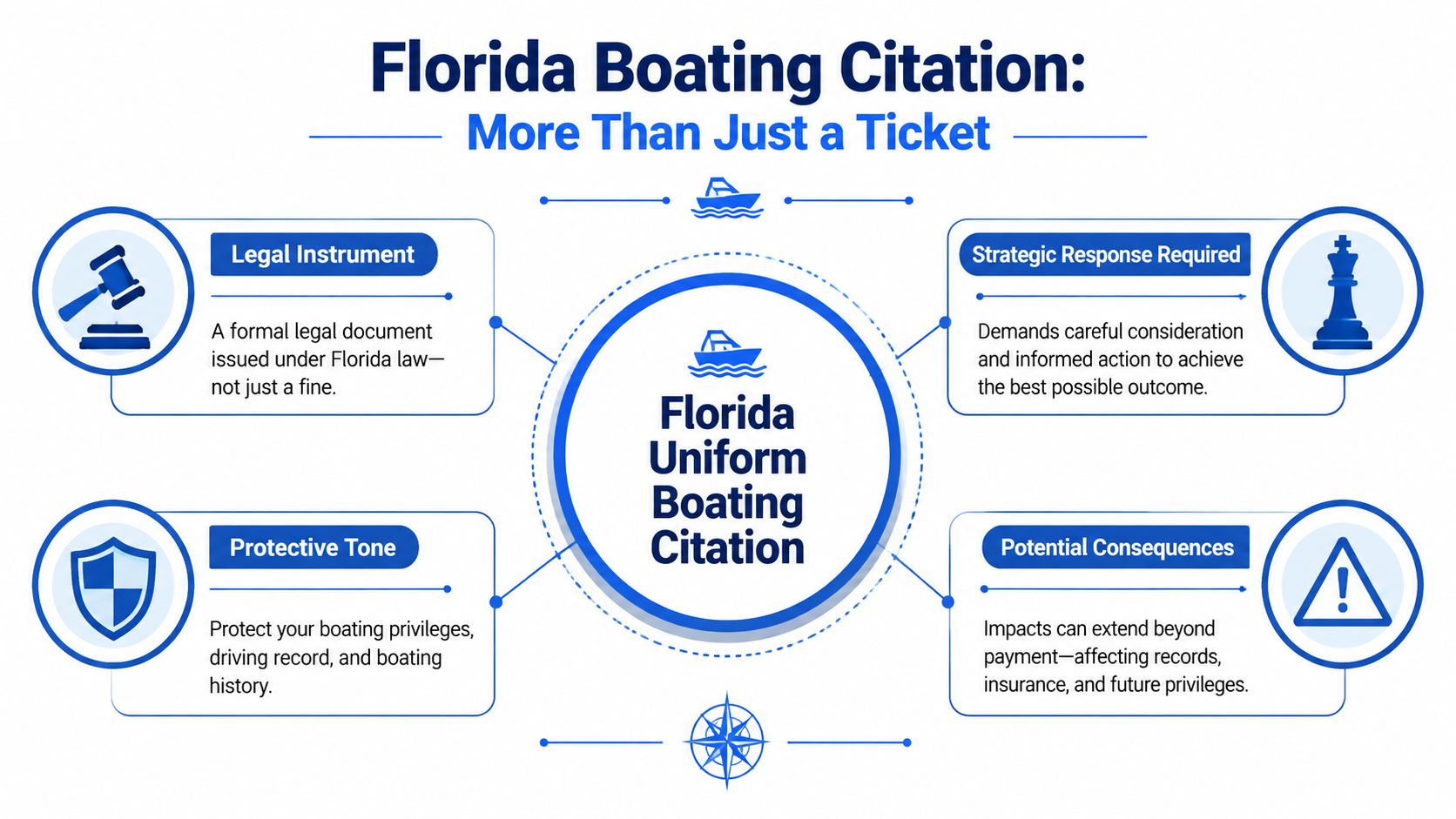
A Florida Uniform Boating Citation is a standardized enforcement form. Don't let the format fool you. It can be used for a minor civil issue or for a criminal allegation.
Under Florida Statutes § 327.74 as discussed here, the same Uniform Boating Citation form can be used for civil infractions and criminal violations. That's the first thing you need to understand. The paper doesn't decide the track. The statutory classification of the alleged offense does.
Why the paper alone doesn't tell you enough
If your citation involves a civil infraction, you may be able to resolve it through payment or by requesting a hearing. If it involves a criminal violation, you're in a different world. Court appearance risk changes. Evidence issues change. Record consequences change.
That's why paying first and asking questions later is reckless.
A boating citation is not just a bill. It is an accusation. You need to identify the charge correctly before you decide whether to admit it, challenge it, or force the state to prove it.
Practical rule: Before you pay a boating citation, determine whether you're resolving a civil infraction or surrendering ground in a criminal case.
A lot of people also struggle to read the citation itself. If you need help decoding the form, start with this guide on how to read a traffic citation. The same disciplined approach matters here. Look at the statute cited. Look at the court instructions. Look at the required response.
What you should do before you pay anything
Use this short checklist:
Read the statute number carefully: The code section matters more than the title scribbled on the ticket.
Check whether payment is offered: If the instructions push you toward a hearing or appearance, that's a warning sign.
Preserve the stop details: Officer location, water conditions, lighting, equipment status, passengers, and any statements made on scene.
Stop talking about the case: Don't “clarify” facts by calling the agency and volunteering explanations.
If you take one point from this section, take this one. A Florida uniform boating citation is a legal matter first, a payment issue second.
How Does the 30-Day Citation Timeline Work
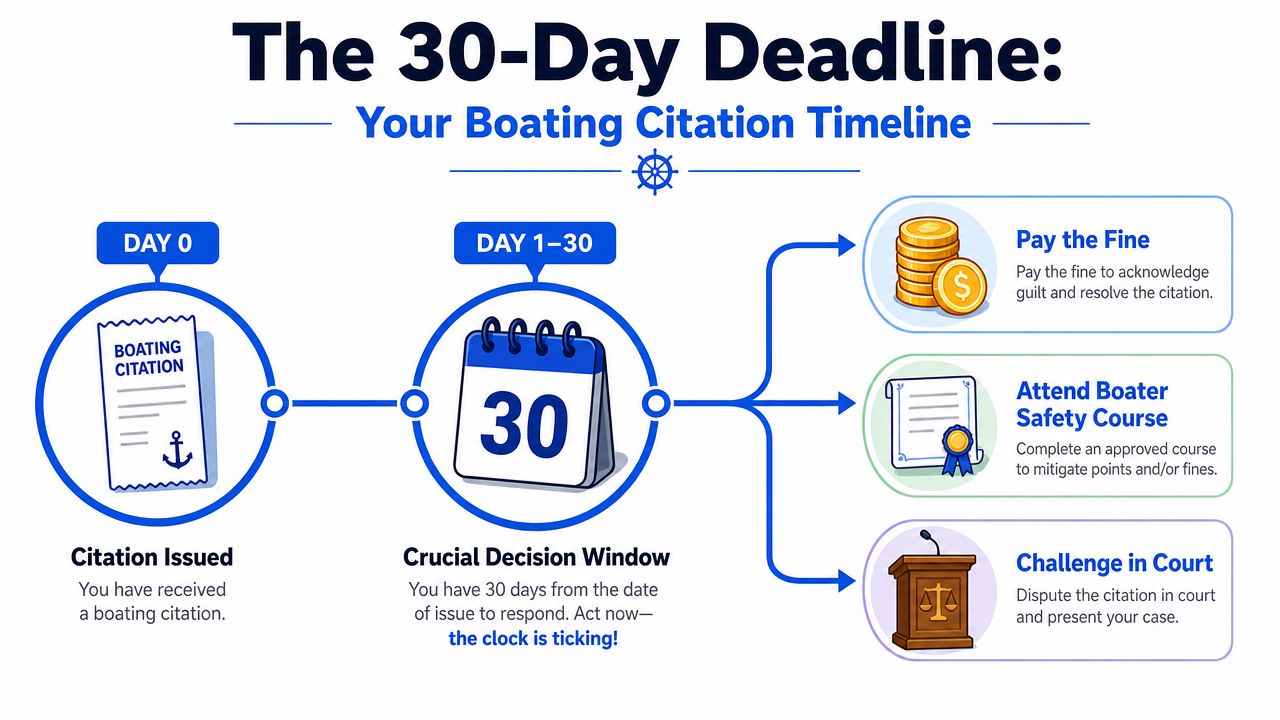
Florida gives you a short fuse. Under Florida Statutes § 327.74, a person issued a uniform boating citation must choose a disposition within 30 calendar days, and if the case is resolved, the court must certify the final disposition to the Florida Fish and Wildlife Conservation Commission within 10 days.
That tight timeline is why delay is dangerous.
What the deadline actually controls
This isn't an open-ended dispute. Florida treats boating citations with an administrative pace that feels more like civil traffic handling than a slow criminal file. If you do nothing, the problem doesn't remain passive. It moves.
At courthouses handling these matters, including the Edgecomb Courthouse in Tampa, the practical issue is simple. Deadlines are processed whether you're ready or not. If you miss the election window, you lose options and invite escalation.
Miss the deadline and you usually don't “buy more time.” You give up control.
If you want context on whether your case may require you to appear, review this article on when a traffic ticket court appearance is required. The principle carries over. Some matters can be handled efficiently. Others can't be ignored or mailed away.
Your three real choices
You usually face a small set of immediate decisions inside that 30-day window:
Pay the citation
This is fast. It is also a legal decision. In a civil case, payment often ends the matter administratively. It can also function as an admission instead of a defense strategy.Request a hearing
This preserves your chance to challenge the allegation. If the officer's observations are weak, the charge is misclassified, or the facts are incomplete, a hearing may be the right move.Retain counsel to handle the response
This is the smartest route when the classification is unclear, when the citation might be criminal, or when you don't want to make a self-defeating election under pressure.
A missed deadline can lead to extra fees and a scheduled court date instead of an unresolved ticket lingering in the background. That's why I tell clients to act immediately. Not emotionally. Immediately.
What Are the Penalties for Boating Violations
People fixate on the amount printed on the citation. That's too narrow. The listed fine matters, but it's not the whole risk.
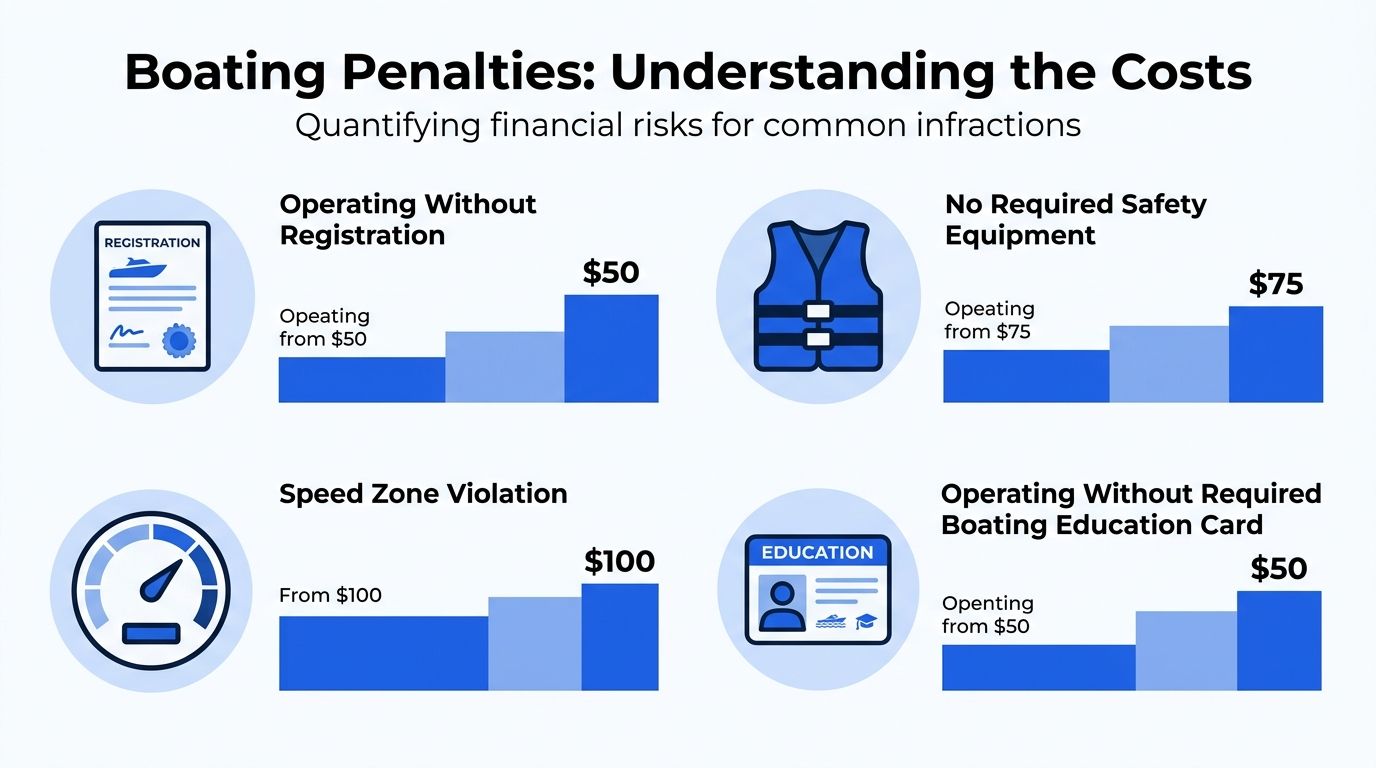
Miami-Dade's clerk guidance shows how these penalties work in practice. The county treats boating and wildlife tickets as civil infractions, and for several common registration-related issues, the within-30-days payment amount is $123 on the Miami-Dade civil infractions schedule.
What the listed fine amounts tell you
Public guidance also shows that some boating penalties rise well above routine paperwork violations. As summarized in this Miami-Dade boating citation discussion, some civil boating citations carry fixed fees such as $123 for registration offenses and $290 to $310 for marine sanitation and discharge issues, while BUI or refusal-related boating offenses carry a mandatory $500 fine.
Here is the practical picture:
Violation type | Publicly listed amount |
|---|---|
Registration-related civil offenses | $123 |
Marine sanitation or discharge issues | $290 to $310 |
BUI or refusal-related boating offenses | $500 mandatory fine |
Those numbers should change how you think about the citation. This isn't symbolic enforcement. Florida puts real money behind these allegations.
Why the posted amount is not the full cost
The dangerous part is what people don't price in.
A bad result can cost you time, hearings, missed work, stress, and a public record of the violation. If the allegation is more serious than a basic civil infraction, the exposure can widen fast. Even when a matter starts with a fine amount, the legal handling can still become the primary burden.
Administrative burden: Deadlines, clerk filings, hearing requests, and compliance obligations don't manage themselves.
Escalation risk: Delay can turn a manageable payment option into a court-managed problem.
Record consequences: Even where the offense is not criminal, the fact that you resolved it by payment may still matter strategically.
The smart question isn't “Can I afford to pay this?” The smart question is “What result am I buying if I do?”
When Is a Boating Citation a Criminal Offense
This is the issue most websites gloss over. They explain how to pay a boating ticket. They don't explain when the same citation form puts you on a criminal track.
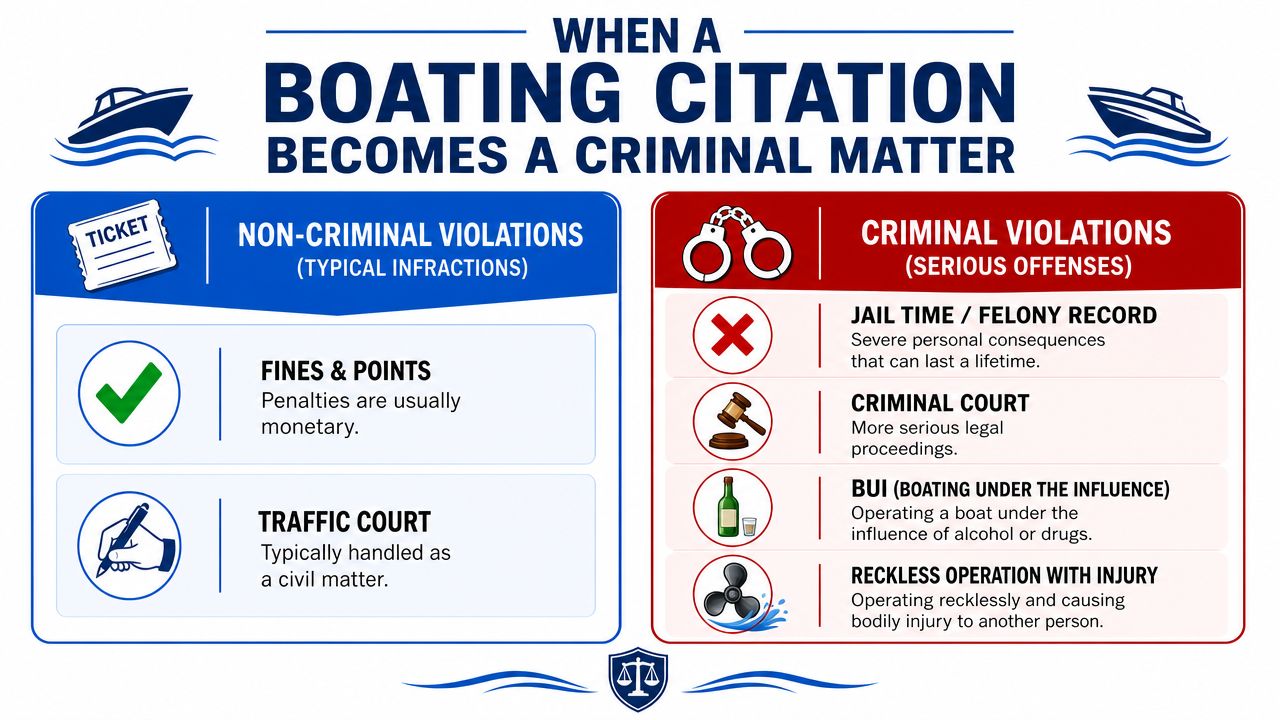
The Florida uniform boating citation system can be used in cases that are not merely civil. The 2026 HB 1103 bill text highlights that violations processed through the uniform boating citation framework are not always handled under the usual civil-infraction treatment. That matters because many boaters think the form itself tells them they're safe. It doesn't.
Why this is the issue most people miss
A criminal boating allegation doesn't announce itself politely. You may still be holding a document that looks routine. That's why people underestimate the danger and make admissions by paying, calling, or explaining.
If the charge carries criminal exposure, you are no longer choosing between convenience and inconvenience. You are choosing whether to protect yourself before the case hardens.
For a broader explanation of how traffic-related allegations can cross into criminal territory, read what is a criminal traffic violation. The lesson applies here. A familiar enforcement form can still lead to criminal court.
A boating case becomes far more serious the moment your response can affect court appearance risk, criminal exposure, or the creation of a lasting record.
How civil handling differs from criminal handling
The difference is structural, not cosmetic.
Civil boating infraction | Criminal boating allegation |
|---|---|
Often resolved by payment or hearing | Typically requires court-focused defense |
Administrative handling is common | Higher evidentiary stakes |
Fine resolution may be available | Mandatory appearance risk can exist |
Limited scope compared with criminal court | Can carry collateral consequences beyond money |
That split is why I tell clients never to rely on assumptions. If you guess wrong, you may treat a criminal case like a simple clerk payment issue. That is the kind of mistake that follows people long after the day on the water is over.
What Are Your Defense Options
A defense starts with facts. Not outrage. Not excuses. Facts.
The rules are also moving targets. Florida's boating regulations were updated as of July 2025, and the FWC regulations page says those summaries cover matters such as PFDs, visual distress signals, navigation lights, manatee protection, and seagrass restrictions on the FWC boating regulations page. If the rule set keeps changing, lazy advice from an app or generic website can hurt you.
Immediate Steps to Take
Do these right away:
Photograph the vessel: Get clear images of registration display, safety equipment, lighting, sanitation equipment if relevant, and the general condition of the boat.
Save location data: Preserve GPS history, route logs, marina records, or launch details if you have them.
Write your timeline: Record when the stop happened, what the officer said, where the vessel was, and what the conditions were.
Identify witnesses: Passengers matter. Nearby operators may matter too.
Preserve documents: Keep registration papers, certificates, rental agreements, and any electronic confirmations.
Stop making statements: Don't call the officer, the clerk, or the agency to explain what “really happened.”
Defense mindset: Preserve first. Talk later.
What a real defense usually examines
Good defense work is not one-size-fits-all. It depends on the charge.
A lawyer may examine whether the stop was lawful, whether the officer correctly interpreted the regulation, whether the equipment issue existed, whether the allegation fits the cited statute, and whether the state can prove each required element. In some cases, the defense turns on scene conditions. In others, it turns on paperwork, training, or how the allegation was documented.
Some defenses are procedural. Others are factual. Some are statutory. The point is that there are usually more angles than a self-represented person sees in the first panic-filled reading of the citation.
If you want a general sense of how attorneys attack citation cases, this article on how lawyers dismiss traffic tickets is a useful starting point.
Don't rely on automated apps for this. They can gather intake. They cannot replace legal judgment. A chatbot won't decide whether your boating citation was misclassified, whether the evidence supports the charge, or whether your best move is contesting, negotiating, or forcing proof.
Why Should You Hire a Ticket Shield Attorney
You should hire a lawyer because boating citations are deceptively technical, deadline-driven, and sometimes criminal.
Ticket mills process volume. Automated apps collect forms. Middlemen send updates. That is not defense. If your case involves a real legal decision, you need a real lawyer reviewing the statute, the facts, and the court posture.
Ticket Shield, PLLC is different. It's a lawyer-led Florida firm. You speak directly to your attorney by phone or text. No chatbot pretending to give legal strategy. No faceless intake chain. No confusion about who is handling your case.
That matters when your goal is clear. Protect your record. Avoid unnecessary court problems. Make smart decisions early. Push back where the allegation is weak. Keep the case from becoming bigger than it needs to be.
If you're ready to take action, start by submitting your case to Ticket Shield, PLLC.
If you got a Florida uniform boating citation, don't guess and don't pay blindly. Visit Ticket Shield, PLLC for a free consultation and get a lawyer-led defense built to protect your record, your time, and your No Points goal.
