Florida Traffic Ticket Court Appearance Required: Guide 2026
Facing a Florida traffic ticket court appearance required? Discover violations, penalties, and your options for 2026.
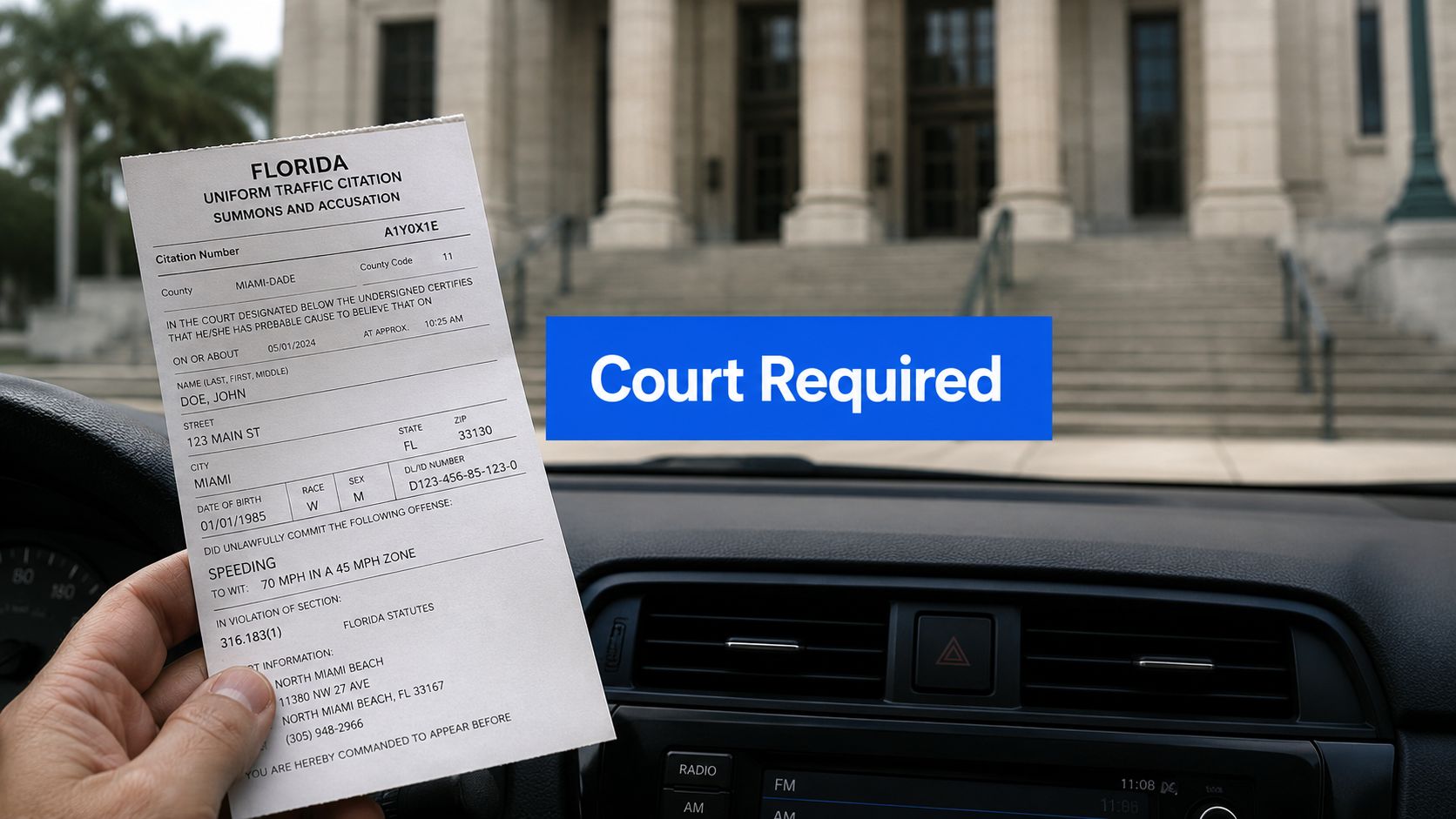
If your Florida ticket says court appearance required, you can't just pay it and move on. You must respond strategically, fast. That box usually means a serious civil or criminal traffic charge, and missing the date can put your license, record, and freedom at risk.
You're probably holding the citation right now, looking for one line that tells you this isn't as bad as it feels. Then you see it. Court appearance required.
That changes the case immediately.
This isn't a routine payable ticket. It isn't the kind of citation you casually handle online during lunch. It's a legal summons. The officer has put you into a process where a judge, not a payment portal, decides what happens next.
For Florida drivers, that distinction matters more than people realize. Some tickets are administrative. You pay, you accept the consequences, and the matter closes. A mandatory appearance ticket is different. It usually signals a charge the court considers serious enough to require a live response, whether because of speed, risk of harm, license status, a crash, or a criminal allegation under Chapter 316, including statutes such as Florida Statute 316.183 for unlawful speed and Florida Statute 316.193 for DUI.
If you're panicking, that reaction makes sense. But panic is useless. Action protects you.
Start by understanding one thing. The words traffic ticket court appearance required are not clerical filler. In other court systems, mandatory appearance language is used to separate routine traffic matters from offenses that demand judicial review, and courts treat that designation as legally meaningful, not optional. For example, Cook County explains that a ticket marked “YOU MUST APPEAR” or “COURT APPEARANCE REQUIRED” means you must answer the charge in court, and that these designations are used for offenses with greater potential for harm or mandatory minimum penalties, according to the Cook County traffic appearance requirements.
If you need a broader primer on defending a citation before you decide your next move, review this Florida traffic ticket defense guide.
Table of Contents
Which Florida Traffic Violations Mandate a Court Appearance?
Frequently Asked Questions About Mandatory Court Appearances
Which Florida Traffic Violations Mandate a Court Appearance?
The fast answer is simple. Serious charges require a judge. In Florida, that usually means one of two things. The allegation is too dangerous to be treated like a payable infraction, or the charge is criminal and carries consequences far beyond a fine.
Hearings for these cases often happen in the same places Florida drivers already know by name, including the Richard E. Gerstein Justice Building in Miami-Dade.
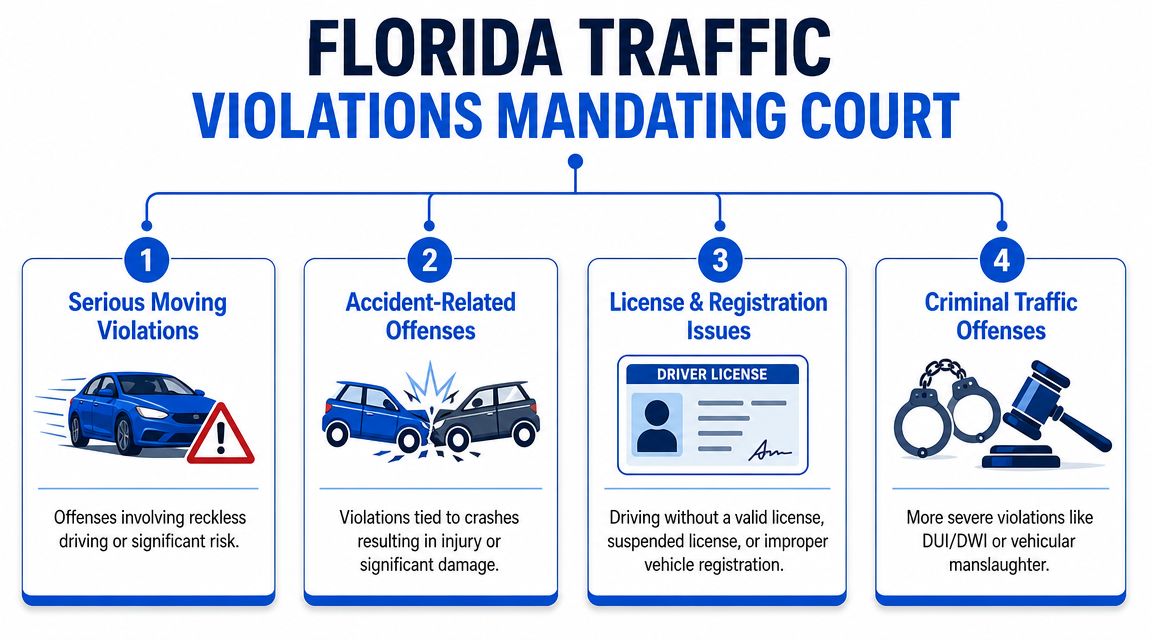
Which civil traffic charges trigger mandatory court?
A common example is speeding far over the limit. Under Florida Statute 316.183, speed becomes more than a routine mistake when the allegation reaches an extreme level. In practice, drivers cited for very high speeds often find themselves ordered into court because the state treats the conduct as unusually risky.
Other civil matters can also trigger a required hearing, especially when the ticket involves:
Excessive speed: Not ordinary speeding, but speed severe enough to put the case in front of a judge.
Crash-related allegations: A citation tied to a collision, injury claim, or disputed facts.
License or registration problems: Cases where the court wants proof, explanation, or compliance before closing the file.
Noncompliance issues: Situations where the issue may be fixable with paperwork, but only if you act quickly and present it properly.
Practical rule: If the citation commands you to appear, stop asking whether you can just pay it. Start preparing your defense.
That last category gets ignored too often. Some tickets aren't really about dangerous driving. They're about what you can prove. Court systems around the country recognize that insurance-related citations and similar proof-of-compliance cases may be avoidable if the driver can show valid coverage, and some courts warn that missing a required appearance can lead to license trouble until the case is resolved, as discussed in this court FAQ on appearing for a traffic citation. The lesson for Florida drivers is straightforward. If your case involves insurance, registration, or license paperwork, gather the documents immediately.
Which criminal traffic charges almost always require a judge?
These are the charges that should put you on alert right away.
Under Florida Statute 316.193, DUI is a criminal offense. You are not mailing in a check and walking away from that. You are dealing with a charge that can affect your license, criminal record, employment, and insurance.
Other criminal or quasi-criminal traffic charges that commonly require court include:
Reckless driving
Driving while license suspended or revoked
Leaving the scene of a crash
Crash cases involving injury
Any traffic offense filed as a misdemeanor or felony
If the officer wrote one of those on your citation or arrest paperwork, you need a defense plan now, not later. For a closer look at the line between routine citations and criminal allegations, read this explanation of what counts as a criminal traffic violation in Florida.
Why does the court force an appearance?
Because the court wants control over the outcome.
A payable ticket usually ends with money and points. A mandatory appearance case can involve testimony, plea discussions, proof problems, mitigation, amended charges, or sanctions a clerk can't impose by processing a payment. The judge needs to see the case, and the prosecutor gets a seat at the table.
That's why I treat these tickets differently from the first phone call. If your citation requires court, your job isn't to “deal with it somehow.” Your job is to keep a bad allegation from turning into a worse result.
What Are the Consequences of Missing Your Court Date?
Ignoring a mandatory court date is one of the worst decisions you can make after a serious traffic citation.

When court is required, silence is not neutral. The court reads it as failure to comply.
What usually happens first after a failure to appear?
The fallout can move quickly and hit from several directions at once:
License suspension risk: Florida can move against your driving privilege after a failure to appear. That creates a second problem on top of the first one.
Default findings: If the court proceeds without you in a payable or civil setting, you lose the chance to challenge the officer's version.
Bench warrant exposure: In criminal traffic matters, missing court can lead to a warrant.
Bond trouble: If bond was posted, the court can address forfeiture issues.
Harder negotiations later: Prosecutors and judges are less flexible when you've already ignored the process.
Miss the date, and you stop defending the original ticket. You start cleaning up a procedural mess too.
That's why timing matters so much in traffic court systems. Other jurisdictions make the same point in different ways. New York's Traffic Violations Bureau allows some drivers to avoid a personal appearance through filings and attorney appearance, but only if the request is made on time. The DMV says a plea request by mail must be received at least 10 days before the hearing, and by phone at least 24 hours before, according to the New York DMV Traffic Violations Bureau procedures. Florida procedure is different, but the practical lesson is the same. Deadlines control outcomes.
Here's a short explanation of the issue in plain terms:
Why missing court makes a bad case worse
A serious citation is still defendable. A serious citation plus a failure to appear is harder, more expensive, and more disruptive.
That's especially true if you drive for work. Delivery drivers, rideshare drivers, field techs, nurses, military personnel, and sales professionals all get hurt when a license problem spreads from one case into employment. Even if the underlying citation had a practical solution, skipping court can weaken your position.
If you're already worried you missed a hearing or might not make one, read this guide on what happens if you miss a Florida court date. Then act immediately. Don't wait for a letter. Don't assume the court forgot.
What Are Your Options When Court Is Required?
You have two practical choices. Go in alone, or put a traffic defense lawyer between you and a judge before a bad ticket turns into a license problem.
Those choices are not remotely equal once the citation requires court. A payable ticket is mostly administrative. A mandatory appearance case can carry criminal exposure, harsher penalties, a suspension risk, or facts that need to be handled carefully from the start. That is the line ticket apps routinely miss. They are built for quick payment decisions, not legal judgment calls.
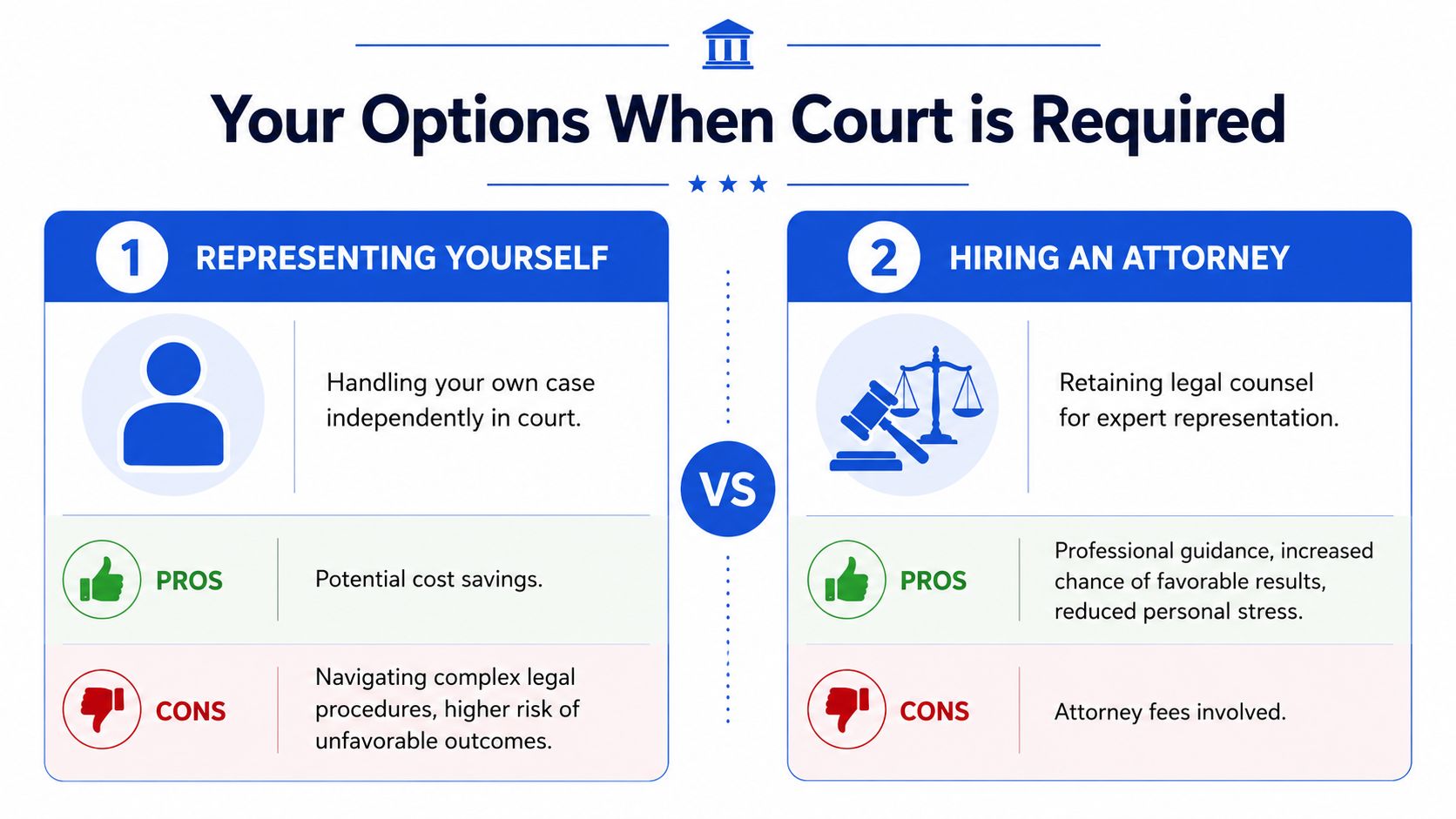
Can you handle it yourself?
Yes, but only if you understand exactly what you are facing and are prepared to make decisions that can affect your record, insurance, and ability to drive.
Handling it yourself usually means you must do all of this correctly, under pressure:
Path | What you're taking on |
|---|---|
Reading the charge | Determining whether the case is civil, criminal, or tied to a compliance issue that can become worse if handled incorrectly |
Evaluating proof | Reviewing the officer's observations, documents, and any factual weaknesses |
Negotiating | Speaking with a prosecutor who handles these cases every day |
Protecting your record | Judging how a plea, withheld adjudication, or conviction can affect points, insurance, and future consequences |
Handling court | Appearing on time, prepared, and careful about what you say on the record |
The danger is not just losing. The danger is saying something unnecessary, agreeing to the wrong resolution, or missing a defense because you treated a court-required ticket like a normal citation you can pay and move on from.
What changes when a lawyer steps in?
A lawyer changes the posture of the case immediately.
Instead of reacting to the ticket, you start working a defense plan. That can mean challenging the charge, fixing a documentation issue before it becomes a conviction, or negotiating for a result that protects your license and keeps the damage contained. In many cases, counsel can also appear on your behalf, which matters if you live out of state, work long shifts, or cannot spend half a day waiting in a crowded courthouse.
If you need to know whether counsel can stand in for you, read whether a lawyer can go to traffic court for you in Florida.
A lawyer-led model makes a real difference. Serious tickets need legal judgment, not software prompts. If a service treats every citation like a payment workflow with a chat intake form attached, that service is not built for the cases that put your license at risk.
One Florida option is Ticket Shield, PLLC. The firm states that clients communicate directly with their attorney by phone or text and that it handles traffic matters statewide. That structure fits court-required cases far better than an automated ticket platform or a volume operation where you never know who is responsible for your file.
If the charge can affect your license, convenience is not strategy. Legal judgment is.
What should you prepare before talking to counsel?
Keep it simple and move fast.
Bring or send the full citation, your court date information, any crash or insurance paperwork tied to the case, your notes about what happened, and any older notices or license-related documents that may matter. The goal is to let the attorney identify the main issue quickly. Is this a case that can be negotiated, a paperwork problem that can be fixed, or a charge that needs to be fought?
If you want a clean checklist before speaking with any attorney, this guide to mastering legal client intake is useful.
Immediate Steps After Getting a Mandatory Appearance Ticket
If your citation says court appearance required, do these five things today.
Lock in the date immediately: Put the court date in your phone, your calendar, and a written backup. Missing it creates a second legal problem.
Photograph the entire ticket: Get clear images of the front and back. Make sure the statute number, officer notes, and court information are visible.
Stop looking for an online payment option: A mandatory appearance ticket usually isn't something you resolve by clicking “pay now.” Treat it like a court case, because that's what it is.
Preserve evidence now: Save dashcam footage, insurance cards, registration proof, repair photos, witness names, and screenshots. If the issue involves speed, location, lane position, or a crash, details disappear fast.
Get legal eyes on the citation right away: A traffic defense attorney can tell you what kind of case you have, whether the court can be handled without your appearance, and what the immediate risk is to your license.
For many drivers, the hardest part is reading the citation correctly. Use this guide on how to read a Florida traffic citation so you know exactly what charge and court command you're dealing with.
The first mistake is the ticket. The second mistake is delay.
Frequently Asked Questions About Mandatory Court Appearances
Do out-of-state drivers have to come back to Florida?
Sometimes yes, sometimes no.
Some required court cases can be handled by counsel without you traveling back. Others require you in the courtroom, especially if the charge is criminal, the judge wants a personal appearance, or your testimony matters to the defense. Do not rely on a ticket app to sort that out. The key question is whether your case is an administrative traffic matter or something with criminal or license-threatening exposure.
Get that answer early. The wrong assumption can cost you a warrant, a suspended license, and an expensive last-minute trip.
Can you just plead guilty by mail?
Usually no.
If the citation says court appearance required, treat that as a direct order from the court, not a suggestion. Mailing in a plea or trying to pay around the hearing often creates a bigger problem because the case stays on the docket and you still get marked absent.
A lawyer can tell you whether Florida law allows a waiver, an attorney appearance, or another lawful option in your specific case. Until then, assume you must answer the court exactly as directed.
Will showing proof of insurance or compliance make the case disappear?
Sometimes. But do not assume paperwork fixes everything.
It depends on the exact charge. Some citations are based on failing to carry proof. Others involve failing to maintain coverage, an expired registration, a suspended license, or conduct the judge may treat as more serious than a paperwork defect. In one case, proof may resolve it. In another, proof only helps reduce the fallout.
Bring every document you have and let a lawyer match it to the statute. That is legal analysis, not clerical work.
Why isn't an app enough for this kind of ticket?
Because serious tickets turn on legal judgment.
Software can remind you about a deadline. It cannot tell you whether the citation is a payable civil infraction, a mandatory court civil offense, or a criminal traffic charge with consequences far beyond points. It cannot cross-examine an officer, raise a compliance defense, negotiate a reduction, or protect you from saying something in court that makes the case easier to prove.
For serious tickets, you need legal judgment, not software prompts. Lawyer-led representation matters because the risk is not just the fine. The risk is your license, your record, and sometimes your criminal history.
If I'm guilty, should I just admit it and ask for mercy?
No.
That approach feels honest, but it usually hands the court and prosecutor facts they did not have to prove on their own. Many drivers say too much because they think the hearing is informal. It is still a legal proceeding, and your words can close off defenses you had before you opened your mouth.
Respect the court. Keep quiet about the facts until you have legal advice. Even in a bad case, there may be room to reduce the charge, avoid points, limit a suspension, or keep a civil matter from becoming something worse.
If your Florida citation says court appearance required, treat it as a legal threat, not a payment problem. Ticket Shield, PLLC handles Florida traffic defense statewide with direct attorney communication by phone or text, and the goal is straightforward: protect your record and pursue a No Points outcome when the law and facts support it. Visit TicketShield.com for a free consultation.