Florida Muffler Law: What Drivers Need to Know
Florida muffler law explained: exhaust requirements, decibel limits, ticket penalties, and proven defenses to protect your license and record.

You're driving home through Tampa or Miami Beach when an officer pulls you over because your exhaust sounded loud under acceleration. You haven't been racing, weaving, or driving recklessly. You may not even realize anything is wrong with the car. Yet the citation can create a court deadline, repair questions, insurance concerns, and a permanent traffic-record issue if you handle it casually.
Florida's muffler law isn't a simple rule saying every loud car is automatically illegal. Florida Statute 316.272 focuses on the condition and operation of the exhaust system, prohibited bypass equipment, and excessive or unusual noise. Section 316.293 adds a separate restriction against modifying a vehicle so it emits more noise than it produced when originally manufactured. Those details matter because a defense should attack the legal elements, not just argue that your car “isn't that loud.”
This guide explains how the Florida muffler law works, how officers commonly enforce it, what the sound-measurement rules say, and which evidence can help challenge or mitigate an exhaust citation.
Table of Contents
How a Florida Muffler Ticket Actually Happens
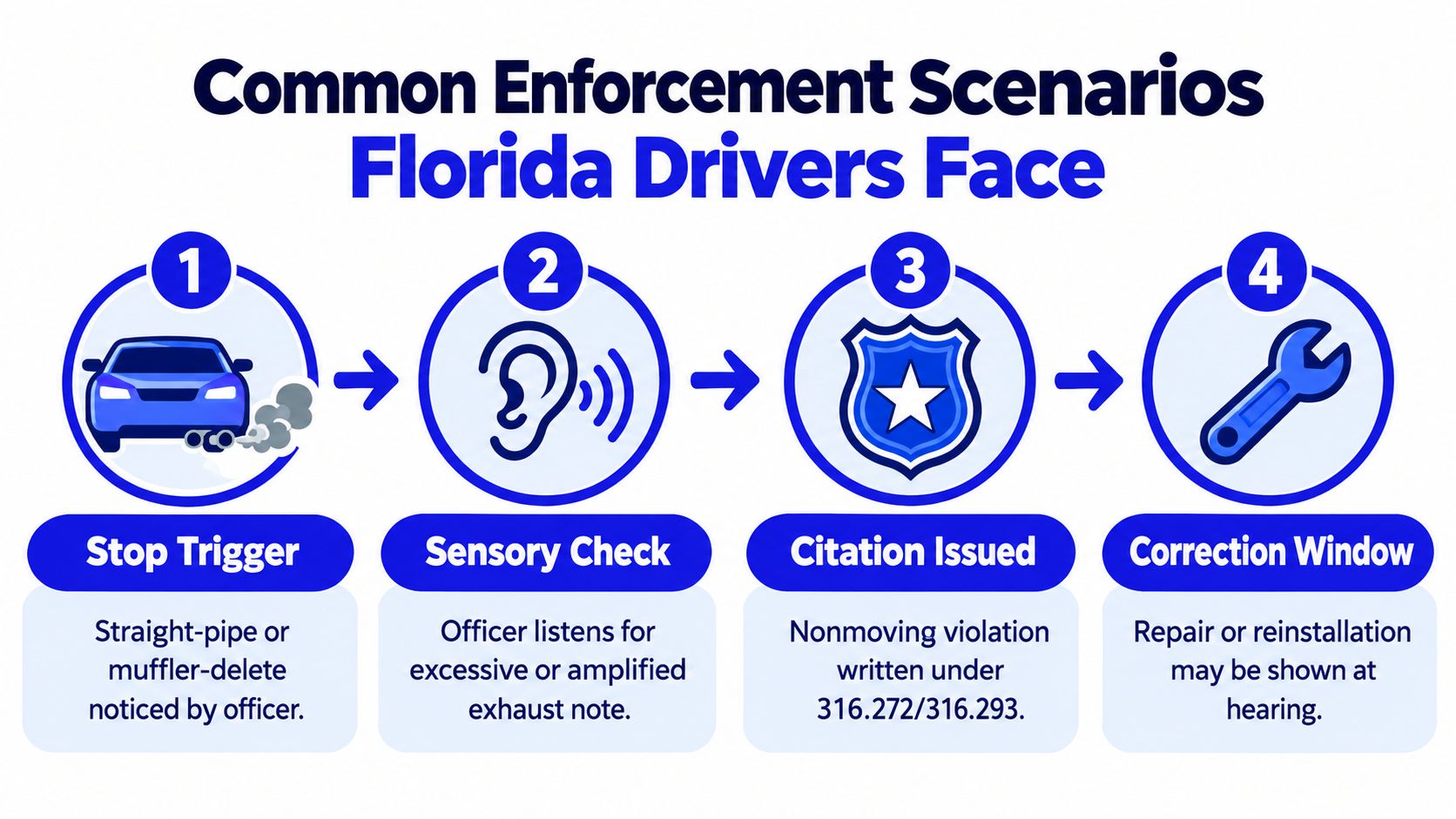
You're cruising normally, perhaps with the windows up and the radio on. The officer says the exhaust was noticeable before the stop, then points to the muffler or tailpipe and writes a citation under Florida's equipment or noise statutes. The interaction can feel subjective from the start because the officer may rely on what the vehicle sounded like during acceleration rather than producing a sound-meter reading at the roadside.
The citation itself is only the first problem. You still have to address the deadline, decide whether to pay or contest it, and determine whether the exhaust should be inspected before anything changes. Paying may close the immediate case, but it can also eliminate your opportunity to challenge whether the officer observed a statutory violation.
Practical rule: Don't repair away the evidence before you understand what the officer actually alleged.
The collateral damage drivers miss
A muffler citation is generally treated as a noncriminal traffic infraction and nonmoving violation under the framework described in section 316.272. That classification matters, but it doesn't make the citation harmless. The record may still matter when an insurer reviews your driving history, when an employer checks a license used for work, or when another officer sees a prior exhaust-related stop.
The practical chain often looks like this:
Traffic stop: The officer identifies unusual or excessive exhaust noise, a missing or defective component, or a suspected bypass.
Citation: The ticket identifies the statute and establishes a deadline for payment or election of a hearing.
Repair decision: You may replace, reinstall, or inspect equipment, but the repair can change the condition that needs to be examined.
Court or administrative follow-up: A missed deadline can create additional problems unrelated to the original sound complaint.
Record consequences: A paid citation can remain relevant even when it doesn't carry driver-license points.
Florida's rule is structured around more than volume. The condition of the muffler, the presence of a cutout or bypass, and the relationship between the modified system and the vehicle's original equipment can all matter. That framework gives a prepared defense more room than a generic argument that the car was merely “loud.”
What Florida Statute 316.272 Really Requires
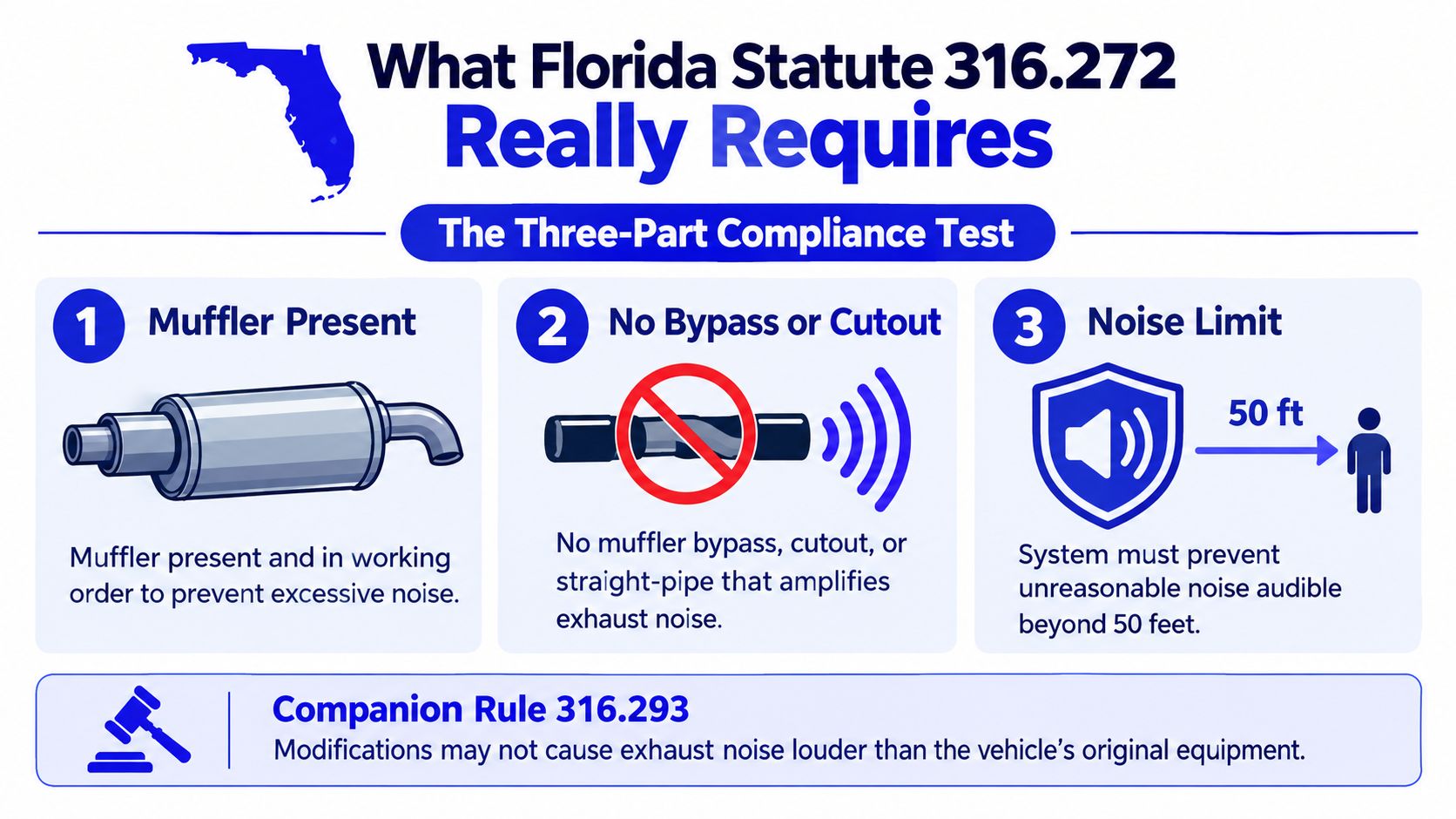
Florida Statute 316.272 requires every motor vehicle to have an exhaust system in good working order and in constant operation, including the muffler, manifold pipe, and tailpiping. The system must prevent excessive or unusual noise, and a vehicle operated on a highway can't use a muffler cutout, bypass, or similar device. The statute also ties the maximum sound level to a standard established through the Department of Environmental Protection and the Department of Highway Safety and Motor Vehicles. See the Florida traffic laws overview for related statutory context.
The cleanest way to analyze a citation is to separate the rule into three questions.
The three-part compliance test
First, is the exhaust system present and functioning? A missing muffler, damaged component, open pipe, or system that isn't operating as designed creates an equipment problem. “There's a muffler somewhere under the car” isn't enough if the system isn't in good working order.
Second, is there a prohibited device? Section 316.272 specifically addresses cutouts, bypasses, and similar devices. A valve or switch that routes exhaust around the muffler can create a violation even if the vehicle has a conventional muffler installed elsewhere in the system.
Third, did the modification increase noise beyond the original manufactured level? Section 316.293 separately prohibits modifying a vehicle's exhaust or other noise-abatement device so the emitted noise exceeds the level produced when the vehicle was originally manufactured. That makes the factory configuration an important comparison point.
Why the wording matters in court
The statute doesn't reduce every case to one universally stated roadside decibel number. It combines equipment condition, system operation, prohibited hardware, and excessive or unusual noise. That structure can produce different enforcement outcomes for similar vehicles, particularly when the officer doesn't identify the specific component or explain how the system failed.
This is also an equipment issue, not automatically a reckless-driving allegation. A loud exhaust citation shouldn't be treated as proof that you drove dangerously. Your defense should force the prosecution to connect the observed sound or hardware to the exact statutory requirement.
Allowed Modifications vs Violations Under State Law
Florida doesn't ban every aftermarket exhaust component. The legal question is whether the finished system remains in proper working order, avoids a prohibited bypass, and stays within the factory-baseline restriction in section 316.293. A professionally installed cat-back system may be easier to defend when it retains effective muffling and doesn't route exhaust around the muffler.
An OEM replacement muffler is the straightforward example. A resonator added to refine tone may also be defensible when it doesn't increase emitted sound above the original configuration. Documentation matters because an officer usually won't know the vehicle's stock exhaust specification merely by looking under the bumper.
The factory baseline is the critical comparison
Florida's rule compares a modified vehicle with the level it produced when originally manufactured. It doesn't ask whether your car is quieter than another modified car at the next intersection. It asks whether the modification increased the vehicle's emitted sound above its original level and whether the system still satisfies the equipment requirements.
That makes the following evidence useful:
Manufacturer documentation: Parts descriptions, installation instructions, and vehicle-specific specifications can show how the system was designed to operate.
Installation records: A professional invoice can identify the components installed and whether the work preserved the muffling system.
Photographs: Clear images can show that the vehicle has a functioning muffler and no visible cutout or bypass.
Inspection evidence: A mechanic's written assessment can address condition, attachment, leaks, and operation.
Use an approved-product resource, such as the Sixrace approved exhaust collection, as a starting point for understanding how exhaust products are described and documented. Product labeling alone doesn't guarantee Florida compliance, but it can help establish what the component is designed to do.
Modification Type | Legal Status | Why It Matters |
|---|---|---|
Cat-back system retaining effective muffling | Potentially compliant | The finished system still must operate properly and avoid excessive or unusual noise. |
OEM replacement muffler | Generally easier to defend | It preserves the original equipment approach, subject to proper installation and condition. |
Resonator added for tone control | Fact-dependent | The key issue is whether the finished system increases emitted sound beyond the original level. |
Straight pipe or removed muffler | High risk of violation | The system may fail the good-working-order and noise-prevention requirements. |
Manual or electronic cutout | Prohibited configuration risk | Section 316.272 addresses devices that bypass the muffler. |
Bypass valve or defeat device | High risk of violation | A functioning muffler elsewhere doesn't cure a device designed to route around it. |
Emission-related questions are separate from exhaust-noise questions, so don't assume an inspection for one issue resolves the other. The Florida emission test failure guidance can help distinguish those compliance categories.
Decoding the Decibel and Sound Measurement Standards
Florida's noise-control framework does include objective measurement procedures. The relevant operating-noise limits are measured at 50 feet from the center of the lane of travel, and the applicable limit varies by vehicle category and roadway-speed condition. For passenger-type vehicles on roads over 35 mph, the cited benchmark is 86 dB(A) for vehicles on or after January 1, 1975. Another category in the same statutory table is 90 dB(A). See the Florida noise-control measurement statute for the measurement framework.
Those figures don't mean every traffic stop includes a meter. In ordinary enforcement, an officer may first rely on hearing an unusually loud or altered exhaust note. That observation can trigger the stop or citation, while the defense later questions whether the statutory elements were established.
What the measurement procedure changes
A sound reading should be tied to the correct distance, vehicle category, roadway condition, and testing procedure. A reading taken close to the tailpipe, inside a garage, or during an unverified acceleration isn't automatically the same as a statutory operating-noise measurement.
Vehicle Class | Measurement Distance | dB(A) Limit | SAE Test Protocol |
|---|---|---|---|
Passenger-type vehicle on a road over 35 mph, vehicle on or after January 1, 1975 | 50 feet from the center of the lane | 86 dB(A) | The applicable statutory procedure must be established from the testing record |
Another vehicle category listed in the statutory table | 50 feet from the center of the lane | 90 dB(A) | The applicable statutory procedure must be established from the testing record |
Don't confuse Florida's exhaust rules with the separate plainly audible at 25 feet standard for radios and electronic sound systems in vehicles. A loud subwoofer can create a different legal issue from an exhaust system, and the officer should identify which sound source allegedly violated which statute. Local rules may also add restrictions, so the location of the stop matters.
The strongest challenge is usually not “the officer needed a meter in every case.” It is more precise: What did the officer observe, what equipment was allegedly defective or prohibited, and how does that observation satisfy the statute? If the citation contains only a conclusion without component details, testing information, or a clear description of the alleged bypass, that lack of specificity can become valuable defense material.
Common Enforcement Scenarios Florida Drivers Face
The classic stop involves a straight-pipe build or muffler deletion. You accelerate from a parking lot, the exhaust cracks sharply, and the officer follows until you stop at an intersection. The officer may never inspect the vehicle in depth before writing the ticket, especially if the sound was the event that prompted the stop.
A different scenario involves a bypass valve. The car may sound restrained with the valve closed and dramatically louder when a switch opens it. That hidden control creates a problem because the legal analysis focuses on the system's configuration and operation on the highway, not just how quiet the car was during the officer's initial approach.
Motorcycles and sound-source confusion
Modified motorcycles, including bikes fitted with aftermarket slip-ons or performance-oriented exhaust systems, can draw attention during acceleration. The legal question remains tied to the vehicle's equipment, operation, and sound output. A motorcycle's appearance or brand doesn't replace the need to prove the alleged statutory violation.
Officers also encounter loud stereos that can be mistaken for exhaust noise. The vehicle may have large subwoofers, an amplified cabin system, or sound escaping through open windows. Florida regulates vehicle radios and electronic sound systems under a separate standard, so the citation should identify whether the alleged problem was exhaust noise or electronic sound.
Evidence matters: If an officer followed you for blocks before stopping you, the body-camera audio, dashcam recording, and exact wording in the report may reveal whether the observation was a clear equipment violation or a broad conclusion about volume.
A useful defense record starts immediately. Save the citation, photograph the exhaust from several angles, preserve dashcam footage, and don't delete videos showing the vehicle operating in its prior condition. If a mechanic later changes the system, retain the old parts and obtain an itemized invoice.
Penalties, Fines, and the Hidden Cost of Paying
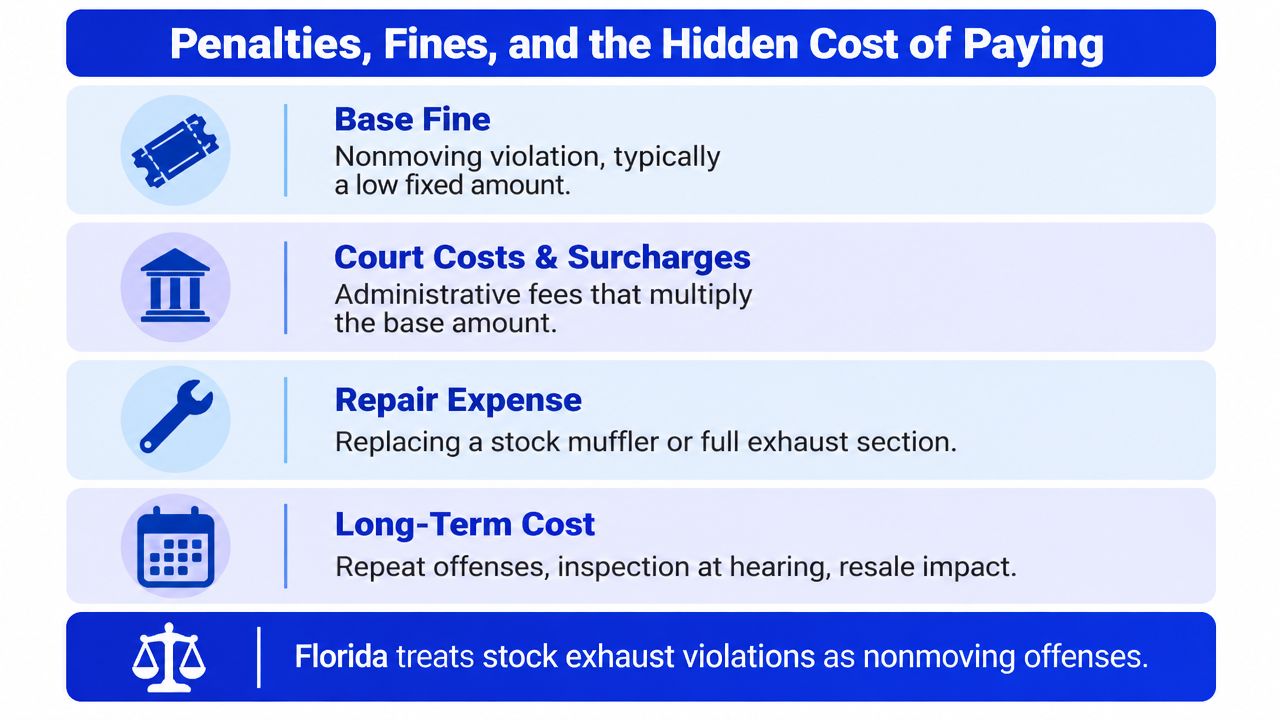
Florida's muffler statute classifies a violation as a noncriminal traffic infraction and nonmoving violation. That generally means the citation isn't treated like a moving offense for point assessment, but it doesn't make payment the safest choice. The amount shown on the ticket may not reflect every court cost, surcharge, repair expense, or administrative consequence that follows.
A driver who pays often loses the chance to contest the officer's account. That matters when the citation doesn't identify a missing muffler, a defective component, a bypass device, or a measurable sound result. A payment can resolve the file while leaving the underlying factual dispute unanswered.
The real cost is often outside the ticket
Budget for more than the printed amount:
Court-related charges: The total may include costs and surcharges beyond the base assessment.
Repair expense: Replacing a muffler, restoring factory baffling, or removing a bypass can cost more than expected.
Insurance review: An insurer may consider the record during underwriting even when the offense is nonmoving.
Resale and inspection concerns: A buyer, lender, or inspection provider may question a visibly altered exhaust system.
Deadline exposure: Ignoring the citation can create consequences separate from the original equipment allegation.
The Florida traffic ticket cost guide explains why the printed citation amount isn't always the complete financial picture. The practical decision is whether paying immediately gives up a defense that could challenge the officer's proof or support a better disposition.
Don't confuse nonmoving status with no consequences
The statute's classification is helpful, but it isn't a guarantee that every record, insurer, or future licensing review will treat the matter as irrelevant. Repeated citations can also create a credibility problem, especially if later evidence shows the same bypass or defective equipment remained in use.
Paying may be appropriate in some cases, but it should be a deliberate decision after reviewing the citation and the evidence. If the officer's report is vague, the vehicle was factory-equipped, or the allegation depends entirely on an unsupported sound impression, contesting the ticket may be the more cost-effective path.
Defending and Mitigating a Florida Exhaust Ticket
A strong defense begins with the citation and the officer's exact allegation. Don't start by arguing that your vehicle sounds good. Start by asking whether the state can prove the required equipment condition, identify a prohibited device, or establish an unlawful increase over the original manufactured sound level.
Attack the missing link in the proof
If the officer heard the vehicle but didn't inspect the muffler, identify a bypass, document a defect, or conduct a reliable sound measurement, the defense can challenge the connection between perception and statutory violation. The absence of a calibrated reading isn't automatically a dismissal, but it can expose a weak case when the report contains only generalized language.
Preserve evidence before making modifications:
Body-camera and dashcam footage: These recordings may show the officer's initial description, the distance between vehicles, and the sound conditions.
Photographs and video: Capture the muffler, tailpiping, valves, clamps, resonators, and any identifying marks.
Service documents: Keep invoices, parts descriptions, manufacturer information, and installation records.
Mechanic testimony: A qualified mechanic can explain whether the system was complete, attached, operational, and free of a bypass.
Witness statements: Passengers or nearby witnesses may help establish what happened before the stop.
A factory-stock exhaust with maintenance records can be powerful because it directly rebuts the claim that you installed a device to amplify or evade the muffler. An aftermarket system requires more technical proof, not less. The product's design, installation, and operation should be documented together.
Mitigation is a strategic tool
A traffic attorney may seek dismissal, reduction, or a withhold of adjudication depending on the facts and local practice. Completing a repair, obtaining an inspection, or presenting proof that the vehicle has been returned to compliant condition can support mitigation, but it doesn't replace the legal defense.
A repair can improve your position without admitting the original citation was valid.
The Florida traffic defense lawyer resource explains the broader value of counsel in civil traffic matters. Direct review is especially important when the officer's narrative is vague, the citation identifies the wrong component, or the vehicle includes a valve or other device whose operation needs technical explanation.
Protect Your License Before the Deadline Hits
Treat the citation as a deadline problem, not merely a noise problem. Read the ticket carefully, identify the election or payment date, and confirm the procedure with the appropriate Florida clerk or court. The consequences of missing a deadline can be more disruptive than the original equipment allegation.
Don't mail payment just because the amount looks manageable. Payment may close the case without giving you a chance to challenge the officer's observation, preserve a favorable disposition, or present proof that the exhaust was compliant. A lawyer can assess whether the facts support dismissal, mitigation, or a negotiated result designed to protect your driving record.
Take these steps immediately
Photograph the vehicle: Capture the full exhaust system and any control valves before repairs.
Preserve recordings: Save dashcam, phone, garage, and parking-lot footage in its original form.
Collect paperwork: Gather purchase documents, installation invoices, repair orders, and manufacturer specifications.
Avoid unnecessary statements: Don't send an insurer, officer, or online forum an admission that your system was designed to bypass the muffler.
Get legal review: Have the citation and evidence evaluated before choosing payment or a hearing.
A nonmoving classification doesn't guarantee that the matter will never affect future insurance or licensing decisions. Review the related Florida driver-license points information, then focus on the actual goal: resolving the ticket without making the record worse.
Ticket Shield, PLLC offers a lawyer-led defense for Florida muffler and exhaust citations, with direct communication with your attorney by phone or text instead of automated apps, corporate answering services, or middlemen. Visit Ticket Shield, PLLC for a free consultation and take action now with the goal of achieving No Points on your license.