Failure to Maintain Lane FSS in Florida: What It Means
Learn what failure to maintain lane FSS means in Florida, the penalties, defenses, and how Ticket Shield helps you fight the ticket and pursue No Points.

You're standing on the shoulder. The lights are still flashing behind you. The officer just handed you a citation that says failure to maintain lane under Florida law, and your first instinct is simple: sign it, pay it, move on.
That instinct can cost you.
A failure to maintain lane FSS ticket in Florida isn't a harmless paperwork problem. It's a moving violation issue that can affect your driving record, your insurance, and, if you already have points, your license status. If you're tempted to treat it like a parking ticket, stop. The next move matters more than the stop itself.
Table of Contents
What Failure to Maintain Lane Actually Means Under Florida Law
Why Lane Drift Happens and What Evidence Tells Your Side of the Story
Pay the Ticket or Fight It A Clear Comparison for Florida Drivers
How Ticket Shield Defends Florida Drivers Against Lane Tickets
The Moment You Hear Those Words From the Officer
You know the scene. You drifted a little. Maybe you touched the fog line. Maybe you moved over to avoid road debris, a rough shoulder, or a driver crowding your lane. The officer walks up and says you failed to maintain your lane. Your chest drops because you know what usually comes next. A signature, a court date, and a fast explanation from the roadside that won't help you.
Don't talk your way into the case.
At the stop, drivers often make the same mistake. They apologize. They volunteer that they were tired, distracted, looking at GPS, reaching for coffee, or checking a mirror. They think honesty will make the officer go easy. Usually, it just gives the State more words to use later.
What to do at the roadside
Keep it tight and professional.
Provide identification: Give your license, registration, and proof of insurance when requested.
Don't explain the drift: You don't need to narrate what happened.
Don't guess: If the officer asks why you moved, don't speculate.
Don't consent to a search: A lane ticket doesn't erase your rights.
Read the citation later: The roadside isn't where you solve the case.
Practical rule: The officer is building a record. Don't help build it against yourself.
A Florida lane ticket is a legal allegation. If you just pay it, you're usually ending the case with a conviction for a moving violation. That's where the domino effect starts. Points can hit your record. Insurers can review your motor vehicle history. If you already have prior tickets, one more conviction can put you closer to license trouble.
The right mindset is simple. Don't focus on the next sixty seconds. Focus on the next response deadline.
What Failure to Maintain Lane Actually Means Under Florida Law
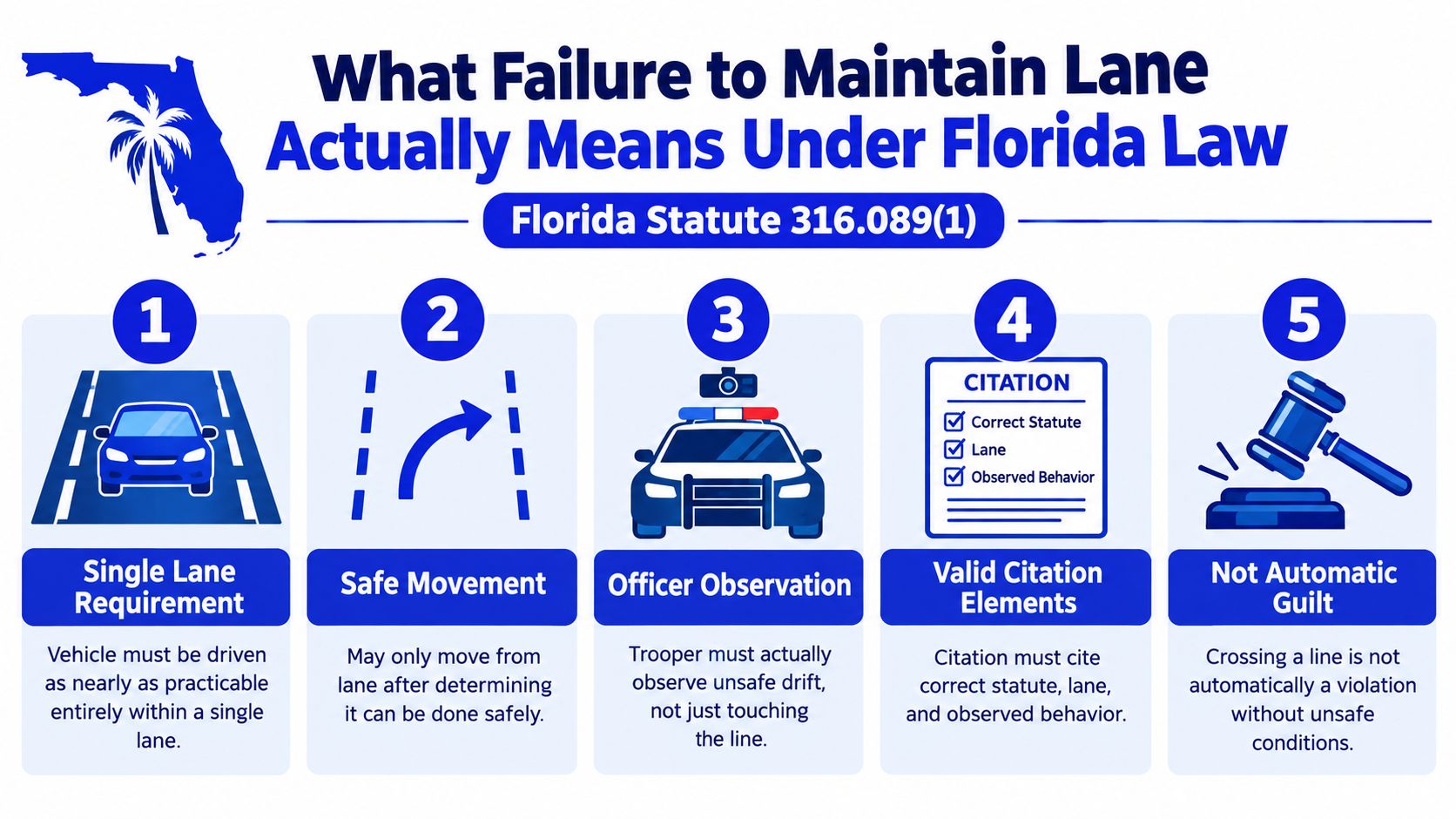
Florida's core lane rule is Florida Statutes section 316.089(1). It says a driver on a roadway divided into two or more clearly marked lanes must drive as nearly as practicable entirely within a single lane and can't move from that lane until the driver has first determined the move can be made safely, as stated in Florida Statutes Chapter 316.
That wording matters. “As nearly as practicable” is not the same as “perfect at all times.”
What the officer actually needs
A valid lane-maintenance case is stronger when the officer can describe more than a brief touch of a line. Florida's lane-maintenance language gives room for normal driving realities, including road conditions, evasive movement, and other safety-related reasons a driver may not stay perfectly centered every second.
If you want a plain-English breakdown of what failure to maintain lane means for a Florida driver, that overview is useful because it frames the charge the way drivers experience it. For a related lane-use issue, Florida drivers should also understand improper lane usage in Florida, because officers sometimes use overlapping lane-related allegations to justify the stop.
The State still has to prove the elements
At trial, the State generally has to prove:
You were driving on a roadway with clearly marked lanes.
You failed to stay within a single lane as nearly as practicable.
The movement wasn't justified by safety necessity or surrounding conditions.
A related statute, section 316.085, also matters when the allegation involves movement from a direct course in a lane. That law says a driver must determine the vehicle isn't being approached or passed in the lane or on the side of intended movement, and that the maneuver can be completed safely without interfering with traffic, as provided in Florida Statutes section 316.085.
A brief drift is not automatic guilt. Context decides whether the stop and the citation hold up.
That's the weakness in many failure to maintain lane FSS cases. If the officer didn't observe unsafe movement, impact on nearby traffic, repeated weaving, or some other meaningful safety concern, the citation may be vulnerable.
Penalties, Points, and the Insurance Domino Effect
Drivers get burned. They stare at the ticket amount and miss the cost.
A lane-maintenance conviction is a moving violation. Once that result posts to your driving record, you're not just dealing with the clerk's window anymore. You're dealing with points, insurer review, and a record that follows you.
The public safety backdrop matters
Lane departure is a serious safety category. A National Highway Traffic Safety Administration crash-population analysis found 1.12 million roadway-departure-type crashes in the U.S., representing 19.4% of all crashes, associated with about 14,844 fatalities, 479,939 MAIS 1-5 injuries, and 863,213 property-damage-only crashes, according to NHTSA crash data publication 812653.
That's why officers and courts take lane-related allegations seriously. It also explains why you should treat the citation seriously, even if your own facts are minor.
What a conviction can trigger
Florida drivers should pay attention to the point system because Florida license points rules affect far more than one case.
Real Cost of a Failure to Maintain Lane Conviction in Florida | ||
|---|---|---|
Cost Category | Pay the Ticket | Conviction After Contest |
Fine and court assessment | You resolve it immediately, but the payment usually closes the case as a conviction | You may still face court-imposed financial obligations if convicted |
Driving record | Conviction posts as a moving violation | Conviction still posts if you lose |
License points | Points can be added to your Florida record | Points can be added if adjudicated guilty |
Insurance review | Your insurer may treat the conviction as a rating event | Same risk if the final result is a conviction |
Future ticket exposure | Another ticket later can stack on top of this one | Same stacking problem if the outcome is still a conviction |
Here's the blunt truth. The posted amount on the citation is often the smallest part of the problem. The larger risk is what happens after the disposition posts.
Points accumulation: If you already have violations, another moving conviction can move you closer to suspension territory.
Insurance impact: Carriers regularly review driving history when pricing renewals.
Commercial consequences: If you drive for work, a moving record issue can create employment headaches.
Long-tail record damage: One conviction makes the next one more dangerous.
California's Strategic Highway Safety Plan also shows how severe lane-departure behavior can be, reporting 56,633 fatal or serious-injury crashes involving a vehicle departing its lane from 2008 to 2017, leading to 15,642 fatalities and 52,249 serious injuries, and noting such crashes represented 44% of fatal or serious-injury crashes, 48% of all traffic fatalities, and 45% of all serious injuries in that period, as detailed in the California Strategic Highway Safety Plan.
Your case is still your case. But the system sees lane departures as a serious category. That's exactly why paying first and thinking later is a mistake.
Why Lane Drift Happens and What Evidence Tells Your Side of the Story
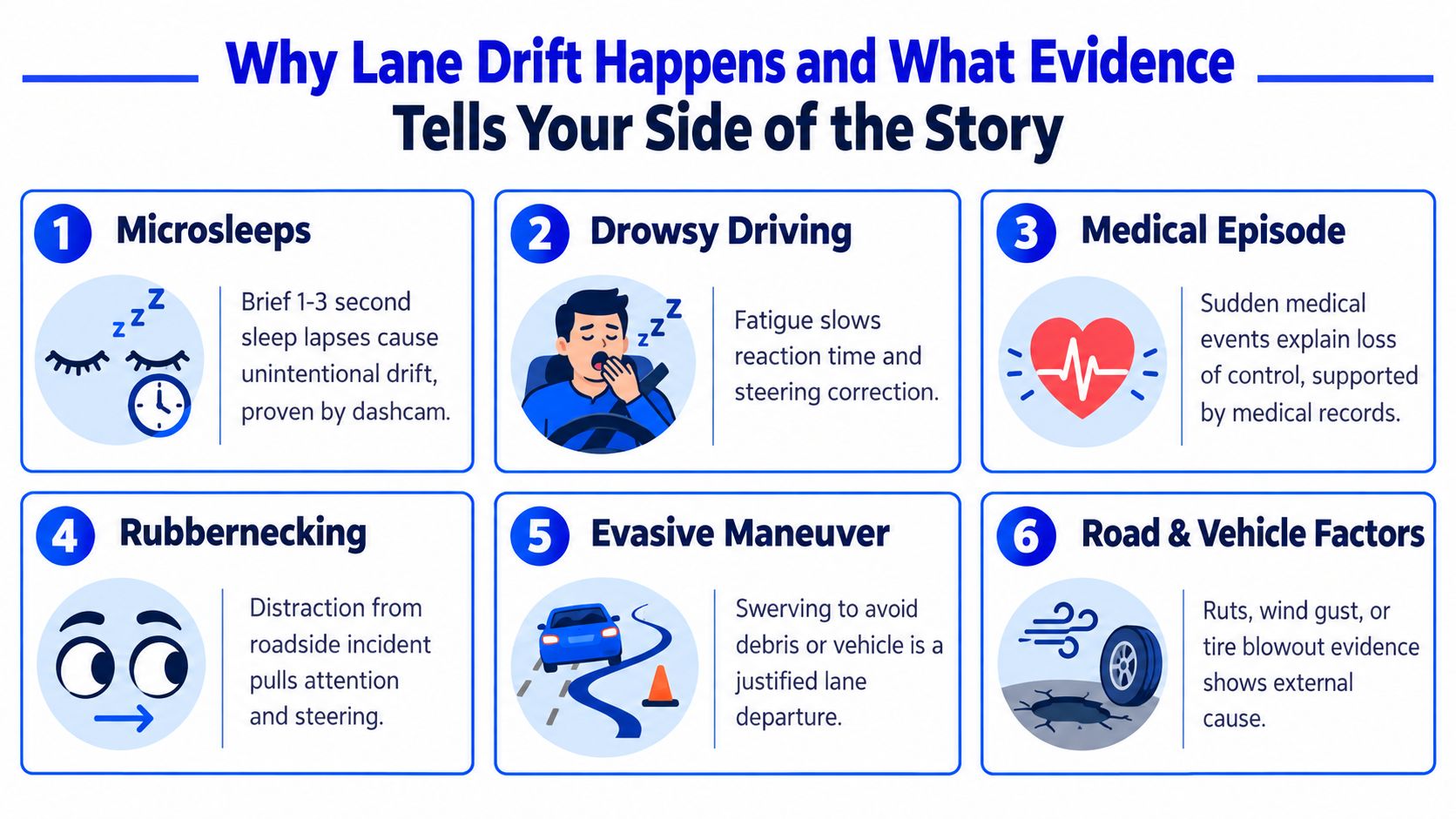
Not every lane movement comes from careless driving. In many cases, the better explanation is a short control lapse, bad roadway conditions, or an evasive response to something the officer didn't fully see.
Independent technical research found lane departure is usually a human-factors problem rather than a pure vehicle-defect issue. The review identified causes such as driver inattention, fatigue, alcohol or drug impairment, relinquished steering, poor road conditions, high speed, and sudden evasive maneuvers. Another sampled roadway-departure study reported 25% involved the driver relinquishing steering control, 20% involved loss of directional control on degraded road surfaces, 21% involved intentional evasive maneuvers, 9% involved inattention to lane tracking, and 5% involved vehicle failures, as discussed in the technical review on lane-departure warning and lane-keeping systems.
Common real-world explanations
That research lines up with what drivers describe every day:
Fatigue or microsleep: A brief lapse can create a short drift.
Medical symptoms: Sudden dizziness, vision problems, or another episode can matter.
Evasive movement: Debris, an encroaching vehicle, or a merging driver can justify movement.
Roadway defects: Faded lane markings, ruts, pooled water, or rough shoulders can change the picture.
Construction confusion: Narrowed lanes and temporary striping often create bad stops.
Preserve proof quickly
Your defense gets stronger when the facts are captured early. Start with visual evidence. Pull available footage from your own dashcam, nearby cameras, business surveillance, or Florida traffic camera resources if the location may have useful roadway footage nearby.
Then build the context.
Save video files immediately: Don't trust overwrite settings.
Photograph the roadway: Focus on lane markings, shoulder condition, potholes, standing water, and construction signs.
Write your memory down: Note the exact location, weather, traffic, and why you moved if you moved intentionally.
Identify witnesses: A passenger or nearby driver may matter.
Check your vehicle condition: Tire issues or steering problems can become relevant.
The officer saw one angle for a short time. Your job is to preserve the angle the officer missed.
Patrol dashcam footage can also cut both ways. Sometimes it confirms the allegation. Other times it shows the movement was minor, explainable, or not unsafe at all. That's why early evidence preservation is not optional.
Pay the Ticket or Fight It A Clear Comparison for Florida Drivers
Emotion makes drivers do dumb things with traffic tickets. A side-by-side comparison fixes that.
If you pay, you get speed and convenience. If you fight, you preserve the chance to avoid a harmful result. That's the trade-off. The wrong move is pretending there is no trade-off.
The real comparison
Drivers weighing whether to pay a ticket or hire a lawyer in Florida need to compare consequences, not just convenience.
Pay vs. Fight A Failure to Maintain Lane Comparison | ||
|---|---|---|
Factor | Pay the Ticket | Fight with Ticket Shield |
Immediate effort | Fast online or clerk payment | Requires action before the deadline |
Case result | Usually ends as a conviction | Creates a chance for dismissal, reduction, or withhold |
Driving record | Moving violation result can post | Attorney can work to protect the record |
Points risk | Points may be assessed | Goal is to avoid points if possible |
Insurance exposure | Conviction can become an underwriting issue | Better final outcomes can reduce that risk |
Court involvement | You finish fast, but accept the consequence | Counsel may handle much of the process |
Which side protects you better
Paying feels efficient because it ends your stress today. Fighting is usually better because it addresses the part that lasts.
Ask yourself one question. Are you trying to end the inconvenience, or are you trying to protect your license and record?
A fast payment solves the paperwork. It doesn't solve the conviction.
For many Florida drivers, especially those who already have tickets, drive for work, or can't afford more record damage, contesting the citation is the more rational move.
How to Fight a Failure to Maintain Lane Citation in Florida
A lane ticket case gets easier to manage once you stop guessing about procedure. Florida gives you a path. Use it.
The first step is simple. Read the citation closely. Check the statute listed, the location, the county, and the response deadline. Florida lane cases usually begin under section 316.089(1), and the wording on the ticket matters.
The first moves to make
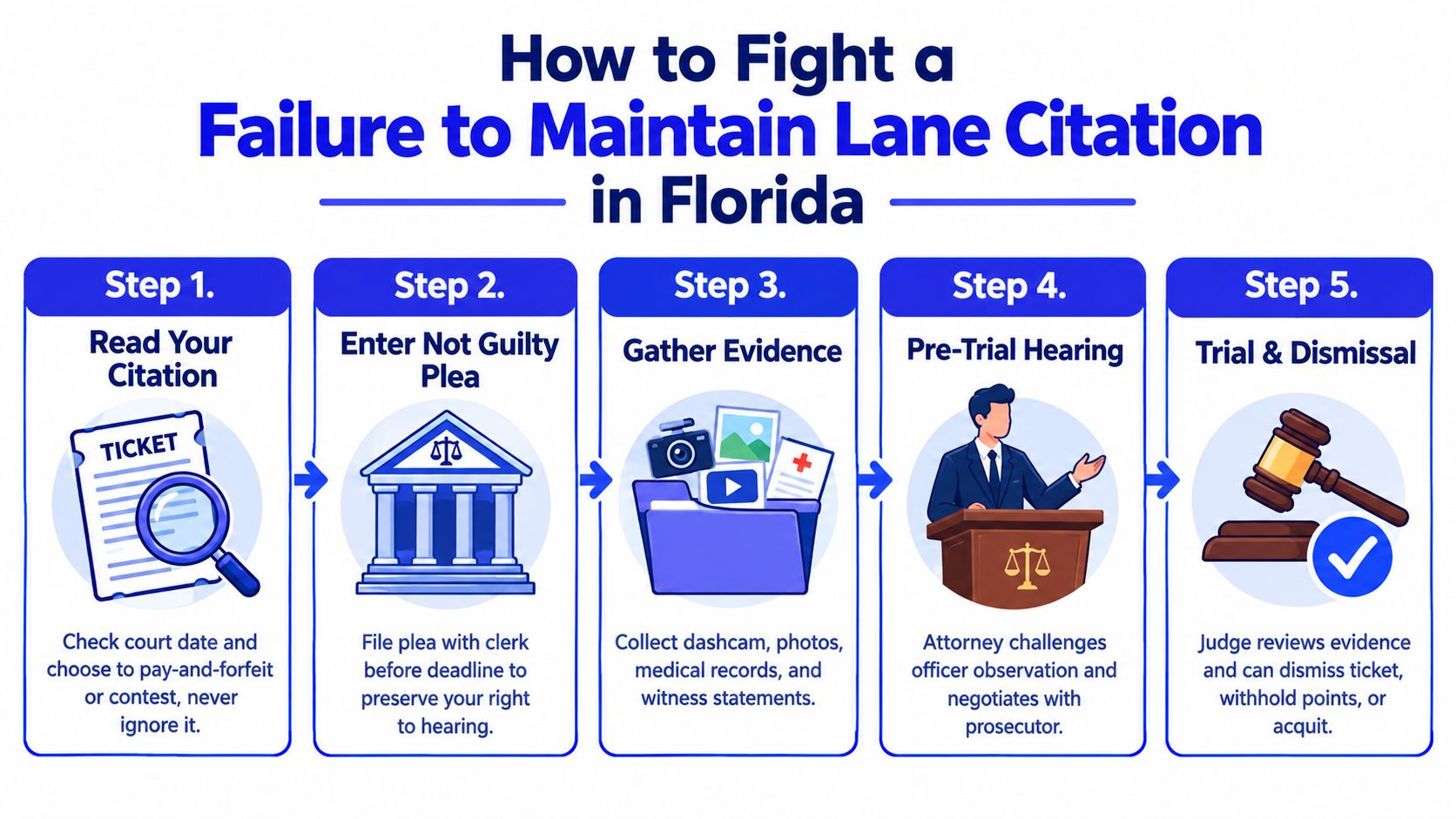
Use a straightforward sequence:
Review the citation for errors. Wrong statute, unclear location, or sloppy observations can matter.
Choose to contest it before the deadline. Ignoring it is how drivers create bigger problems.
Preserve your evidence. Video, photos, witness names, and medical context should be gathered early.
Request the State's evidence. That can include officer reports and in-car video.
Prepare the legal theory. The defense may focus on necessity, weak observation, road conditions, or failure of proof.
A more detailed process guide on how to fight a traffic ticket in Florida is useful if you want the county-court flow in plain English.
This video also gives drivers a practical look at the contest process:
What you're attacking in court
Florida's statute doesn't ban every imperfect lane movement. It targets movement that falls outside what was practicable and safe under the circumstances. That means your defense often turns on context and proof.
Some arguments are factual. Some are procedural. Some attack the stop itself. Others attack whether the officer can prove unsafe movement on a clearly marked roadway.
Marked-lane problem: Were the lane lines clear?
Necessity defense: Did you move to avoid danger?
Observation weakness: Did the officer see enough to support the charge?
Video contradiction: Does the camera show something different from the narrative?
The strongest lane-ticket defenses aren't dramatic. They're specific.
How Ticket Shield Defends Florida Drivers Against Lane Tickets
A lane ticket is where cheap traffic defense falls apart.
These cases turn on details. What the officer saw. What the video shows. Whether the roadway was clearly marked. Whether the movement was unsafe or just momentary drift. If the firm handling your case runs drivers through a volume system, your ticket gets processed instead of defended. That is how a small citation turns into points, insurance trouble, and a mark on your record that could have been avoided.
A real Florida traffic defense lawyer handles lane cases by building a position around facts, proof, and the local court. That is the standard you should expect.
What a lawyer-led defense should actually do
For a failure to maintain lane charge, the job is specific.
It starts with the citation and the officer's account. Then it moves to the video, the road conditions, the lane markings, and the county court handling the case. Good defense work also looks at outcome strategy early, because the right result is not always the same in every county or driving record.
That usually means:
Checking the charge itself: The statute and written allegation must match the facts.
Pressing the observation issue: An officer needs more than a vague claim that you touched or crossed a line.
Using objective proof: Dashcam, bodycam, patrol video, and scene details can help your side.
Pushing for a record-saving result: Dismissal is ideal, but reduction or a no-points resolution can still protect you from the bigger insurance problem.
Preparing for the local court, not a generic script: County practice matters in traffic court.
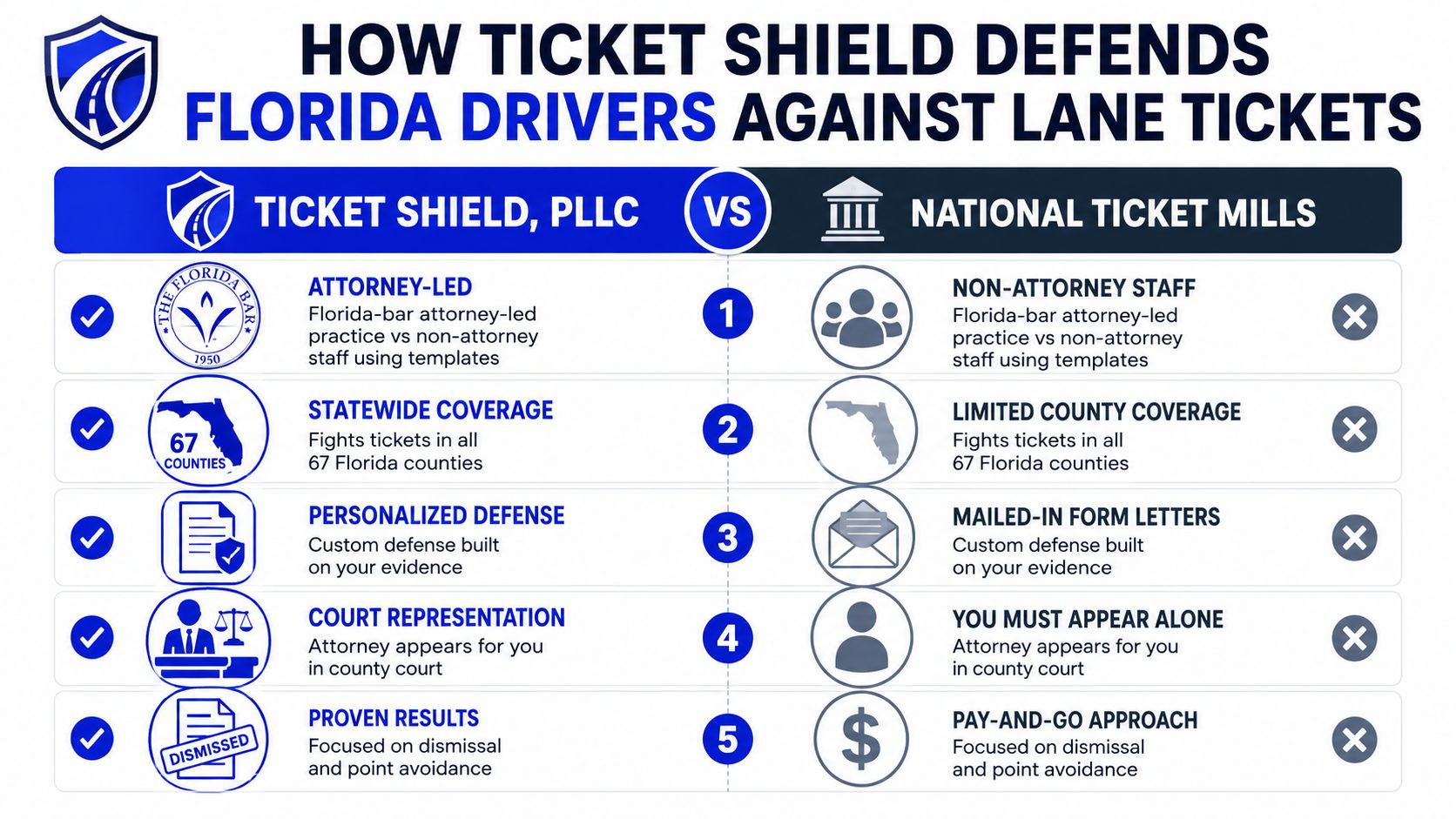
Ticket Shield, PLLC is a Florida-based firm focused on traffic defense. Its published model emphasizes direct communication with an attorney and representation for drivers across the state. That structure fits lane-maintenance cases because these tickets need legal judgment, not automated processing. You need a lawyer who can test the officer's version against section 316.089 and the actual evidence.
What to avoid
Stay away from ticket services built on volume.
If you cannot get a straight answer about who is handling your case, what the defense theory is, or what result they are trying to get, you have a problem. A real lawyer should be able to tell you whether the path is dismissal, reduction, withhold, or trial, and why. If all you are getting is intake messages and generic updates, your case is being moved through a system, not defended by strategy.
Stop Guessing and Get a Lawyer on Your Side Today
You get home, set the citation on the counter, and tell yourself you will deal with it later. That is how a lane ticket turns into points, higher premiums, and a driving record problem that lasts longer than the stop itself.
Treat this like a deadline with consequences, because that is exactly what it is. A conviction can follow you into insurance reviews, employer checks, and the next traffic stop. Paying fast may feel easy. It is often the move that costs you more.
Start with the basics today. Read the citation. Check the statute, county, and response date. Save any dashcam footage. Write down what happened before your memory gets cleaned up by stress and time.
Then get a lawyer to review it before you make a plea or pay anything.
A real Florida traffic defense lawyer looks at your case to protect your record, not to process a file and move on. That matters. Attorney-led defense means someone can spot weaknesses in the charge, check the officer's account against the facts, and push for an outcome that avoids the insurance domino effect.
Ticket Shield, PLLC handles Florida traffic cases with that attorney-driven approach.
Do not guess. Do not assume this ticket is too small to fight. Do not hand yourself points because a website made it sound simple.
Get legal advice while your options are still open.