
Escambia County Traffic Court: Defend Your License
Fight your ticket in Escambia County traffic court. Our 2026 guide explains options, deadlines, and how to protect your license and avoid points.

TL;DR: If you got a ticket in Escambia County, act fast. You usually have 30 days to pay or contest a traffic citation in Escambia County, Florida. Miss that window and your license can be suspended automatically.
You're probably reading this with a citation on the passenger seat, a court date you don't fully understand, and a knot in your stomach. That reaction is justified. A traffic ticket in Escambia County can turn into a license problem, an insurance problem, and a work problem if you handle it casually.
The biggest mistake drivers make is assuming this is just a fine. It isn't. In Florida, traffic court is a legal system with deadlines, procedural traps, and consequences that can follow you long after you mail in payment. If you're dealing with Escambia County traffic court, you need to treat the ticket like a case, not an inconvenience.
Table of Contents
What Are the Immediate Steps After a Ticket in Escambia County
What Are Your Three Paths After a Ticket Pay School or Fight
What Are the Immediate Steps After a Ticket in Escambia County
You get stopped in Pensacola on the way home. The officer hands you a citation. By that night, the actual risk is no longer the stop itself. It is what you do next.
A traffic ticket in Escambia County can turn into a suspended license, points on your record, higher insurance premiums, and a preventable court problem if you sit on it or make the wrong first move. The court gives you a short window to respond. Treat that deadline like a threat to your license, because it is.
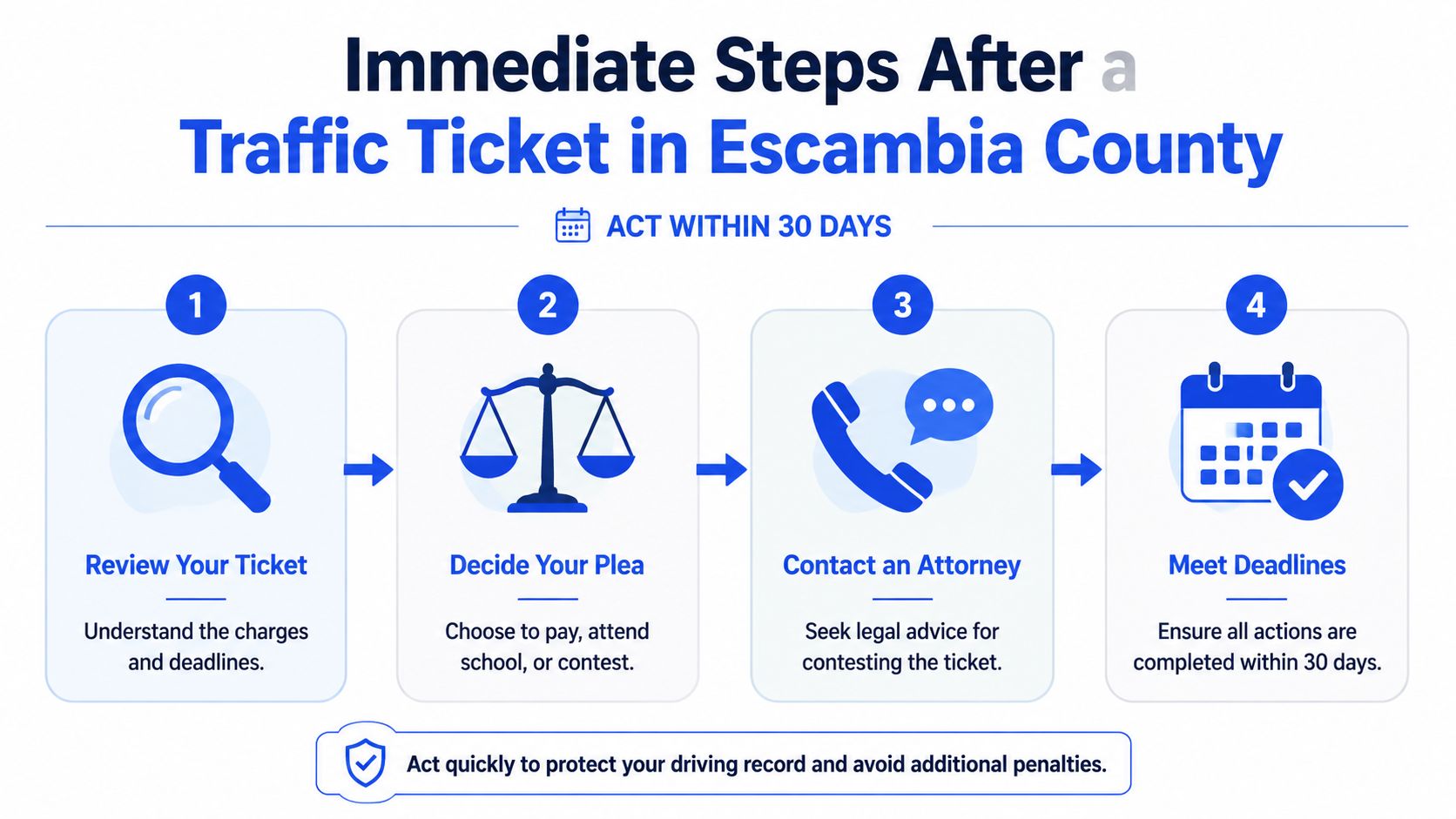
Start here, the same day if possible:
Read the citation closely: Check the charge, the date, the location, and whether Escambia County is listed. Small details matter later.
Lock down the deadline: Put it in your phone, your calendar, and your reminders. Missing it can trigger license trouble fast.
Write down the facts while they are fresh: Note the road, traffic flow, weather, signage, where the officer was positioned, and exactly what was said.
Gather your documents: Keep the ticket, license, registration, and insurance card together so nothing gets lost.
Do not choose a response blindly: Paying, electing school, and contesting lead to very different consequences.
Use a practical first-step checklist: This step-by-step guide on what to do when you get a ticket helps you get organized before you make an expensive mistake.
Here is the point many drivers miss. The deadline is only the first problem. The bigger problem is choosing an option that looks convenient now and costs you far more later. A quick payment can follow you through insurance renewals. A careless statement can weaken a defense before a lawyer ever sees the case.
What should you avoid right now
The first few days decide whether you keep control of this case or hand that control away.
Avoid these mistakes:
Do not ignore the ticket: Escambia County traffic court will keep moving even if you do nothing.
Do not assume paying is the cheap option: The fine is often the smallest part of the cost once points and insurance are factored in.
Do not ask the Clerk for legal strategy: The Clerk processes paperwork. The Clerk does not protect your record.
Do not send a rushed explanation without a plan: What you put in writing can limit your defense later.
Do not rely on what you said on the roadside: Those statements do not end the legal analysis, and they can create problems if handled poorly.
If you drive for work, the risk is higher. Rideshare drivers, delivery drivers, commercial drivers, military members, and long-distance commuters have more to lose from a suspension or a spike in insurance costs. Acting fast protects your options. Handling it alone often protects nothing.
Practical rule: The day you receive the ticket is the day you start protecting your license, your record, and your insurance rate.
How Do You Navigate the Escambia County Clerk of Court
Escambia County traffic court feels confusing because drivers often mix up the Clerk's office with the judge's courtroom. They are not the same thing, and treating them like they are can lead to bad decisions.
The Escambia County Courthouse is located at 190 West Government Street, Pensacola. That location matters because it's where your traffic matter is anchored administratively and procedurally in Escambia County. If you're contesting a citation, that filing path runs through the local system tied to that courthouse.
What does the Clerk actually do
The Clerk handles the intake and processing side of a traffic case. That includes recording the citation, receiving payments, and managing the basic case flow. If you're checking status, confirming whether a citation is in the system, or trying to identify your case number, the Clerk is part of that process.
That's why drivers often need a reliable way to track down their paperwork early. If you're trying to sort out missing details, this Florida citation number lookup guide can help you get organized before you make a costly mistake.
Where do drivers get confused
Drivers get into trouble when they assume administrative access equals legal protection. It doesn't. The Clerk can tell you procedural information. The Clerk can't tell you whether paying is smart, whether a defense exists, or whether a contested hearing gives you a better chance to protect your record.
The system is built to process tickets efficiently. It is not built to protect you from long-term fallout.
That's why local procedure matters. A driver in Pensacola faces one county's workflow. A driver in Tampa deals with another, including matters tied to the Edgecomb Courthouse. Experienced statewide traffic counsel understands those differences and uses them. A generic app usually doesn't.
If you're handling Escambia County traffic court, separate the logistics from the legal strategy. Use the Clerk for records and process. Use legal judgment for everything that affects your license, points exposure, and insurance future.
What Are Your Three Paths After a Ticket Pay School or Fight
You have three basic paths after a traffic ticket. Pay it. Elect school. Fight it. Only one of those options consistently keeps your legal options open.
What happens if you just pay it
Paying is the fastest option. It's also often the most expensive in the long run.
When you pay, you usually stop asking whether the officer's observations were solid, whether the equipment was properly handled, whether the citation has weaknesses, or whether the case could be reduced or dismissed. You trade strategy for speed. A lot of drivers do that because they're busy, embarrassed, or convinced they have no defense.
That's a mistake, especially with a speeding allegation under Florida Statute 316.183, where the legal standard can involve whether you were driving faster than was reasonable and prudent under the circumstances. That kind of case is not always as simple as the printed number on the citation.
Is traffic school really the safe middle ground
Traffic school appeals to drivers who want a middle option. Sometimes it helps. Sometimes it doesn't fit. Sometimes it still leaves you with a result that is acceptable only because no one stopped to test whether you could do better.
The problem with school is psychological as much as legal. Drivers treat it like a guaranteed shield. It isn't. It's an administrative choice, not a courtroom defense. If your priority is protecting your record as aggressively as possible, school may be too passive.
It can feel safer than it is: You're still resolving the case rather than challenging it.
It doesn't test the state's proof: No one forces the issue.
It may not serve your bigger goal: If your job, clearance, or driving history matters, “good enough” can still be harmful.
Why fighting the ticket is often the smart move
Fighting the ticket keeps options open. That matters. A contested case allows a lawyer to evaluate the citation, the officer's basis for the stop, the method used to estimate speed, procedural compliance, and negotiation opportunities.
That doesn't mean every ticket gets dismissed. It means you stop surrendering before anyone has done the legal work.
Here's the clean comparison:
Outcome | Pay the Ticket | Hire Ticket Shield |
|---|---|---|
Control over strategy | Minimal | Direct legal strategy focused on protecting your record |
Review of weaknesses in the case | None | Attorney review of facts, procedure, and defenses |
Pressure on the prosecution | None | Active contesting and negotiation |
Focus on no points goal | Weak | Stronger, defense-driven approach |
Convenience | Quick payment now | Legal handling designed to reduce your burden |
If you want a broader breakdown of these decision points, review these Florida speeding ticket options.
Paying ends the paperwork. Fighting protects your future.
A lot of drivers also ask whether they can fight the ticket themselves. You can. You can also represent yourself in any technical legal matter where the other side already knows the system better than you do. That doesn't make it wise.
Escambia County traffic court is not a customer service desk. It's a legal forum. The hidden financial risk of going alone isn't just the citation itself. It's what follows when the result lands on your driving record and starts affecting the parts of your life that don't show up on the front of the ticket.
What Are Common Defenses to Florida Traffic Tickets
You read the ticket, see a fine, and assume the case is simple. That mistake is expensive.
In Escambia County traffic court, strong defenses come from facts, procedure, and pressure applied at the right time. Drivers who handle a ticket alone usually argue fairness. The court cares about proof, legal sufficiency, and whether the officer and the state can carry their burden.

How does Florida speeding law create room to defend a case
Florida speeding law gives the officer room to make a judgment call. That also gives your lawyer room to attack that judgment.
A speeding case can rise or fall on questions such as:
Whether traffic and road conditions were described correctly
Whether speed was measured by radar, lidar, pacing, or visual estimate
Whether the officer's conclusion matched the actual conditions
Whether the citation and notes match what happened during the stop
Those details matter because a conviction can cost far more than the ticket amount. Points, insurance increases, and a damaged driving record often do the lasting harm. If you want a closer look at defense strategy, read this guide on how to beat a speeding ticket.
What technical defenses matter in real court
The best defenses are often technical, and technical defenses win cases because they give the court a legal reason to reduce, amend, or dismiss.
Common defense angles include:
Equipment problems: Radar and lidar cases can be challenged through maintenance records, calibration history, operator training, and how the device was used during the stop.
Observation weaknesses: Weather, heavy traffic, lane positioning, lighting, and obstructed sightlines can weaken the officer's identification of your vehicle and speed.
Citation defects: Mistakes on a ticket do not automatically end the case, but the right error can create an advantage in negotiation or undermine the state's presentation.
Procedure failures: The timing of the stop, the officer's documentation, notice issues, and courtroom readiness all matter.
Traffic court rewards precision. It does not reward panic, explanations, or good intentions.
Timing can also become a defense in the right case. Florida traffic cases are subject to procedural deadlines, and delay can create dismissal arguments when the rules apply and the record supports it. A driver without counsel usually misses that issue completely.
That is the hidden danger of going alone. You are not just risking the fine. You are risking the chance to find the weakness that protects your license, your insurance rate, and your record before the case is closed.
Why Is a Lawyer Better Than a Ticket App
Automated apps sell convenience. Traffic court requires judgment.
That's the core difference.
What do apps miss that lawyers catch
Apps and ticket mills work from templates. They move cases through a system. That can sound efficient until your case needs nuance, local insight, negotiation skill, or a technical defense that doesn't fit a canned workflow.
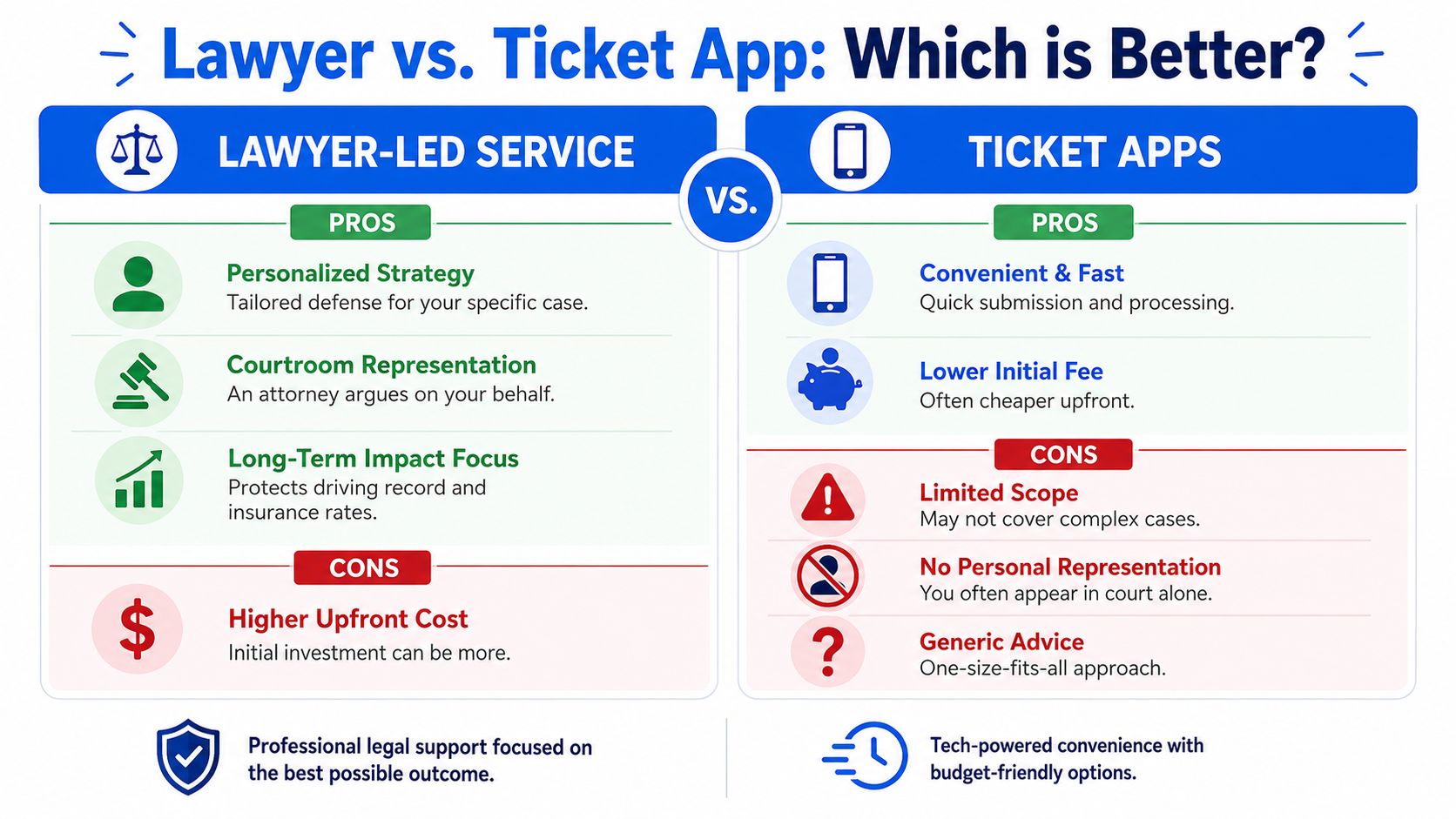
A lawyer looks at the stop, the charging document, the court procedure, the officer's method, and the long-term risk to your record. An app usually asks a few intake questions and funnels you into a standardized process.
That's not protection. That's processing.
Why direct attorney access changes the outcome
When you hire a lawyer-led firm, you should be able to speak directly with your attorney by phone or text. You should not be routed through a chatbot, a case manager who can't give legal advice, or a middleman reading from a script.
That distinction matters when:
Your case has unusual facts
You're a military driver worried about career impact
You drive for Uber, Lyft, or delivery platforms
You already missed a step and need damage control
You need someone to explain your real options in plain English
For a deeper comparison, read why many drivers choose a local lawyer over apps.
This also comes down to accountability. A lawyer stands behind strategy. An app stands behind a workflow.
Here's a short breakdown from a practical standpoint:
Lawyer-led service: customized legal judgment, actual advocacy, direct communication.
Ticket app: generic intake, limited personalization, no real attorney relationship in many situations.
Ticket mill model: volume first, client second. That's exactly what you should avoid.
This video walks through the difference in a more direct way.
If your goal is no points, you need a defense strategy built for your case, not software built for volume.
FAQs About Escambia County Traffic Court
Do I have to go to court myself
A lot of drivers ask this after the panic sets in. You get the ticket, check your work calendar, think about missing a day, and start wondering if paying it is the fastest way out. That is how people turn a manageable traffic case into points, higher insurance, and a record that follows them longer than the fine.
In many Escambia County traffic cases, a lawyer can appear for you or handle major parts of the case without dragging you into court. That matters if you travel for work, serve in the military, drive for a living, or do not want to risk saying the wrong thing in a courtroom.
The smart question is not, "Can I deal with this myself?" The smart question is, "What does handling this alone cost me if I get it wrong?"
What if I already missed a deadline
Act now.
A missed deadline does not always end the case, but it raises the stakes fast. License holds, added costs, missed hearing problems, and fewer legal options can follow if you wait another week hoping it sorts itself out.
A lawyer needs to check the case status, the court record, and what can still be fixed. The earlier that happens, the more room there is to protect your license and limit the fallout.
Can a speeding ticket be defended
Yes, if the defense is built on facts and procedure instead of guesswork.
A speeding case may be challenged based on the officer's observations, how speed was measured, whether the stop and paperwork were handled properly, or whether the court deadlines and prosecution steps were met. Some cases are stronger than others, but many drivers give up too early because they assume the ticket is unbeatable.
Florida traffic cases also run on deadlines and procedural rules. As noted earlier, some non-criminal traffic infractions can be dismissed if the state does not bring the case to trial on time. That kind of issue does not help you unless someone spots it and uses it correctly.
What is the hidden cost of handling it alone
The fine is usually the smallest part of the problem.
Consequences often appear later. Points can affect your driving record. Insurance companies do not care that you were in a hurry, late for work, or trying to save time by paying the ticket. Employers care about moving violations, especially if driving is part of your job. And once you choose the wrong option, undoing it is harder and more expensive.
Here is what drivers usually overlook:
Insurance increases: A cheap ticket can trigger costs that last far longer than the case itself.
License risk: Too many points or a missed court step can create larger problems than the original citation.
Work consequences: Commercial drivers, military members, and anyone who drives for income have more to lose.
Costly admissions: Drivers representing themselves often say things that hand the state its case.
Lost opportunities: Defenses and procedural openings disappear if no one raises them in time.
If your ticket came from a business or residential area, Florida speed laws matter, but the statute alone does not decide the case. The details do. That is why a generic app or quick online form is a poor bet when your record and insurance are on the line.
The blunt answer is this. Handling an Escambia County ticket alone is a gamble with consequences far beyond the fine. If you want the best chance at a No Points result, you need a lawyer-led defense and direct access to your attorney. That is exactly how Ticket Shield, PLLC handles traffic cases for Florida drivers.
If you want to protect your license, protect your record, and fight for the No Points result, visit Ticket Shield, PLLC for a free consultation.
