Domestic Violence Lawyer Miami: Your Complete Defense Guide
Domestic Violence Lawyer Miami. Facing domestic violence charges in Miami-Dade? Learn your rights under Florida law, local court process, defenses, and how

You were arrested or handed an injunction in Miami, and now every phone call, text, and court date matters. Don't treat this like a paperwork problem. In Miami-Dade, a domestic violence case can split into a criminal track and a civil protection track, and the wrong move in either one can box you in fast.
The first job is control. Do not contact the other person, do not post about the incident, and do not assume silence from law enforcement means the case is going away. If you were just released, your next move is to get the booking number, the probable cause affidavit, and the exact terms of any no-contact order, then hand that information to a lawyer who knows Miami-Dade practice inside and out.
Table of Contents
Your Rights Under Florida Law During Booking and Questioning
What to Ask at Your First Consultation With a Miami Defense Lawyer
The First 72 Hours After an Arrest in Miami-Dade
The moment you're out, stop acting like you can explain this away on your own. Anything you say now can be used later, especially if detectives call back, a deputy tries to “clear something up,” or the other side sends bait by text. If you're in that window, your job is simple, protect the record and stop creating new problems.

Lock down the paperwork and the timeline
Get the booking number, the arresting agency, and the exact charge language. Save the probable cause affidavit, bond paperwork, and any release conditions. Then pull together screenshots, call logs, texts, photos, and names of anyone who saw what happened or saw the aftermath.
The reason is practical. Booking photos, body-worn camera footage, 911 audio, and scene photos can become key evidence, but only if someone asks for and preserves them before they disappear or get harder to obtain. Use a lawyer early, because you want those requests sent while the details are still fresh.
Practical rule: if you're thinking about “explaining your side,” stop and let counsel do it. A well-timed call from counsel is worth more than three emotional calls from you.
Don't make the classic Miami mistake
Do not go back to the shared residence unless the order and your lawyer clearly say you can. Do not text the alleged victim, even if your message is polite or “just logistical.” Do not post a vague status update on social media and pretend it won't be screenshotted.
A smart first call can also help you understand pretrial release conditions and what the court may impose next. Review pretrial release conditions before you improvise your way into another violation. The first 72 hours decide whether you're building a defense or cleaning up a mess.
Your Rights Under Florida Law During Booking and Questioning
Miami-Dade jail intake is not a place to freestyle. If police want a statement, the safest answer is usually the shortest one, I want a lawyer and I'm invoking my right to remain silent. Florida's protections under Article I of the Florida Constitution and the Fifth Amendment matter most when an officer keeps asking after you've already said enough.
What to say, and what not to say
If detectives approach you after release, don't try to “clarify” the case. You're not helping yourself by correcting small details on the spot, because those details can be turned into admissions, inconsistencies, or follow-up questions.
Say this once, clearly:
I'm not answering questions without my lawyer.
I do not consent to questioning.
I want all contact through counsel.
Then stop talking. The point isn't to be rude, it's to keep the State from building its version of events out of your own words.
Bond, first appearance, and the no-contact order
At first appearance, the judge looks at release issues, conditions, and the practical risk tied to the allegation. In a domestic-violence case, that usually includes a no-contact order, which can affect where you sleep, who handles child pickups, and whether you can return home.
If the court issues a no-contact order, read it literally. “I just needed my charger” is not a legal excuse.
The Miami lawyer who handles this well knows that booking and first appearance are not side notes, they're the first battleground. Use warrant requirements to understand how quickly a paper problem can become a custody problem, then let counsel deal with the courthouse steps.
Common Defenses Used by a Domestic Violence Lawyer in Miami
The State still has to prove its case. That means proof of intent, proof that the alleged victim's story is reliable, and proof that the facts support the charge beyond a reasonable doubt. If any of those pieces wobble, the defense gets real traction.

The defense theories that actually matter
Self-defense comes up when you were trying to stop harm, not start it. Defense of others matters when a child or another person was in the middle of the incident. Mutual combat can matter when both people were actively engaged and the State can't cleanly identify a primary aggressor.
False allegation cases often turn on anger, revenge, custody conflict, or a bad breakup. Lack of intent matters when the contact was accidental, reflexive, or the product of a chaotic struggle. Insufficient evidence is the broadest and often the strongest position when the police report leans on assumption instead of proof.
Criminal case versus injunction case
The criminal case asks whether the State can prove a crime. The injunction case asks whether the court should enter protective relief. Those tracks overlap because the same texts, photos, 911 calls, and witness accounts can show up in both places, but the burdens and consequences are different.
That's why a lawyer has to look at the full file, not just the police report. For a tighter look at suppressing weak evidence before it hurts you, review what is a motion to suppress evidence. A defense that wins the facts on paper and loses the procedure in court is still a bad defense.
How The Law Office of John P. Sherman, PLLC Can Help
When you're comparing counsel, you need someone who can read the Miami-Dade docket, not someone handing your case to a call center. The office behind domestic violence lawyer Miami focuses on direct client communication and practical court strategy, which matters when your case has both criminal and injunction consequences.

What a serious local lawyer should do for you
A strong defense lawyer should get the discovery, track the hearing calendar, spot any service problem on the injunction side, and push for the cleanest resolution path available. That means reviewing police reports, body-cam footage, witness statements, texts, and any prior filings that could change the judge's view of the case.
Speed and clarity matter most. If your lawyer won't tell you who is appearing with you, how often they communicate, or what's included in the fee, keep looking. In a case like this, direct access to the attorney is not a luxury, it's the baseline.
How to think about fit
Choose counsel that gives you a straight assessment of risk, not a sales pitch. You want someone who explains the likely court calendar, how discovery moves, what the no-contact order means day to day, and whether the facts point toward dismissal, negotiation, or trial.
That's the standard a client should demand. If you're deciding between a generalist and a lawyer who lives in this courtroom, pick the one who knows the local process cold.
The Miami-Dade Court Process and Likely Timeline
A domestic violence arrest in Miami-Dade starts a clock you do not control. The criminal case moves through arrest and booking, first appearance, arraignment, pretrial, then either a negotiated resolution or trial. If an injunction is filed too, that civil case can move on a separate track, and service problems or mismatched hearing dates can change your position fast.
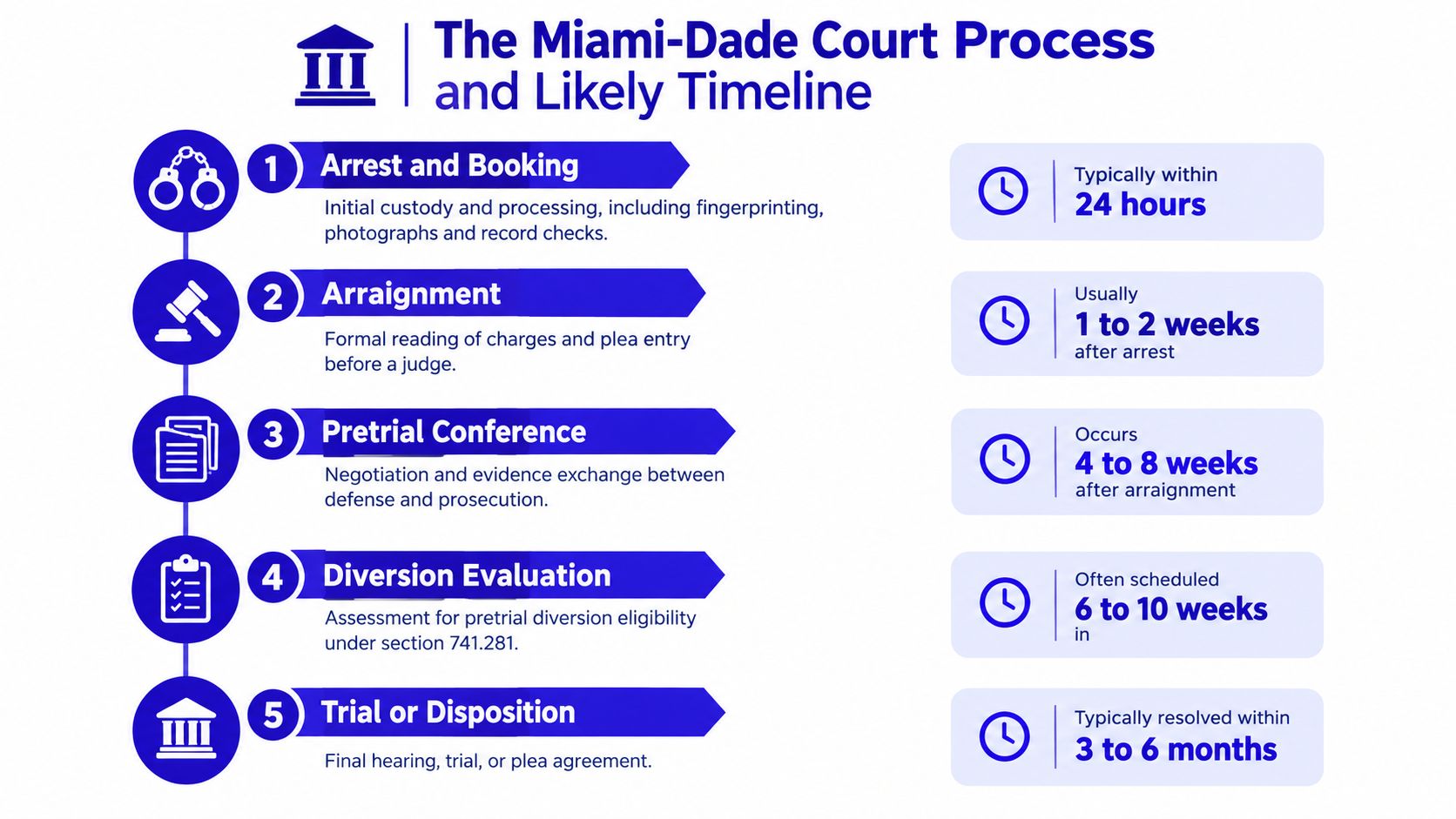
What happens first
Booking usually comes first, then first appearance. At that hearing, the judge can set bond, no-contact terms, and other release conditions that affect where you sleep, who you can see, and how you communicate.
Arraignment follows, where the charge is read and a plea is entered. If you want to understand that step in plain English, review what happens at arraignment hearing. After arraignment, the defense presses for discovery and checks whether the State has a clean case or gaps that matter.
What the timeline means for your defense
The early hearings set the tone. A lawyer who understands Miami-Dade domestic violence practice should use that window to watch the criminal file and the injunction file together, because the wrong move in one court can hurt you in the other. If the injunction was not properly served, or the hearings do not line up, that is not a detail to ignore. It is the kind of procedural problem that can change strategy.
You do not need a lawyer who talks in abstractions. You need one who can tell you what happens at each hearing, what the court is likely to do, and what must be challenged right away.
What to Ask at Your First Consultation With a Miami Defense Lawyer
Walk in with paper, not excuses. Bring the police report, charging papers, screenshots, photos, witness names, and every court document you were served. A consultation should feel like a hard interview, because your lawyer needs the facts fast and you need answers you can act on.
Start with the questions that matter
Ask, Have you handled Miami-Dade domestic violence cases in this courthouse recently? Ask who will appear at hearings, because some firms hand the file to someone you have never met. Ask how you will get updates, whether you can reach the attorney directly, and how fast you should expect a response when the criminal case and the injunction move on separate tracks. If you want a model for that interview, review this criminal defense attorney consultation checklist.
Then press for specifics. What evidence does the lawyer need today, and what should wait?
Police reports and charging documents
Screenshots of texts, DMs, and call logs
Photos of injuries, scene conditions, or property damage
Witness names and phone numbers
Any prior protective orders or related filings
If you were just served with an injunction, ask whether service was proper and whether the hearing date lines up with the criminal case. A lawyer who understands Miami-Dade practice will check both files together, because a service defect or a scheduling mismatch can change the fight before it really starts.
Compare the resolution tracks before you pay
Ask the lawyer to explain diversion, plea, mitigation, and trial in your exact fact pattern. If the State's proof is thin and the injunction file has service problems, the strategy is different than it is in a case with a clean witness and a detailed report. You need the lawyer to connect the facts to the path, not give you a speech about every possible outcome.
Bottom line: you should leave with a real strategy, not a sales pitch.
Watch the billing language closely
Get the fee in writing. Ask what the retainer covers, what triggers extra charges, and whether trial work, investigators, or expert witnesses are billed separately. If the lawyer will not explain that before you sign, keep looking.
Avoid anyone who promises a result, pushes you to pay on the spot without reviewing the case, or will not say who handles your day-to-day calls. In Miami-Dade, the lawyer who knows the local docket explains the trade-offs plainly and tells you what needs to happen first.
Resolution Paths, Diversion, Plea, Mitigation, or Trial
Your case usually lands on one of four tracks. The right track depends on the facts, the strength of the proof, and how much risk you can tolerate. There is no honest lawyer answer that fits every domestic violence file in Miami.
How the four outcomes differ
Pretrial diversion can be the right answer when the case is eligible and the facts support compliance instead of litigation. Negotiated plea works when the evidence is strong enough that the goal becomes reducing damage, not pretending the case is spotless. Mitigation matters when the judge needs a fuller picture of the person, the relationship, and the context. Trial is for cases that need a full challenge because the State's proof is weak or unreliable.
Protect the evidence immediately
Save every text, photo, voicemail, video clip, and witness contact while they still exist. Keep medical records, receipts, and 911 information in one place, and stop deleting anything just because it makes you uncomfortable. If an app auto-deletes messages, turn that off now.
Read the consequences before you choose
A plea can bring probation, a no-contact order, or other restrictions. Diversion can still require compliance work before dismissal. Trial carries the highest risk, but sometimes it's the only path that makes sense when the case rests on bad assumptions or inconsistent witness statements.
What you choose should fit the facts, not your panic. If the evidence is messy and the service issue is unresolved, that may create an advantage. If the proof is strong, mitigation may be the better move. Either way, the lawyer should tell you plainly what the path costs you and what it can save.
Evidence Preservation Checklist and Final Takeaways
The best defense starts with preservation, not panic. Miami-Dade domestic violence cases move fast, and the 15-day injunction hearing window makes delay expensive. If you wait until a hearing is set, you may already have lost the cleanest version of the evidence.
Save this now
Texts and DMs: Keep full conversations, not just screenshots of one line.
Photos and video: Save original files when possible, because metadata can matter.
Voicemail and call logs: Keep missed calls, voicemails, and timestamps.
911-related records: Preserve anything that identifies the time, caller, and sequence.
Medical records: Document injuries, treatment, and discharge paperwork.
Witness information: Names, numbers, emails, and what each person saw.
Receipts and location records: Keep anything that helps place you where you say you were.
Stop doing these things immediately
Do not delete messages, even if they look bad. Do not ask friends to message the other side for you. Do not post about the case, the relationship, or the arrest. Do not go back and “clean up” the story, because inconsistent explanations create more problems than the original facts.
Keep your hands off the evidence and off the other person. That discipline helps your lawyer more than any apology ever will.
Your next moves should be ordered
Contact counsel right away and give them the booking information, court papers, and screenshots.
Follow every release condition exactly, especially any no-contact order.
Preserve every document and digital record tied to the incident.
Calendar every court date the moment you get it.
Let your lawyer handle contact, filings, and court strategy.
A domestic violence lawyer in Miami should take the procedural burden off your shoulders fast, because the courthouse does not wait for you to get organized. Visit TicketShield.com for a free consultation and push for the goal, No Points on your license.
You do not need a cheerful pep talk. You need a lawyer who can tell you, in plain English, what the State has, what it still needs, and what the next hearing can change. Bring the papers and ask direct questions, because the first consultation is where weak representation exposes itself fast.
Ask about the courthouse, not the brochure
Start with this question, How many domestic violence cases have you handled in Miami-Dade Domestic Violence Criminal Court? Then ask who will appear with you in court, who reviews discovery, and who handles motions. If the lawyer can't answer those questions without drifting into generalities, that's a warning sign.
Ask whether the lawyer regularly deals with the local calendar, the no-contact order, and the parallel injunction track. Miami-Dade's domestic-violence cases aren't just about the charge on paper, they're about how the criminal file interacts with the civil protection order and the service status on that order. You want someone who knows what happens when service fails, when it's enforceable, and when the hearing clock starts running.
Bring the right documents into the room
A productive consult depends on what you hand over. If you show up with nothing but a story, the lawyer has to guess. If you show up with the record, the lawyer can start working.
Bring these items:
Police reports and the probable cause affidavit
Bond paperwork and any no-contact order
Screenshots of texts, calls, DMs, and voicemails
Names and contact information for witnesses
Photos, videos, medical records, and receipts
Any prior injunctions, custody orders, or related filings
Practical rule: if it happened on a phone, save it before an app deletes it. If it happened in person, write down the date, time, and who else saw it while the memory is still fresh.
Ask the lawyer what else they need before the next hearing. A serious attorney will tell you to preserve originals, not just screenshots, and to avoid any conversation with the other side that could be spun as a violation or an admission. If children are involved, you also want guidance on how to handle exchanges and logistics without creating a new criminal problem.
Compare the resolution paths before you sign anything
Do not let the meeting become a sales pitch for a single outcome. The lawyer should explain four tracks, not one. Diversion makes sense when eligibility and compliance are realistic. Plea becomes the focus when the evidence is strong and damage control matters more than a trial fight. Mitigation helps when the facts call for context, not denial. Trial is for cases where the State's proof is thin, inconsistent, or overreaching.
Ask which track fits your file and why. A lawyer who gives you a canned answer before reviewing the evidence is guessing, and guessing is expensive. The right recommendation should line up with the report, the witness statements, the injunction posture, and any service issues affecting the civil side.
Get specific about fees and communication
Ask for the fee in writing and ask what it includes. In Miami-Dade misdemeanor domestic-violence defense, lawyers often use either a flat fee or a retainer tied to appearances, discovery review, motions, and trial preparation. A flat fee usually makes sense when the case is straightforward and the scope is predictable. A retainer can make more sense when the file is likely to require heavier motion work or a contested hearing schedule.
Bottom line: if you can't tell who answers your calls and texts, you're buying uncertainty, not representation.
Ask whether the fee covers court appearances, negotiations, and standard discovery, and what triggers extra cost. Private investigators, experts, appellate work, and unusual hearings often sit outside the base fee. Also ask what happens if the case resolves early, because you should know whether unused funds are credited, refunded, or absorbed by the work already done.
Watch for the red flags
Do not hire the lawyer who promises a result. Do not hire the one who wants a huge payment before reviewing the police file. Do not hire the office that hides behind receptionists, ticket mills, or chatbot-style intake and won't let you speak to the actual attorney who'll handle your case.
You need calm, direct answers, not theater. If the lawyer can't explain the local process, the service problem, the no-contact order, and the practical cost of each resolution path, keep moving. Good counsel is specific, measured, and reachable.
Resolution Paths, Diversion, Plea, Mitigation, or Trial
Your case doesn't resolve by hope. It resolves through one of four routes, and the right one depends on the facts, the paperwork, and how much risk you can live with. The lawyer's job is to tell you which lane fits, not to push you toward the most convenient one.
Diversion, plea, mitigation, and trial side by side
Pretrial diversion is the cleanest result when the case qualifies and you can complete the conditions. Under section 741.281, successful completion can lead to dismissal, but the point is compliance, not denial. If the file is eligible and the evidence is manageable, diversion is often the path that gives you the least long-term damage.
Negotiated plea is for cases where the State has enough proof that a fight to the finish doesn't make sense. You may be looking at reduced exposure, a withhold of adjudication, or probation terms instead of trial risk. That is not a moral failure, it's a practical decision when the evidence is strong.
Mitigation-focused resolution matters when the facts are bad enough to require accountability, but not so bad that context should be ignored. That's where character references, counseling, employment history, family responsibilities, and the lack of prior violence can matter. A judge can't ignore the facts, but the judge can hear the full picture.
Trial is the right move when the State's case is weak, the accuser is inconsistent, or the record depends on assumptions instead of proof. Trial carries the highest risk, but it's the only path that forces the prosecution to prove every element in open court.
Preserve the evidence while the case is still moving
Save everything now, not after the first conference. Keep the full text thread, the original photos, the voicemail file, the call log, medical records, and the names of every witness who saw the incident or the aftermath. If a security camera, apartment system, or neighbor's video might exist, write that down immediately.
Delete nothing. Edit nothing. Don't ask the other party to “just explain it.” That contact can wreck your defense and complicate the injunction side at the same time.
Read the consequence before you choose
A plea can leave you with probation terms and ongoing restrictions. Diversion can still require classes, reporting, and strict compliance before dismissal. Trial can clear you, but it can also end in a conviction if the evidence lands against you. Your lawyer should connect each option to the specific file, not an abstract theory.
If the service issue is unresolved or the injunction hearing hasn't happened yet, that procedural posture may matter more than the accusation itself. The smartest move is to let your lawyer preserve an advantage, narrow the risk, and keep your options open for as long as the facts allow.
Evidence Preservation Checklist and Final Takeaways
The case gets easier to defend when you preserve the record early. Miami-Dade domestic violence matters move on a short fuse, and the 15-day hearing window can turn a sloppy start into a serious disadvantage. If you wait until the courthouse date is close, you're already behind.
Save the evidence in one place
Create one folder, digital and physical, and put everything there.
Texts and direct messages. Save the full conversation, not isolated screenshots.
Photos and videos. Keep originals when possible, because the file itself matters.
Voicemail and call logs. Preserve timestamps, missed calls, and recordings.
Medical records. Keep discharge notes, treatment records, and injury documentation.
Witness details. Save names, phone numbers, email addresses, and short notes on what each person saw.
Receipts and location proof. Keep anything that helps fix the timeline.
Court papers. Save the arrest paperwork, bond conditions, and injunction documents together.
Stop the self-sabotage
Do not delete messages because they look bad. Do not start a side conversation through friends, family, or a mutual contact. Do not post about the arrest, the relationship, or the hearing. Do not contact the alleged victim just to “clear the air.”
Practical rule: if you wouldn't want a judge to read it aloud, don't send it.
Do not move money, wipe devices, or change account settings just because you're nervous. Those moves create new problems and make everything look worse. If there's video, a camera system, or a work log that might help, tell counsel now so preservation can start before the record disappears.
Keep your next moves simple
Call a lawyer immediately and give them the booking details, court papers, and evidence folder.
Follow the no-contact order exactly and read every condition carefully.
Save every record tied to the incident before it disappears.
Put every court date on your calendar the minute you get it.
Let counsel handle communications with the court and the other side.
That's the play. Not excuses, not improvisation, not damage control after the fact. A domestic violence lawyer in Miami should take over the procedure fast, protect the record, and keep you from making a bad day turn into a worse one.
Visit TicketShield.com for a free consultation and start fighting for the goal, No Points on your license.