Does a Cop Have to Show You the Radar Gun if You Ask?
Does a cop have to show you the radar gun if you ask? Learn Florida rules on radar disclosure, calibration records, and how to challenge a speeding ticket.

You're asking the wrong question if you think a radar-gun display will make your Florida speeding ticket disappear. The question is not, “Does a cop have to show you the radar gun if you ask?” The question is whether the State can prove, in traffic court, that the speed-measuring device was approved, properly tested, and operated by a trained officer who visually identified your vehicle.
In Florida, asking to see the device is generally allowed. But the officer usually doesn't have to show you the radar unit or its reading during the stop, and refusal alone usually won't invalidate the citation. Your strongest defense usually begins after the roadside encounter, through the evidence connected to the specific device and officer.
Table of Contents
The Short Answer About Radar Guns in Florida
No, a Florida officer generally doesn't have to show you the radar gun at the roadside just because you ask. You can make the request, but Florida law doesn't create a general right to physically handle the device, closely inspect it, or demand that the officer display the speed reading before you're released. A widely cited legal summary reaches the same practical conclusion, asking is allowed, but no state law generally requires an officer to show the radar gun during a traffic stop. You can review that explanation in this Florida radar-gun legal summary.
Florida's courts treat the traffic stop differently from a courtroom hearing. The shoulder of the road is usually a temporary detention, not a trial where the officer must present calibration certificates, testing records, and training documents on demand. The legal fight typically concerns whether the State can later establish the reliability of the evidence, not whether you saw the equipment for a few seconds beside your vehicle.
Florida traffic practice also recognizes that an officer's refusal to display the reading doesn't, by itself, defeat the ticket. A Florida traffic resource explains that officers aren't required to show a driver the radar-device readout during the stop, so your request doesn't create an immediate legal entitlement to see it. That distinction is central to the answer to “does a cop have to show you the radar gun if you ask?” in Florida.
Practical rule: Ask politely if you want the information, but don't treat a refusal as a dismissal.
What you should preserve instead
Arguing over the device at the window rarely helps your defense. A better approach is to listen carefully and remember details that can later be checked against discovery materials:
The alleged speed: Note the speed the officer says was recorded.
The unit information: If the officer voluntarily identifies the radar make, model, or serial number, preserve it.
The officer's description: Pay attention to where the officer says the speed was measured and how your vehicle was identified.
The circumstances: Remember traffic, visibility, weather, lane position, and nearby vehicles.
You shouldn't argue calibration, accuse the officer of lying, or demand that a judge be called to the shoulder. An aggressive exchange can create unnecessary tension and may produce statements that the State later uses against you. Stay calm, provide required identification documents, and save the technical challenge for court.
Florida drivers should think about litigation timing, not roadside theatrics. The device may not be shown to you, but its records can become important later. Florida traffic discovery rules focus on identifying the speed-measuring device, including its type and, for an electronic or mechanical device, its manufacturer's serial number. That information can help connect the citation to the correct records.
How Florida Statute 316.1906 Controls Radar Evidence
Florida Statute 316.1906 provides the framework for using radar and other speed-measuring devices in speeding cases. The statute defines radar for speed enforcement broadly enough to include law-enforcement speed radar and other laser-based or microwave-based systems used to detect a motorist's speed. Its requirements matter in court, not because they give you a roadside inspection right, but because they establish what the State must prove before relying on the reading.
The first safeguard is human observation. Under the statute, the law enforcement officer must independently determine visually that the vehicle is speeding. The radar reading isn't supposed to replace the officer's observation. The officer must also be able to associate the measured speed with a single vehicle when issuing a citation based on radar evidence. Florida Statute 316.1906 addresses these requirements directly in its speed-measuring-device provisions.
The foundation the State must establish
Florida law also addresses the device and the person operating it. The radar or other qualifying speed-measuring unit must meet the applicable Department of Highway Safety and Motor Vehicles design criteria, and the officer must complete the approved radar training course required by the statute. The statute's foundation requirements are why the State's evidence may include training documentation, device information, and testing records.
The same statute includes technical operating conditions. These include requirements concerning automatic speed locks, audio alarms, audio Doppler, and the unit's approved design. Those details aren't roadside conversation points. They're potential courtroom questions that can expose a gap between the State's assumption that the device worked and its ability to prove that it operated lawfully during your stop.
The radar reading is only one piece of the case. Florida law also focuses on visual identification, approved equipment, and trained operation.
Where a defense attorney looks for weakness
A radar challenge may become meaningful if the cited unit wasn't an approved type, if the officer's training doesn't cover the relevant equipment, or if the State can't connect the records to the specific device used. The defense can also examine whether the officer's visual observation supported the reading and whether traffic conditions allowed the speed to be assigned to one vehicle.
For a practical overview of challenging the evidence, review radar-gun speeding-ticket defense. The point isn't to claim that every missing document automatically wins your case. The point is to force the State to prove each required foundation rather than asking the judge to accept an unexplained number from the citation.
Roadside Disclosure Versus Courtroom Discovery
At the roadside, you have limited control over the equipment. An officer may decline to hand you the radar gun, decline to show the display, and decline to discuss the unit's calibration history. Florida law doesn't generally require the officer to answer those technical questions during the stop.
That doesn't mean you have no rights during the encounter. You should remain respectful, provide the identification and vehicle documents the officer requests, and avoid making admissions about your speed. You can ask for the officer's name and agency, and you can remember or record the basic facts of the stop when it's safe and lawful to do so. What you say matters because an admission can become evidence, while a roadside argument about the device usually proves very little.
The courtroom is different. There, the issue is whether the State can establish the evidentiary foundation for the particular radar reading. Florida Rule of Traffic Court 6.445 requires the citation to identify the speed-measuring device by type and, for radar or another electronic or mechanical device, by the manufacturer's serial number. That identification can help you seek records tied to the unit rather than asking general questions about every radar device used by an agency. Read the rule through this Florida traffic discovery rule.
The evidence that can matter later
Depending on the case and applicable procedure, a defense request may seek materials such as:
Device identification: The manufacturer, model, and serial number connected to the citation.
Approval materials: Documentation showing the unit meets applicable DHSMV requirements.
Testing records: Calibration certificates, internal self-checks, and tuning-fork results.
Operator proof: Training and certification records for the officer who used the device.
Maintenance history: Repair and service records that could affect reliability.
A motion to suppress evidence may be relevant when the State's proof has a legal defect, but the proper filing depends on the facts and the court's procedures. You can review the distinction in this Florida motion-to-suppress guide.
The practical divide is simple: you usually can't force disclosure on the shoulder, but you may be able to pursue meaningful records before the hearing. Don't measure your defense by whether the officer opened the patrol-car door and showed you a screen. Measure it by whether the State can prove the reading through admissible, case-specific evidence.
Requesting Calibration and Maintenance Records in Florida
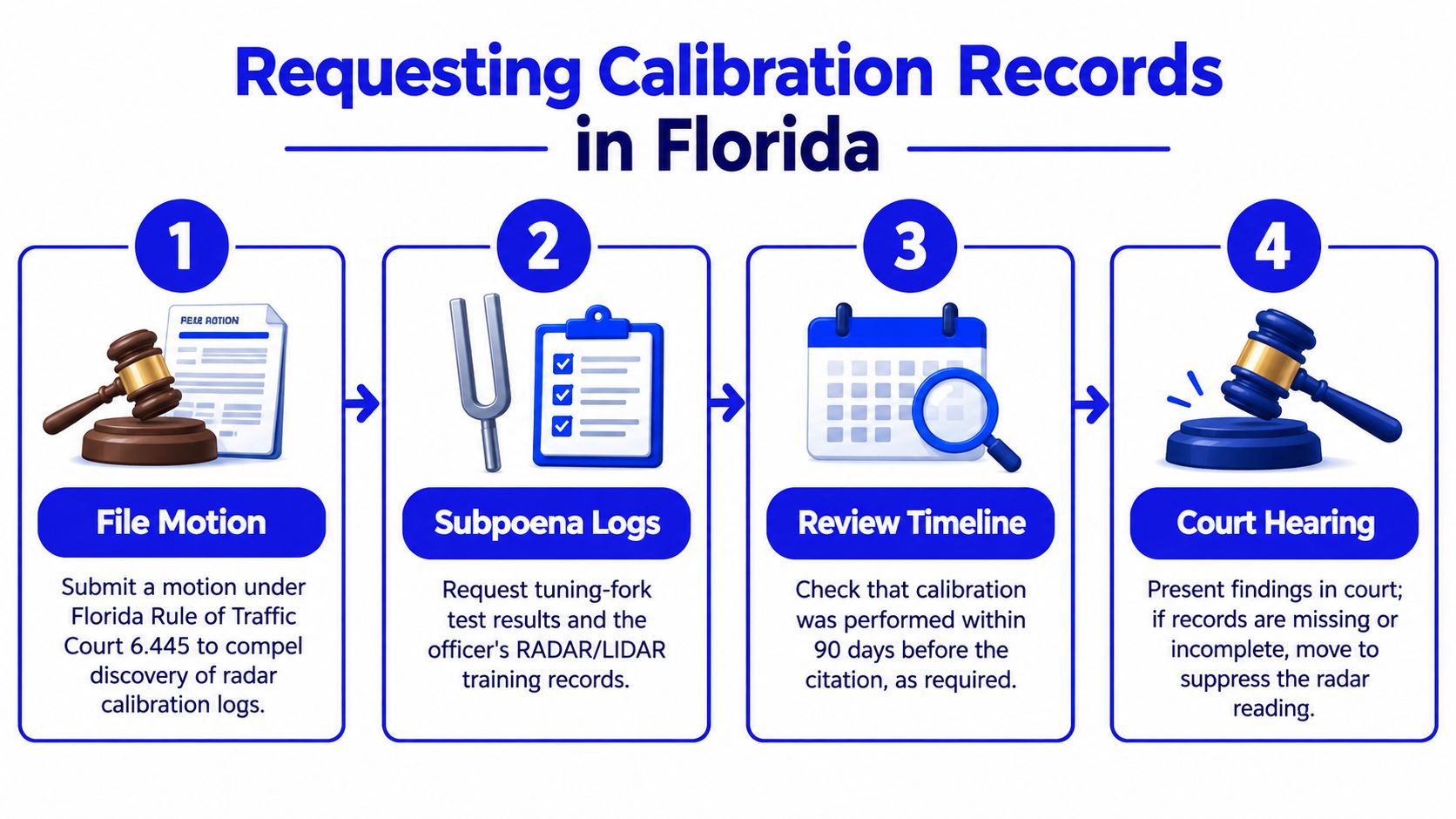
Start with the citation. Confirm the device type and look for the manufacturer's serial number required by Florida Rule of Traffic Court 6.445. If the citation doesn't identify the device as the rule requires, preserve that issue and discuss it with counsel rather than guessing which unit the officer used.
Then make a written discovery request directed to the appropriate prosecuting authority or agency procedure. Ask for records tied to the cited device and the officer who operated it. A broad demand for “all radar records” is less useful than a focused request identifying the citation number, stop date, officer, device type, and serial number.
A practical records request
Request documents such as:
The officer's approved radar or speed-measuring-device training certificate.
The device's manufacturer, model, and serial-number history.
The most recent calibration certificate connected to the unit.
Daily tuning-fork, internal self-check, or zero-set testing records for the stop date.
Repair, maintenance, and service records for the relevant period.
The agency's notes or reports describing the speed measurement and visual observation.
The provided traffic-defense material describes calibration certificates, tuning-fork tests, internal self-checks, and training records as common proof used to challenge radar reliability. A Florida traffic-court discovery resource also emphasizes the importance of state-specific discovery rules and device-serial-number requirements.
The plan notes for this process refer to a 10-day pretrial discovery window and checking calibration timing within 90 days before the citation. Those deadlines and timing requirements should be verified for your specific court and case because the governing rule, local practice, and type of proceeding control. Don't assume a generic internet deadline applies automatically.
A sample written request
You can adapt this format:
Pursuant to Florida Rule of Traffic Court 6.445, I request the records and materials relating to the speed-measuring device identified on citation number [citation number], including calibration records, tuning-fork or internal testing records, maintenance and repair records, device identification records, and the citing officer's radar training and certification records. Please provide records sufficient to identify the device used on the date of the alleged violation.
If the agency or prosecution doesn't provide the records, don't respond by repeatedly calling the roadside officer. Ask the court for the appropriate discovery remedy, which may include a motion or subpoena duces tecum. Missing, incomplete, or unrelated records can support an argument that the State hasn't established the required foundation, but the judge will decide the legal consequence.
For background on the technology itself, see how radar speed guns work. Understanding the device helps you ask targeted questions, but it doesn't replace a properly timed discovery request.
What to Say and Do During a Florida Speeding Stop
The patrol vehicle's lights come on. You pull over, shut off the engine, and keep your hands visible. The officer approaches and asks whether you know how fast you were going.
Don't volunteer a number. Saying “I was only going a little over” can give the State an admission that no calibration argument can erase. You can provide your license, registration, and insurance information as required, but you don't need to debate the alleged speed from the driver's seat.
Florida Statute 316.1906 requires an independent visual determination, but you won't establish a statutory violation by arguing that point beside the road. You also can't cross-examine the officer, inspect the unit's testing history, or force a complete evidentiary foundation during a traffic stop.
Use short, controlled answers
Keep your roadside communication limited and professional:
If asked about your speed: “I'm not going to speculate about my speed.”
If asked to explain the circumstances: “I'd prefer not to answer substantive questions.”
If you want the device information: “Officer, may I note the radar unit's make, model, serial number, and the speed reading?”
If the officer declines: “Understood.”
Don't reach toward the radar equipment, step out without being directed, or insist that the officer turn the display toward you. You can ask whether the officer's agency has a report or citation record identifying the unit, but the officer may not provide technical details at the scene.
After the stop, write down the exact time, location, direction of travel, lane position, traffic density, lighting, weather, and anything the officer said about how the speed was measured. If a passenger or dash camera captured the event, preserve the original file. Don't edit it before giving it to an attorney.
A calm stop preserves your defense. A roadside confession can weaken it before you ever request a calibration record.
The Florida traffic-law stop guide can help you review the broader interaction. Your objective isn't to win an argument with the officer. Your objective is to avoid creating unnecessary evidence while preserving the facts your attorney can test in court.
Typical Courtroom Outcomes for Florida Speeding Cases
Paying the citation ends the immediate dispute, but it also means accepting the legal and driving-record consequences attached to that resolution. A Florida traffic-defense decision should account for points, insurance exposure, eligibility for available courses or other resolutions, and the strength of the State's evidence.
The plan for this article calls for specific consequences and outcome percentages, including 3 points, a 15 mph-or-more surcharge, insurance increases averaging 20% to 30% for three to five years, mandatory driver school at 12 points, and percentages attributed to Florida clerk statistics. Those figures aren't included in the verified data provided for this article, so they shouldn't be presented as established facts here. The exact consequences can depend on the citation, speed alleged, prior record, county procedure, and resolution.
Two different strategies
If you pay, you give up the opportunity to examine whether the State can prove the radar foundation. If you contest the citation, your attorney can evaluate the officer's visual observation, device identification, training, testing, calibration, and maintenance evidence.
Possible results can include dismissal when the State cannot establish the required foundation, a negotiated nonmoving resolution where legally available, or another outcome that reduces the effect on your driving record. None of those results is automatic, and a radar issue must be matched to the actual evidence in your case.
Outcome | Pay the Ticket | Fight on Radar Grounds |
|---|---|---|
Immediate process | Resolves the citation without a contested hearing | Requires timely review of the citation and available evidence |
Radar records | Usually not tested in court | May be examined through discovery and court procedures |
Officer proof | Usually not challenged | Training, visual observation, and operation can be examined |
Driving-record goal | Depends on the resolution selected | Counsel can pursue a result aimed at No Points |
Time and effort | Less immediate involvement | May require discovery, motions, or a hearing |
A traffic attorney can also determine whether the case involves a technical defect unrelated to calibration. The device's serial number may not match the records, the officer's training may not cover the unit, or the citation may fail to identify the device as required.
The important decision comes before payment. Once you pay, your options may narrow. If protecting your license and insurance position matters, have the citation reviewed first.
Your Florida Radar Defense Checklist and Next Steps
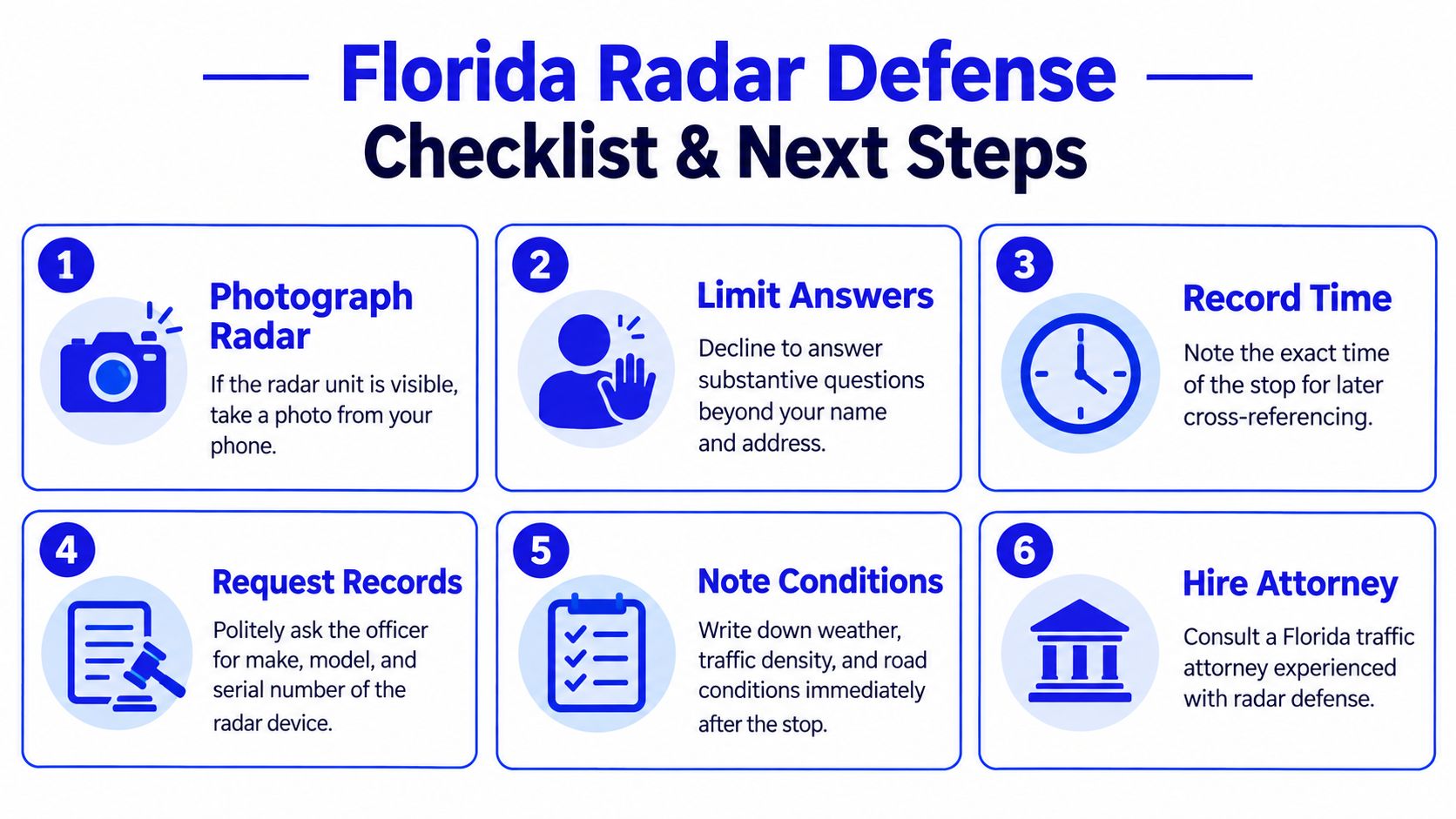
Treat the roadside encounter as evidence preservation, not a courtroom. You don't need to force the officer to display the radar gun. You need to leave the stop without making unnecessary admissions and then move quickly to preserve the information that can be tested later.
Use this checklist:
Photograph the radar unit: If the device is visible and you can safely photograph it without interfering, capture the make, model, or serial number.
Limit answers: Provide identification information, but decline substantive questions about your speed or explanation.
Record the time: Note the exact time and location as soon as the stop ends.
Request records: Politely ask for the radar device's make, model, and serial number for your notes.
Note conditions: Write down weather, traffic density, visibility, lane position, and road conditions.
Hire counsel: Consult a Florida traffic attorney who can review the citation and pursue applicable discovery.
Scripts you can use
At the stop, keep your words controlled:
“Officer, I'm declining to answer questions about the alleged speed. Please issue the citation or release me.”
Before the hearing, a written request can state:
“Pursuant to Florida Rule of Traffic Court 6.445, I request all calibration and maintenance records for the cited radar unit, along with the applicable testing records and operator training file.”
Don't send a vague demand, miss a court deadline, or assume a missing roadside display proves the citation is invalid. The Florida traffic-defense lawyer resource can help you understand what a lawyer should review, including the citation, officer notes, device materials, and available testing records.
Ticket Shield, PLLC is a lawyer-led Florida traffic-defense firm that allows clients to communicate directly with their attorney by phone or text, rather than routing questions through middlemen, corporate answering services, automated apps, or chatbots. The firm can request and review disclosure evidence related to speeding allegations, including officer notes and speed-measuring-device materials, while pursuing a resolution focused on protecting your driving record.
Visit Ticket Shield, PLLC for a free consultation about your Florida radar speeding citation. A lawyer can review the device evidence, discovery issues, and courtroom strategy with you, with the ultimate goal of achieving “No Points” on your license.