Adjudication Withheld Meaning Traffic Ticket
Adjudication withheld meaning traffic ticket. Learn the adjudication withheld meaning for traffic tickets in Florida, how it differs from a conviction, what it

If you're asking about the adjudication withheld meaning traffic ticket in Florida, it generally means the court resolves the case without entering a formal conviction, and an eligible violation may result in no points. That matters because Florida lists unlawful speed more than 15 miles per hour over the lawful or posted speed as 4 points, while unlawful speed resulting in a crash is listed as 6 points.
You've probably just opened a Florida citation, looked at the fine, and noticed a court date or response deadline. Your first instinct may be to pay online and move on. That can be the wrong move. Payment is ordinarily treated as a conviction, while an authorized adjudication-withheld disposition may protect your license from points when the violation qualifies and you complete every required condition.
Table of Contents
What Adjudication Withheld Means on a Florida Traffic Ticket
How Withheld Adjudication Differs From a Conviction or Dismissal
How Withholding Adjudication Affects Points Insurance and Your Record
What Adjudication Withheld Means on a Florida Traffic Ticket
Adjudication withheld is a Florida court disposition. The court resolves the traffic case, but it doesn't enter a formal conviction against you. For many eligible civil traffic violations, that can prevent points from being assessed if you satisfy the court's requirements, such as paying the civil penalty and court costs or completing an approved driver-improvement course. Florida's official citation guidance explains the difference between paying a citation as a conviction and receiving an authorized withholding of adjudication. Read the Florida traffic-citation guidance.
That distinction is critical. If you just pay the citation, you generally accept the conviction consequences associated with the offense. If the court withholds adjudication, the disposition may avoid points for an eligible violation. But the ticket doesn't disappear, and withholding isn't a guarantee that every licensing or insurance consequence vanishes.
What you must do to protect the result
A withheld adjudication is conditional. The court may require payment, proof of course completion, or another specific compliance step. You must follow the clerk's instructions and preserve every receipt, certificate, and clearance document.
Practical rule: Don't choose a payment option until you know whether it treats the ticket as a conviction or preserves an eligible withholding option.
The Florida traffic-school route is addressed in Florida Statute section 318.14. For qualifying listed violations, a driver may elect an approved basic driver-improvement course instead of appearing in court, while still paying the applicable civil penalty and related costs. The election has conditions and exclusions, so eligibility must be confirmed before you act.
A withholding is also different from a dismissal. A dismissal ends the case without the same type of disposition, while adjudication withheld resolves the case through a court-approved outcome that can remain visible on your driving record. Early action matters because paying first can eliminate the opportunity to pursue a different resolution.
If your citation involves unusually high alleged speed or another serious traffic allegation, review the facts with counsel before making an election. A lawyer can assess whether a negotiated resolution, a hearing, or another lawful option is appropriate. You can review one example of Ticket Shield's Florida speeding-ticket defense service without assuming that every citation receives the same result.
How Withheld Adjudication Differs From a Conviction or Dismissal
The disposition on your Florida traffic ticket controls what happens next. A conviction can trigger points and insurance problems. A dismissal closes the case without the same guilty disposition. Adjudication withheld avoids a formal conviction in qualifying cases, but it does not erase the ticket from your driving record.
A conviction usually follows a guilty disposition, including the ordinary result of paying a civil traffic citation. Points may then be assessed according to the violation. Florida's guidance states that points remain on a driver record for at least five years from the disposition date, subject to the offense and applicable record rules. Review Florida's point and suspension guidance.
A dismissal ends the case without the court entering the same guilty disposition. That outcome is not automatic. The citation, evidence, procedure, and steps taken in the case determine whether dismissal is available.
Adjudication withheld resolves the case without a formal conviction. The disposition can still appear on your Florida driving record. When legally available and properly completed, withholding may prevent points from being assessed. It does not guarantee a clean record, remove the citation, or prevent every insurance or reporting consequence.
Comparison at a glance
Outcome | Driving Record | Points | Insurance and Reporting |
|---|---|---|---|
Conviction | A guilty disposition may appear | Points may be assigned under the violation | The conviction can create licensing and insurance concerns and may be reported or evaluated by another state |
Dismissal | The case ends without the same guilty disposition | No points from the dismissed violation | No conviction-based consequence from that ticket, although the insurer controls its own coverage decisions |
Adjudication withheld | The disposition may remain visible | No points when withholding is legally available and conditions are satisfied | It may reduce point-related exposure, but insurers and other states may view or evaluate the record differently |
Do not treat withheld adjudication as a dismissal. A Florida record can still show the disposition, and a home state, employer, or insurer may apply its own reporting or underwriting rules. The practical result depends on what was entered, what you completed, and who later reviews the record.
Florida law also limits certain traffic-school elections to no more than 8 during a lifetime and no more than 1 during any 12-month period, effective July 1, 2024. See Florida's official driving-record questions and answers. That limit makes the choice of resolution a record-management decision, not a routine payment decision.
A no-contest plea can affect the final disposition through the required compliance and clerk processing. Before entering one, review what a plea of no contest means in Florida traffic cases. Act before paying or entering a plea, because the first choice can determine which options remain available.
The Florida Law Behind Withheld Adjudication
Florida's traffic laws provide the framework for speeding citations and other civil traffic infractions. Florida Statute section 316.187 governs Florida's speed-zone framework. It addresses how reasonable and safe speed limits are established after an engineering and traffic investigation, and it sets a 70-mile-per-hour maximum on limited-access highways. Read section 316.187 directly.
That statute matters because the facts of a speeding citation are specific. The roadway, posted signage, alleged speed, and charged subsection can affect how the citation should be evaluated. A withholding may prevent points when legally available, but it doesn't erase the underlying citation or eliminate the civil penalty and compliance requirements.
Florida Statute section 318.14 supplies a separate statutory path for driver-improvement-course elections involving qualifying listed violations, including violations of sections 316.183(2), 316.187, or 316.189. The statute requires the driver to pay the applicable civil penalty and related costs. It also contains exclusions and election limits.
What the legal process means for you
You don't receive a withholding because you ask for one. The clerk must process the election correctly, or the court must enter the appropriate disposition. If the case proceeds to a hearing, the evidence and the charge matter. Your attorney may address the alleged speed, signage, roadway conditions, citation details, and other facts that affect the available resolution.
Prepare before any deadline:
Identify the exact charge: Read the statute and subsection listed on the citation.
Confirm the response date: Missing the applicable deadline can close off an option.
Check election eligibility: Review your prior traffic-school history and the citation category.
Preserve evidence: Keep photographs, dashcam material, location information, and relevant vehicle records.
Ask what disposition will be entered: “No points” should never replace confirmation of the actual court outcome.
The legal authority doesn't make withholding automatic. It gives you a framework for evaluating whether the option is available and how to pursue it without accidentally accepting a conviction.
How Withholding Adjudication Affects Points Insurance and Your Record
Adjudication withheld protects you from points tied to an eligible violation. It does not erase the citation, erase every record entry, or control how an insurer evaluates the event. Florida assigns points by violation. The official guidance lists 4 points for unlawful speed more than 15 miles per hour over the lawful or posted speed and 6 points for unlawful speed resulting in a crash. A conviction that produces points can keep them on the driving record for at least five years from the disposition date. The Florida Highway Safety and Motor Vehicles point table sets out the offense-specific rules.
Withholding adjudication means points generally are not assessed for that qualifying disposition. That is the benefit. The citation still existed, and an insurer, employer, licensing authority, or other authorized record user may still consider it.
The point question
Violation | Points if Convicted | Points if Withheld | Insurance Impact |
|---|---|---|---|
Unlawful speed more than 15 miles per hour over the lawful or posted speed | 4 | No points when withholding is legally available and completed | Point exposure may decrease, but insurance effects may remain |
Unlawful speed resulting in a crash | 6 | No points only if the disposition qualifies legally | The crash and underlying event may still affect insurance or licensing decisions |
Other eligible civil traffic violation | Depends on the listed offense | No points when authorized withholding applies | The specific disposition controls |
Your driving record still matters. Florida states that guilty and adjudication-withheld dispositions may appear on the driver's entire record, subject to retention and purging rules. Certain clerk-of-court adjudication-withheld entries can remain for 75 years, according to the agency's driving-record guidance. Treat withholding as a point-avoidance result, not as a complete record-clearing remedy.
The correct question isn't only “Will I get points?” Ask what disposition will appear, who can see it, how long it can remain, and whether it affects your future eligibility for relief.
Insurance companies make independent underwriting decisions. A withhold may prevent the direct point consequence, but it does not guarantee unchanged premiums, eligibility, or renewal. Do not pay the fine based on a promise that insurance will be unaffected. Confirm the disposition before accepting a resolution.
CDL holders need a separate review. Commercial drivers generally cannot use driver-improvement-school elections to avoid points for traffic citations. The offense and circumstances control, so a CDL holder should obtain a case-specific answer before electing school or paying.
For a focused explanation of Florida point accumulation, review Florida driver's license points and traffic tickets.
Common Ways Drivers Get Adjudication Withheld in Florida
There isn't one universal path. A qualifying driver may pursue a driver-improvement-course election, seek a negotiated disposition, or contest the citation and ask the court to enter an appropriate result. The right route depends on the offense, prior election history, evidence, county procedure, and whether the driver has a commercial license.
Course election
For an eligible civil violation, the driver may elect an approved basic driver-improvement course under the conditions in section 318.14. The driver still pays the civil penalty and related costs, and completion must be handled exactly as the clerk requires. This option is structured, but it isn't available for every citation or every driver.
Negotiated resolution
A Florida traffic attorney may communicate with the clerk, prosecutor, or court process to seek a lawful disposition that protects the driver's record. The requested result might involve withholding adjudication, a different charge, or another resolution supported by the facts and local procedure. No lawyer can guarantee that a judge or prosecuting authority will accept a specific offer.
Litigation and court resolution
Some citations require closer review. The defense may examine the citation, roadway, signage, officer observations, records, and available evidence. If the case proceeds, the court decides the outcome under the applicable rules and facts. A driver should not assume that a hearing automatically produces a dismissal or a withholding.
A traffic-school option is a legal election, not merely an online class. Enrolling in a course without properly handling the court election may not protect your record.
Out-of-state drivers need a separate workflow. Florida clerk guidance says a driver with an out-of-state license should first confirm eligibility with the home state's licensing authority. After resolution, the Florida clerk may issue a clearance letter that must be submitted to the licensing state. The driver should obtain the final Florida disposition, preserve proof of course completion, request clearance documentation when applicable, and confirm that the home jurisdiction received it.
That last step is essential because Florida's disposition doesn't guarantee another jurisdiction will process the event identically or update its records promptly. A Florida withhold also isn't all-purpose immunity from licensing consequences in serious cases involving death or serious bodily injury.
You can review the procedural issues that may affect a traffic defense in how lawyers approach traffic-ticket dismissal, but your own citation still requires an individualized evaluation.
What to Do After You Get a Florida Traffic Ticket
Treat the citation as a deadline problem, not a bill. Your first decision can determine whether you preserve an opportunity for a withhold or accept a conviction.
Start with the document itself. Confirm the county, citation number, alleged violation, court date, and response deadline. Photograph both sides of the citation and save the images somewhere you can access later.
Your immediate checklist
Calendar every date: Record the response deadline and any scheduled appearance. Don't rely on memory.
Preserve the scene: Photograph roadway conditions, lane markings, signs, lighting, and nearby landmarks when it's safe and lawful.
Collect available evidence: Save dashcam clips, location records, vehicle-maintenance information, and witness contact details.
Check the election route: Ask the appropriate Florida clerk whether the violation qualifies for driver-improvement school and what disposition will be entered.
Avoid premature payment: Don't pay online until you understand whether payment will be treated as a conviction and whether it eliminates another option.
Escalate early: Consult a Florida traffic defense attorney before arraignment, a court appearance, or an irreversible election.
Paying the civil penalty is not a neutral administrative act. Florida's official citation guidance distinguishes ordinary payment, which is ordinarily treated as a conviction, from an authorized adjudication-withheld disposition. That's why you should not click through a payment portal just because it's convenient.
A clerk can explain processing instructions, but the clerk can't act as your lawyer or evaluate defenses. If the citation involves a potentially significant point assessment, a crash, a commercial license, a prior election, or an out-of-state license, get legal advice before choosing school or entering a plea. A lawyer can identify the actual decision fork instead of guessing from a generic online form.
For a practical overview of the first steps, see what to do when you get a Florida traffic ticket.
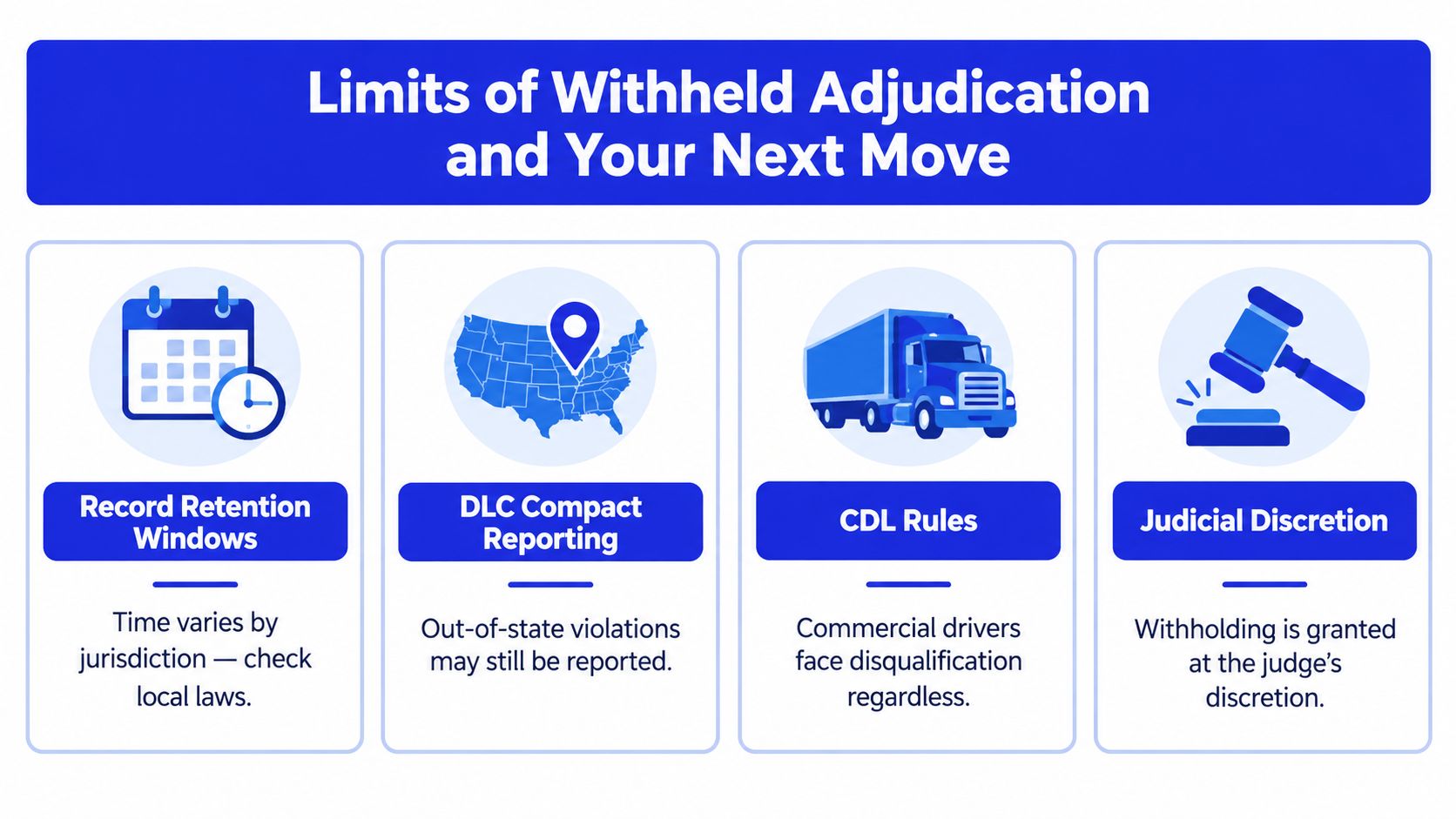
Limits of Withheld Adjudication and Your Next Move
Adjudication withheld helps, but it does not erase every consequence. The disposition can remain on your Florida driving record, and some entries can remain for 75 years. Florida also limits certain traffic-school elections to 8 during a lifetime and 1 during a 12-month period. Florida's driving-record guidance distinguishes withholding entered by a clerk from withholding ordered by a judge or traffic magistrate.
Out-of-state drivers must secure the final disposition and complete the reporting process. A Florida clerk may mail a clearance letter for submission to the licensing state, but you must confirm eligibility, send the document, and verify that your home state received it. Commercial license holders face separate restrictions. A case involving death or serious bodily injury can also create suspension concerns, even with adjudication withheld.
Protect your options before paying or entering a plea:
Confirm payment's effect: A payment may close off better results.
Check eligibility: Review the offense, license type, and prior elections.
Keep proof: Save the disposition, certificate, receipts, and clearance letter.
Verify reporting: Contact the Florida clerk and, if needed, your licensing state.
Get legal advice early: A traffic defense lawyer can act before your choices narrow.
If you've received a Florida traffic ticket, visit Ticket Shield, PLLC for a free consultation. Ticket Shield, PLLC offers direct lawyer communication by phone or text and seeks a lawful result with the goal of “No Points” on your license.