Cómo ganar una multa por pasarse un disco de Pare en la corte: Defensa en Florida
Aprenda cómo ganar una multa por pasarse una señal de alto en la corte con estrategias legales específicas para Florida. Proteja su licencia y las tarifas de su seguro hoy.

You're staring at a Florida stop-sign citation and wondering whether it's worth fighting. The ticket may look like a minor inconvenience, but the decision you make now can affect your driving record, future license status, and available options. Paying without reviewing the allegation is rarely a sound legal strategy.
The practical answer to how to win a stop sign ticket in court is not to insist that the stop was unnecessary. It's to test whether the officer's observations establish every part of the rule in Florida Statute § 316.123, then choose the path that best protects your license.
Table of Contents
Why Paying Your Stop Sign Ticket Is a Risky Mistake
A payment can close the immediate court obligation, but it may also resolve the citation as a conviction for a moving violation. Florida classifies failure to obey a traffic-control device, including a stop sign, as a three-point violation, and those points remain on the driving record for at least five years from the conviction or disposition date, according to the Florida Department of Highway Safety and Motor Vehicles point-system guidance.
That makes the ticket more than a fine. A point on your record can matter when you already have prior violations, depend on your vehicle for work, or need to preserve an already vulnerable license. The financial consequences also depend on your individual driving history, insurer, and record, so nobody should promise a fixed insurance result from one citation.
The admission you may not intend to make
Many drivers pay because they want the matter over quickly. That choice can eliminate the opportunity to challenge the officer's account, the intersection layout, or the exact stopping point. It can also remove the practical advantage that comes from examining whether the citation accurately describes conduct prohibited by Florida law.
Read the Florida stop sign ticket price information before treating the listed fine as the full cost. The fine is only one part of the decision. You also need to consider points, eligibility for driver improvement school, court deadlines, and the possibility that a conviction could contribute to a future suspension.
Practical rule: Don't pay first and investigate later. Review the citation and your available dispositions before you make an election.
Point accumulation can threaten your license
Florida's point system includes suspension thresholds. The Florida Driver License Handbook states that 12 points within 12 months results in a 30-day suspension, while higher accumulation thresholds can produce longer suspensions under the applicable rules. A stop-sign case may therefore become important even when the citation itself feels routine.
The right decision depends on facts that a payment won't test. Was there a clearly marked stop line? Was a crosswalk present? Did you stop at the legally required location before proceeding? Did the officer observe the relevant part of the maneuver? Those questions can determine whether contesting the citation is worth pursuing.
The Legal Reality of Florida Stop Sign Citations
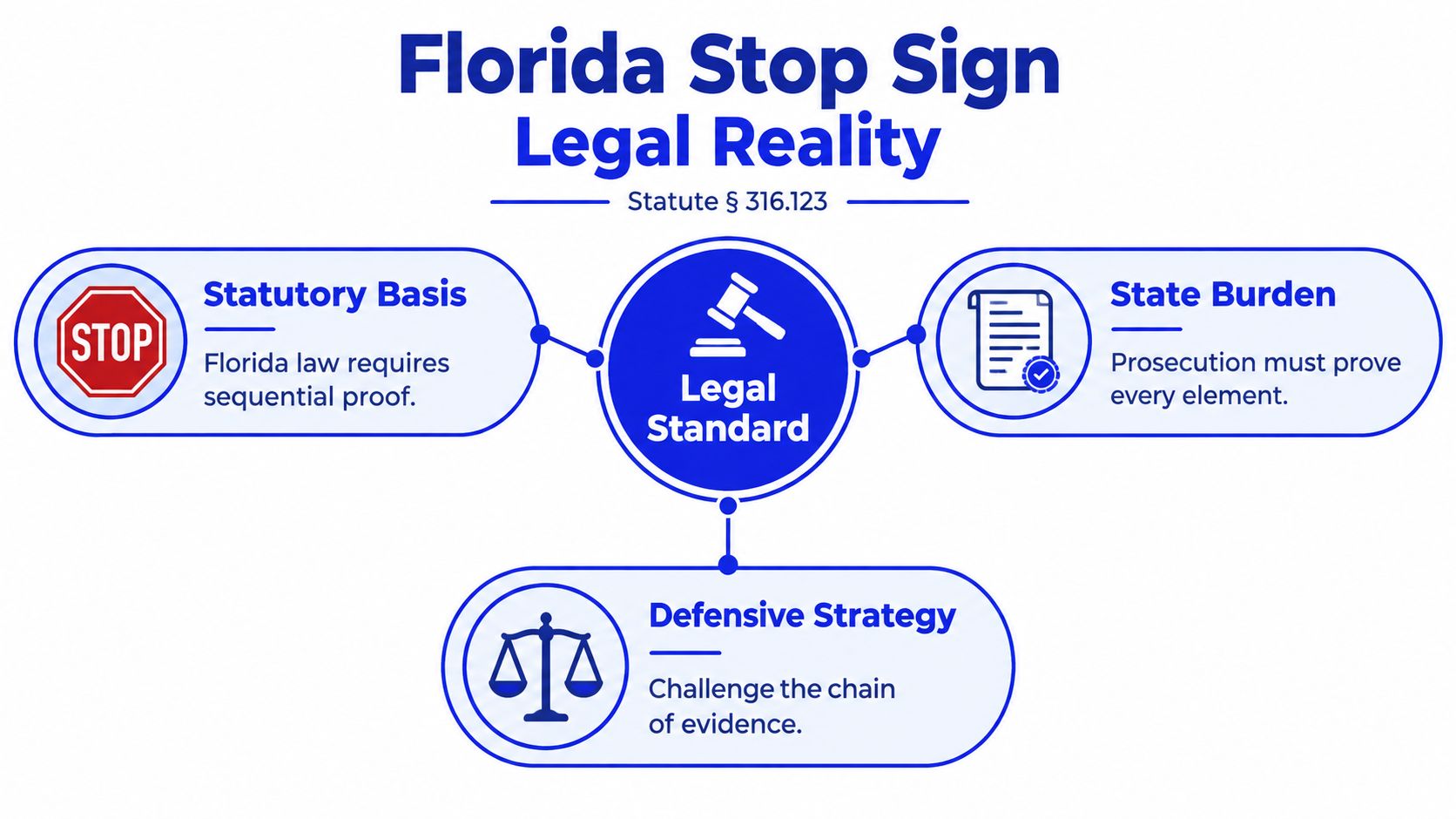
Florida Statute § 316.123 does not create one universal stopping point for every intersection. It creates a sequence. The driver must first stop at a clearly marked stop line. If no stop line exists, the driver must stop before the near-side crosswalk. If there's no stop line and no crosswalk, the driver must stop at the point nearest the intersecting roadway where the driver can see approaching traffic before entering the intersection. The Florida statute governing stop intersections supplies the controlling framework.
That sequence matters because an officer may describe a vehicle moving past a line without addressing whether the driver had already stopped at the legally prescribed location. The defense should focus on the actual statutory question, not on whether the maneuver looked awkward or whether the vehicle rolled forward afterward.
Separate stopping from yielding
Section 316.123 also addresses what happens after the driver stops. The driver must yield to traffic already in the intersection and to traffic approaching closely enough to create an immediate hazard. At a four-way stop, the first vehicle to stop proceeds first. When vehicles stop simultaneously, the driver on the left yields to the driver on the right.
Those are related but distinct duties. A citation alleging that you failed to stop should be analyzed differently from an allegation that you failed to yield. Your defense should identify exactly what the officer claims happened and whether the evidence supports that particular allegation.
A decision matrix for your next move
Option | When it may fit | Main concern |
|---|---|---|
Self-representation | You have clear evidence, understand the allegation, and can follow the court's procedures | You may overlook a statutory issue, deadline, or distinction between stopping and yielding |
Driver Improvement School | You qualify and prefer a no-points disposition without litigating the facts | The election has eligibility limits, costs, and a completion deadline |
Legal counsel | The location, officer's observation, record, or license status creates meaningful risk | You pay for representation, and no lawyer can guarantee dismissal |
A useful explanation of the practical issues appears in this guide to Florida stop-sign violations. The strongest defense usually begins by asking what the state can prove about the required stopping point, not by arguing that the stop seemed unnecessary.
Evaluating Your Defense Options and Outcomes
You have more than two choices after receiving a Florida stop-sign citation. You can contest the allegation yourself, elect an eligible driver-improvement course, or retain counsel to investigate and defend the case. Each route creates different risks, and the correct choice depends on your record, the intersection evidence, and the consequences of a conviction.
Florida court materials recognize a four-hour Driver Improvement School option for eligible drivers. The election can result in a withhold of adjudication and avoidance of license points, but eligibility is limited. The materials state that a driver generally cannot elect the course if it was elected within the preceding calendar year or if it has already been elected eight times during the driver's lifetime. Review the Florida court traffic materials before choosing that route.
What happens after the citation
Start with the citation itself. Confirm the court, response deadline, alleged violation, and instructions for requesting a hearing or selecting an available disposition. Don't assume that missing a deadline can be fixed casually.
Next, decide whether you're seeking a factual defense or a record-protection alternative. If the evidence suggests the officer may have misunderstood the legally required stopping point, a hearing may be appropriate. If you qualify for driver improvement school and want to avoid points, that may be a practical alternative, but it doesn't test whether the allegation was proven.
If you elect the course, pay the required amounts and complete the course within the court's deadline. Florida's highway-safety agency explains that failing to complete an elected course within the deadline can result in the driver being treated as having admitted the infraction and being adjudicated guilty. The course is not a way to ignore the case.
Compare the trade-offs before making an election
Option | Potential Benefits | Key Risks and Limitations |
|---|---|---|
Contest the ticket alone | You can present photographs, diagrams, and testimony directly | You must understand the statutory sequence, present evidence properly, and respond to the officer's testimony |
Driver Improvement School | An eligible driver may receive a withhold of adjudication and avoid points | Prior elections, the lifetime limit, payment requirements, and the completion deadline can restrict this option |
Hire counsel | An attorney can review the citation, develop the statutory defense, appear when permitted, and negotiate or litigate | Representation is not a guarantee, and a court may still find that the violation occurred |
A lawyer's role isn't just to ask for mercy. Counsel can examine whether the citation identifies the correct location, whether the physical conditions support the officer's version, and whether a negotiated resolution protects your record. The practical difference between generic paperwork and a case-specific defense is discussed in how lawyers may dismiss traffic tickets.
Preparing Your Case Before Court Proceedings
A credible stop-sign defense begins at the intersection, not in the courtroom. Obtain the citation and any officer notes available through the court process, then examine the approach from the same direction you were driving. Your objective is to reconstruct what a driver could see and where the statute required the vehicle to stop.
Take photographs from safe locations. Document the stop line, crosswalk, sign placement, lane markings, nearby objects, lighting, and any obstruction that affects visibility. Don't alter the scene or trespass to get a better angle. If measurements are necessary, use a lawful and reliable method, and preserve the date and location of the images.
Build the evidence around the sequence
Organize your materials in the order required by § 316.123:
Stop line: Determine whether a clearly marked line existed and whether it was visible from the approach.
Crosswalk: If there was no stop line, document the near-side crosswalk and its position.
Visibility point: If neither feature existed, identify the nearest point where the driver could see approaching traffic before entering the intersection.
Officer's viewpoint: Compare the officer's observation point with the location of the vehicle and the relevant stopping features.
Traffic conditions: Separate whether the allegation concerns stopping, yielding, or both.
The defense doesn't need speculation. It needs a factual comparison between the statutory stopping point and the officer's account. A driver who stopped at the required fallback point may have a legitimate factual defense even if the vehicle moved beyond the line afterward. On the other hand, saying the vehicle “almost stopped” is weak because the statute doesn't prescribe a minimum number of seconds.
Preserve documents and prepare testimony
Keep the original citation, photographs, diagrams, correspondence, course documents, and any dashcam footage in an organized file. Write down your recollection while it's fresh, but don't embellish it. Your testimony should address what you saw, where you stopped, what features were present, and what happened next.
The Florida Driver License Handbook states that accumulating 12 points within 12 months triggers a 30-day suspension. That makes record review part of preparation, not an afterthought. Use this practical checklist for what to bring to traffic court, then verify the requirements of the court handling your citation.
Navigating Courtroom Tactics and Negotiations
The strongest courtroom presentation is usually narrow and factual. Instead of arguing that the ticket is unfair, focus on the precise point where the evidence fails to establish the alleged violation. Ask whether the officer saw the vehicle before, at, or after the legally required stopping location, and whether the officer's position allowed a reliable view.
Challenge the observation, not the officer personally
A respectful defense can expose uncertainty without attacking the officer. Questions may address the officer's location, distance, line of sight, traffic conditions, lighting, and whether the officer observed the vehicle's wheels stop or only saw it move past a line. If the citation doesn't identify which statutory stopping point applied, that omission may matter when the physical layout is disputed.
A self-represented driver may be tempted to tell a long story. That often weakens the presentation. Keep the focus on the statutory sequence and the evidence supporting each part of the allegation.
Courtroom focus: The question isn't whether the maneuver looked imperfect. It's whether the evidence proves that you failed to stop where Florida law required you to stop.
Negotiation requires a clear objective
A negotiation should begin with a defined goal. That may be dismissal, a resolution that avoids points, or another lawful disposition that protects your license. Don't assume a prosecutor or hearing officer will discover the intersection problem without seeing the photographs, diagram, or legal argument that makes it relevant.
Automated apps and impersonal ticket services may collect information, but they don't replace a lawyer who can evaluate conflicting details and communicate with you about the actual defense. A lawyer-led practice can also prepare for the possibility that negotiations fail and the case proceeds to a hearing.
The following video provides additional context for drivers evaluating traffic-defense representation:
If the evidence is strong, a hearing may be the appropriate path. If the evidence is mixed but your record is especially important, an eligible course election may offer a more predictable no-points result. If you're unsure, get legal advice before making an irreversible election.
Secure Your Defense and Protect Your License
A successful outcome isn't defined only by whether you pay less. For many Florida drivers, the objective is No Points on the license. A dismissal can eliminate the violation, while an eligible withhold through driver improvement school may avoid points under the applicable requirements. A reduction may also be worth considering, but the result depends on the court, the evidence, the allegation, and your eligibility.
The strategic question is whether your case has a defensible statutory issue. If the stop line was missing, the crosswalk was unclear, the visibility point was different from the one described by the officer, or the officer couldn't reliably observe the stopping maneuver, those facts deserve careful legal review. A lawyer can also separate a failure-to-stop allegation from a failure-to-yield allegation instead of treating every intersection event as the same violation.
Direct communication matters
Ticket Shield, PLLC uses a lawyer-led model in which clients can communicate directly with their attorney by phone or text. That differs from automated apps and ticket mills that may route clients through middlemen, corporate answering services, or automated chatbots. Direct access matters when the defense depends on a detail about the intersection, the officer's observation, a prior course election, or the status of your license.
The firm reviews Florida traffic citations and may pursue a reduction or dismissal based on the facts and applicable law. Learn more about how to get a stop sign ticket dismissed before deciding whether to pay, elect a course, or contest the citation.
Don't wait until the deadline is close. Gather the citation, review your driving record, preserve intersection evidence, and obtain advice before choosing a disposition. No attorney can promise a particular result, but prompt, case-specific preparation gives you a meaningful opportunity to protect your license and pursue the outcome that matters.
Visit Ticket Shield, PLLC for a free consultation about your Florida stop-sign citation. You'll speak with a lawyer-led team that can review your case, explain your options, and fight for the ultimate goal of No Points on your license.