Abogado de conducción distraída: defienda su licencia de Florida
¿Enfrenta un cargo por conducir distraído? Conozca las defensas clave, cómo funcionan las pruebas y por qué contratar a un abogado especializado en conducción distraída protege su licencia y su seguro.

You're driving home after work when an officer signals you to pull over. You weren't texting, but the officer says your eyes appeared to drop toward your phone. A few minutes later, you're holding a citation and wondering whether paying it is easier than fighting it.
That decision can affect more than the immediate fine. In Florida, the allegation may involve the phone itself, the way it was used, or another activity that allegedly diverted your attention. A distracted driving lawyer examines what the officer saw, what the statute requires, and whether the evidence proves each element of the violation.
Table of Contents
Understanding the Real Cost of a Distracted Driving Charge
A routine stop can become a record problem quickly. An officer may see a driver glance downward, notice a device near the driver's hand, and interpret the movement as unlawful phone use. The citation then arrives before the driver has had a meaningful opportunity to explain the circumstances or inspect the evidence.
Paying the citation may feel efficient, but it can function as an admission or otherwise resolve the case without testing the officer's observations. The consequences can include fines, court costs, points, insurance effects, and additional license pressure. Those consequences depend on the charge and the driver's record, so you shouldn't assume the citation's immediate payment amount reflects the full cost.
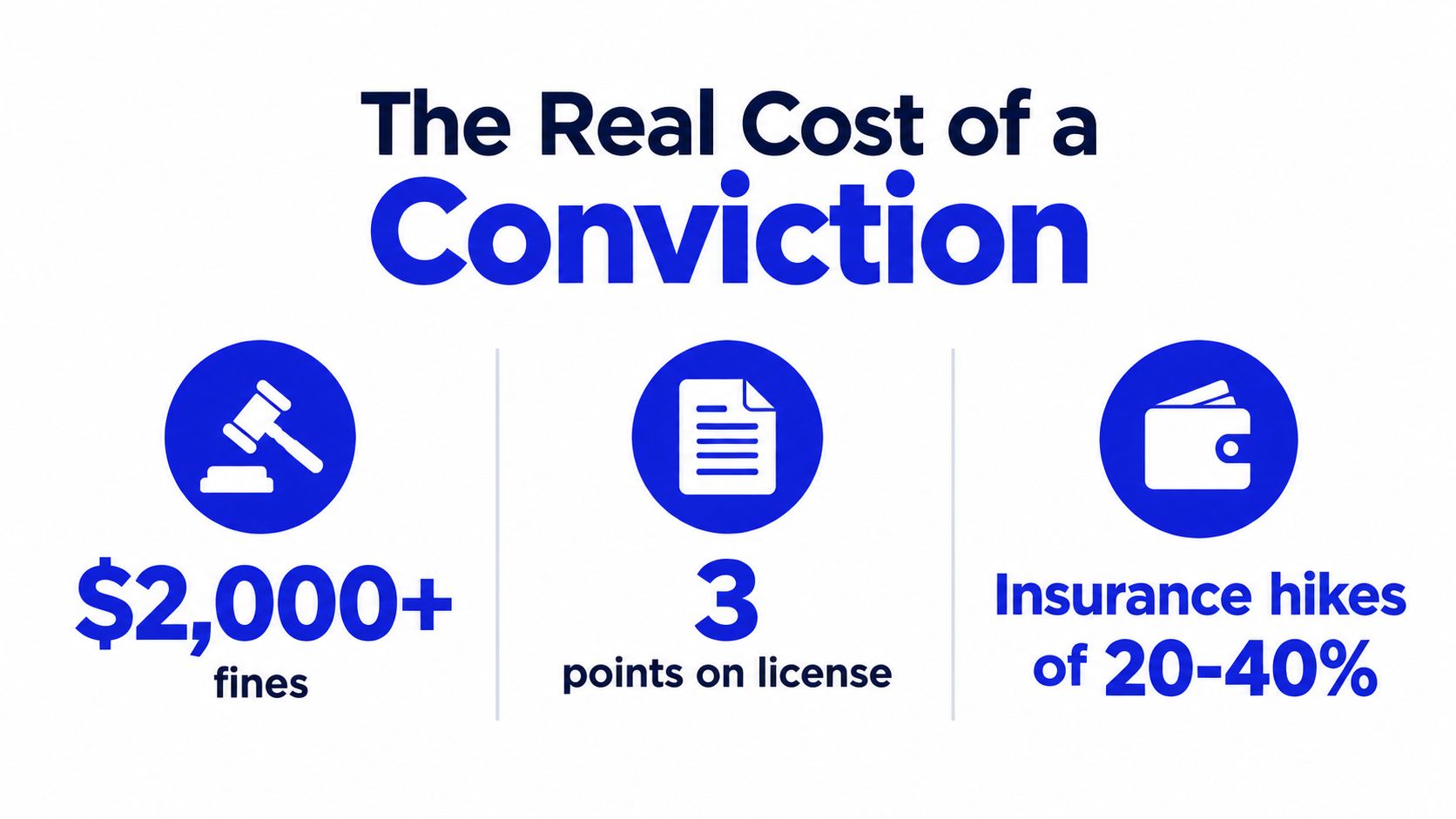
A traffic conviction can also complicate an existing record. If you already have points or unresolved citations, another disposition may create a more serious license issue than the original stop suggests. Insurance carriers make their own underwriting decisions, and a conviction can become part of the information they consider when evaluating your policy.
The decision before you pay
You have practical choices after receiving a citation:
Pay immediately: This may close the court matter, but it can surrender the opportunity to challenge the officer's account or seek a disposition that protects your record.
Request legal review: An attorney can examine the statute, citation, available records, and local procedure before you choose a resolution.
Contest the allegation: A hearing may expose gaps in the officer's view, timing, identification of the device, or description of the alleged conduct.
Pursue a negotiated outcome: Depending on the facts and eligibility, counsel may seek a result that limits or avoids points.
Florida traffic penalties vary by violation and circumstances. The Florida traffic ticket cost guide can help you identify the financial issues that may follow a conviction, but it can't evaluate the evidence in your specific case.
Practical rule: Don't treat a citation as an invoice. Treat it as a legal allegation that should be reviewed before you decide how to resolve it.
Florida Law and the Legal Basis for Your Citation
Florida's distracted-driving framework isn't limited to one broad prohibition that covers every moment of inattention. Different conduct can trigger different legal theories. The statute most commonly associated with texting while driving is Florida Statute § 316.305, the Florida Ban on Texting While Driving Law.
Section 316.305 addresses manually typing, entering, or sending text messages while operating a motor vehicle. The statutory analysis turns on the alleged conduct, the operation of the vehicle, and whether the facts fit the language of the statute. An officer's conclusion that a driver was distracted doesn't automatically establish every required element.
Florida's broader traffic framework also matters. Florida Statute § 316.0895 addresses following too closely, while other provisions in Chapter 316 govern careless or unsafe operation. The applicable charge must match the conduct alleged in the citation. A defense lawyer should identify the exact statute, not rely on the general label “distracted driving.”
What the state must establish
The prosecution's burden depends on the nature of the proceeding and the charged violation. In a criminal traffic matter, the state generally must prove the charged elements beyond a reasonable doubt. A civil traffic infraction uses a different standard, but the officer still must establish the violation required by the cited statute.
That distinction matters because “the driver looked down” is not the same as “the driver manually typed or sent a text message while operating the vehicle.” The state may rely on the officer's testimony, the driver's statements, device evidence, photographs, or other records. Each item must be connected to the specific conduct prohibited by the statute.
A useful review asks:
What exact action did the officer claim to observe?
Could the officer identify the device and its use from the stated position?
Did the officer see typing, reading, sending, or only a brief movement?
Was the vehicle moving or otherwise being operated at the relevant moment?
Does the citation accurately identify the statute and alleged conduct?
The Florida traffic laws overview provides general context, but it isn't a substitute for reviewing the actual citation and evidence. A generic argument that “everyone uses a phone” won't answer the statutory question. The defense must focus on what happened, what was observed, and what the law requires the state to prove.
Challenging the Evidence and Officer Observations
An officer's testimony can be important, but it isn't automatically conclusive. The courtroom question isn't whether the officer suspected phone use. It's whether the observation was clear enough, specific enough, and reliable enough to prove the charged conduct.
Distance, traffic conditions, lighting, window tint, the officer's angle, and the duration of the observation can all matter. A phone resting in a center console may look different from a phone held in a driver's hand. A driver adjusting navigation may create a different evidentiary issue from a driver manually composing a message. The citation should preserve those distinctions.
Observation is only one part of the record
A strong technical proof stack can include phone records, witness statements, police reports, traffic-camera or dashcam footage, vehicle event-data-recorder downloads, and preservation notices sent quickly to carriers or manufacturers, as described in this practical guide to proving distracted driving.
That evidence can support either side. Phone records may show activity, but activity alone may not establish what the driver was doing with the device at the exact moment of observation. A carrier record might show a call or data session without proving who used the phone, where the phone was located, or whether the activity violated the statute charged.
The same principle applies to vehicle data. Event-data-recorder information may help establish braking, speed, or steering behavior, but it generally doesn't identify the driver's mental state or prove that a phone caused the lapse in attention. Digital evidence needs interpretation, timing, and authentication.
Building a focused challenge
A defense review should compare the officer's account against every available source:
The report: Does it describe the driver's hand position, the device, the exact movement, and the duration of the observation?
The physical setting: Could the officer see the screen or only an object near the driver?
The timeline: Does phone activity correspond to the alleged violation, or does it merely show general device activity?
The video: Do dashcam or traffic-camera images confirm the officer's view?
The driver's statements: Did the driver make an admission, or did the officer infer conduct from an ambiguous movement?
A motion may also be appropriate when evidence was obtained through an unlawful search or seizure. The Florida motion to suppress evidence guide explains why the method used to obtain evidence can matter as much as the evidence itself.
The strongest defense often isn't “the officer was wrong.” It's “the available proof doesn't establish the specific act required by the statute.”
Immediate Steps to Protect Your Rights After a Stop
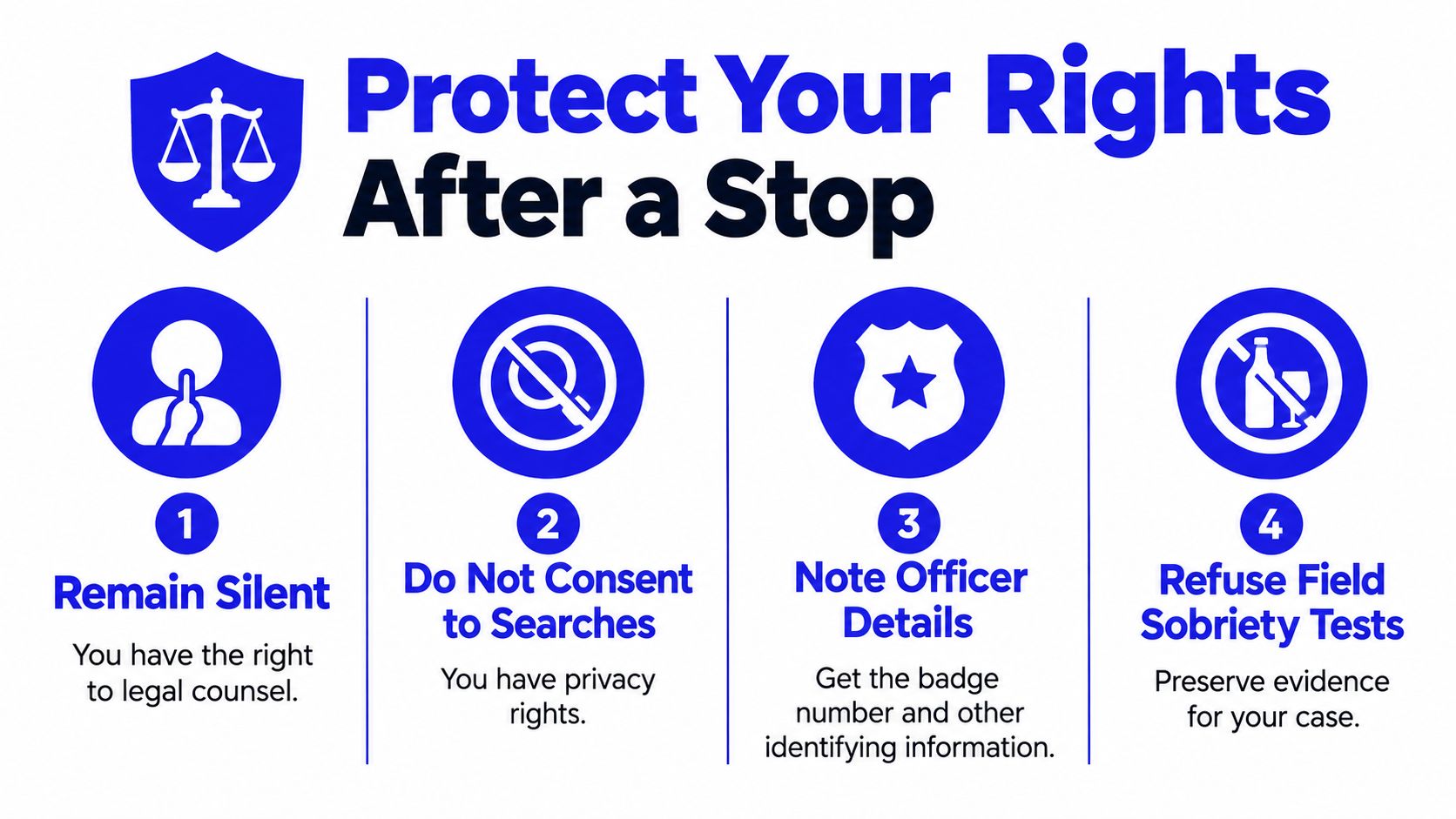
Your conduct during and after the stop can shape the evidence. Stay calm, provide required documents, and avoid arguing beside the roadway. A roadside debate rarely changes the citation, but statements made under pressure can appear in the officer's report or become testimony later.
You can ask what the stop concerns. You don't need to volunteer a detailed explanation about where your phone was, who may have used it, or what you were doing immediately before the stop. If the officer asks to search the vehicle or device, state clearly and respectfully that you don't consent. Don't physically resist if the officer proceeds. Record your objection and let counsel address the legal issue.
Create a contemporaneous record
As soon as it's safe, write down:
The location and time: Include the road, direction of travel, weather, lighting, and traffic.
The officer's position: Note whether the officer was behind you, beside you, approaching from another lane, or viewing through a windshield.
The description given: Record the officer's words about the device and alleged activity as accurately as possible.
The people and cameras nearby: Identify passengers, other drivers, businesses, intersections, or vehicles that might have captured the event.
Your device status: Preserve relevant records, but don't delete, alter, or reset anything.
Don't contact witnesses to coordinate stories. Save photographs, dashcam files, location information, and messages that may establish where you were or what occurred. Digital evidence can disappear or be overwritten, so prompt preservation matters.
The Florida traffic stop guide covers the basic encounter and your responsibilities. After the stop, calendar the response deadline on the citation and obtain legal advice before choosing payment, election, or a contested hearing.
Why Hiring a Dedicated Traffic Attorney Makes a Difference
Self-representation can look simple because the citation is short. The legal work isn't. You must understand the charged statute, request or review records, assess the officer's testimony, identify procedural defects, and present a focused argument under the applicable court rules.
A dedicated traffic attorney can separate a weak defense from a useful one. “I wasn't distracted” is a conclusion. A stronger defense may show that the officer couldn't identify the alleged phone activity, that the observation lasted too briefly, that the citation doesn't match the conduct described, or that the available records fail to corroborate the allegation.
What a lawyer changes
Representation can provide practical advantages:
Evidence review: Counsel can compare the citation, report, video, phone records, and witness accounts rather than relying on memory alone.
Court strategy: An attorney can determine whether negotiation, a hearing, evidentiary motion, or another procedure fits the facts.
Record protection: The focus stays on points, insurance consequences, eligibility, and the long-term effect of the disposition.
Direct advocacy: Counsel can communicate with the prosecutor or court and present the defense without requiring you to improvise under pressure.
Not every case should be taken to a hearing. A hearing may be valuable when the officer's observation is vulnerable, but it also requires preparation and carries uncertainty. A negotiated resolution may be more practical in another case. The right choice depends on the evidence, the charge, your driving record, and the consequences attached to each outcome.
Direct lawyer access matters
A lawyer-led firm should give you a clear explanation of who is handling the case and how you'll communicate. Ticket Shield, PLLC describes a model in which clients communicate directly with their attorney by phone or text, rather than relying solely on automated apps, corporate answering services, or layers of middlemen.
That distinction matters when the facts are specific. You need to explain where the officer was positioned, what the officer said, whether a passenger handled the phone, and whether video exists. An automated chatbot can't evaluate those details or make courtroom judgments.
Get Help from a Trusted Florida Traffic Defense Firm
A distracted-driving citation should be approached as an evidence problem, not merely a payment decision. Florida Statute § 316.305 may apply to texting conduct, but the state still must connect the alleged behavior to the statute's requirements. Officer observations deserve careful review, and digital records, video, and preservation requests can affect what the court ultimately sees.

You should also act before deadlines pass. Gather the citation, preserve relevant records, write down the stop while your memory is fresh, and avoid making informal statements that could be misunderstood. A lawyer can then assess whether the observation proves the charged conduct, whether evidence should be challenged, and whether a resolution can protect your license.
Ticket Shield, PLLC is a Florida traffic defense firm offering lawyer-led representation and direct communication by phone or text. Its attorneys handle traffic matters throughout Florida and can review the facts before you decide how to respond. You can also submit your Florida traffic case for review.
A short explanation of the defense process can help you understand what happens after a citation and why early legal review matters.
The goal isn't to promise a particular result. It's to make a deliberate decision based on the statute, the evidence, and the consequences of each available option. If the officer's account is incomplete or the proof doesn't establish the required conduct, a strategic defense may protect your driving record more effectively than just paying the citation.
Visit Ticket Shield, PLLC for a free consultation about your Florida distracted-driving citation. Speak with a lawyer-led team directly by phone or text and pursue a strategic defense with the ultimate goal of achieving “No Points” on your license.