Unpaid Speeding Ticket Florida What Happens Next
Unpaid speeding ticket Florida risks suspension, points and fees. Learn deadlines, how to resolve it and protect your license with Ticket Shield.

You find the old speeding ticket while checking your mail, searching your records, or trying to renew a license. You thought it was only a fine. Now you're wondering whether Florida suspended your license, whether points were added, and whether paying today will solve the problem.
Treat an unpaid speeding ticket in Florida as a licensing event, not ordinary debt. The clerk, the court, and the Florida Department of Highway Safety and Motor Vehicles can turn a missed deadline into a suspension that remains active until you satisfy the citation requirements. Waiting rarely improves your position. It can limit your resolution choices and expose you to additional consequences if you drive without knowing your status.
Table of Contents
What an Unpaid Speeding Ticket Really Means in Florida
An unpaid speeding ticket doesn't sit harmlessly in a file. Florida treats failure to respond as a compliance problem. If you ignore the citation, the issuing clerk can begin the process that blocks your driving privilege, even if the original speeding allegation was a noncriminal civil infraction.
Suppose you received the citation months ago and assumed the court would send another reminder. You moved, missed the notice, or couldn't afford the full amount. Then you discover that the license record may show a suspension connected to the unresolved citation. The amount owed is only one part of the problem. You must also address the court matter and confirm what the state requires before you drive again.
The Florida Highway Safety and Motor Vehicles guidance explains that a driver who fails to comply with a traffic citation can receive notice that the license will be suspended unless the driver complies within 30 days and pays a delinquency fee of up to $25. The same guidance recognizes that traffic courts may allow online payment, but payment must resolve the citation requirements, not merely give you confidence that you took some action. See the Florida traffic citation and court suspension guidance before choosing your next step.
The record matters more than the envelope
A late payment can also create a separate points problem. Paying a citation may resolve the unpaid balance while leaving the conviction and associated points on your driving record. That distinction matters if you already have other moving violations or need a clean license for work.
Protective rule: Don't drive until you verify your license status through the appropriate Florida channel and determine which county court controls the citation.
The correct response depends on the current status. A citation that is merely overdue may present different options from one that has already produced a suspension. If you contest the ticket, seek a payment plan, or need to address a missed appearance, timing and procedure matter. An automated app may route you through a generic workflow. A lawyer can evaluate the actual citation, the court record, and the license consequence together.
How Florida Law Treats Speeding and Unpaid Citations
Florida Statute 316.187 supplies the legal foundation for speed enforcement. It establishes baseline speed limits, including 70 mph on limited access highways, 65 mph on certain divided highways outside urban areas, and a maximum 60 mph ceiling for other roadways under the Department of Transportation's authority. The statute also states that speed-limit violations are moving violations punishable under Chapter 318. Review the Florida speeding statute for the statutory framework.
The process then moves from Chapter 316 into Chapter 318. A speeding citation may begin as a civil infraction, but the obligation to respond is still enforceable. Florida Statute 318.14 requires a person cited for a noncriminal infraction to act within 30 days by paying the civil penalty and any delinquent fee or entering a payment plan with the clerk. The deadline is not a casual suggestion. It is the point at which the court expects compliance.
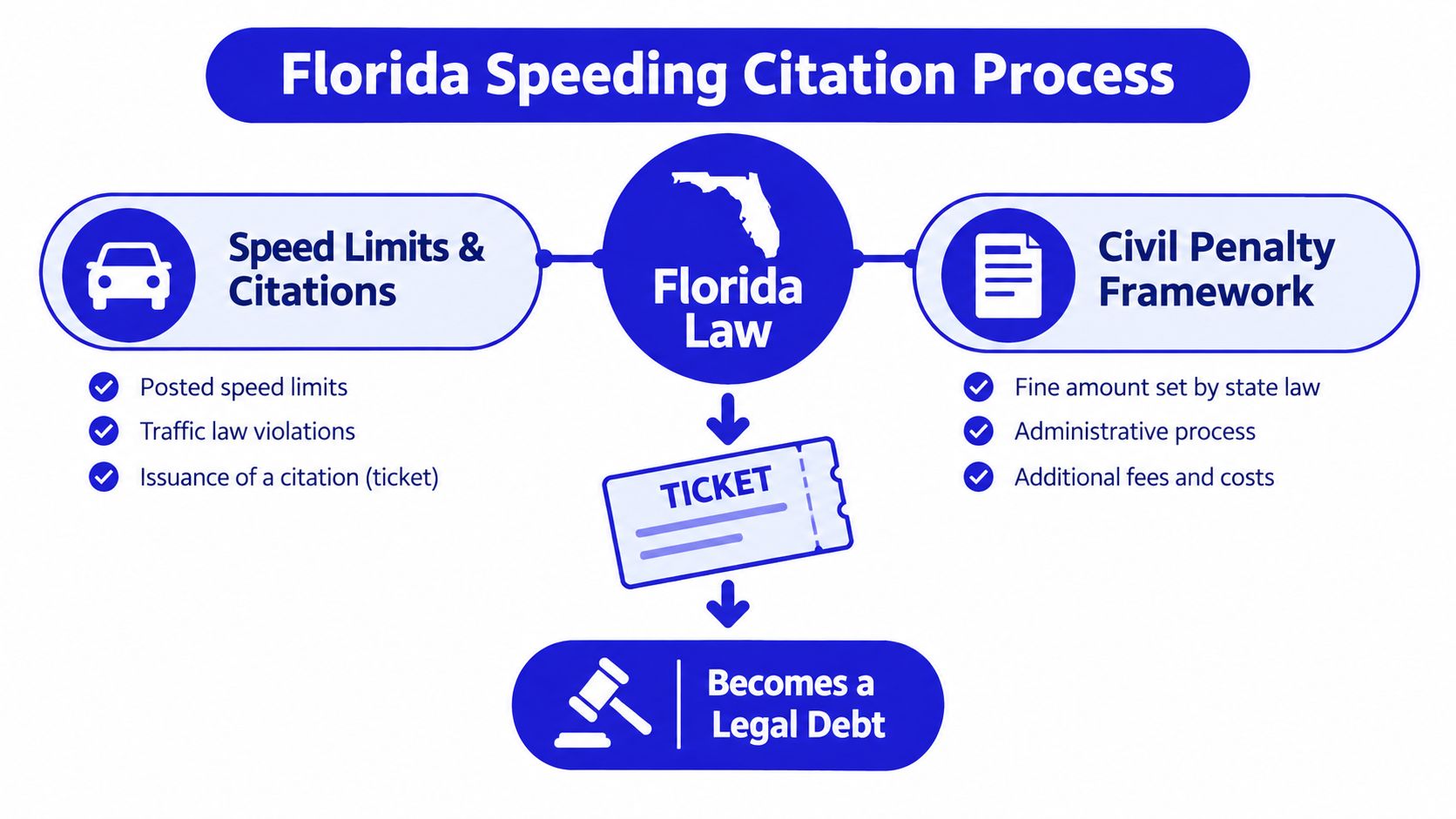
The compliance chain
Think of the law as a chain with separate links:
Speed limit and citation: Florida Statute 316.187 gives the legal authority for speed limits and moving-violation treatment.
Civil penalty: Chapter 318 gives you a deadline to pay, enter a plan, or otherwise comply.
Clerk notification: Nonpayment or noncompliance moves the matter from an unpaid balance toward a license action.
State suspension order: The Department issues the order under the statutory process.
Florida law also treats certain higher-speed conduct more severely. Under Florida Statute 316.1926, exceeding the applicable speed limit by 50 mph or more under the referenced speed-limit statutes is classified as a moving violation under Chapter 318. That classification can change the stakes beyond an ordinary overdue civil citation. Read the Florida statute addressing extreme speeding classifications if your alleged speed was substantially above the limit.
If a required appearance applies and the court finds you liable, Florida Statute 318.14 authorizes a $1,000 civil penalty and a six-month license suspension. That is why you shouldn't treat every unpaid ticket as a simple online transaction. First determine whether your case is eligible for payment, a plan, a hearing, or a defense strategy.
The 30 Day Clock and How Your License Gets Suspended
The suspension process follows a defined sequence. The first critical event is the clerk's notice. Florida guidance says the clerk must notify a driver who failed to comply that the license will be suspended unless the driver complies within 30 days and pays a delinquency fee of up to $25. That notice gives you a short window to stop the matter from advancing.
Florida Chapter 318 also addresses the clerk's reporting duty. If you fail to pay civil penalties, fail to comply with a payment plan, fail driver improvement school, or miss a scheduled hearing, the clerk must notify the Department within 10 days. After receiving the electronic notice, the Department must issue a suspension order that becomes effective 20 days after mailing under the statutory process. The Florida Chapter 318 provisions governing noncompliance and suspension show why an unpaid citation can become a state licensing matter.

The timeline you need to understand
Notice arrives: The clerk tells you that failure to comply can lead to suspension.
The compliance window opens: You have 30 days to satisfy the citation requirements and address the delinquency fee.
The clerk reports noncompliance: If you still haven't paid, complied with the plan, completed required school, or appeared as required, the clerk reports the matter within 10 days.
The order takes effect: Once the Department issues the order, the suspension becomes effective 20 days after mailing.
Florida Statute 322.245 describes the same cause-and-effect structure for unpaid traffic citations. Once the notice is electronically received, the Department must issue the suspension order, and the license remains affected until the underlying court matter is resolved. Read the Florida statute on suspension for failure to pay traffic fines for the statutory mechanics.
Online payment may help when the court permits it and the citation is eligible for that resolution. A payment plan may also be available through the clerk, but don't assume opening a plan automatically restores your driving privilege. Confirm whether the plan clears the hold, what payments must remain current, and what additional action the Department requires.
For practical guidance on the court-to-license connection, review how a Florida speeding ticket can lead to license suspension. If your notice has already arrived, act before the deadline rather than waiting for a suspension record to appear.
Points Insurance and the Hidden Cost of Doing Nothing
An unpaid speeding ticket creates one problem through noncompliance. A conviction creates another through points. Those tracks can overlap, but they aren't identical. Resolving the balance doesn't automatically mean you avoided the record consequences of accepting responsibility.
Florida's point system establishes escalating suspension thresholds. Twelve points within 12 months triggers a 30-day suspension, 18 points within 18 months triggers a three-month suspension, and 24 points within 36 months triggers a one-year suspension, according to Florida's official points suspension guidance. A speeding conviction can contribute to those totals even when the original citation isn't criminal.
Why payment can be the wrong first move
Payment often looks efficient because it closes the financial obligation. But if you pay before evaluating your options, you may give up the opportunity to contest the allegation or pursue a resolution designed to avoid points. The precise result depends on the citation, the court, your record, and the available legal options.
Insurance companies may also consider driving-record information when evaluating risk. You don't need a spreadsheet to understand the practical point. A points conviction can follow you beyond the courthouse, especially if other moving violations are already on your record.
The strategic question isn't only “How do I pay?” It's “What resolution protects my license and record?”
Repeated violations can create a cycle. One ticket adds points, another pushes you toward a threshold, and an unpaid matter can separately suspend the license for noncompliance. Once you must fix both a court obligation and a driving-record problem, the process becomes harder to manage without a clear plan. Use the Florida driver license points resource to understand why the point count deserves attention before you accept a resolution.
Don't assume that a late payment erases the risk. Check whether the citation is still open, whether a conviction was entered, whether points were assessed, and whether the license record contains a suspension. Those are separate questions, and you need answers to each one.
Your Options to Resolve an Unpaid Speeding Ticket
You generally face three practical paths, but the right choice depends on the court record and your priorities. Paying may be appropriate when you have confirmed the citation is eligible for payment and accept the record consequences. A payment plan may address the balance when a lump sum isn't realistic. Contesting may be the correct strategy when points, insurance impact, or an incorrect allegation make acceptance unacceptable.
Resolution Path | Upfront Cost | Points Risk | License Impact |
|---|---|---|---|
Pay through the traffic court | Civil penalty and any applicable delinquent fee | Accepts the consequences assigned to the resolution | May resolve the unpaid-citation hold if all requirements are satisfied |
Contest the citation | Legal fee and any court-related obligations depend on the case | Defense seeks to avoid a points conviction, but outcome depends on the case | Can protect against a points-based consequence if the case resolves favorably |
Enter a clerk payment plan | Initial payment and plan terms set by the clerk | The plan itself doesn't necessarily eliminate the underlying points issue | Can address inability to pay in full, but missed plan payments can restart enforcement |
When paying makes sense
Paying online can be efficient if the clerk confirms that payment fully resolves the citation and you understand whether it results in points. Save the confirmation and verify that the court transmitted the resolution properly. A receipt alone isn't proof that every license hold has cleared.
When a plan is the practical answer
A payment plan may be the workable route when you can't pay the full civil penalty immediately. Ask the issuing clerk whether a plan is available, whether the license status changes when the plan is active, and what happens after a missed installment. The Florida traffic ticket payment-plan guidance can help you identify the questions to ask.
When you should contest
Contest the citation when avoiding points matters, the alleged speed is disputed, the officer's account is questionable, or the license consequences are serious. Direct lawyer access matters. Ticket Shield, PLLC describes a lawyer-led model in which clients communicate with their attorney by phone or text rather than relying on middlemen, corporate answering services, or automated chatbots. That approach lets you discuss the actual citation and strategy with counsel instead of feeding facts into a generic ticket mill.
How to Fix a Suspension and Handle Failure to Appear
If your Florida license is already suspended for an unpaid speeding ticket, stop treating the matter as a payment reminder. Florida's official guidance states that a license can be suspended indefinitely for failure to pay a traffic fine, and reinstatement requires contacting the issuing county's traffic court and satisfying the citation requirements. Start with the county that issued the ticket, not a random payment website.
A practical reinstatement sequence
Confirm the suspension: Check your Florida license status and identify the exact citation or court obligation connected to it.
Contact the issuing clerk: Ask for the current balance, compliance requirements, appearance status, and payment-plan availability.
Address a missed hearing: If the record shows a failure to appear, ask what procedure the court requires to reopen or resolve the matter. Don't assume paying online fixes a missed appearance.
Choose a resolution: Pay, enter an approved plan, or obtain legal representation to contest or negotiate the citation.
Verify clearance: After satisfying the court, confirm that the clerk transmitted the clearance and that the Department's record reflects the required update.
Failure to complete driver improvement school, failure to maintain a payment plan, and missing a scheduled hearing can all trigger the same clerk-to-Department reporting process described in Chapter 318. The clerk must notify the Department within 10 days for the specified forms of noncompliance, and the suspension order becomes effective 20 days after mailing under the statutory procedure. For missed appearances, review what to do after missing a Florida court date before contacting the court.
Don't drive while you believe the license is suspended. A trip to work can create a new legal problem that makes reinstatement more difficult. If the clerk requires a hearing or you need to challenge the underlying citation, an attorney may be able to handle the court process without requiring you to appear, depending on the case and court rules.
For a visual explanation of the suspension path, watch the following resource after reviewing your court status:
A payment plan can be a practical workaround when paying everything at once isn't possible, but it isn't a substitute for confirming reinstatement. Ask for written confirmation of each requirement and keep every receipt, order, and clearance notice.
Protect Your License and Get No Points With Ticket Shield
An unpaid speeding ticket can create two separate threats. The first is an administrative suspension for failing to satisfy the court. The second is point accumulation after an unfavorable resolution. You need a strategy that addresses both, not a generic button that accepts payment and ends the conversation.
Act promptly when the clerk's notice arrives. If the deadline has passed, identify the issuing county, confirm your license status, and determine whether payment, a plan, or a defense offers the safest path. Don't accept points automatically when protecting your driving record is the priority.
Ticket Shield, PLLC is a Florida traffic defense firm serving all 67 Florida counties, with direct attorney communication by phone or text. Its lawyer-led model is different from automated apps and ticket mills that place middlemen, corporate answering services, or chatbots between you and the person handling your case. The firm states that it can appear for clients in major Florida courts and pursue resolutions focused on protecting the license and avoiding points when the case permits.
The objective should be clear: resolve the unpaid citation, restore lawful driving privileges, and pursue No Points on your license. A free consultation gives you a chance to discuss the actual ticket, court status, and suspension issue with a lawyer before you choose a resolution that may affect your record.
Visit Ticket Shield, PLLC for a free consultation about your unpaid speeding ticket, suspension, or missed court obligation. Speak directly with a Florida traffic defense attorney by phone or text and pursue the ultimate goal of No Points on your license.