What to Do If You Miss Court Date: Florida Steps to Take Now
What to do if you miss court date: Learn immediate steps to avoid a warrant, address a failure to appear, and protect your license in Florida.
That sinking feeling in your stomach when you realize you've missed a court date is awful. But the absolute worst thing you can do right now is nothing. Ignoring it won't make it go away; in fact, it practically guarantees the court will issue a bench warrant for your arrest and suspend your driver's license.
Your first move is to grab your ticket, pull together any case information you have, and get proactive. Fast.
Your Immediate Game Plan After Missing a Court Date
That moment of realization is stressful, especially when dealing with the crowded court systems in places like Broward County. A missed court date isn't just a forgotten appointment; it's a formal failure to appear (FTA) that kicks off a series of serious legal consequences.
But here’s some good news: taking deliberate, informed steps right away can dramatically change the outcome. The goal is to shift from a state of panic to a position of control.
You’re not the first person this has happened to. Life is messy—work emergencies, family crises, or even a simple scheduling mistake can cause you to miss a court date. It's a problem thousands of people face. Research from the Vera Institute actually found that simple things like text message reminders significantly reduce failure-to-appear rates, which just goes to show how often these situations are completely unintentional.
Don't Panic, Take Action
Procrastination is your worst enemy here. It almost always leads to a suspended license and an active warrant for your arrest. A judge doesn't know why you weren't in court—they only see your absence. Without any information, they have to assume the worst and take action to force you to appear.
This simple flowchart lays out the two paths you can take.
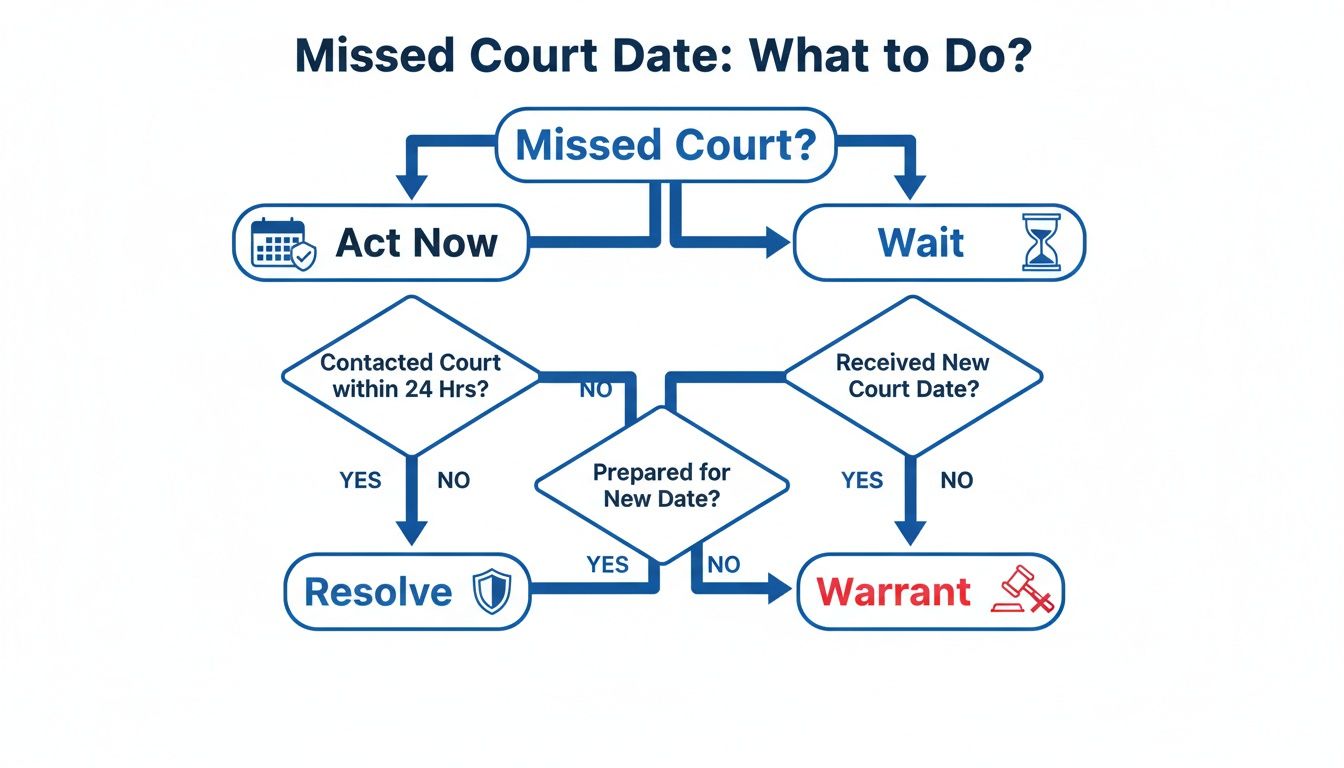
As you can see, taking action leads toward a resolution. Waiting around only makes things worse.
Your immediate goal is to show the court that your failure to appear wasn't on purpose. You need to demonstrate respect for the legal process, even after the fact. This is where a clear plan makes all the difference.
To put it plainly, the choices you make now will have very different results. This table shows exactly what's at stake.
Proactive Steps vs Inaction Consequences
Smart Proactive Steps | Consequences of Inaction |
|---|---|
Immediately contact the court clerk or an attorney. | The court issues a bench warrant for your arrest. |
File a motion to have the case reopened or reset. | Your driver's license gets suspended by the DHSMV. |
Address the situation before the warrant is served. | You risk being arrested during a routine traffic stop. |
Show the court you're taking responsibility. | You face additional fines and reinstatement fees. |
Potentially avoid points and insurance hikes. | Your car insurance rates will likely skyrocket. |
The contrast couldn't be clearer. Acting quickly and strategically is the only way to protect your license and avoid turning a simple ticket into a much bigger problem.
Gather Your Essential Information
Before you can take any concrete steps, you need to get your facts straight. Find your original traffic ticket or any other court papers you received.
You're going to need:
Your Citation or Case Number: This is the single most important piece of information. It's how the court finds your specific case file.
The County and Court Location: Was your case in Miami-Dade, Broward, or somewhere else? The procedures are specific to that court.
The Original Court Date: You'll need the exact date you missed for any paperwork or calls to the court.
The Nature of the Original Charge: Was it for speeding, a red light camera ticket, or a more serious criminal traffic offense?
Having these details organized and ready is vital for what comes next, whether you decide to call the court clerk yourself or get professional legal help. In many cases, having a plan in place before your absence is even processed by the system can give you a huge advantage. If you knew ahead of time you were going to miss the date, it’s worth bookmarking our guide on how to ask for a continuance in court for future reference.
Key Takeaway: The consequences of a missed court date aren't set in stone if you act fast. The court system is much more likely to work with someone who tries to fix their mistake proactively than with someone who waits to get caught. Your response in the first 24-48 hours is critical and sets the tone for how your case will be handled.
Finding Out If a Warrant Was Issued for Your Arrest
The single most urgent question after missing a court date is whether there's a warrant out for your arrest. A judge won’t wait around for an explanation; their first move is often to issue a bench warrant. This is a direct order from the court telling law enforcement to take you into custody for failing to show up.
The second that warrant becomes active, any run-in with the police—even a routine traffic stop for a broken taillight—could end with you in handcuffs.

This is not a situation to ignore and hope it goes away. You need to find out your status right now so you can take the right steps to fix it.
How to Check for a Warrant in Florida
Luckily, Florida makes this information public. You can usually check for warrants online through the official Clerk of Court website for the county where you got the ticket. Each of Florida's 67 counties has one, and they are the most reliable source for your case information.
Let's use Broward County as an example to walk through how it works. The process is pretty similar in most other Florida counties.
Online Search Steps for Broward County:
Go to the Broward County Clerk of Courts website.
Find the portal for "Case Search" or "Public Records Search."
You can usually search by your name and date of birth, but the most accurate way is to use your case number or citation number.
Once you pull up your case, look at the case docket or summary. This is a timeline of everything that has happened. You’re looking for phrases like "Warrant Issued," "Capias Issued," or "Failure to Appear."
This is the official record of the court's action after you missed your appearance.
Understanding What You Find
When you're looking through the clerk's records, you'll see some specific legal terms. It’s important to know what they mean for you.
Bench Warrant: This is the most common type of warrant for a missed traffic court date. It's issued directly by the judge ("from the bench") and gives law enforcement the authority to arrest you and bring you to court.
Capias: In Florida, this is just another name for an arrest warrant and is often used interchangeably with "bench warrant." If you see "Capias Issued" on your case docket, it means there's an active warrant for your arrest.
Important Distinction: A bench warrant is different from a standard arrest warrant, which is issued based on probable cause that a crime was committed. A bench warrant is a tool the court uses to force you to appear. The end result, however, is the same: you can be arrested.
If the online records aren't clear or you can't find your case, your next step is to call the Clerk of Court in the county where the ticket was issued. If you're worried about handling this yourself, you can get professional guidance by requesting a free consultation.
What to Do If You Confirm a Warrant Exists
Finding out you have a warrant is scary, but it's much better to know than to be caught by surprise during a traffic stop. Do not go to a police station to ask about the warrant. You will almost certainly be arrested on the spot.
Your next move has to be a legal one. The goal is to file a motion with the court to withdraw or "set aside" the warrant. This is a formal request asking the judge to cancel the arrest order and put your case back on the calendar.
Getting this done correctly is essential to reinstating your driver's license and finally resolving the original ticket. This requires a specific legal approach and is best handled by an attorney who knows the procedures for that particular court.
Understanding the Full Impact of a Failure to Appear
Missing a court date in Florida is a much bigger deal than forgetting a dentist's appointment. It's not a simple administrative hiccup. It's a single misstep that immediately triggers a severe chain reaction of legal and financial penalties, turning a manageable traffic ticket into a serious legal crisis.
The court doesn't pause to hear your excuse. The moment you're a no-show, the system is designed to react swiftly and decisively to force you to deal with the problem.
The Automatic Bench Warrant
The first and most immediate consequence is the judge issuing a bench warrant. This isn't a maybe; it's a near certainty. When your name is called and you aren't there, the judge will issue a direct order for any law enforcement officer to take you into custody on sight.
That warrant stays active indefinitely. It means any future interaction with police—even for something as minor as a broken taillight or being a witness to an accident—will end with your immediate arrest. There's no warning and no chance to explain yourself on the side of the road.
The D-6 License Suspension
At the same time the warrant is issued, the court clerk notifies the Florida Department of Highway Safety and Motor Vehicles (DHSMV) that you failed to appear. The DHSMV then places an indefinite suspension on your driver's license, known as a D-6 suspension.
You might not even realize your license is suspended until you get pulled over again. Driving on a suspended license is a separate criminal offense in Florida, meaning you could be facing a new set of charges, more fines, and even jail time—all stemming from that one missed court date. This suspension won't be lifted until the court tells the DHSMV that you've finally resolved the original issue.
Real-World Scenario: A commercial truck driver in Broward County gets a speeding ticket and misses his court date, assuming it's a small matter he can deal with later. A bench warrant is issued, and a D-6 suspension is placed on his license. Because that suspension also applies to his Commercial Driver's License (CDL), he is now legally unable to work. His entire career is on hold until he can get the warrant cleared and his license reinstated.
New Fines and Escalating Costs
Your problems don't end with a warrant and a suspended license. The cost of your original ticket is now just the starting point. The court will begin tacking on new fines and fees directly tied to your failure to appear.
These extra costs often include:
Late fees because you didn't handle the original ticket on time.
Court administrative fees for the hassle of issuing the warrant.
License reinstatement fees you'll have to pay the DHSMV after the suspension is eventually lifted.
A ticket that started at a hundred dollars can easily spiral into several hundred dollars or more. That doesn't even factor in the financial damage from a suspended license, like lost wages or the inevitable hike in your insurance premiums. You can learn more about how quickly these costs add up in our detailed guide on the Florida traffic ticket point system.
The national data on this is shocking. An incredible 13% of all U.S. jail bookings—over 1 million people a year from just 562 jails—are connected to a failure-to-appear (FTA), with 546,000 of those being for the FTA alone. This leads to an estimated 19 million extra nights spent in jail annually. For common traffic cases like speeding or red-light violations in Florida, an FTA warrant snowballs into a suspended license, arrest on sight, and a criminal record that can haunt your job prospects and insurance rates. You can explore more of these findings on PrisonPolicy.org. It's a clear illustration of how a small mistake can become a massive legal and financial burden.
How to Fix a Missed Court Date in Florida
Alright, you've grasped the serious mess a "Failure to Appear" creates in Florida. Now, let's focus on the fix. Ignoring it is not an option—that warrant and license suspension won't just disappear. Thankfully, there's a clear legal path to get your case back on the rails. The main goal is to undo the damage: get the warrant canceled and the suspension lifted so you can finally deal with the original ticket.
This isn't something you can fix with a quick phone call to the clerk's office. It takes a formal legal action to show the judge you're serious about making things right.
The Key: Filing a Motion to Set Aside
The legal tool for this job is a Motion to Set Aside. This is a formal, written request filed with the court asking a judge to cancel—or "set aside"—the bench warrant and the guilty judgment that happened because you missed your date. In simple terms, you're asking the court for a do-over.
This motion is your official way of explaining to the judge that you didn't intentionally blow off the court and that you want to handle the ticket responsibly. A well-written motion gives the judge the legal justification they need to pull back the warrant.
Key Takeaway: A Motion to Set Aside isn't just a form; it's a legal argument. It has to be filed correctly and persuasively to convince a judge to give you a second chance and put your case back on the calendar.
Why You Need a Pro in Your Corner
While you can technically file this motion yourself, having an experienced traffic ticket attorney handle it is a game-changer. An attorney knows the specific procedures and what certain judges in busy counties like Broward want to see. They know which arguments work and which ones fall flat.
Here’s how an attorney makes a real difference:
They can almost always appear for you: For most traffic ticket cases, especially non-criminal ones, your lawyer can go to court for you. This means you likely won't have to miss work, and more importantly, you won't risk being arrested when you show up at the courthouse.
They frame the best legal argument: Your lawyer knows how to present the reason for your absence in a way the court will accept. Whether it was a legitimate emergency, a simple mix-up, or you never got the notice, they articulate it professionally.
They manage the entire process: Filing the motion is just step one. Your attorney handles everything else—coordinating with the clerk, scheduling the hearing, and talking to the state attorney's office if needed. They do all the legal legwork.
The whole point of hiring a pro is to protect your record and your driver's license. Once the warrant is gone, the focus goes back to the original traffic ticket. From there, your attorney can work to get the charges reduced or even dismissed. To understand more about these options, you can learn about a traffic ticket deferral and see how it might apply.
The Steps an Attorney Takes
When you hire a firm to handle your Failure to Appear, the process is straightforward and designed to get you back on track as fast as possible.
Case Review: First, we dig into your case details—the original charge, the missed court date, and the status of the warrant.
Motion Prep and Filing: We then draft and file the Motion to Set Aside with the Clerk of Court in the right county.
Court Representation: Our attorney represents you at the hearing for the motion, arguing to have the warrant recalled and your case reset.
License Reinstatement: As soon as the judge withdraws the warrant, we get you the paperwork you need (often called a D-6 clearance form) to take to the DHSMV and get your license valid again.
You don't have to face the court system by yourself. Having a knowledgeable advocate in your corner is the single most effective way to undo the damage of a missed court date and get back to fighting the original ticket. Past results do not guarantee future outcomes, but a strategic legal approach is always a sound choice.
Why Working With a Traffic Defense Firm Is a Strategic Decision
Trying to clean up a missed court date on your own is a tough road to travel. The legal system is notoriously complex, and one wrong move—like filing the wrong motion or saying the wrong thing to the court—can dig you into an even deeper hole. This is where partnering with a traffic defense firm becomes a practical, strategic decision, not a luxury.
Our practice is built around traffic and DUI defense, and we handle these cases across all 67 counties in Florida. From the controlled chaos of Miami-Dade to the quieter courts in the Panhandle, every county has its own unique procedures, local rules, and even judicial preferences. An attorney who is in these courts day in and day out understands these critical nuances.
For example, the process to get a warrant recalled in Broward County might be completely different from how it's done in a smaller, rural county. Knowing who to speak with at the State Attorney's Office or how a particular judge wants to see a Motion to Set Aside is knowledge you only get from experience. You won't find that kind of on-the-ground insight in a Google search.
Streamlining a Complicated Process
When you hire a firm to handle your Failure to Appear, you're not just getting legal advice; you're getting an efficient, battle-tested process. Our goal is to lift the entire burden off your shoulders. We file the right motions, we communicate directly with the court, and we focus on the two things that matter most: getting that warrant recalled and lifting the D-6 license suspension.
This speed and efficiency are crucial. The longer a warrant hangs over your head and your license is suspended, the more risk you're exposed to. Our team is built to act fast to minimize that exposure. We handle the paperwork, the phone calls, and the court appearances so you don't have to. For most non-criminal traffic cases, this means you likely won’t ever have to step foot in a courtroom.
Our Goal: The objective is to protect your license and your record. By managing this mess from start to finish, we aim to resolve the Failure to Appear so you can get back to your life without the constant fear of being arrested during a routine traffic stop. Past results do not guarantee future outcomes, but a focused approach is key.
Experience and Transparency in Action
Navigating the fallout of a missed court date requires more than just knowing the law; it demands a real understanding of why good people miss court in the first place. We get it. Transportation issues, work conflicts, family emergencies, or just plain fear of the outcome are common, legitimate reasons.
The data shows just how widespread this issue is, with failure-to-appear rates sometimes hitting a staggering 10-50% for a given court date. Studies have even shown that simple interventions like text message reminders can dramatically reduce these numbers, proving that most missed court dates are unintentional. We've built our entire service around this reality, which is why over 99% of Ticket Shield clients never have to go to court themselves.
We also believe in a straightforward, no-nonsense approach. That’s why we offer a transparent, flat-fee pricing model. You know exactly what the service costs from the very beginning—no hidden fees, no surprises. This removes the financial anxiety that makes legal problems even more stressful and lets you focus on the solution.
Ultimately, working with a dedicated firm turns a reactive crisis into a proactive strategy. You gain an advocate whose sole purpose is to clean up the mess, protect your driving privileges, and then deal with the original ticket to get the best possible outcome. If you're still weighing your options, our guide can help you decide if you need a lawyer for your traffic ticket. It provides a solid framework for making an informed choice.
Your Top Questions About a Missed Florida Court Date
So, you've missed a court date. The initial panic is normal, but what comes next is what truly matters. We hear the same questions from drivers across Florida every day, so let's get you some straight answers based on our experience in the trenches.
This is for your general information, of course. For advice on your specific ticket, the best move is always a confidential chat with an attorney.
Will I Get Arrested Right Away If I Missed My Court Date?
Not necessarily on the spot, but it's almost a guarantee that the judge will issue a bench warrant for your arrest.
What does that mean in the real world? It means that the next time a police officer runs your name—whether it’s during a routine traffic stop or for any other reason—they will see that active warrant. And they will take you into custody. It might not happen tomorrow, but that warrant hangs over your head indefinitely until the court recalls it.
How Long Does a Bench Warrant Last in Florida?
Forever. A bench warrant in Florida does not have an expiration date. It stays active and waiting until you are arrested, you turn yourself in, or an attorney convinces the court that issued it to withdraw or "quash" it.
This is a critical point we can't stress enough: Ignoring a warrant hoping it will just fade away is a major mistake. It will follow you for years until it's properly handled through the court system.
Can I Just Pay the Ticket to Make It All Go Away?
No. That ship has sailed. Once you miss your court date, the problem has escalated far beyond the original ticket. You can't just go online and pay the fine to resolve a Failure to Appear and the warrant that comes with it.
First, you have to deal with the warrant and the license suspension. Only after a judge agrees to recall the warrant and put your case back on the calendar can you even begin to address the original traffic citation.
Can I Fix This Myself Without Hiring a Lawyer?
You certainly have the legal right to represent yourself, but it's a complicated and risky path. You'd need to file a formal "Motion to Set Aside" with the court, schedule a hearing, and argue your case in front of a judge—all while there's an active warrant out for your arrest.
An experienced traffic attorney manages this whole minefield for you. For most non-criminal traffic tickets in Florida, we can appear in court on your behalf, which means you likely won't have to show up at all. Our goal is to protect your license and your record while taking the stress and risk off your shoulders. Keep in mind, past results do not guarantee future outcomes in any legal case.
What’s Going to Happen to My License?
The moment you miss your court date, the clerk's office notifies the Florida Department of Highway Safety and Motor Vehicles (DHSMV) about your Failure to Appear. The DHSMV then suspends your driver's license indefinitely. This is officially known as a D-6 suspension.
Your license will stay suspended until the court issues a special form—a D-6 clearance—confirming that you've sorted out the Failure to Appear. You then have to take that form to the DHSMV and pay a reinstatement fee to get your driving privileges back.
If you've missed a court date in Florida, the clock is ticking. Ticket Shield, PLLC has the experience to help you get the warrant recalled, your license reinstated, and your case back on the right track. For a free, confidential consultation, contact us 24/7 at https://www.ticketshield.com.
Attorney Advertisement. Office in Broward. Submitting information via this site does not create an attorney-client relationship. Past results do not guarantee future outcomes.