Unlawful Speed Florida: Penalties, Defenses, and Guide
Fight a ticket for unlawful speed Florida? Learn penalties, points, proven defenses, and your options after a citation.

You just got the ticket, and the officer already made the situation feel smaller than it is. Don't buy that. An unlawful speed Florida citation is a legal decision point, and the next move you make can lock in fines, DMV points, and a record that follows you long after the roadside stop ends.
If you were on I-95, I-75, I-4, or a local state road, the paper in your hand is not just a nuisance. Under Florida law, speeding is a moving violation under Chapter 318, and moving violations can affect your license status and your insurance. Florida's speed rules and penalties are threshold-driven, which means a small difference in speed can change the fine band, the point total, and the long-term damage. Florida's speeding statute is where that trap starts.
Practical rule: Treat the citation like a deadline, not a bill. Paying it is usually the same as admitting it.
Do nothing, and you leave the state's version of events unchallenged. Handle it the right way, and you may be able to protect your license, reduce the insurance hit, and keep the case from becoming a bigger problem later. The rest of this guide covers the legal trigger, the penalty bands, the defense angles, your response options, and the outcome that matters, No Points.
Table of Contents
The Citation in Your Hand Is a Decision Point
The moment the officer hands you the citation is the moment your case starts. If you were stopped on a Florida interstate and told to sign, that signature usually isn't an admission of guilt, but it does not make the ticket disappear. It starts the clock, and the state expects you to respond before the deadline closes.
Why waiting hurts you
A speeding citation is rarely just about the fine printed on the paper. Paying it can function like a guilty plea, which means the conviction, the points, and the insurance consequences can all start to attach without any fight. Florida drivers often learn too late that a single moving violation can sit on the record and create problems with both renewals and premiums.
The worst move is to assume a minor ticket stays minor. It doesn't, especially once points enter the picture.
The hidden cost is silence. If you miss the response window, you can turn a traffic case into a license problem. That is the kind of mistake that shows up later when you're trying to renew your license, clean up an MVR, or explain a violation to an employer.
What you need to decide right away
You need to decide whether you're going to:
Pay and accept the outcome.
Contest the citation.
Push for a reduced result.
Protect your record before the deadline passes.
If you want the practical next step, review what to do when you get a ticket before you hand the state an easy win. This isn't about panic, it's about preventing a citation from becoming a longer-term licensing and insurance problem.
What Florida Law Actually Calls Unlawful Speed
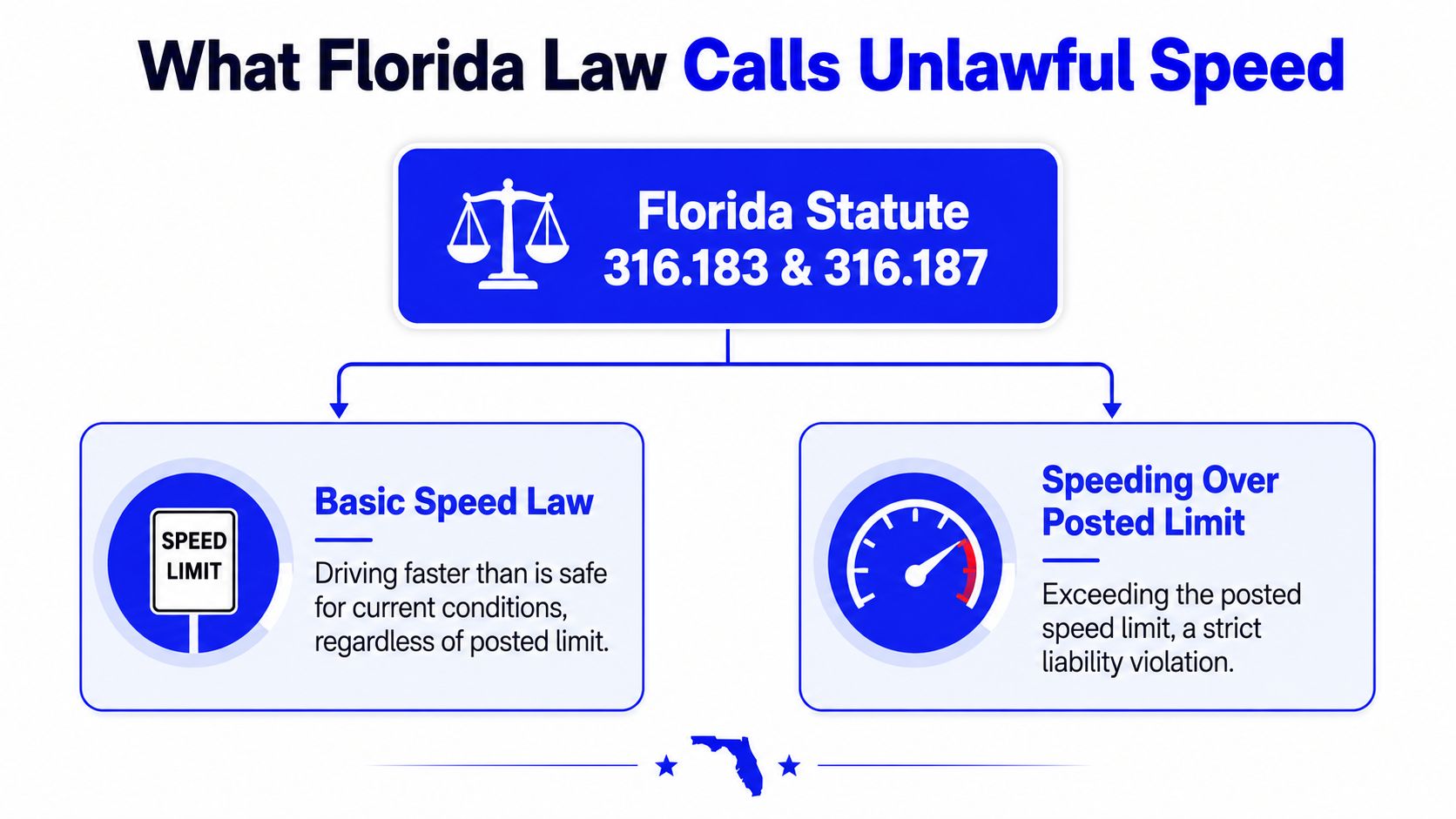
Florida doesn't define speeding as just “you were over the sign.” The law uses two separate triggers, and both matter. One is absolute, based on the posted or statutory limit. The other is contextual, based on whether your speed was safe for the conditions in front of you.
The two legal triggers
Under Florida Statute 316.183, the statewide baseline is 30 mph in business or residence districts and 55 mph elsewhere unless a different limit is posted under the applicable authority. Florida also recognizes the separate rule that you cannot drive faster than is reasonable and prudent for the actual hazard conditions. That means visibility, traffic, weather, and roadway layout all matter, even if your speed looks harmless on paper. Florida's basic speed law
On state roads, Florida Statute 316.187 gives the Florida Department of Transportation authority to set speed limits after an engineering and traffic investigation when the roadway conditions justify a different safe speed. The statute also requires warning signs before the limit becomes effective. FDOT speed-limit authority and signage requirement
If you're on a limited-access highway, Florida's statewide framework also recognizes higher maximums, including 70 mph on limited-access highways and 65 mph on certain divided highways outside urban areas. That's the legal ceiling, not a guarantee that the number is always safe in every condition. Florida speed-limit statute
Why that distinction matters in real life
A driver doing 45 in a foggy construction zone on I-4 can still get cited because the issue isn't only the posted number. The officer can claim the speed was unsafe for the hazard conditions even if the driver stayed under a sign that looked normal at a glance. That's why speed cases often turn on signage, engineering history, and what was happening on the road.
If you want a deeper legal breakdown of when a citation crosses into more serious exposure, review what is criminal speeding. Florida still treats unlawful speed as a noncriminal traffic infraction in ordinary cases, but the 2025 excessive-speed law changed the stakes for extreme conduct.
Penalties, Points, and Suspension Triggers You Should Know
You get the citation, and suddenly the fine looks like the whole story. It is not. In Florida, the fine is only one layer, the points are the second, and the license consequences come next if you let the ticket sit on your record.
Florida Speeding Penalty Bands by Speed Over the Limit
MPH Over Limit | Statutory Fine | DMV Points | Additional Risk |
|---|---|---|---|
1–5 mph | Warning | 3 points for speeding applies only when the citation is entered as speeding, based on the statutory and point schedule framework | Small mistake, but still a record concern |
6–9 mph | $25 | 3 points | Insurance and record consequences start here |
10–14 mph | $100 | 3 points | Noticeably more expensive, still point-heavy |
15–19 mph | $150 | 4 points | Higher suspension pressure |
20–29 mph | $175 | 4 points | Serious escalation in both cost and risk |
30 mph or more | $250 | 4 points | Can also raise criminal-exposure concerns in extreme cases |
Florida's civil penalty schedule follows those bands, and school-zone violations are harsher, including a $50 fine for up to 5 mph over and double the listed fine for other school-zone speed violations. Florida civil-traffic penalty schedule
Why the point system is the greater threat
The point total is where drivers get burned. Florida assigns 3 points for speeding up to 14 mph over the limit, 4 points for 15 mph or more over, and 6 points when speeding contributes to a crash. Those points do not sit there harmlessly. They stack toward suspension at 12 points in 12 months, 18 points in 18 months, and 24 points in 36 months. Florida driver license point rules explain how fast a single ticket can start pushing you toward that line. Florida driver license points
The hidden cost is simple. People focus on the fine and ignore the record. That is a mistake.
Florida also made extreme speeding far more dangerous in 2025 by creating dangerous excessive speeding. A first conviction can mean up to 30 days in jail or a $500 fine. A second or later conviction can mean up to 90 days in jail or a $1,000 fine, plus a mandatory 180-day to 1-year revocation if the repeat offense happens within five years. Florida crash facts and speeding enforcement data
Bottom line: do not treat a speeding ticket as a disposable nuisance. Once points start stacking, the real risk is suspension, and extreme speeding can push you into criminal exposure too.
A ticket on paper is one thing. The record it creates is what costs you later.
Defenses That Actually Work in Florida Speed Cases
Speed cases are evidence cases. That means the state has to prove the number, the method, and the context. If any of those pieces are weak, you have room to push back. A lawyer-led review matters because you need someone to read the discovery, not just the citation.
The four weaknesses that matter most
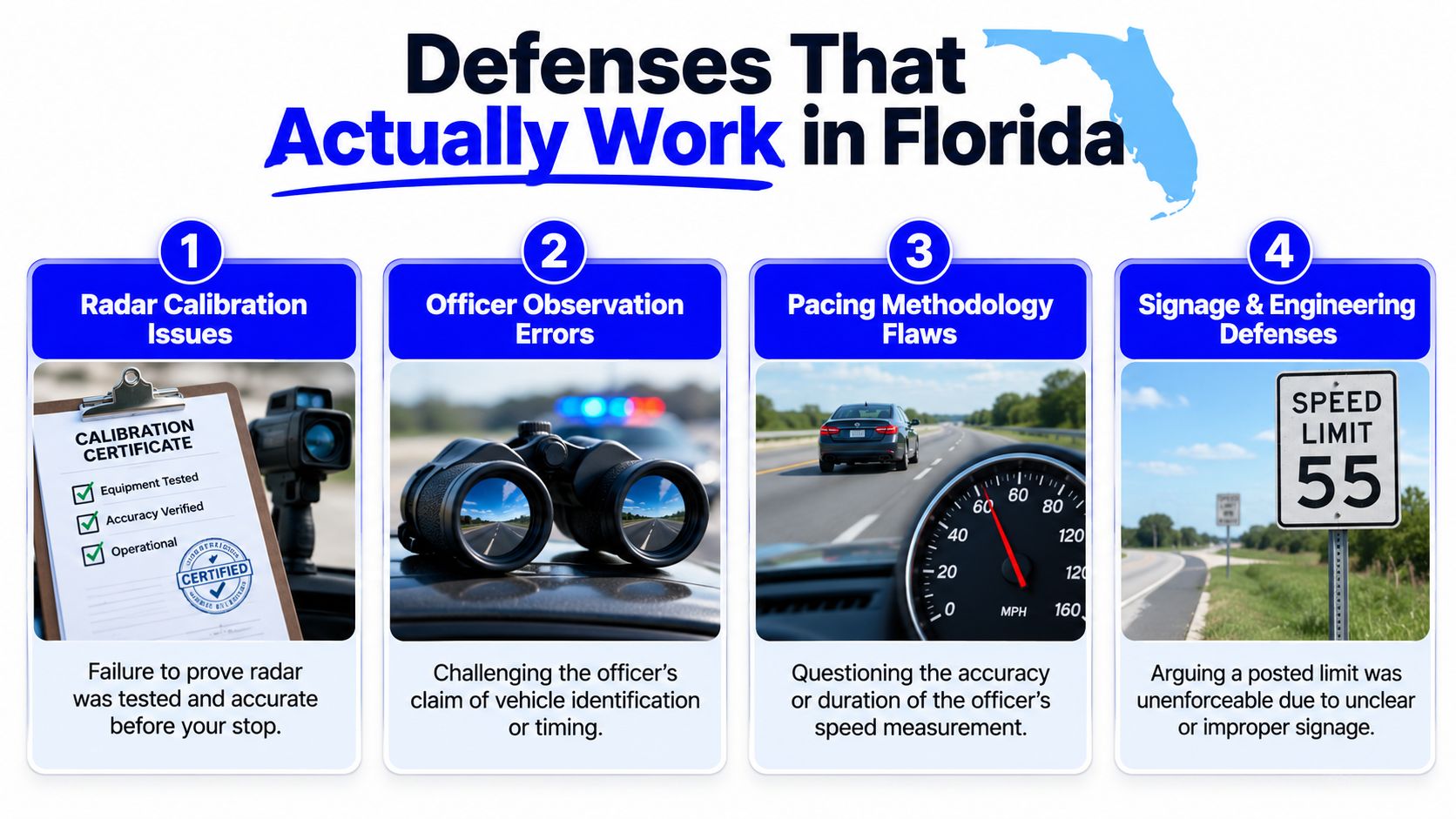
Radar and LIDAR cases often rise or fall on calibration and operator certification. If the device wasn't properly maintained or the officer's certification is stale, the reading is attackable. That's not theory, it's discovery work. A defense lawyer has to ask for the logs, the test records, and the paperwork that proves the device was reliable.
Pacing cases create a different fight. The officer has to maintain a verified speed for a sustained distance, and any interruption can break the chain. Traffic changes, lane changes, and cruiser speedometer issues all matter. If the pacing was sloppy, the state's number gets shaky fast.
Where visual estimation and signage create openings
Visual estimation is even thinner. If the prosecution is relying only on what the officer thought they saw, the case can become a pure credibility fight. That is where timing, distance, and traffic pattern details can help the defense.
Practical rule: if the speed zone itself is wrong, outdated, or poorly posted, fight the sign before you fight the number.
That is why speed zone disputes matter. A posted limit can be challenged if the roadway class, the statutory limit, or the DOT engineering study doesn't line up with what the sign says. Florida Statute 316.187 gives DOT that engineering-based authority, which also means the paperwork behind the sign matters.
If you want to see how a structured defense is built, review how to beat a speeding ticket. In many Florida cases, the practical win is a reduction to a non-moving violation, which avoids points and usually keeps the insurance damage far lower than a straight conviction.
Your Four Options After You Get the Ticket
You do have choices, but they are not equal. Some options protect your record. Others just end the problem on paper and create a bigger one later. The right move depends on your speed, your history, and whether you can tolerate points.
Response Option | Out-of-Pocket Cost | Point Impact | Insurance Impact | Court Appearance |
|---|---|---|---|---|
Pay the fine | Immediate fine payment | Points usually stay in place | Likely negative | No, but the case is effectively over |
Contest it yourself | Filing and time costs | Possible reduction or dismissal if you win | Better if reduced or dismissed | Often yes |
Hire a traffic defense lawyer | Fee-based, often value-driven compared with downstream costs | Goal is reduction, withhold, or dismissal | Usually the strongest protection | Often avoided |
Traffic school where allowed | School cost plus citation cost | May help in limited situations, but doesn't fix everything | Can soften the impact if paired correctly | Usually no courtroom need |
What each choice really means
Paying the ticket is the easiest path, and it is also the one most likely to leave you stuck with the long-term result. If you are a first-time driver with a very minor issue and no licensing concerns, that may be acceptable. For everyone else, it's often the most expensive short-term convenience you can buy.
Handling it yourself preserves your rights, but you're now responsible for deadlines, clerk procedures, discovery, and how a hearing works. That's a lot to juggle when you're already dealing with work, family, and a citation on your record.
A lawyer-led firm is the practical middle ground when points, insurance, or a commercial license matter. Ticket Shield, PLLC is one Florida option that handles speeding citations with direct attorney contact by phone or text. That matters because you're not trying to explain your case to an automated app or a middleman.
If your record matters, choose the path that protects the record first.
How Ticket Shield Handles Your Case Across Florida

When you hand over a speeding ticket, the first thing that matters is whether anyone reads it correctly. A free review should identify the county, the statute, and whether the citation hints at criminal exposure, especially if the speed is in the extreme range. That initial screen is where a lot of avoidable mistakes get caught.
The next step is attorney access and case handling. Ticket Shield's process starts at $39.99, and the point is direct contact with the lawyer, not a chatbot or a call center. In a speeding case, that matters because the lawyer needs to know what happened, what the officer wrote, and what the driver can prove.
Discovery and motion practice are where the pressure comes from. The attorney pulls the notes, the radar logs, and any dash or body camera footage, then uses that material to push for a better result. The goal is usually a reduction to a non-moving violation, a withhold of adjudication, or a dismissal.
Florida's major court locations include the Richard E. Gerstein Justice Building in Miami-Dade, the Broward County Judicial Complex, the Main Judicial Center in West Palm Beach, the Edgecomb Courthouse in Tampa, the Orange County Courthouse in Orlando, and the Duval County Courthouse in Jacksonville. If you're dealing with a case in one of those places, you want someone who already knows the local terrain.
Speeding ticket lawyer services are worth considering when you don't want to spend your own time fighting paperwork and court rules. The practical advantage is simple, the attorney handles the case, and you stay out of the loop of automated follow-up.
After the initial work is done, the case usually moves toward negotiation rather than a courtroom appearance. Over 99% of clients never step into a courtroom, which is the key benefit of using a lawyer-led process instead of guessing your way through it. If you're worried about who answers the phone, the answer should be your attorney, not a script.
Why a No-Points Outcome Is the Only Finish Line That Matters
A speeding ticket only looks small until you stack the consequences on top of each other. The fine hurts, the points follow you, and the record can make insurance, employment screening, and future licensing more complicated than most drivers expect. If you're already near a suspension threshold, one more conviction can push you over the edge.
The smart goal is not “get it over with.” The smart goal is a No Points outcome, because that is what protects your license and keeps the insurance company from getting the easy win. A dismissal or a withhold is the cleanest finish line. Anything less leaves you paying for the mistake in ways the citation itself never spells out.
If you want the result that matters, fight for the record, not just the fine. Visit TicketShield.com for a free consultation and focus on the only result that counts, No Points on your license.
Florida Speeding Ticket Questions We Hear Most
How fast should you act after a citation? Right away. The deadline controls your options, and waiting only helps the state.
Can a Florida attorney handle an out-of-state driver's citation? Yes, if the case is in Florida, the defense happens under Florida law.
How long does a speeding conviction matter? Long enough to affect your record, your insurance, and in some cases your employment screening. Don't treat it like a one-month problem.
Does a CDL holder have more to lose? Yes. If you drive for a living, points and violations can create job risk fast, so a weak defense is a bad idea.
Is school zone speeding treated differently? Yes. Florida's fine structure is harsher in school zones, and that makes a reduction even more important.
Ticket Shield, PLLC handles Florida speeding citations with a lawyer-led defense built to protect your license, record, and insurance. If you want a direct review of your case and a real shot at a No Points outcome, visit Ticket Shield, PLLC for a free consultation today.