
Your Florida Ticket for Careless Driving Explained
Got a ticket for careless driving in Florida? Understand the points, fines, and insurance risks. Learn how to protect your record with a strategic defense.

You're probably reading this with the ticket still on your passenger seat, wondering if you should just pay it and move on. Don't. If you got a ticket for careless driving in Florida, paying it online is a guilty plea that can put points on your license, affect your insurance, and create real problems if you drive for work.
It's a common and expensive mistake drivers make. They treat a careless driving citation like parking ticket paperwork. It isn't. In Florida, this charge sits in the middle ground. It's not the same as a criminal reckless driving case, but it's serious enough to damage your record fast if you handle it the lazy way.
Table of Contents
Your Instant Guide to a Florida Careless Driving Ticket
A Florida ticket for careless driving can put points on your license and raise the stakes for your insurance and job. Don't just pay it. Paying is a guilty plea. A strategic defense may protect your record and keep the case from getting worse.
Under Florida Statute § 316.1925, careless driving is defined broadly. That broad wording is exactly why drivers get trapped by it.
“Any person operating a vehicle upon the streets or highways within the state shall drive the same in a careful and prudent manner, having regard for the width, grade, curves, corners, traffic, and all other attendant circumstances, so as not to endanger the life, limb, or property of any person.”
In plain English, the court looks at whether you drove like a reasonably careful person would have driven under the same conditions. Rain. Traffic. Lane movement. Stopping distance. Visibility. Road conditions. Those details matter.
If you're holding this ticket now, your first move is simple. Preserve your options. Don't admit guilt, don't pay online out of frustration, and don't assume the officer's version is the final version.
What Exactly Is a Florida Careless Driving Ticket
A Florida careless driving ticket usually comes after a crash, a near-crash, or a stop where the officer believes you failed to use proper caution. The charge is usually tied to Florida Statute § 316.1925, and the wording gives officers a lot of discretion.
What does the statute actually say
This isn't a charge that requires the state to prove you meant to do something dangerous. It's about whether your driving fell below the standard of ordinary care. That's why a driver can receive a ticket for careless driving after what felt like a routine mistake.
Here's the practical issue. “Due care” sounds simple until you're the one defending it in traffic court. The officer may say you followed too closely, moved lanes unsafely, or drove too fast for the road conditions even if you weren't speeding.
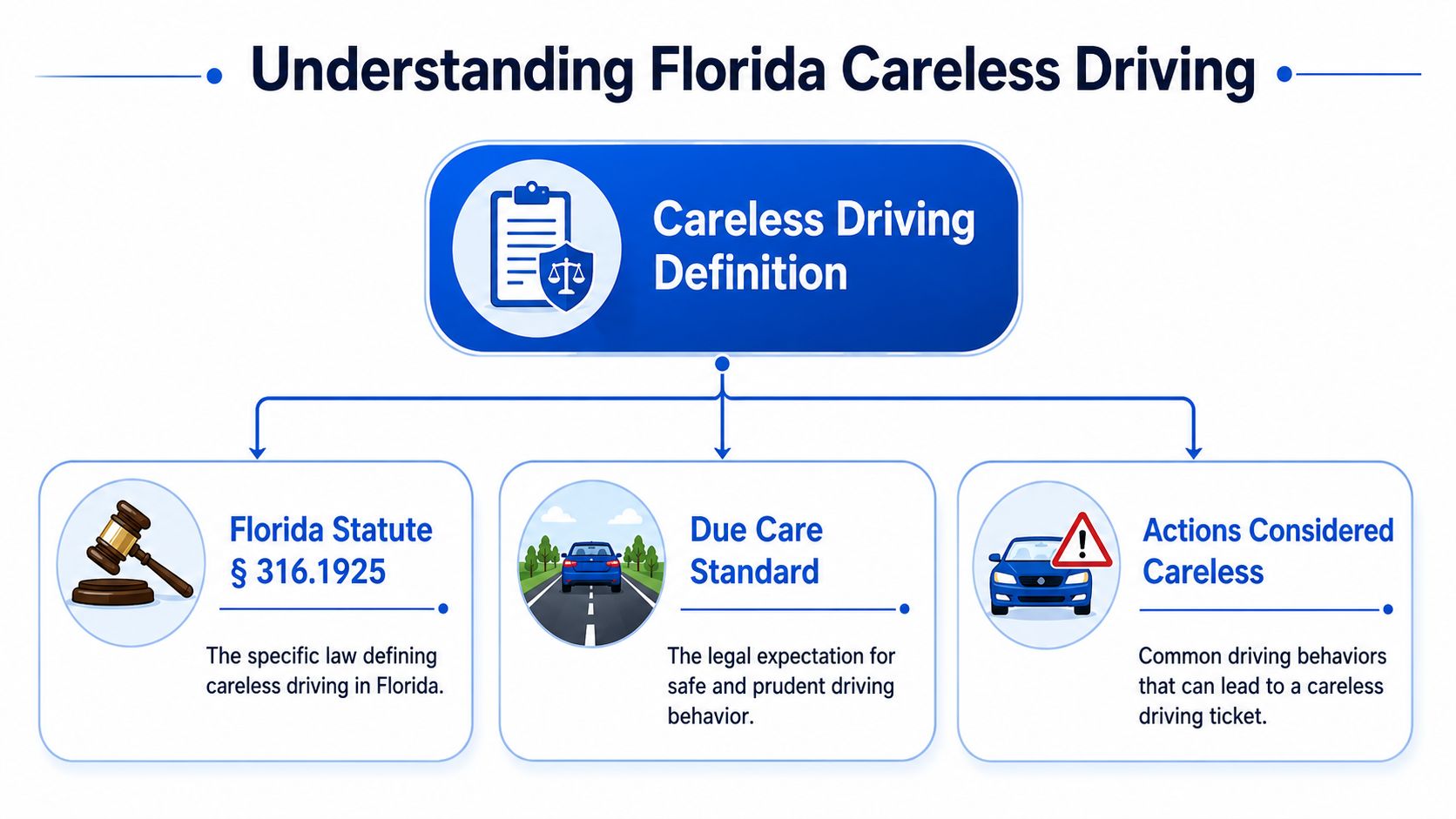
What counts as lack of due care
A careless driving citation often grows out of everyday driving decisions that suddenly look worse after an officer reviews them. Common examples include:
Following too closely: You didn't leave enough space to react safely.
Unsafe lane movement: You changed lanes and another driver had to brake or swerve.
Driving too fast for conditions: The road, weather, or traffic made your speed unsafe even if the posted limit wasn't exceeded.
Poor judgment at an intersection: You moved when the situation called for more caution.
Practical rule: A crash by itself doesn't automatically prove careless driving. The state still has to prove that your conduct was not careful and prudent under the circumstances.
If you want a closer look at examples officers rely on, review these actions commonly defined as careless driving in Florida.
Why this ticket gets written so often
Careless driving is a significant factor in accidents nationwide, involved in approximately 7.6% of all traffic incidents according to the National Safety Council's improper driving data. That matters for one reason. Officers, courts, and insurers already treat this as a recurring safety issue, not a harmless technicality.
You are not facing a criminal label just because you received this citation. But you are facing a broad, subjective allegation. Those are exactly the cases that deserve a real defense, because broad allegations are often easier to challenge than drivers think.
How Is Careless Driving Different from Reckless Driving
Many drivers use the words interchangeably. Florida law doesn't.
The legal line is negligence versus criminal conduct
A ticket for careless driving is tied to negligence. A reckless driving charge under Florida Statute § 316.192 is different. That charge is based on a much more serious level of behavior, commonly described as a willful or wanton disregard for safety.
That difference matters because the long-term consequences change sharply once a case crosses into reckless driving territory. A careless driving case is still serious. A reckless driving conviction can follow you much longer and hit much harder.
Unlike a civil careless driving ticket, a conviction for reckless driving in Florida under Statute 316.192 is a misdemeanor that creates a permanent criminal record, which can void security clearances and employment contracts, as explained in this reckless driving analysis.
Careless Driving vs Reckless Driving in Florida
Factor | Careless Driving (FL Statute § 316.1925) | Reckless Driving (FL Statute § 316.192) |
|---|---|---|
Statute | § 316.1925 | § 316.192 |
Legal nature | Civil traffic offense | Criminal misdemeanor |
Mental state | Failure to use due care | Willful or wanton disregard for safety |
Jail risk | Not treated like a criminal traffic misdemeanor in the ordinary careless driving context | Criminal exposure exists |
Record impact | Driving record consequences | Permanent criminal record risk |
Employment risk | Can affect driving-based work and insurance status | Can affect jobs, contracts, and clearances |
If you want a side-by-side breakdown of where courts draw that line, see the difference between careless and reckless driving.
Why points still create major risk
Don't relax just because careless driving isn't the criminal version. In Florida, accumulating 6 or more points within 12 months triggers a 30-day suspension, 12 points in 18 months triggers a 60-day suspension, and 18 points in 36 months triggers a 1-year suspension under the point thresholds summarized in this Florida points overview.
That means a single moving violation can become the ticket that starts the slide. One citation turns into points. Points turn into a suspension risk. A suspension risk turns into lost work, higher premiums, and questions from employers.
For professional drivers, the pressure is worse. If driving is how you earn money, any moving violation can threaten your income. Waiting to “see what happens” is not a strategy.
What Are the Real Penalties for a Careless Driving Ticket
The penalty isn't just the fine. It's what the conviction sets in motion after you pay it.
What happens if you just pay it
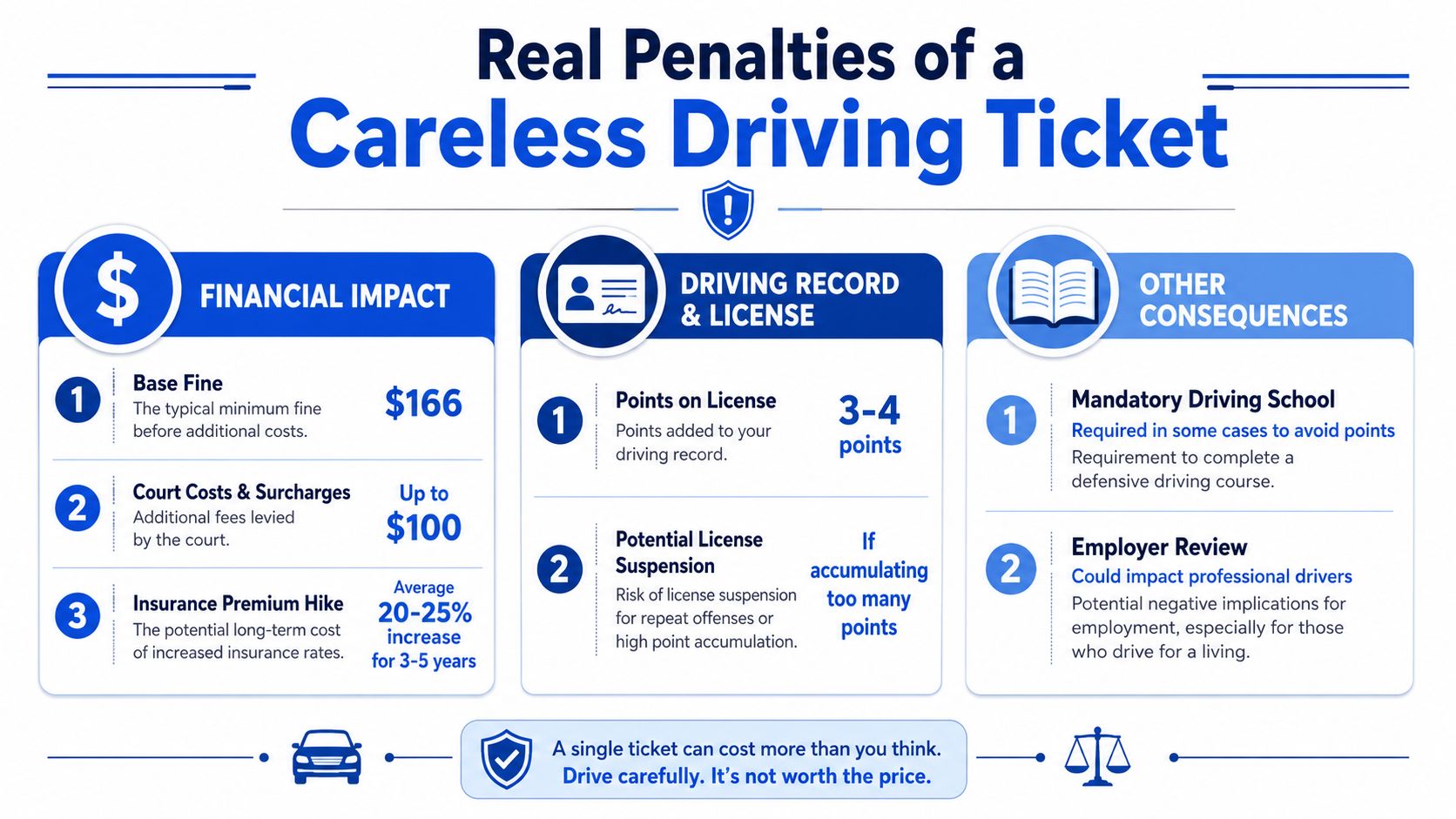
In Florida, a careless driving conviction results in exactly 2 points on your license and a fine of $50 to $200, plus $33 in court costs and a $6 assessment fee, with judicial discretion to impose up to 15 days in jail for extreme cases, according to this Florida careless and reckless driving penalty discussion.
That's the official consequence structure. The practical consequence is worse. A conviction becomes part of your driving history. Insurers review it. Employers can review it. If your record is already carrying prior points, this ticket can become the one that pushes you into suspension trouble.
Which path makes sense for you
Drivers usually have three choices after getting a ticket for careless driving. They are not equal.
Path | What you gain | What you risk |
|---|---|---|
Pay the ticket | Quick closure | Guilty plea, points, record damage |
Fight it yourself | Full control | Time, procedural mistakes, weak negotiation leverage |
Hire counsel | Strategic defense and negotiation | Legal fee, but stronger protection effort |
Paying online is convenient. It's also the one option that gives away your leverage immediately.
If you need a Florida-specific breakdown of how these cases are handled, start with this guide to a careless driving ticket in Florida.
Why gig drivers face the hardest hit
If you are a gig economy driver for Uber, Lyft, or DoorDash in Florida, receiving a conviction for careless driving can lead to immediate and permanent account deactivation due to their zero-tolerance policies for moving violations, as noted in this Florida gig-driver traffic violation discussion.
That changes the entire analysis. For a gig driver, this isn't just a traffic case. It's an income protection case.
If your work depends on your driving status, don't act like a retail consumer handling a utility bill. Treat the ticket like a threat to your livelihood, because that's exactly how the platforms treat it.
What Are Your Options After Getting the Ticket
You have choices after a careless driving citation. One of them is usually a mistake.
Option one is paying the ticket
Paying the fine is the fastest way to end the paperwork. It's also the fastest way to lock in the damage. When you pay, you are resolving the case by accepting responsibility.
That means you don't get to negotiate facts later. You don't get to challenge whether the officer saw enough. You don't get to ask the court for a better outcome from a position of strength.
Option two is fighting it yourself
Some drivers decide to contest the ticket on their own. That can work in limited situations, but the risk is simple. You only get one shot to present your case cleanly.
At a courthouse like the Richard E. Gerstein Justice Building in Miami, traffic dockets move quickly. Hearing officers and judges hear excuse after excuse. If your defense is vague, emotional, or unsupported, it usually goes nowhere.
There's another problem. Many drivers think they have an easy defense because something sudden happened. A distraction. A loud noise. Debris. A confusing moment in traffic. Florida courts do not treat those explanations casually.
Option three is hiring an experienced traffic attorney
Florida's court system allows for judicial discretion in careless driving cases, meaning an attorney can often negotiate a resolution to withhold points or secure a dismissal, an option unavailable when you pay the fine online, as explained in this discussion of why lawyer representation changes traffic court outcomes.
That is the value of counsel. Not magic. Not slogans. Strategy.
A lawyer can review whether the officer observed the alleged conduct, whether the narrative is too vague, whether the facts support a lesser outcome, and whether local court practice creates room for negotiation. If you use a lawyer-led service such as Ticket Shield, PLLC, you also communicate directly with your attorney by phone or text instead of getting pushed through a chatbot or middleman.
Immediate Steps to Take
Read the citation carefully: Check the statute listed, the court information, and the deadline to respond.
Write down what happened: Road conditions, traffic flow, weather, where the officer was positioned, and what was said during the stop.
Preserve evidence: Save photos, dashcam footage, repair records, and names of any witnesses.
Don't admit fault casually: That includes online payment, loose texts, or statements to insurers that go beyond basic reporting.
Get legal advice quickly: Delay helps the state, not you.
How Can You Defend Against a Careless Driving Charge
A real defense starts with facts, not hope. If you want to beat a ticket for careless driving, you need to challenge proof, interpretation, or both.
A real defense attacks proof, not just the story
Strong defenses often focus on issues like these:
Observation problems: The officer may not have had a clear view of the alleged driving behavior.
Weak detail in the citation: Some tickets describe the result, such as a crash, but not the specific careless act.
Reasonable driving under bad conditions: Your response to road conditions may have been prudent, not careless.
Sudden emergency facts: An unexpected event may have forced a reaction that a reasonable driver would also have made.
A defense lawyer also looks at whether the evidence proves the legal standard, not just whether the event looked bad after the fact. That distinction matters in traffic court.
For a more forceful look at how these cases are contested, review aggressive careless driving Florida ticket defense strategies.
Inadvertent distraction is not an automatic defense in Florida
Many drivers get burned, assuming that if something unexpected distracted them, the judge will automatically understand.
Florida courts require much more than that. Many drivers mistakenly believe that claiming an “inadvertent distraction” is a simple defense, but unlike other states, Florida courts require a high evidentiary bar to prove the distraction was unavoidable, and over 68% of such claims are rejected without strong legal representation, according to this Florida traffic defense discussion on distraction-based arguments.
A distraction defense only works when you can show the event was truly unavoidable and that you acted as carefully as possible under the circumstances.
That means evidence. Photos. Timing. Witness statements. Vehicle condition. Scene details. If all you have is “I got distracted for a second,” that usually won't carry you.
Local court knowledge matters
Courtroom reality matters as much as legal theory. The same argument can land differently depending on the judge, hearing officer, and local practice. That's why knowing the courthouse matters, whether your case is set in Miami, Orlando, Tampa, or Fort Lauderdale.
An automated app can collect your payment and push your citation through a process. It can't stand next to your facts and shape a defense around them. A lawyer can. When your record, your insurance, or your job is exposed, personal strategy beats automation every time.
Why You Need a Lawyer and Not an App
A careless driving ticket isn't data entry. It's judgment, negotiation, and risk control. Automated apps and ticket mills are built for volume. They rely on standard workflows, middlemen, and canned updates. That may feel convenient, but convenience is not the same as protection.
You need direct answers from the attorney handling your case. You need someone who can tell you whether the officer's account is weak, whether the court is likely to consider a withhold, and whether your work status raises urgency. That requires actual legal judgment, not software prompts.
If you want to understand why local, lawyer-led defense matters more than app-based processing, read why choosing a local lawyer over apps can protect your record better.
When you hire a lawyer-led firm, you're not buying a dashboard. You're hiring a person to protect the No Points goal.
If you got a ticket for careless driving in Florida, act now. Speak directly with an attorney, protect your license, and pursue the outcome that matters most: No Points. Visit Ticket Shield, PLLC for a free consultation.
