What Actions are Defined as Careless Driving in Florida?
What actions are defined as careless driving in florida? See common examples, typical fines, 3 points, and what to do after a ticket.
Tuesday, October 21, 2025
A careless driving ticket in Florida can mean a fine, license points, and higher insurance. Here’s what the law covers and what your options usually look like.
When you get a traffic ticket in Florida, the first step is figuring out exactly what the citation alleges. A speeding ticket is usually straightforward. A careless driving citation is different because the statute is broad and officers often apply it to many different on-road situations.
Our practice focuses on traffic and DUI defense, and in reviewing Florida ticket scenarios, we have seen that many drivers are less confused about what happened than about what the officer believed made the driving legally “careless.” This guide focuses on the statute, the point system, and the practical choices drivers face after a citation.
How We Evaluated What Counts as Careless Driving in Florida
This article is based on the current text of Florida’s careless driving statute, Florida driver-license point and suspension rules, and Florida court process guidance for civil traffic cases. We reviewed the statutory standard in section 316.1925, the state’s published driver license point system, and Florida court information on civil traffic infraction hearings.
We also compared how the rule is typically used in real ticket situations: distraction, weather-related driving, lane movement, following distance, and post-crash citations. In our review of Florida traffic cases, instead of a slogan like "drive safely," the legal question an officer and court look at is whether the driver operated in a careful and prudent manner under the surrounding conditions.
That method matters because careless driving is not defined by one forbidden act alone. It is a context-based violation. The same lane movement or speed may be harmless on an empty road and citable in heavy rain, dense traffic, or near pedestrians.
Defining Careless Driving Under Florida Law
Attorney Advertisement. Office in Broward.
Florida defines careless driving in Fla. Stat. 316.1925 as driving “in a careful and prudent manner, having regard for the width, grade, curves, corners, traffic, and all other attendant circumstances, so as not to endanger the life, limb, or property of any person.” That wording explains why the citation can feel broad: the law is built around road conditions and risk, not just one named maneuver.
In practical terms, “careful and prudent manner” means a driver is expected to adjust to the situation in front of them. “Attendant circumstances” is the catch-all phrase that allows an officer to consider everything surrounding the event: traffic density, rain, road work, visibility, pedestrians, cyclists, lane configuration, and whether the driver had enough time and space to react safely.
In our review of Florida careless driving scenarios, officers most often use this statute when they believe a driver failed to adapt to obvious conditions rather than when they can prove a highly technical violation. Common examples include following too closely in stop-and-go traffic and then nearly causing a rear-end crash, changing lanes abruptly across multiple lanes near an exit, or driving too fast for a heavy afternoon downpour even while staying under the posted speed limit.
A few Florida-specific examples help make the definition more concrete:
Driving at normal highway speed through standing water or limited-visibility rain on I-95 or the Turnpike, where a reasonable driver would have slowed.
Cutting across lanes late to make a turn or exit in dense urban traffic, especially when other drivers must brake suddenly to avoid contact.
Failing to use sufficient caution around a crosswalk, school-zone activity, cyclists, or roadside construction where the risk to others is elevated.
The statute has been on the books for decades, and Florida continues to track careless driving as both a citation category and a crash-related safety issue through its crash and citation reporting resources. That ongoing state tracking is one reason the label matters more than many drivers initially assume.
The "Catch-All" Traffic Violation
Careless driving is often described as a catch-all violation because it gives officers room to cite conduct that is unsafe even when another statute does not fit perfectly. That does not mean the ticket is automatic or unchallengeable. It means the case usually turns on what the officer observed, what the surrounding conditions were, and whether the facts really show a lack of reasonable caution.
A careless driving charge is still negligence-based rather than intent-based. The state is not alleging you meant to create danger. It is alleging your driving fell below the standard of reasonable care under the circumstances.
Florida Careless Driving at a Glance
Aspect | Details |
|---|---|
Relevant Statute | Florida Statute 316.1925 |
Violation Type | Non-criminal civil traffic infraction |
Common Penalties | Fine, court costs, and license points |
Key Standard | Failure to drive in a careful and prudent manner under the circumstances |
A helpful bottom line is this: an officer does not need an accident to issue a careless driving ticket. The statute focuses on endangerment and risk, so a citation may be written based on observed driving alone.
Civil Infraction vs. Criminal Offense
It’s important to understand that standard careless driving is a non-criminal civil traffic infraction. A conviction does not create a criminal record by itself.
That said, civil does not mean minor. It can still affect your driving record, your insurance pricing, and your future exposure under the point system. In advising drivers after these citations, we often find that the largest consequence is not the ticket amount itself but the longer financial tail that follows a conviction.
Past results do not guarantee future outcomes.
Common Actions That Lead to a Careless Driving Ticket
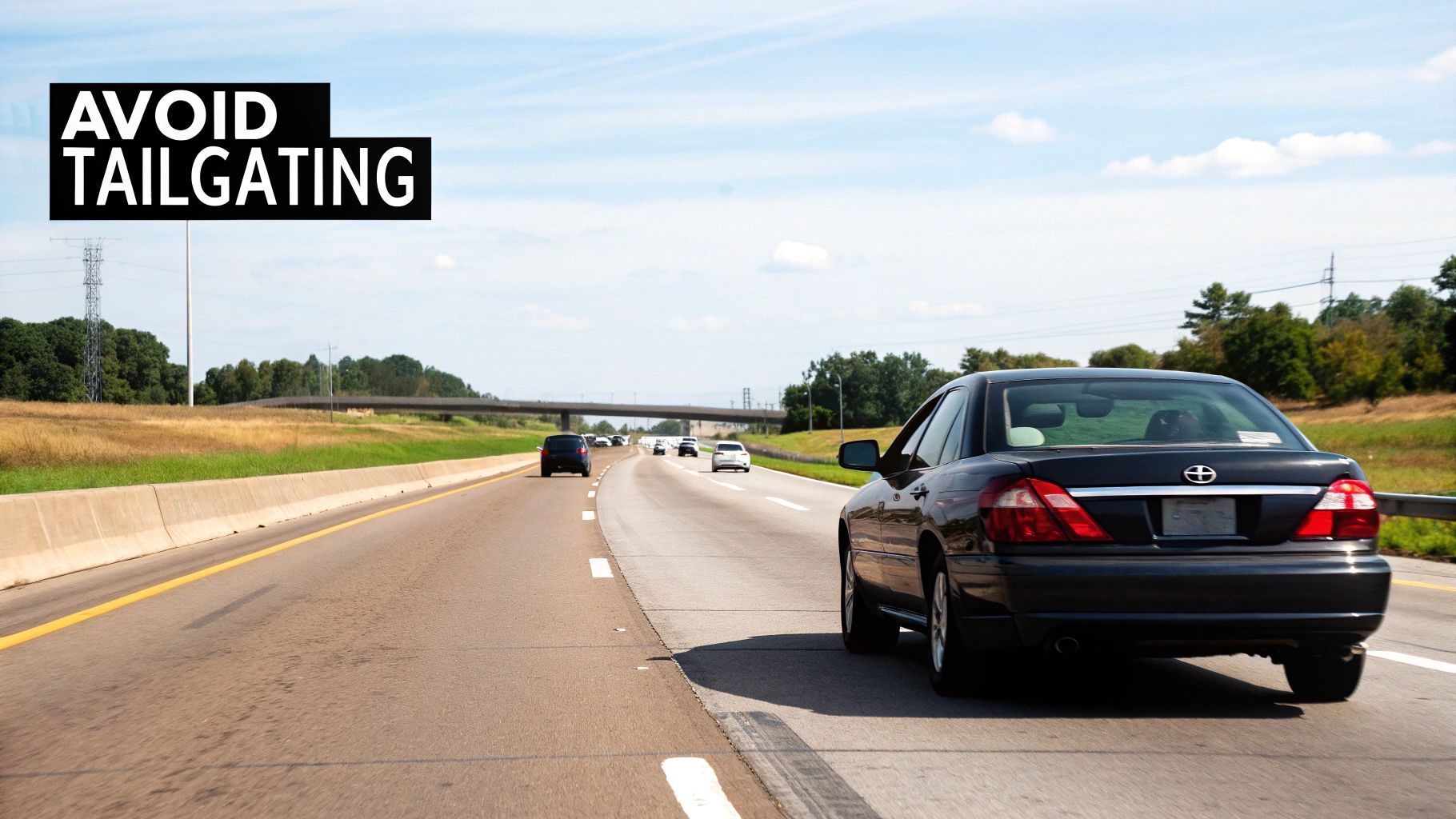
Knowing the textbook definition of careless driving is a start, but what does it look like on the road? Because the law is written so broadly, a whole range of everyday habits can suddenly land you with a ticket.
An officer doesn't have to prove you were trying to cause a problem—just that your driving created a potential risk. This is a huge gray area. What one law enforcement professional might shrug off as a simple mistake, another could see as a citable offense.
Distracted Driving Behaviors
Let's be honest, distracted driving is probably the number one reason people get slapped with a careless driving ticket. In a world where we’re always connected, anything that pulls your focus away from the road can be considered negligent.
And we're not just talking about texting—that's a separate violation all on its own. The "careless" ticket is a catch-all for a much wider world of in-car distractions.
Think about it. You could get a ticket for:
Messing with the GPS: Fiddling with your navigation app or typing in a new address while the car is moving.
Eating or Drinking: That moment you spill your coffee or drop a french fry can easily cause your car to swerve.
Changing the Music: Getting lost in a complicated infotainment system or endlessly scrolling for the right playlist.
Dealing with Passengers: Turning around to talk to people in the back seat, especially when trying to manage kids.
Bottom line? If it takes your eyes off the road, your hands off the wheel, or your mind off of driving, you're rolling the dice on a careless driving citation.
Poor Judgment in Traffic
Beyond the obvious distractions, a huge chunk of these tickets comes from making bad calls around other cars. These are the moves that violate the "careful and prudent" standard because they completely ignore the flow of traffic.
The key isn't just how you're driving; it's how you're driving in relation to everyone else. A lane change that’s perfectly fine on an empty interstate can become a classic "careless" move during rush hour gridlock.
Officers may write tickets for things like:
Following Too Closely: We all know it as tailgating. It’s a guaranteed way to end up in a rear-end collision because it leaves you zero room to react.
Improper Lane Changes: Weaving through traffic without a signal, cutting someone off, or changing lanes inside an intersection are all prime examples. We cover this in more detail in our guide to improper lane change violations.
Failing to Yield: Blowing through a yield sign or not giving pedestrians the right-of-way is a direct invitation for a ticket.
Driving Unsafely for Conditions
Finally, one of the biggest misconceptions is that if you're under the speed limit, you're in the clear. Not so fast. Driving too fast for the conditions is a classic setup for a careless driving ticket, even if you’re technically legal.
Florida weather is famous for turning on a dime, and the law expects you to adapt instantly. An officer can decide your speed wasn't "careful and prudent" during:
Heavy Rain: When visibility drops and the roads get slick, you’re expected to slow way down to maintain control.
Dense Fog: Going the speed limit when you can barely see the car in front of you is a textbook example of driving unsafely for the conditions.
Construction Zones: Trying to navigate lane shifts, bumpy pavement, and road crews requires extra caution and a much slower speed.
As you can see, a simple lapse in judgment is all it takes to get a ticket that can mess with your driving record and your wallet. Our goal is to protect your license from the fallout of these all-too-common situations. Attorney Advertisement. Office in Broward.
The True Cost of a Careless Driving Conviction
The cost of a careless driving conviction in Florida usually comes in three layers: the ticket amount itself, the license-point consequences, and the insurance impact that can continue long after court is over. In our review of post-ticket options, many drivers focus on the fine first and underestimate the other two.
Base Fine, County Costs, and Why the Number Varies
A careless driving ticket is a noncriminal moving violation, but the amount due is not perfectly uniform from one county to another because counties add statutory and court-related costs. Florida’s traffic schedules commonly place a standard careless driving citation in the general range many drivers see on their citation, but the exact amount should be confirmed with the clerk or county court handling the case rather than assumed from another county’s number.
That is one reason asking “how much is the ticket” only tells part of the story. If there was a crash, if another citation was issued with it, or if the matter proceeds into court rather than being paid outright, the total out-of-pocket cost can change.
License Points and When Suspension Becomes a Bigger Risk
For a standard careless driving conviction, Florida commonly assesses 3 points on the driver’s license under the state point system described by the Florida Highway Safety and Motor Vehicles. The older “3 to 4 points” shorthand is too imprecise for most readers. Three points is the usual baseline for the citation itself.
Point exposure can become more serious when a crash is involved or when the same stop also includes additional violations. And the cumulative totals matter. Florida can suspend a license at 12 points in 12 months, 18 points in 18 months, or 24 points in 36 months, according to FLHSMV’s suspension rules.
If you want a broader explanation of how multiple citations stack, our guide to the Florida traffic ticket point system walks through the larger framework.
Insurance Impact Is Often the Most Expensive Part
Insurance pricing is where many careless driving cases become expensive. A conviction signals elevated driving risk, and carriers may treat it differently depending on your age, prior history, vehicle, county, and whether the citation involved a crash. A realistic way to think about the insurance consequence is as a likely rate increase over the next renewal cycle rather than a fixed dollar penalty.
For many drivers, that increase can mean several hundred dollars a year, and for others it can run much higher, especially with a prior violation history or an at-fault crash. In reviewing these cases, we have found that this is the reason some drivers choose to contest a citation even when the fine itself seems manageable.
Florida’s own safety reporting shows why insurers pay attention to this category. State reporting resources continue to track careless driving in both crash and citation data, and one statewide summary source notes long-running monitoring of crash facts and annual citation statistics through Florida crash and citation reports. Separate reporting has also highlighted careless driving as a frequent contributing cause in crash analysis, which helps explain why insurers may view the label seriously in underwriting; see this Florida crash-cause discussion.

This infographic breaks down how quickly the costs stack up, from the initial fine to the long-term insurance hikes.
Attorney Advertisement. Office in Broward.
Careless Driving Versus Reckless Driving Explained
In everyday conversation, you might hear people use "careless" and "reckless" driving interchangeably. But when you’re standing on the side of the road with a ticket in hand, the difference between these two terms is enormous. In the eyes of Florida law, they are worlds apart, and confusing them could mean misunderstanding the seriousness of your situation.
One is a simple traffic ticket. The other is a criminal charge. Understanding which one you’re facing is the first step toward building a proper defense.
Intent Makes All the Difference
So, what’s the big divide? It all comes down to intent.
Think of careless driving as a mistake—a lapse in judgment or a moment of inattention. The classic example is a driver who spills a hot coffee in their lap and momentarily swerves out of their lane. They didn’t mean to create a dangerous situation; it was an accident caused by a distraction. It was negligent, but not malicious.
Reckless driving, on the other hand, is a conscious choice. It involves a "willful or wanton disregard" for the safety of others. This is the driver who intentionally weaves through rush-hour traffic at 90 mph, fully aware of the danger they're creating. Their actions aren’t just a mistake; they’re a deliberate gamble with everyone’s safety, which elevates the offense from a civil infraction to a criminal matter.
Comparing the Two Offenses
To put it in perspective, let's lay out what's at stake. The penalties, legal classification, and long-term impact on your life are drastically different for each offense. It’s critical to know exactly what you’ve been cited for.
Careless Driving vs. Reckless Driving in Florida
Factor | Careless Driving | Reckless Driving |
|---|---|---|
Legal Classification | Civil Traffic Infraction | Criminal Misdemeanor |
Element of Intent | Negligence (unintentional) | Willful or Wanton Disregard (intentional) |
Points on License | 3-4 points | 4 points |
Potential Jail Time | None | Up to 90 days for a first offense |
Criminal Record | No | Yes, a conviction results in a permanent record |
As you can see, a reckless driving charge is in a completely different league. You’re not just looking at a fine and points; you’re facing potential jail time, probation, and a criminal record that follows you forever, impacting jobs, housing, and more.
The line between a serious careless act and a reckless one can be blurry, and it often comes down to the police officer's judgment at the scene. How they interpret your actions in that moment determines the ticket you get, which makes the specific details of your case incredibly important.
Our goal is to protect your license and record by carefully analyzing the facts of your case. Past results do not guarantee future outcomes. We handle criminal traffic matters across Florida, providing a clear path forward.
Attorney Advertisement. Office in Broward.
Why Florida Law Enforcement Issues Many Careless Driving Tickets
If you just got a careless driving ticket, it’s easy to feel like you were unfairly singled out. You might be thinking, "Was what I did really that bad?" But to understand why these tickets are so common, you have to look at the bigger picture of traffic safety in Florida.
That ticket isn't just about one minor mistake. It's a key tool law enforcement uses to get ahead of the thousands of preventable accidents that happen across the state every year. By enforcing Florida Statute 316.1925, officers are trying to correct risky driving habits before they cause a crash.
A Strategy for Proactive Accident Prevention
Let's be honest, Florida’s roads are jam-packed. This makes proactive enforcement more than just a good idea—it's essential for keeping people safe. The careless driving law is intentionally broad, giving officers the flexibility to step in when they see behavior that, while maybe not criminally reckless, definitely raises the risk of an accident for everyone nearby.
This covers all the common (and frustrating) habits that lead to collisions: tailgating, weaving through traffic, or just not paying attention. The goal of the ticket is to put a stop to these actions through consistent enforcement, hopefully making the roads safer for all of us.
If a careless driving event did lead to soreness or a collision-related injury, practical follow-up matters too. For readers dealing with the physical side of a crash, Aspen Falls Wellness offers car-accident treatment information that may be useful alongside the legal and insurance issues.
When an officer writes a careless driving ticket, they're sending a message: even small lapses in judgment have consequences. It’s meant to be a deterrent, a wake-up call to stay focused and alert behind the wheel.
The Numbers Tell the Story
The sheer volume of careless driving tickets handed out each year really drives home its importance as an enforcement tool. The statistics are pretty staggering and show just how often officers witness drivers failing to operate their vehicles in a "careful and prudent manner."
Florida’s own tracked data shows how common the issue is. State reporting resources compile annual crash and citation information, and one statewide summary source noted long-term tracking through 2023 in the FLHSMV reporting archive. The statute itself is also the anchor point for a category that has historically generated a very high volume of enforcement, with prior statewide reporting showing nearly 200,000 careless driving citations in a single year under section 316.1925.
This data makes it clear: these tickets aren't random. They are a direct response to a very real and persistent safety problem on Florida's roads. Our firm focuses on traffic defense precisely because we know how to help drivers handle these common, yet potentially impactful, situations. Attorney Advertisement. Office in Broward.
Your Options After Receiving a Careless Driving Ticket
After a Florida careless driving ticket, the first deadline to watch is usually the 30-day response window shown on the citation. You must choose how to resolve the ticket during that time; ignoring the deadline can lead to additional penalties, collections issues, or a license suspension for failing to comply.
In advising drivers on next steps, we usually frame the decision this way: are you mainly trying to end the matter quickly, avoid points, protect a clean record, or reduce insurance fallout? The best option depends on that answer.
Understanding Your Three Main Choices
Florida drivers generally have three main paths:
Pay the ticket. This is the simplest option, but legally it functions as an admission of the infraction. Paying usually means a conviction is entered, the case closes, and the applicable points are reported to your driving record.
Elect a basic driver improvement course, if eligible. Florida allows some drivers to choose traffic school for certain citations. Completing the course can keep points from being assessed in many cases, but it does not erase the ticket itself, and it does not mean the stop never happened. Eligibility and frequency limits apply under Florida’s driver improvement rules.
Contest the citation. This is the option that preserves the chance of a dismissal, a reduced charge, or another negotiated outcome depending on the facts and local practice.
What Contesting Usually Involves in Florida
Contesting a civil traffic ticket is more structured than many drivers expect. The process commonly starts with electing a hearing rather than paying. Depending on the county and court procedure, that may lead to a hearing date, pre-hearing paperwork, or another local scheduling step through the clerk or traffic division. Florida court guidance on traffic cases and hearings outlines the basic framework.
At the hearing stage, the officer’s testimony often becomes central. The court may consider what the officer saw, whether there was a crash, road and weather conditions, whether other drivers had to take evasive action, and any photos, diagrams, or witness accounts. In some cases, the result is straightforward; in others, the citation may be amended, dismissed, or resolved through a negotiated outcome.
We often see drivers assume that if an officer wrote “careless driving,” the issue is already decided. It is not. A citation is an allegation, and the surrounding facts still matter.
What Traffic School Can and Cannot Do
Traffic school can be helpful, but it is not a universal fix. It may keep points off your license if you are eligible and complete the course on time. It does not guarantee an insurer will ignore the incident, and it does not convert the citation into a dismissal. It also cannot always solve the bigger issue for drivers who need to protect a spotless history for employment, a commercial license, or unusually sensitive insurance underwriting.
When Fighting the Ticket May Be Worth It
Contesting a careless driving citation is often more worth considering when one or more of these factors are present:
The officer’s observations were brief, limited, or based on an inference rather than a clear dangerous act.
There was no crash and no independent witness showing actual endangerment.
Weather, roadway layout, construction, or another driver’s conduct helps explain what happened.
The citation appears to be based on a single lane movement, braking event, or evasive reaction rather than sustained unsafe driving.
You have a clean record and want to avoid points and insurance consequences.
You hold a CDL or work in a role where even a civil moving violation can create employment complications.
For a broader overview of what preparation and court strategy can involve, see effectively fight a traffic ticket in Florida. Our firm’s role in these cases is to evaluate the facts, explain the risk of paying, and help drivers decide whether a challenge is worth the effort.
Can a Careless Driving Ticket Be Reduced or Kept Off Your Record?
Sometimes, yes—but not automatically, and not the same way in every county.
A careless driving ticket may be reduced, amended, or resolved in a way that avoids points depending on the facts of the stop, whether there was a crash, the driver’s prior record, local court practice, and whether the case is contested rather than paid. In some situations, traffic school is the practical route to avoid points. In others, the better outcome comes from a hearing or negotiated amendment.
Reduction or Amendment
A reduction usually means the original citation is changed to a different nonmoving or less consequential offense, or otherwise resolved on terms that reduce point exposure. That depends heavily on case specifics. In our review of these matters, the best candidates are often cases involving limited officer observations, ambiguous road conditions, no collision, or a driver with a strong prior record.
Kept Off Your Driving Record
Drivers often use this phrase to mean one of two different things: avoiding points, or making the event disappear entirely. Those are not the same.
If you pay a careless driving ticket, the conviction is generally reported as part of your Florida driving history. Traffic school may prevent points if you are eligible, but that does not necessarily mean the underlying citation leaves no trace. A dismissal or successful challenge is different from a standard paid resolution.
Can It Be Removed Later?
For most drivers, a routine civil traffic conviction is not something that gets “expunged” the way a criminal record might. That is why the decision made during the ticket window matters so much. If record consequences, insurance, or professional licensing concerns are important in your situation, it is usually better to evaluate the ticket before resolution rather than hoping to clean it up afterward.
Common Questions About Careless Driving
When that ticket lands in your hand, the practical questions come fast. Here are short answers to a few of the ones not already covered above. Please note that submitting information via our website forms does not create an attorney-client relationship and any legal questions should be directed to a licensed attorney.
Can I Get a Ticket if There Was No Accident?
Yes. An officer can issue a careless driving citation based on observed driving that allegedly endangered people or property, even if no collision occurred. The statute is risk-based, not crash-dependent.
Does a Careless Driving Citation Stay on My Florida Driving Record?
If you pay the citation or are found to have committed the infraction, the resolution typically becomes part of your driving history. For many drivers, the more immediate issue is that a standard conviction commonly brings 3 points unless an eligible traffic-school election prevents point assessment.
Can a Careless Driving Ticket Sometimes Be Reduced or Withheld?
Sometimes. Depending on the facts, county practice, and how the case is handled, a citation may be reduced, amended, or resolved in a way that changes the record and point consequences. That is a possibility, not a guarantee, and it usually requires looking closely at the officer’s observations and the surrounding circumstances.
Attorney Advertisement. Office in Broward.
If you've been handed a careless driving ticket, don't just pay it and hope for the best. At Ticket Shield, PLLC, our practice focuses on traffic and DUI defense across Florida. We can look at your case and walk you through your options. For a free consultation, visit Ticket Shield, PLLC or give us a call today. Submitting information via our forms does not create an attorney-client relationship.