7 Causes of an Improper Lane Change Ticket in Florida
An improper lane change in Florida usually means a moving violation under F.S. 316.085 and often 3 points—here’s what to check before you pay.
Friday, October 10, 2025
An improper lane change in Florida is usually charged under F.S. 316.085, which requires a driver to move from a lane only after first determining the maneuver can be made with reasonable safety. That matters because the charge is a noncriminal traffic infraction, but it is still commonly treated as a moving violation with real consequences for points, insurance, and how future tickets are viewed.
In our review of how these citations are usually described, the biggest reader confusion is not what a lane change looks like in everyday driving; it is whether the ticket was written under the lane-change safety statute, a signaling statute, or another related lane-use rule. Before deciding what to do, look at the citation itself and confirm the exact statute number and wording printed by the officer.
Quick read of your situation
Your situation | Best next step |
|---|---|
No crash, and the officer says you cut someone off | Write down traffic conditions immediately, preserve any dashcam footage, and verify the exact statute listed on the citation. |
Citation mentions F.S. 316.085 or related lane-use language | Compare the ticket to the text of Florida's lane-change statute and confirm whether a specific subsection was cited. |
You are worried about points or insurance | Do not pay before checking the consequences through FLHSMV points information. |
The stop followed a crash | Get the crash report, photograph vehicle damage and lane markings, and evaluate whether the officer observed the maneuver or inferred fault after impact. |
You have a CDL or already carry prior points | Get legal review quickly, because even a routine moving violation can carry outsized employment or suspension risk. |
Disclaimer: This article is for informational purposes only and does not constitute legal advice. Past results do not guarantee future outcomes. The information provided is intended to be a general guide. Submitting information via our website form does not create an attorney-client relationship. For advice on your specific situation, please consult a licensed attorney.
How We Evaluated the Most Common Reasons Drivers Get an Improper Lane Change Ticket
We selected the seven causes below using four practical filters. First, we looked at the language of F.S. 316.085, which focuses on whether the driver first determined the movement could be made with reasonable safety. Second, we focused on the fact patterns that most often show up in lane-change stops and crash investigations: blind spots, distraction, gap judgment, speed differences, signaling problems, aggressive maneuvers, and bad conditions.
Third, issues that overlap with related Florida traffic rules are relevant, because many drivers assume every lane-related ticket is the same when it is not. A signal problem may point to F.S. 316.155, while the officer may still describe the overall event as an unsafe lane change. Fourth, prioritize factors that affect outcomes after the stop: whether there was a crash, whether the officer had a clear vantage point, whether independent evidence exists, and whether paying the citation would add points or complicate insurance.
We also tried to keep this article practical rather than theoretical. In our experience, readers do better with a short decision aid and statute-grounded explanations than with generic safe-driving filler.
1. Failure to Check Blind Spots
One of the most frequent reasons for an improper lane change citation in Florida is a driver's failure to check their blind spots. Under F.S. 316.085, the legal question is not whether the driver intended to merge carefully; it is whether the driver first determined the move could be made with reasonable safety. In real traffic stops, officers often infer that the lane change was unsafe because another driver had to brake, honk, swerve, or because the maneuver ended in a sideswipe crash.
These are the zones around a vehicle that cannot be seen in the rearview or side-view mirrors. Typically located at the rear left and right quarters of your car, these areas can easily hide an entire vehicle from your line of sight.
When a driver initiates a lane change relying only on their mirrors, they risk colliding with a vehicle occupying that space. This lapse in spatial awareness is a critical error that law enforcement officers look for when determining fault in a traffic incident. Florida law requires a lane change to be made only when it can be done with reasonable safety, and failing to account for blind spots directly violates this principle.
The Dangers Hiding in Plain Sight
A concrete Florida example is the driver leaving the center lane on I-95 to pass slower traffic, sees an opening in the mirror, and moves left without a shoulder check. If a smaller sedan is already sitting beside the rear quarter panel, the officer may never need to hear an admission about blind spots; the surrounding traffic reaction can itself become the basis for concluding the movement was unsafe.
The risk is especially serious around larger vehicles. Federal Motor Carrier Safety Administration materials on truck blind areas explain how passenger vehicles can disappear along the sides and rear of a commercial vehicle's field of view, making quick lane moves especially dangerous near trucks. Broader lane-change research from NHTSA's lane-change study found 8,667 observed lane changes with a mean duration of 9.07 seconds, which underscores how much visual checking and timing must happen in a short window.
The following infographic illustrates the significant risks associated with blind spot-related driving errors.

Actionable Tips to Avoid Blind Spot Accidents
To prevent an improper lane change ticket and a potential accident, integrate these habits into your driving routine:
Perform a Shoulder Check: Always physically turn your head to look over your shoulder before changing lanes or merging. This is the most reliable way to see what your mirrors miss.
Adjust Your Mirrors Correctly: Position your side mirrors further outward so you can just barely see the side of your car. This "blind spot setting" method can significantly reduce the size of the blind spot.
Utilize Technology: If your vehicle is equipped with a Blind Spot Monitoring (BSM) system, learn to trust its alerts. For older vehicles, consider adding small, inexpensive convex mirrors to your side mirrors.
Change Lanes Gradually: Avoid abrupt movements. Signal your intention early, check your mirrors, perform a shoulder check, and then move over smoothly, checking again as you go.
2. Distracted Driving
A significant contributor to an improper lane change ticket is distracted driving. This occurs whenever a driver's focus is diverted from the primary task of safely operating their vehicle. Distractions fall into three main categories: visual (eyes off the road), manual (hands off the wheel), and cognitive (mind off driving). A lane change demands a driver's full attention, and any distraction severely compromises their ability to perform this maneuver safely, often leading to a citation or a collision.
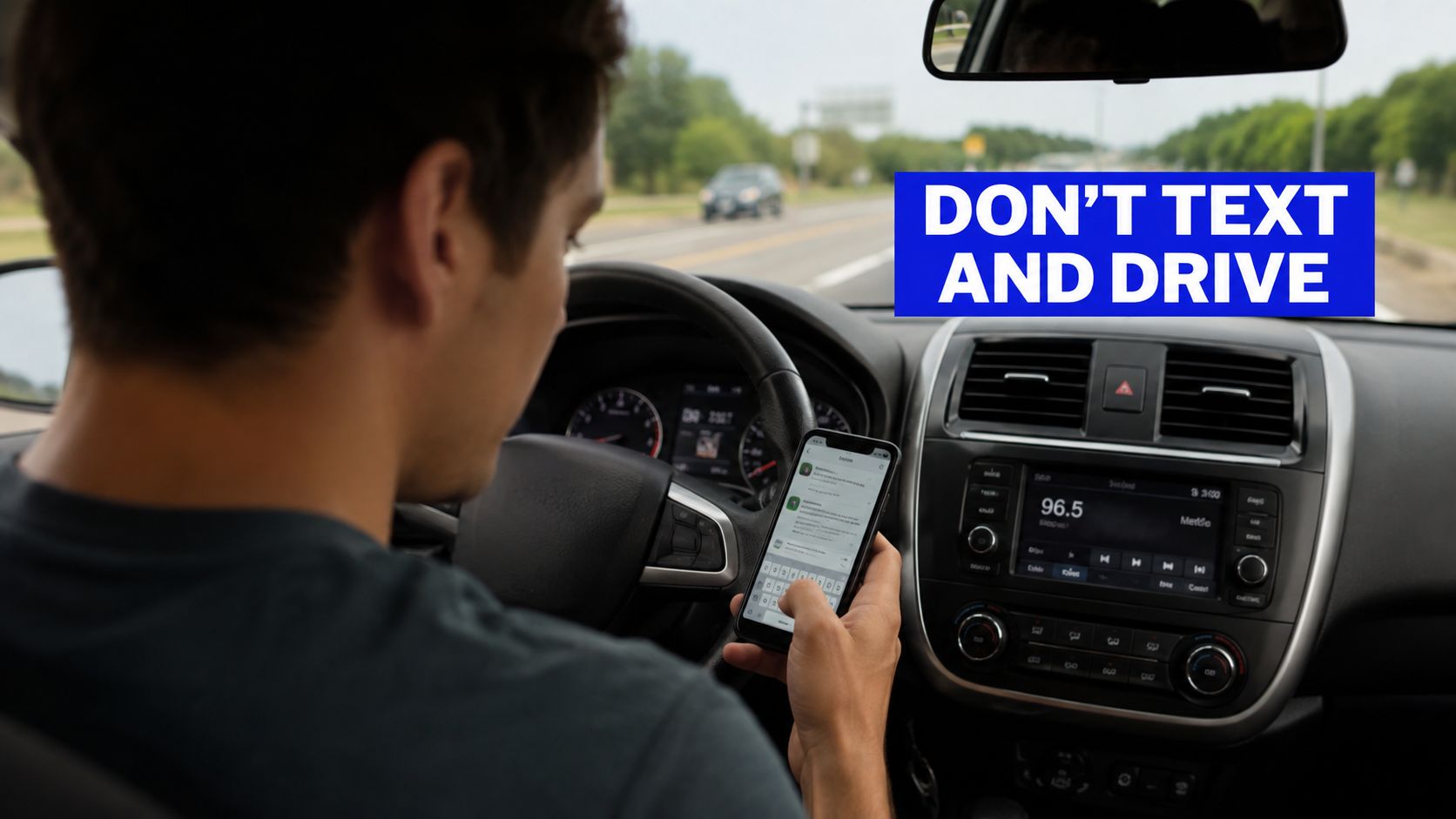
Engaging in distracting activities means a driver cannot properly assess traffic flow, check mirrors and blind spots, or react to sudden changes. This lapse in attention is a common reason law enforcement issues tickets for careless driving, as it directly violates the requirement to operate a vehicle with due regard for the safety of others.
The High Cost of a Moment's Inattention
The dangers of distracted driving, especially during a complex maneuver like changing lanes, are well-documented and severe. The Virginia Tech Transportation Institute found that texting while driving increases the risk of a crash by a staggering 23 times. A driver looking at their phone for just five seconds while traveling at 55 mph covers the length of a football field without looking at the road.
Statistics from the National Highway Traffic Safety Administration (NHTSA) reveal the devastating scale of this problem. In 2020 alone, distracted driving was responsible for 3,142 deaths and 396,000 injuries across the United States. High-profile incidents frequently involve drivers who caused accidents while changing lanes and simultaneously using a navigation system, adjusting entertainment controls, or even troubleshooting a malfunctioning key fob. These scenarios underscore how quickly a simple distraction can turn into a life-altering event.
Actionable Tips to Maintain Focus on the Road
To avoid a ticket for an improper lane change and protect yourself and others, eliminate distractions. Incorporate these habits into your driving routine:
Silence Your Phone: Put your phone on "Do Not Disturb" mode or place it out of reach to remove the temptation to check it.
Prepare Before You Drive: Adjust your mirrors, set your GPS, choose your music, and configure climate controls before you put the car in drive.
Use Voice Commands Sparingly: For essential tasks, use hands-free voice commands, but remember that even this can be a cognitive distraction.
Pull Over for Urgent Matters: If you must attend to something that requires your attention, find a safe place to pull over and stop the vehicle first.
Avoid Multitasking: Refrain from eating, drinking, grooming, or engaging in any other activity that takes your hands, eyes, or mind off the task of driving.
3. Insufficient Use of Turn Signals
A fundamental breakdown in driver communication, the failure to use turn signals properly, is a common cause of an improper lane change ticket. Turn signals are the primary way drivers announce their intentions to others on the road. When a driver neglects to signal, or signals too late, they create a hazardous and unpredictable environment. This forces surrounding motorists to react suddenly, often leading to emergency braking and preventable collisions.
Florida law is clear on this: a signal of intention to turn or change lanes must be given continuously during not less than the last 100 feet traveled by the vehicle before turning, as stated in F.S. 316.155. That signaling rule is related to, but distinct from, the lane-change safety rule in F.S. 316.085. In other words, using a signal does not automatically make an unsafe merge lawful, and a lane move that was otherwise safe can still create a separate signaling issue if the required notice was not given.
We see this confused constantly: drivers remember that they signaled and assume that ends the analysis. It does not. A ticket may involve one statute, the other, or multiple related allegations depending on what the officer says happened, so the exact code section printed on the citation matters.
The Dangers of Silent Maneuvers
Failing to signal is a widespread issue with severe consequences. A study by the Society of Automotive Engineers (SAE) revealed a startling statistic: nearly half of all drivers do not use their turn signals when changing lanes. This widespread neglect contributes to an estimated two million crashes annually across the country, turning a simple flick of a lever into a life-saving action.
In dense urban traffic, such as in downtown Miami or Orlando, an unsignaled lane change can easily trigger a chain-reaction collision. On high-speed highways like the Florida Turnpike, the stakes are even higher. Research indicates that the consistent and proper use of turn signals can reduce lane-change-related crashes by a significant margin, underscoring the importance of this simple habit.
Actionable Tips for Proper Signal Use
To avoid a ticket for an improper lane change and enhance road safety for everyone, integrate these signaling habits into your driving:
Signal Every Single Time: Make it an essential habit to signal before every lane change or turn, even if you don't see any other cars. The vehicle you don't see is the one that poses the greatest risk.
Follow the "Three-Second Rule": A good rule of thumb is to activate your signal and count to three before you begin to move. This provides other drivers with adequate time to see your signal and react accordingly.
Signal Early, Not Late: Give other drivers as much warning as possible by signaling well in advance of your maneuver, not as you are already moving over.
Don't Assume Right of Way: Your turn signal is an indication of intent, not a demand for space. Always verify it is safe to proceed and that other drivers are allowing you to merge before you commit to the lane change.
Cancel Your Signal: After completing your maneuver, ensure your signal turns off. A lingering signal can confuse other drivers about your intentions.
Perform Regular Checks: Periodically walk around your vehicle and check that all your signal lights are functioning correctly as part of your routine maintenance.
4. Excessive Speed and Velocity Differential
Executing a lane change at an excessive speed or when there is a significant difference in velocity between lanes is a critical factor leading to an improper lane change ticket. The physics of high-speed maneuvers drastically reduces a driver's reaction time and significantly increases the vehicle's stopping distance. When a driver weaves into another lane while traveling much faster than the flow of traffic, they create a dangerous and unstable environment on the road.
This action is considered reckless because it compresses the time available for both the driver and surrounding motorists to assess and react. Similarly, merging into a much faster-moving lane without accelerating to an appropriate speed can force vehicles approaching from behind to brake suddenly. Florida law mandates that all vehicle movements, including lane changes, be made with reasonable safety, a standard that is clearly violated by high-speed or mismatched-speed lane changes.
The Dangers of High-Velocity Maneuvers
The consequences of a high-speed improper lane change are severe and often catastrophic. Interstate highways like the Florida Turnpike or I-75 are common sites for these incidents, where a single aggressive lane change can trigger a multi-vehicle pileup. The increased force of impact at higher speeds means that even a minor miscalculation can lead to more severe injuries and vehicle damage.
Data from safety organizations consistently shows a strong correlation between speed and collision severity. Aggressive weaving through traffic is not just a ticketing offense; it's a behavior that frequently instigates road rage incidents and escalates minor traffic disagreements into dangerous confrontations. The precision required for high-speed lane changes is so great that even professional race car drivers undergo extensive training, highlighting how challenging and unsafe it is for the average motorist. If you've been cited for a speed-related offense, it's important to know what options are available. For more information, you can learn more about handling speeding tickets in Florida.
Actionable Tips to Manage Speed During Lane Changes
To ensure your lane changes are safe and lawful, and to avoid a ticket for an improper lane change, focus on matching your speed to the surrounding traffic:
Match the Flow: Before initiating a lane change, adjust your speed to match the vehicles in the target lane. This creates a smoother, more predictable merge.
Plan Ahead: Avoid last-minute, high-speed maneuvers by anticipating your need to change lanes well in advance, especially when approaching exits or interchanges.
Change One Lane at a Time: Rapidly crossing multiple lanes of traffic is extremely dangerous. Complete one lane change, re-establish your position and speed, and then assess for the next one.
Allow an Extra Cushion: When a significant speed difference exists, increase your following distance and the space you need to merge. This gives everyone more time to react.
Be Cautious on Curves: Changing lanes on a curve adds another layer of complexity due to physics. Exercise extra caution and reduce speed if necessary to maintain control.
5. Misjudgment of Available Space and Gap Acceptance
A common but critical error leading to an improper lane change citation is a driver's misjudgment of the available space in traffic. This concept, known as "gap acceptance," refers to a driver’s ability to accurately assess if there's enough room in the adjacent lane to merge safely. This involves a complex calculation of the gap's size, your own vehicle's speed, and the speed of approaching cars.
When a driver underestimates the speed of an oncoming vehicle or overestimates the size of the gap, they force other motorists to brake suddenly or swerve to avoid a collision. This failure to properly judge distance and speed is a direct violation of the Florida statute requiring a lane change to be made only when it can be completed with reasonable safety. Law enforcement will often cite this lack of spatial awareness as the primary cause of an accident.
The Dangers of Forcing the Gap
The consequences of poor gap judgment can be severe, often causing rear-end or sideswipe collisions when the merging vehicle cuts off another driver. Statistics reveal that certain demographics are more prone to this error. For example, inexperienced teen drivers are significantly more likely to misjudge gaps than seasoned adults, while some older drivers may require larger gaps due to changes in processing speed.
This issue is particularly dangerous on high-speed roads like the Florida Turnpike, where even a slight miscalculation can have catastrophic results. A driver attempting to squeeze into a gap that is too small not only commits a moving violation but also creates a hazardous situation for everyone around them, disrupting the flow of traffic and risking a multi-car pileup.
Actionable Tips to Improve Gap Judgment
To avoid an improper lane change ticket and ensure you merge safely, integrate these practices into your driving habits:
Use the Two-Second Rule: Before moving over, watch the car ahead of the gap pass a fixed object (like a sign or an overpass). If you cannot count to "two-one-thousand" before the front of your car reaches that same object, the gap is too small.
Prioritize a Safety Cushion: Always look for a gap that appears larger than you think you need. This extra space serves as an important buffer if another driver's speed changes unexpectedly.
Assess Speed, Not Just Distance: A distant vehicle approaching at high speed will close a gap much faster than a closer vehicle moving slowly. Always factor in the closing speed of traffic in the other lane.
Wait for a Clear Opening: Patience is key. Never try to force your way into traffic. It is always safer to wait for a clearly adequate space than to risk causing an accident. When in doubt, don't make the move.
6. Aggressive Driving and Impatience
A significant portion of improper lane change tickets stems not from a simple mistake but from the driver's state of mind. Aggressive driving, fueled by impatience, anger, or a competitive attitude, often leads to dangerous and illegal lane-changing maneuvers. This psychological state impairs rational judgment, causing drivers to take unnecessary risks like cutting off other vehicles, weaving through traffic, and forcing their way into spaces with insufficient clearance.
When a driver's emotions take over, they prioritize speed over safety, disregarding the legal requirement to ensure a lane change can be made safely. Florida law enforcement is trained to recognize these behaviors as precursors to serious incidents. An abrupt lane change made out of frustration is a clear violation and is often symptomatic of a larger pattern of dangerous driving.
The Dangers of Driving with Emotion
The consequences of letting impatience dictate your actions behind the wheel can be catastrophic. The AAA Foundation for Traffic Safety has found that aggressive driving is a factor in a staggering 56% of fatal crashes, underscoring the lethal potential of this behavior. This isn't just about rudeness; it's a direct threat to public safety.
Furthermore, studies show that the perceived time savings from aggressive maneuvers are often minimal, with aggressive drivers saving an average of only four minutes on a 45-minute commute. The immense risk taken for such a small gain highlights the irrationality of this driving style. When these actions result in a collision, the aggressive driver is far more likely to be found at fault, facing not only an improper lane change citation but potentially more severe charges. In some cases, these actions can escalate into a criminal charge for reckless driving. For more information, you can learn more about reckless driving in Florida.
Actionable Tips to Maintain a Calm Demeanor
To avoid an improper lane change ticket and the dangers of aggressive driving, focus on managing your mindset and environment:
Leave Earlier: The most effective way to combat impatience is to remove time pressure. Plan your trips to include a buffer for unexpected delays.
Practice Stress Management: If you feel frustration building, use simple techniques like taking slow, deep breaths to calm your nervous system.
Reframe Your Perspective: Remind yourself that arriving safely is the ultimate goal. A few minutes' delay is a minor inconvenience compared to a collision.
Avoid Engagement: Do not challenge or react to other aggressive drivers. Let them pass, create distance, and focus on your own safe driving. For those looking to monitor driving behavior or enhance overall vehicle safety, a GPS car tracker with advanced security features can provide valuable insights.
Create a Calm Cabin: Listen to calming music or an engaging podcast instead of stressful talk radio or news. A peaceful environment can influence a more peaceful state of mind.
Know When to Pull Over: If you find yourself becoming angry or aggressive, the safest action is to pull over when you can and take a few minutes to reset before continuing your journey.
7. Adverse Weather and Poor Road Conditions
Failing to adapt driving behavior to environmental factors is a common cause of an improper lane change violation in Florida. Conditions like heavy rain, fog, or high winds dramatically alter a vehicle's handling and a driver's perception, making standard maneuvers hazardous. These elements reduce tire traction, impair visibility, and increase the distance needed to stop safely, turning a routine lane change into a high-risk action.
Florida law mandates that drivers operate their vehicles in a reasonable and prudent manner, considering actual and potential hazards. When a driver attempts a lane change during a downpour without reducing speed or ensuring adequate visibility, they are not acting prudently. This failure to adjust for adverse conditions can lead directly to a collision and a subsequent citation, as the maneuver could not be completed with the required level of safety.
The Dangers Hiding in Plain Sight
The risks associated with changing lanes in poor weather are substantial and often underestimated. For instance, the Federal Highway Administration reports that wet pavement contributes to over one million vehicle crashes annually. During Florida's intense summer storms, roads can become slick with oil and water, a condition known as "hydroplaning" can occur, and visibility can drop to near zero in an instant.
Attempting a lane change on a wet road like the Palmetto Expressway can easily result in a loss of control, leading to a spin-out or a multi-car pileup. Similarly, fog, which can appear suddenly on roads like Alligator Alley, severely limits a driver's ability to judge the speed and distance of other vehicles. In such conditions, an otherwise simple lane change can become a catastrophic error if another vehicle is hidden in the haze.
Actionable Tips to Avoid Weather-Related Accidents
To prevent an improper lane change ticket and maintain control of your vehicle in challenging conditions, integrate these safety practices into your driving:
Reduce Your Speed: Decrease your speed significantly to compensate for reduced traction. A good rule of thumb is to slow down by 5-10 mph in rain and even more if conditions are severe.
Increase Following Distance: Double your normal following distance from three seconds to at least four to six seconds. This gives you more time to react and brake safely if needed.
Make Gradual Movements: Avoid any sudden steering, braking, or acceleration. When changing lanes, use smooth and deliberate steering inputs to prevent breaking traction on a slippery surface.
Enhance Your Visibility: Always turn on your headlights in rain, fog, or at dusk to help other drivers see you. Florida law requires headlights to be on during rain.
Be Cautious on Elevated Surfaces: Bridges and overpasses can become icy before other road surfaces in cold weather. Avoid changing lanes on these structures if possible.
What to Do After Receiving an Improper Lane Change Citation
If you received this citation, start with the exact paper in your hand. An improper lane change charge in Florida is generally tied to F.S. 316.085, which makes the offense a noncriminal traffic infraction and frames the issue around whether the movement was made only after first determining it could be completed safely. That sounds simple, but the practical consequences are not.
Paying the ticket usually means you are resolving the case as charged rather than challenging it. For most drivers, that means accepting a moving violation, with the ordinary consequences that follow from a conviction or adjudication on a qualifying offense. Florida's licensing system assigns points for moving violations through FLHSMV's driver improvement and points guidance, and county traffic-citation pages commonly list improper lane change as a 3-point violation. In our review, this is the second biggest source of confusion after the statute number itself: many drivers think the fine is the only issue, when the longer-term cost may be license points and insurance pricing.
Before you respond, confirm the exact charge. Look for the statute number, subsection if one is printed, the officer's description, and whether the ticket references a crash. A citation that says 316.085 raises a different analysis from one centered on signaling or another lane-use rule. If your paperwork is unclear, county clerk and county court traffic pages such as the Miami-Dade traffic citations information page can help explain response options, deadlines, and how traffic infractions are processed.
What paying the ticket usually means
You are usually closing the case without contesting the officer's account. Once paid, the case is generally treated as resolved.
The violation is generally handled as a moving violation. That matters for points and insurance, not just the base fine.
Three points are commonly associated with the offense. Florida drivers should verify this through official FLHSMV materials and the local court or clerk instructions tied to the ticket.
Insurance can cost more than the citation itself. If the stop followed a crash, it also helps to understand how claims history can affect pricing; this overview on QuoteFii, LLC's page gives a useful high-level explanation of post-accident insurance effects.
What to verify on the citation before you decide
Statute number: Confirm whether the ticket lists 316.085, 316.085(2), a signaling statute, or another related code section.
Narrative description: Read how the officer described the maneuver. "Unsafe lane change," "failed to maintain lane," and "failed to signal" are not interchangeable.
Crash involvement: If there was contact between vehicles, get the crash report and note whether the officer personally observed the lane change or reconstructed it afterward.
Response deadline: Follow the date and instructions on the citation or local clerk page. Missing the deadline can create separate problems.
Realistic ways to evaluate or defend the ticket
We do not think every lane-change citation is automatically defensible, but several recurring fact patterns are worth a close look.
1. Officer visibility and angle of observation
If the officer was several lanes away, behind a visual obstruction, or observing at highway speed in dense traffic, the state's view of what happened may be less clear than the ticket suggests. In our experience, the closer the case gets to "I saw one car brake," the more important dashcam footage, witness accounts, and roadway layout become.
2. Whether the lane change was actually unsafe
The statute focuses on safety, not perfection. A driver can make a quick but still safe move, while another can signal properly and still cut off traffic. If no driver had to brake, swerve, or take evasive action, that factual point may matter.
3. Avoiding a road hazard or obstruction
Sometimes the driver moved to avoid debris, a disabled vehicle, sudden braking ahead, or another immediate hazard. That does not erase the charge by itself, but it can change how the maneuver is evaluated.
4. Crash case versus observation-only ticket
A crash-related citation is often more complicated because the officer may infer the unsafe lane change from the collision aftermath rather than from a direct view of the maneuver. An observation-only stop may depend much more heavily on the officer's description of traffic reactions.
Practical next steps
Do not pay first and investigate later. Once the case is resolved, your options narrow.
Save evidence immediately. Dashcam files, photos, maps, and notes about traffic flow are most useful when preserved early.
Check your driving history exposure. This matters even more for CDL holders, drivers with prior points, or anyone already near a suspension threshold.
Get legal help if the consequences are bigger than the fine. That is especially true when the ticket followed a crash, involved disputed facts, or could affect work driving.
If you're facing a citation for an improper lane change in Florida, don't leave the outcome to chance. The team at Ticket Shield, PLLC focuses its practice on traffic defense to protect your driving record and handle the complexities of traffic law on your behalf. Our office is in Broward. Visit Ticket Shield, PLLC for a free consultation to understand your options and how we can help.
Frequently Asked Questions
What is an improper lane change in Florida?
In Florida, the term usually refers to moving from one lane to another without first determining that the move can be made with reasonable safety under F.S. 316.085. The focus is on whether the maneuver interfered with other traffic or created an unsafe condition, not just whether the driver used a turn signal.
What does F.S. 316.085 say?
The statute is Florida's lane-change and roadway movement rule. It provides that a vehicle should be driven as nearly as practicable within a single lane and that a driver may not move from that lane until the driver has first determined the movement can be made with safety, as shown in the text of Florida Statute 316.085.
Is an improper lane change 3 points in Florida?
It is commonly treated as a 3-point moving violation, but drivers should verify the exact charge and how it is being processed through FLHSMV's official points information and their local clerk or court instructions. The exact paperwork matters because related statutes can carry different consequences.
Is 316.085(2) the same thing as every lane-related ticket?
No. Drivers often use the phrase broadly, but lane-related tickets can involve distinct statutes covering lane movement, signaling, or other roadway conduct. We recommend checking the citation line by line instead of assuming every lane-change stop falls under the same subsection.
Can you fight an improper lane change ticket?
Yes. Common issues include whether the officer had a clear view, whether the movement was unsafe, whether another event caused the traffic reaction, and whether the stop followed a crash rather than a direct observation. The strength of a challenge depends on the facts, the available evidence, and the exact statute charged.
Should you just pay the ticket?
Not before you understand what paying does. For many drivers, paying means accepting a moving violation and the related points consequences. If you are concerned about insurance, prior points, employment driving, or a disputed set of facts, review the charge first and consider legal advice.
Key Topic | Description |
|---|---|
Florida Statute | Governed by F.S. § 316.085, requiring lane changes to be made with 'reasonable safety.' |
Penalties | Includes fines, court costs, and typically 3 points on your driving record. |
Common Causes | Range from distracted driving and blind spot errors to aggressive maneuvers and adverse weather. |
Defensive Strategies | Options include challenging the officer's observation, proving the maneuver was safe, or seeking a withhold of adjudication. |
Legal Assistance | A traffic attorney can handle court appearances and work toward minimizing penalties. |
Issue | Implementation Complexity 🔄 | Resource Requirements ⚡ | Expected Outcomes 📊 | Ideal Use Cases 💡 | Key Advantages ⭐ |
|---|---|---|---|---|---|
Failure to Check Blind Spots | Moderate: Requires attention & mirror adjustments | Low to Moderate: Mirror adjustments, blind spot tech | High reduction in side-swipe collisions; prevents fatal accidents | Everyday lane changes, highway merging | Improves spatial awareness, reduces blind zone collisions |
Distracted Driving | High: Difficult to control driver focus consistently | Low: Behavioral change, phone settings | Significant reduction in crash risk, injury, and fatalities | All driving conditions needing high focus | Enhances driver attention and safety through behavior modification |
Insufficient Use of Turn Signals | Low: Simple habitual action | Minimal: Vehicle signal maintenance | Reduces unpredictability, prevents sudden braking and collisions | Urban and highway traffic management | Enhances communication, improves traffic flow predictability |
Excessive Speed and Velocity Differential | High: Speed control and timing require discipline | Low to Moderate: Driver education, enforcement | Decreases severe crash risk and loss of control | High-speed highway driving | Increases safety by matching lane speeds, reduces multi-vehicle collisions |
Misjudgment of Available Space and Gap Acceptance | Moderate: Requires spatial awareness & experience | Low: Driver training and awareness | Lowers abrupt braking and rear-end collisions | Novice drivers, complex traffic situations | Improves judgment accuracy, reduces last-minute lane changes |
Aggressive Driving and Impatience | High: Requires behavioral and psychological control | Low: Stress management, awareness programs | Substantial crash risk reduction, improves emotional control | All drivers prone to stress/pressure | Reduces crash frequency, promotes safer driving mindset |
Adverse Weather and Poor Road Conditions | High: Requires adaptation to environment | Moderate: Weather-aware driving, infrastructure maintenance | Lowers weather-related crashes and injuries | Driving in rain, snow, fog, construction | Enhances safety through adjusted driving and planning |