Practical Guide to careless driving ticket florida: Penalties and Defenses
A careless driving ticket florida usually adds 3 points. See what happens if you pay, when traffic school helps, and how drivers fight it.
Attorney Advertisement. Office in Broward.
Getting a careless driving ticket in Florida is more than just an inconvenient fine. It’s a citation under Florida Statute § 316.1925 that can add points to your license, trigger an insurance hike, and leave a lasting mark on your driving record.
Because it’s a broad, "catch-all" violation for driving without the caution a situation demands, it's a ticket that may be worth contesting.
Understanding What a Florida Careless Driving Ticket Really Means
A careless driving ticket is one of the most common citations handed out in the state, but its vague definition is a major source of confusion for drivers. Unlike something specific like speeding, a careless driving charge is based entirely on an officer’s subjective judgment call.
In plain English, it means the officer believes you failed to drive your vehicle in a "careful and prudent manner," taking into account the traffic, road conditions, and everything else happening around you at that moment.
This can cover a whole host of behaviors that an officer thinks put people or property at risk. The key thing to understand is you don't have to break another specific traffic law to get this ticket. The officer just needs to decide your driving wasn't cautious enough for the circumstances.
The Broad Scope of Florida Statute § 316.1925
The vague wording of the law gives police a significant amount of discretion. This means actions that might seem relatively minor could still result in a citation if an officer decides they were unsafe in that particular context.
It's exactly why careless driving tickets are so frequently issued after minor traffic accidents where it’s not immediately obvious who was at fault based on other violations.
Common situations that can trigger a careless driving ticket include:
Following the car in front of you too closely (tailgating).
Failing to yield the right-of-way, forcing another driver to take evasive action.
Getting into a minor fender-bender at a stoplight.
Making a sudden lane change without using your turn signal.
Getting familiar with the specific actions defined as careless driving in Florida can make it clearer why you received the ticket and what a potential defense might look like.
Why This Citation Is More Serious Than It Appears
The consequences of just paying that fine go far beyond the dollar amount on the ticket. When you pay a careless driving ticket Florida, you are legally admitting guilt. That guilty plea automatically triggers penalties that can follow you for years. To see the bigger picture, it helps to understand the general Florida driving regulations that all drivers must follow.
A conviction for careless driving adds 3 points to your Florida driver's license. If you accumulate just 12 points in a 12-month period, you could be facing a license suspension.
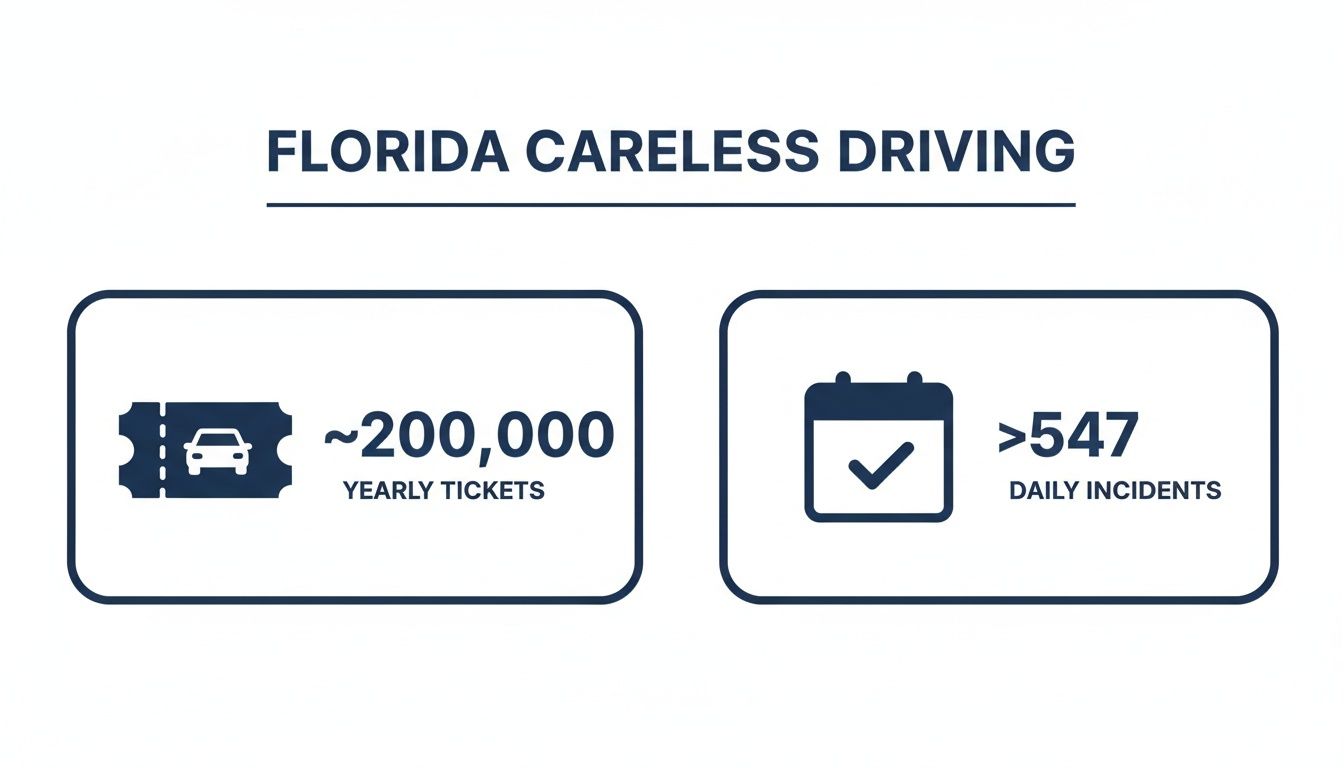
These tickets have been a constant on Florida's roads for a long time. In 2018, for example, law enforcement wrote nearly 200,000 careless driving citations statewide. That averages out to more than 547 tickets every single day.
This high volume highlights why it’s so critical to understand what's at stake and carefully consider your options instead of just mailing in a check. Our goal is to protect your license and record from unnecessary penalties.
The True Cost of Points, Fines, and Insurance Hikes
A careless driving conviction in Florida typically adds 3 points to your license because it is treated as a moving violation under Florida Statute 316.1925. Those 3 points matter most if you already have prior tickets: under the FLHSMV point system, Florida can suspend your license at 12 points in 12 months, 18 points in 18 months, and 24 points in 36 months. In other words, the ticket may feel routine, but paying it can move some drivers much closer to a real suspension problem.
Florida also tracks careless driving as its own major enforcement category. In the state's citation reporting system, careless driving is listed as code 455, and one statewide breakdown shows 140,090 careless driving citations in 2020 according to FLHSMV crash and citation reports. That volume helps explain why this citation appears so often after accidents and roadside stops.
Understanding Florida's Driver's License Point System
The points answer is straightforward; the practical risk depends on your record. A driver with no recent tickets may be dealing mainly with record and insurance consequences. A driver who is already carrying points can be dealing with much more. FLHSMV's current 2026 guidance still uses these suspension thresholds:
12 points within 12 months leads to a 30-day suspension.
18 points within 18 months leads to a 3-month suspension.
24 points within 36 months leads to a 1-year suspension.
That is why a 3-point careless driving ticket can be minor for one driver and a license-risk issue for another. For a fuller breakdown of how Florida counts moving violations, see our guide to the Florida traffic ticket point system.
The Fine on the Ticket Is Not the Final Number
The payable amount is not uniform statewide. Florida traffic tickets usually include a base civil penalty plus county-specific court costs and assessments, so the exact amount can vary depending on where the citation was issued and how the clerk processes elections. For example, county clerks explain that payment options, hearing requests, and total balances are handled locally through the clerk's office, as shown on the Miami-Dade Clerk traffic page and the Orange County Clerk traffic infraction guide. If you are comparing your ticket to someone else's, do not assume the same total applies.
Insurance Impact Is Real, but Not Automatic at One Fixed Rate
Insurance consequences are harder to predict because they are not set by the court. A conviction for a moving violation can affect premiums, but the size of any increase depends on the insurer, your prior driving history, whether the company re-rates midterm or at renewal, and whether the ticket is the only recent issue on your record. Some drivers see little change; others see a noticeable increase after a moving violation is reported.
That is a more accurate way to think about the financial risk than using a universal percentage. The legal system controls points and court costs. Your insurer separately decides how to price the conviction.
Careless vs. Reckless Driving: What’s the Real Difference?
On the street, "careless" and "reckless" driving might sound like the same thing, but in a Florida courtroom, they are worlds apart. Understanding this distinction is an important first step after getting a ticket, because it shapes everything that comes next—the penalties, the legal process, and the approach to protecting your record.
The difference is simple: a careless driving ticket in Florida is a civil traffic infraction, like a speeding ticket. Reckless driving, however, is a criminal offense.
Think of it this way: careless driving is a momentary mistake, a brief lapse in attention. Reckless driving is a conscious choice to ignore the rules and endanger others.
The Critical Difference in Legal Standards
The heart of the matter comes down to your state of mind as a driver. To write a careless driving ticket, an officer only needs to believe you failed to drive in a “careful and prudent manner.” It’s a fairly subjective call based on a perceived lack of caution at that moment.
Reckless driving is a much more serious charge for the state to prove. Under Florida Statute § 316.192, a prosecutor has to show you drove with a “willful or wanton disregard for the safety of persons or property.” This isn't just a simple error; it's behavior that demonstrates indifference to the harm you could cause.
Key Takeaway: Careless driving is about a failure to pay proper attention. Reckless driving is about a deliberate choice to be dangerous. This one distinction changes everything in the eyes of the law.
Careless vs Reckless Driving a Side-by-Side Comparison
That split between a civil ticket and a criminal charge creates a massive gap in the potential outcomes. A criminal charge puts jail time and a permanent criminal record on the table—consequences you just don't face with a standard traffic ticket. This table breaks down the essential differences.
Aspect | Careless Driving (Civil Infraction) | Reckless Driving (Criminal Offense) |
|---|---|---|
Legal Status | Non-criminal traffic violation. Similar to a speeding ticket. | Misdemeanor criminal charge. Creates a permanent criminal record if convicted. |
Common Examples | A minor rear-end collision, failing to yield, or making an improper lane change. | Excessive speeding while weaving through traffic, street racing, or fleeing from law enforcement. |
Penalties | Fines, court costs, and points on your driver's license. No jail time. | Potential jail time (up to 90 days for a first offense), significant fines, and a criminal record. |
License Impact | 3 points added to your license, contributing to a potential suspension. | 4 points added to your license and a possible immediate license suspension by the court. |
To see an even more in-depth breakdown, check out our guide on the difference between careless and reckless driving.
Because the legal bar for reckless driving is so high, officers sometimes issue a careless driving ticket after an accident when no other specific violation really fits, even if the driving was aggressive. Knowing which charge you’re up against is step one. Our goal is always to build the right defense for your specific citation to protect your license and your record.
Navigating Your Options After Getting a Ticket
After a careless driving citation, the first deadline usually matters more than the arguments you plan to make later. In most Florida counties, you generally have 30 days from the date of the citation to choose how to respond: pay, elect school if eligible, or request a hearing. Clerks around the state describe that election process on their traffic pages, including the Broward Clerk traffic ticket options and FLHSMV's overview of civil traffic infraction choices. If you miss the election window, extra fees, collection issues, or license complications can follow.
You have three paths to choose from.

Option 1: Pay the Ticket
Paying is the fastest option, but it is usually the worst one if your goal is to keep the citation from counting against you. In ordinary traffic cases, payment functions as an admission and closes the case as a conviction for the infraction. For a careless driving ticket, that usually means the 3 points are assessed and the case becomes part of your driving history.
That matters not only for points. A paid moving violation can also affect insurance underwriting, and it removes any chance of dismissal or reduction in that case.
Option 2: Elect Traffic School
If you are eligible, a basic driver improvement election can prevent points from being added to your license, but it is not the same as beating the ticket. Florida explains the eligibility rules and limits through its driver improvement school guidance: the election is limited, cannot be used endlessly, and still requires timely paperwork and payment.
The practical result is usually this:
You still pay the ticket and applicable court costs.
You separately pay for the course.
You avoid points if the election is properly completed.
The case is typically resolved with a withhold of adjudication, not a dismissal.
That distinction matters. A withhold is better than a conviction for points purposes, but it does not erase the fact that the citation existed. It also uses one of your limited school elections.
Option 3: Contest the Ticket
Contesting the citation is the only path that can produce a true dismissal or a negotiated reduction. Procedurally, this usually means entering a not-guilty plea or requesting a hearing through the clerk or court listed on the ticket, then appearing at a scheduled hearing date unless counsel appears for you where allowed.
In a typical contested case, the officer may need to appear, the court hears testimony, and the judge decides whether the state proved the infraction. In some counties, cases resolve before a full hearing through negotiation. Depending on the facts, common outcomes can include:
dismissal,
a reduction to a non-moving violation,
withheld adjudication where available,
or the original charge being upheld.
If the ticket came out of a crash, you may also want to separate the traffic case from any property-damage issues. For drivers dealing with post-accident valuation questions, Auto Appraisal Expert's page gives a useful overview of diminished value claims.
A Simple Decision Framework
If you are deciding what to do, ask these questions in order:
Are you close to a suspension threshold already? If yes, points may be the main issue.
Are you eligible for traffic school, and do you want to use one of your limited elections here?
Is there a crash, commercial license issue, or disputed fact pattern that makes the case more serious?
Would a reduction matter as much as a dismissal? In many cases, keeping the charge from staying as a moving violation is the realistic goal.
That framework is often more useful than the blanket advice to just pay and move on.
Effective Defenses Against a Careless Driving Ticket
The state does not win a careless driving case just because an officer wrote the ticket or because a crash happened. Under Fla. Stat. 316.1925, the state still has to prove that you failed to operate the vehicle in a careful and prudent manner, having regard for the width, grade, curves, corners, traffic, and all other attendant circumstances. That wording is broad, but it still requires evidence tied to what happened.
Florida's traffic-safety context helps explain why officers use this citation so often. State-reported data shows a crash occurs every 44 seconds in Florida, and the state reported nearly 300 distracted-driving deaths in 2023, according to this Ticket Shield analysis of Florida crash trends. But public safety concerns do not lower the burden in an individual case. The judge still has to decide whether the evidence proves this driver committed this infraction.
When the Officer Did Not Personally See the Driving
Many careless driving tickets are written after an accident scene investigation, not after the officer directly watched the driving from start to finish. That creates an immediate defense issue. If the officer did not personally observe the alleged careless conduct, the state may be relying heavily on statements from other drivers, witness summaries, vehicle positions, or a conclusory crash narrative.
That does not automatically make the ticket invalid, but it can weaken the proof. A defense can focus on whether the officer had firsthand observations or drew an inference after arriving later.
No Independent Evidence Beyond a Conclusion
A common weakness is a report that says the driver was careless without explaining the specific facts that make the conduct legally careless. A label is not proof. Courts still need a factual basis: speed for conditions, following too closely, unsafe lane movement, failure to react, or some other concrete act.
If there is no dashcam, bodycam, reliable witness testimony, scene reconstruction detail, or clear factual explanation, the defense may argue that the case rests on a conclusion rather than evidence.
Road, Weather, and Visibility Conditions
The statute itself tells the court to consider the surrounding circumstances. That cuts both ways. The state can argue poor conditions required more caution, but the defense can also use those same conditions to show why what happened was not careless at all.
Examples include:
glare that limited visibility,
standing water or slick pavement,
an obstructed intersection,
unclear lane markings,
or sudden traffic backups around a curve.
In these cases, the argument is not that conditions were perfect. It is that the state's version ignores conditions that make the event more ambiguous than the ticket suggests.
Mechanical Problems and Sudden Emergency
A mechanical failure is not a universal defense, but it can matter if there is evidence that the event was caused by something like brake failure, tire failure, or another issue the driver did not create and could not reasonably anticipate. The same is true of sudden-emergency situations: debris in the roadway, another driver's abrupt maneuver, or an animal entering the lane.
The key question is whether your reaction was reasonable under the circumstances. A driver is not held to perfect hindsight in a split-second emergency.
Contesting Guilt vs. Negotiating the Outcome
Not every good result comes from proving complete innocence. Some cases are fought on factual guilt because the evidence is weak. Others are approached as negotiation matters because a dismissal is unlikely but a reduction is realistic. That can still be valuable.
For example, even where a judge may be unlikely to throw the ticket out, a lawyer may be able to pursue a non-moving amendment or another resolution that avoids points. That is different from saying the state cannot prove the charge. It is a strategy choice based on the county, the hearing officer or judge, the officer's availability, and the quality of the evidence. For a deeper dive, you can learn more about how to get a careless driving ticket dismissed in our related guide.
Can a Careless Driving Ticket Be Removed From Your Record?
Sometimes yes, but the answer depends on how the case ends.
If the citation is dismissed, there is no conviction for careless driving and no points should be assessed. If the case is resolved by traffic school with a withhold of adjudication, points are usually avoided, but that is not the same as the ticket disappearing entirely. If you are found guilty or you pay the ticket, the moving violation is recorded and the usual point consequences apply.
What many drivers mean by “removed” is really one of three different outcomes:
Dismissal: the best result for record purposes.
Reduction to a non-moving violation: the original careless driving charge does not remain as the final moving offense.
Withhold of adjudication through a school election or negotiated outcome: no conviction points, but not a true erasure.
Florida drivers should be careful with the word “expunge” here. A standard careless driving citation is a civil traffic matter, not the kind of criminal case people usually mean when discussing expungement. In practice, the more useful question is whether you can avoid a final moving violation disposition. That usually happens through dismissal, reduction, or an eligible withhold—not through a later cleanup process after you already paid the ticket.
How a Traffic Attorney Can Defend Your Case
That careless driving ticket in Florida might seem like a simple fine, but most of the work in these cases is in the documents and procedure. A traffic attorney's job is not just to “go to court.” It is to evaluate what the state can prove, what local resolution options exist, and whether the facts support a dismissal fight or a reduction strategy.
Our practice focuses on defending Florida drivers against traffic tickets and DUI. We handle traffic matters across Florida, and we understand the local court procedures. Getting our help starts with one simple, no-pressure conversation.

Our Straightforward Process
We've designed our process to be as clear and stress-free as possible. The goal is to give you peace of mind while we handle all the legal heavy lifting for you.
Step 1: Free Consultation: It all starts with a free, confidential case review. You tell us what happened, and we’ll give you an honest take on your situation and walk you through your options.
Step 2: Building Your Defense: If you decide to hire us, we get to work immediately. We start by digging into the specifics of your citation, reviewing the officer's report and any other evidence we can find to build a defense strategy.
Step 3: Handling Court for You: This is a huge relief for most of our clients. We handle the court appearances for you. In the vast majority of our cases, our clients never have to step foot in a courtroom, which saves them a ton of time and anxiety.
Step 4: Keeping You in the Loop: We make sure you know what's going on every step of the way. You'll have direct access to your attorney to ask questions and get updates as your case moves forward.
What an Attorney Actually Reviews
In a careless driving case, the useful review usually includes the citation itself, the crash report if there was an accident, witness statements, bodycam or dashcam footage if available, the court's case history, and your prior election history for traffic school. Those details can change the strategy. A missing witness, a thin narrative report, or a school election you cannot use again may matter more than the ticket's face amount.
An attorney also looks at what outcome is realistically available: dismissal, amendment to a non-moving violation, withhold of adjudication, or a hearing on the merits. Not every case supports the same approach.
When Self-Representation Can Be Riskier
Some drivers can handle a simple ticket on their own, but the risk goes up when the case has consequences beyond the fine. That includes drivers with commercial licenses, drivers already close to FLHSMV suspension thresholds, drivers whose jobs depend on a clean record, and drivers facing a ticket tied to a crash with disputed facts.
In those situations, the question is usually not whether court is intimidating. It is whether a bad procedural choice now creates a record problem later.
Local Court Practices Matter
County and court variation affects traffic strategy more than many drivers expect. Some courts are more structured around formal hearings; some clerks make election procedures easier to follow than others; some jurisdictions are more open to negotiated non-moving resolutions on the right facts. That is one reason a one-size-fits-all answer can be misleading in Florida traffic cases.
What We Aim to Achieve
When we take on your careless driving ticket, our goals are squarely focused on protecting your best interests. While no attorney can ever promise a specific outcome, we are dedicated to pursuing the best possible result for every single client.
Our Primary Goals: Our entire focus is on protecting your license and your record. We work to seek a complete dismissal, negotiate for a lesser penalty like a non-moving violation (which means no points), and ultimately keep your driving record clean.
Hitting these goals helps you avoid the long-term consequences of a conviction, like points piling up on your license and your insurance premiums going through the roof. We understand what's at stake, and we’re ready to seek a favorable outcome for you. Past results do not guarantee future outcomes.
Common Questions About Florida Careless Driving
Getting a careless driving ticket in Florida kicks off a wave of questions and uncertainty. Here are some straight answers to the things drivers ask us most often, designed to give you a clear picture of what you're up against.
Do I Have to Go to Court if I Hire an Attorney?
This is one of the biggest sources of relief for our clients: in the vast majority of cases, the answer is no. An attorney can handle all the required court hearings and legal steps for you.
This means you don't have to take time off work, deal with the stress of finding the courthouse, or stand in front of a judge alone. We manage the legal side of things so you can keep your focus on your life.
How Long Does a Careless Driving Ticket Stay on Your Record?
If you're convicted of careless driving, that ticket and the points that come with it can stay on your official Florida driving record for three to five years. That’s a long time for insurance companies, law enforcement, and the courts to see it.
This is exactly why our primary goal is to protect your license and keep your record clean. We work to get the ticket dismissed or avoid a conviction entirely, because a clean record is your best defense against future insurance hikes and the risk of a license suspension.
Is It Worth Fighting a Ticket if There Was an Accident?
Absolutely. It’s a huge misconception that a ticket from an accident is a lost cause. Even when a crash is involved, the state still has to prove that your driving met the legal definition of "careless"—and that’s often harder than it sounds.
The fact that an accident happened isn't automatic proof of carelessness. There are plenty of solid defenses an attorney can use, like challenging an officer’s conclusions (especially if they didn't see the crash) or arguing that a sudden, unexpected emergency was the true cause. An experienced lawyer knows how to dig into the details of the accident to build a strong case.
This content is for informational purposes only and does not constitute legal advice. Submitting information through our website does not create an attorney-client relationship. Office in Broward.
If you've received a careless driving ticket, don't just pay it and accept the consequences. Ticket Shield, PLLC is here to defend your rights and protect your driving record. Contact us 24/7 for a free, no-obligation consultation to discuss your case. Let our experience work for you. Learn more at https://www.ticketshield.com.