
Florida Speedy Trial Rights: Your Ultimate Defense Guide
Your guide to Florida's speedy trial rights. Learn the deadlines under Rule 3.191, how to assert your right, and how a lawyer can protect your record.

Yes. Speedy trial rights can protect you in a Florida traffic or DUI case, but only if they're asserted correctly and guarded aggressively. Waiting passively is how drivers lose their advantage, waive deadlines, and let the State control the pace.
You got the ticket. Maybe it was reckless driving under Florida Statute § 316.192, or maybe a DUI arrest that already put your license and job at risk. Then the case just sits there. Court dates move. Paperwork drags. Nobody explains what the delay means for you.
That's where people make a costly mistake. They assume a “speedy trial” right works automatically.
It doesn't.
Your speedy trial rights are a legal weapon. Used properly, they can force action, expose delay, and sometimes support dismissal. Used carelessly, they can disappear. One missed setting, one bad continuance, one sloppy filing, and you can hand the State more time.
If you're staring at a pending case in Florida and wondering whether the delay helps you, the answer is simple. Maybe. But only if someone is actively protecting the clock. That matters in courthouses across the state, from the Richard E. Gerstein Justice Building in Miami to local county criminal divisions handling DUI and serious traffic charges.
And if you're trying to figure this out through automated apps, call centers, or ticket mills, you're exposed. Speedy trial strategy requires judgment, timing, and direct legal advice. You need a lawyer, not a chatbot.
Table of Contents
Your Traffic Case Is Dragging On What Now
A dragging case is not harmless. It creates pressure on you, not the court.
That pressure shows up fast. You lose sleep. You worry about points, insurance, a suspended license, a criminal record, or what your employer will see. If you drive for work, the delay can be even worse because your livelihood may depend on clearing the case quickly.
Nationwide delay is real, and it's serious. A 2023 study of criminal delay found that 57% of pending felony cases in sampled jurisdictions were older than 180 days, and thousands exceeded 720 days. The lesson is obvious. Courts do not reliably protect speedy trial rights unless someone forces the issue.
Practical rule: If your case feels stuck, assume nothing is being protected unless your lawyer is tracking every date.
Florida drivers often get trapped by passivity. They keep waiting for the next notice. They trust that if the State waits too long, the case will vanish. That's fantasy. Delay only helps you when the right deadlines apply, when the record is clean, and when your side has preserved the issue correctly.
Why waiting is dangerous
The longer your case lingers, the more chances there are for problems:
Court-date confusion: A missed appearance can create a separate crisis. If that's already happened, review what happens if you miss a court date.
License risk: In DUI and related cases, your driving privilege can be threatened long before a final trial date.
Bad record-building: Informal agreements and casual resets can damage a future speedy trial argument.
What should you do first
Don't guess. Get the timeline in order.
Start with the arrest date, notice to appear, arraignment date, and every continuance. Find out who asked for each delay. That part matters more than most drivers realize.
If you don't know whether the clock is helping you or hurting you, you're already behind.
What Exactly Is Your Right to a Speedy Trial
Your speedy trial rights come from the Sixth Amendment. They exist to stop the government from leaving you in legal limbo while your life, work, and defense get worse.
In plain English, the right exists because delay can break a case without anyone ever admitting it. Witnesses disappear. Memory fades. Stress builds. Jobs get harder to keep. Court isn't supposed to hang over your head forever.

Why does this right exist
The point isn't convenience. The point is protection.
A long delay can damage your defense even if nobody says the words out loud in court. It can also punish you before any conviction. That's why judges treat the issue seriously when it's raised properly.
For traffic-related crimes and DUI cases, this matters because criminal court moves on one track while your real life moves on another. The legal system may tolerate delay better than your employer, insurer, or licensing reality does.
How do courts decide if delay went too far
Courts use the Barker v. Wingo balancing test. The National Association of Criminal Defense Lawyers explains that courts look at four factors: the length of delay, the reason for delay, whether the defendant asserted the right, and prejudice to the defense. Delays approaching one year are generally treated as presumptively prejudicial.
Imagine a scale. No single factor always wins. But each fact changes the weight.
Factor | What the court asks |
|---|---|
Length of delay | Has the case dragged long enough to trigger real concern? |
Reason for delay | Did the State cause it, did the defense cause it, or was there a valid reason? |
Assertion of the right | Did you actually demand protection, or stay silent? |
Prejudice | Did the delay hurt your defense, freedom, stress level, or ability to move on? |
Delay alone doesn't automatically win your case. Silence doesn't help either.
If you never assert the right, you make the argument weaker. If you repeatedly agree to delay, you may undercut it further. That's why speeding-ticket logic does not work in a criminal traffic case. These are litigation decisions, not clerical ones.
What Are Florida's Specific Speedy Trial Deadlines
Florida doesn't leave this issue entirely to theory. In criminal cases, hard deadlines matter. For serious traffic offenses and DUI-related prosecutions, the controlling rule is Florida Rule of Criminal Procedure 3.191. It's not in Chapter 316, but Chapter 316 is often what creates the underlying charge, such as § 316.193 for DUI or § 316.192 for reckless driving.
The practical point is this. You need to know both the charge and the clock.
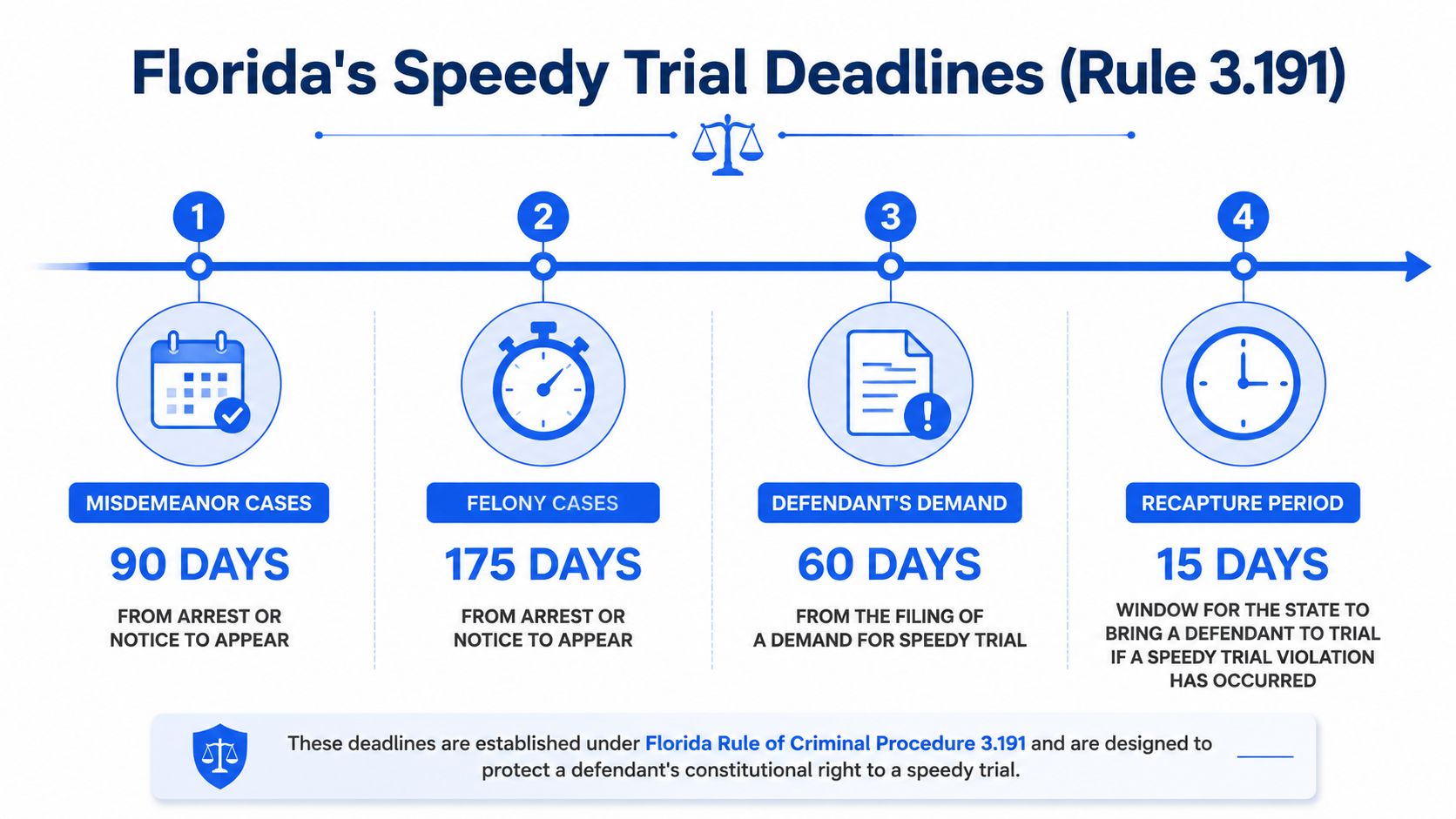
Which deadlines matter most in traffic and DUI cases
These are the deadlines Florida drivers need to remember under Rule 3.191:
Case type or filing | Key deadline |
|---|---|
Misdemeanor case | 90 days |
Felony case | 175 days |
Demand for speedy trial | 60 days from demand |
Recapture period | 15-day window |
Many serious traffic cases fall into the misdemeanor category. Some do not. DUI can be a misdemeanor or felony depending on the facts. Reckless driving is commonly charged as a misdemeanor, but the exact classification matters.
The court file, the charging document, and your procedural posture all matter. That's why counting days from memory is reckless.
Here's a quick visual overview:
What should you track immediately
Most drivers only track the next court date. That's not enough.
Track these instead:
The charging level: Misdemeanor or felony changes the rule.
The trigger date: Arrest or notice to appear can matter.
Every continuance: Who requested it matters.
Any demand filed: Filing a demand changes the posture of the case.
Any expiration issue: The State may still get a recapture chance.
Warning: A deadline on paper is only useful if the record supports your position.
If you're also trying to sort out whether a delay issue overlaps with filing deadlines more generally, review how Florida limitation periods differ from ticket timing issues. Don't confuse separate legal concepts. Drivers do that all the time, and it leads to bad decisions.
A prosecutor won't volunteer that the clock is a problem. A judge won't act as your strategist. You or your lawyer must raise the issue the right way, at the right time, with the right paperwork.
How Do You Formally Demand a Speedy Trial
Knowing the rule isn't enough. You have to use it.
A formal speedy trial filing is not a casual note to the court. It's a procedural move with consequences. Depending on posture, lawyers may use a Demand for Speedy Trial or a Notice of Expiration of Speedy Trial Time. The choice matters. The timing matters. Service matters.

What filing actually triggers action
A demand tells the court you are available, prepared, and insisting on movement. That sounds simple. It isn't.
When you file the wrong document, file too early, file too late, or fail to serve the prosecutor correctly, the move can become useless. Worse, a badly timed demand can force your case forward before the defense is ready.
That's why arraignment matters. If you haven't been through that step yet, read what happens at arraignment in Florida criminal court. The posture of your case affects everything that follows.
Immediate Steps to Take
Get the docket first: Don't rely on memory. Pull the court history and charging paperwork.
Confirm your availability: A demand usually signals you are ready for trial. If you aren't, the filing can hurt you.
Match the filing to the posture: Demand and expiration are not interchangeable tools.
Serve the prosecutor properly: A filing that isn't properly served can collapse on contact.
Preserve the record: Every hearing statement counts when speed becomes an issue later.
File nothing until you know what it commits you to.
A lot of drivers think a speedy trial demand is just pressure. It's more than pressure. It's a declaration that can shape the entire case. If your lawyer makes that move, it should be because trial readiness, negotiation posture, witness status, and collateral risk have all been evaluated first.
What Can Pause or Void Your Speedy Trial Clock
At this point, drivers lose good arguments.
They assume the clock runs in a straight line. It doesn't. A speedy trial clock can pause, get extended, or become useless because of what happens in court. Sometimes the reason is legitimate. Sometimes it's preventable. Often, the damage comes from the defense side without the driver realizing it.
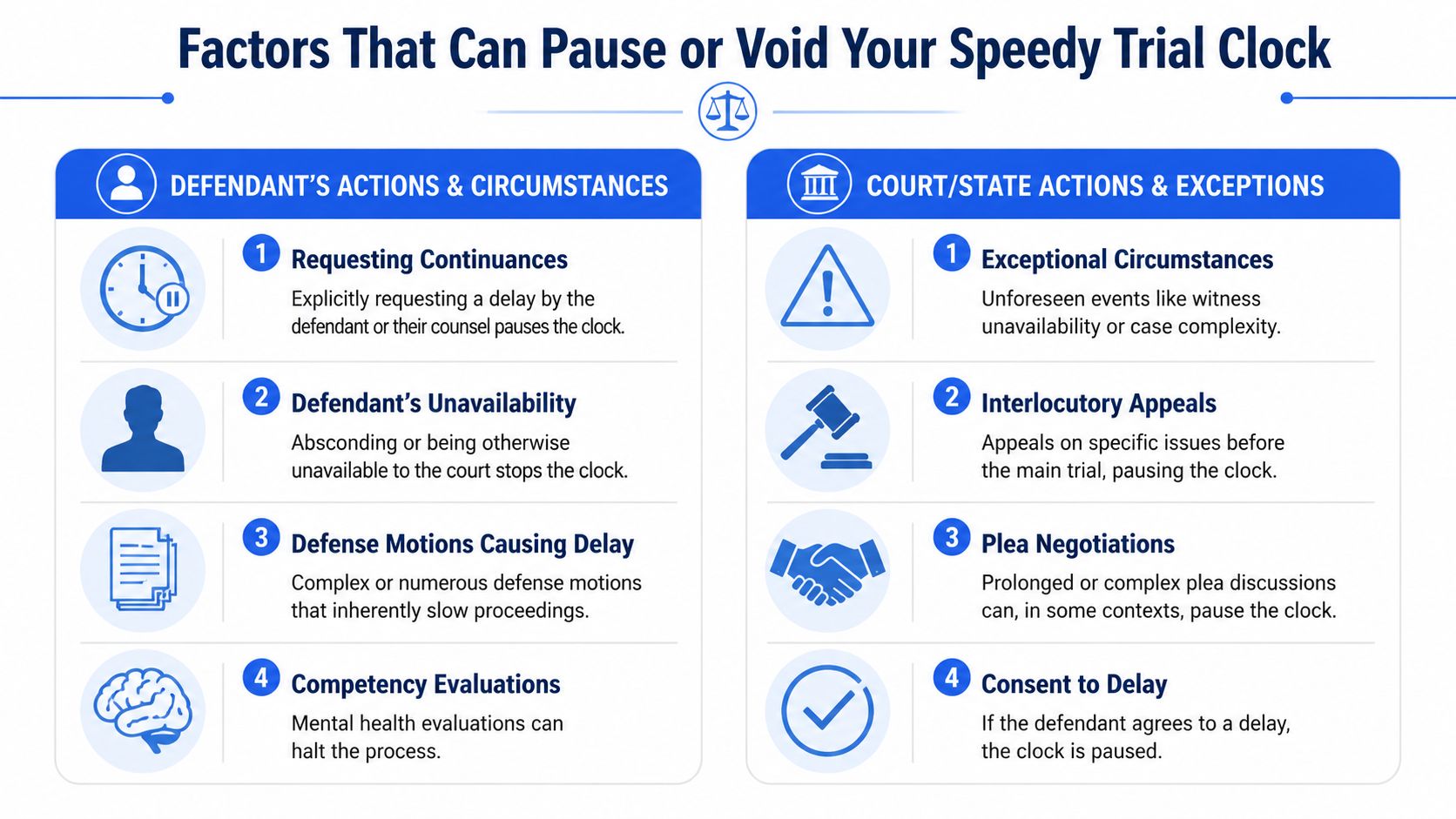
Which mistakes hurt drivers most
The biggest problem is consent. If you agree to a continuance without understanding the effect, you may be giving up an advantage.
Common danger points include:
Requested continuances: If the defense asks for more time, that can affect the clock.
Agreed resets: Even a polite agreement to move a date can create waiver issues.
Unavailability: Missing court, failing to appear, or being unreachable can hurt you fast.
Defense motions that create delay: Some motions are necessary. Some also affect timing.
Plea discussions: Ongoing negotiation can complicate a future speedy trial claim.
If you're considering a reset, understand how a continuance works in court before you agree to one.
Why DUI and traffic cases feel urgent long before trial
Theory and reality split apart.
For DUI and similar traffic cases, the administrative side often moves faster than the criminal side. The military justice digest source provided on this issue notes that DMV license suspensions can move much faster than the criminal court's constitutional clock, and gig drivers can be deactivated long before the criminal case is resolved.
That means a driver can be technically “waiting” on court while already suffering real damage:
License trouble: Your ability to drive can be hit early.
Insurance consequences: Carriers don't wait for your perfect legal timeline.
Work disruption: Rideshare, delivery, sales, and field-service work can dry up quickly.
Professional stress: Employers don't always care that your trial date is months away.
The criminal clock and the life clock are not the same clock.
That's why you can't look at speedy trial rights in isolation. A delay might help one part of the case and hurt your actual life. Good strategy weighs both.
Why Is a Lawyer Your Best Weapon for Speedy Trial
Because speedy trial rights are not self-executing. They are strategic.
That's the part people miss. They think the issue is speed. It's really strategic advantage, preservation, and timing. Push too soon and you may force a bad trial posture. Wait too long and the argument weakens or disappears.
Why pushing too hard can backfire
A lot of misdemeanor cases end through negotiation, not trial. An ABA survey referenced in the constitutional commentary noted that about 70% of misdemeanor cases were resolved by plea, often after continuances consented to by the defense. That matters because many Florida traffic crimes and DUI-related charges live in that same practical world.
So yes, demanding speed can be powerful. It can also ruin a favorable outcome if used blindly.
A strong lawyer asks harder questions:
Is the State weak now, or will it get weaker with time?
Are witnesses available?
Is a plea offer developing?
Will a fast trial increase risk more than it provides an advantage?
Are collateral issues, like driving privilege, better handled through another move first?
Why direct lawyer access matters
This is exactly why automated apps and ticket mills are a bad fit for criminal traffic strategy. A chatbot cannot decide whether to preserve a deadline, negotiate a reckless amendment, challenge availability, or avoid an accidental waiver in open court.
You need direct legal judgment. You need to speak with your attorney by phone or text, ask what the next hearing means, and get an answer tied to your actual docket.
If you're trying to understand how badly a missed hearing can complicate timing issues generally, even outside Florida, this plain-language guide on what happens when you miss court in Ventura County is useful because it shows how fast procedural problems can snowball. The county is different. The lesson is the same. Court absence destroys any advantage.
If your charge involves speed, reckless driving, or another moving violation with criminal exposure, learn more about working with a Florida speeding ticket lawyer who understands the court record, not just the citation.
The right move in a speedy trial case is rarely obvious from the outside. That's why real defense work matters.
Frequently Asked Questions About Speedy Trial Rights
Does filing a motion stop the speedy trial clock
Sometimes it can affect timing, especially if the motion creates delay or requires hearings and rulings that change the case schedule. The answer depends on the motion, the posture, and what happens next in court. Don't assume every filing helps you.
What if you live out of state but got charged in Florida
Florida court dates still matter. Florida procedure still controls. If the case is criminal, distance does not protect your speedy trial rights, and it does not excuse missed appearances unless the court has approved a lawful arrangement. Out-of-state drivers need tighter monitoring, not less.
Can a Florida DUI case be dismissed for a speedy trial problem
Yes, it can happen in the right case. But DUI dismissal is not automatic just because time passed. The record must support the argument, the right deadlines must apply, and your side must avoid waiver. DUI cases are especially dangerous because license consequences can hit before a trial issue is fully developed.
If the prosecutor keeps agreeing to move the case, is that good for you
Not necessarily. Delay can help, hurt, or do both. It may give the defense time to negotiate or prepare. It may also keep you under stress, increase collateral harm, or weaken a future speedy trial claim if the delay becomes attributed to the defense or accepted by consent.
Should you demand a speedy trial right away
Usually, you should decide that only after a lawyer reviews the docket, the evidence, your readiness, and the likely negotiation path. Fast is not always smart. Strategic is smart.
If your Florida traffic or DUI case is dragging and you want the strongest path toward No Points, don't leave the clock unguarded. Visit Ticket Shield, PLLC for a free consultation and speak directly with a lawyer, not a middleman or chatbot.
