Statute of Limitations Speeding Tickets: Florida Rules Explained
Learn the statute of limitations speeding tickets in Florida, including key deadlines, filing timelines, and how these limits affect your case.

In Florida, getting a speeding ticket comes with a ticking clock—not just for you, but for the state as well. The statute of limitations for a speeding ticket, which is considered a noncriminal traffic infraction, is generally one year from the day of the alleged violation. This means the state has a firm deadline to start legal proceedings against a driver.
What Is a Statute of Limitations for Speeding Tickets
Think of it as a legal expiration date on the state’s ability to take action. This legal stopwatch starts the moment you're accused of speeding. Florida law puts these deadlines in place for a good reason: to make sure cases are handled in a timely manner and to protect people from the endless threat of being prosecuted for something that happened long ago. If the state doesn't file the case within that one-year window, it usually loses the right to pursue it.
For drivers anywhere from Miami-Dade to the Panhandle, this is a critical concept. It sets the boundary for how long an officer has to issue the citation after a traffic stop and, more importantly, how long the state has to formally prosecute that ticket in court. These aren't just guidelines; they're hard legal deadlines.
The Purpose of These Legal Deadlines
So, why do these time limits exist? It really comes down to three key principles:
Ensuring Fairness: It’s just not fair to have a minor infraction hanging over your head for years. These deadlines prevent the state from dragging things out indefinitely.
Preserving Evidence: Time is the enemy of memory and evidence. Timely prosecution means the officer's memory is fresher, and any potential evidence like dashcam footage is still available and reliable.
Promoting Diligence: Deadlines force law enforcement and prosecutors to be efficient. It keeps the system moving and prevents cases from getting lost in a bureaucratic shuffle.
It’s also important to understand that there are two main clocks running. The first is the deadline for the officer to issue the ticket, and the second is the deadline for the state to prosecute it. They might sound like the same thing, but they're two distinct steps in the process. For a wider view on legal deadlines and ensuring general legal compliance, understanding these distinctions is key.
A statute of limitations is a safeguard. It ensures legal action for traffic violations happens within a reasonable time, protecting drivers from being in legal limbo over a minor issue forever.
Now, relying on a missed deadline as your defense isn't as simple as just pointing at a calendar. The rules can get complicated. Certain situations can pause, or "toll," the clock, extending the state's time to act. For a full breakdown of how these rules work for different types of tickets, you can learn more about the Florida statute of limitations for traffic violations in our guide. Simply hoping a ticket is too old to matter is a risky bet that could lead to much bigger problems, like a suspended license if you ignore it.
Florida Speeding Ticket Deadlines at a Glance
Navigating the various timeframes associated with a Florida speeding ticket can be confusing. This table breaks down the key deadlines and what they mean for you, from the moment you get the ticket to its long-term impact.
Event | Typical Timeframe in Florida | What This Means for You |
|---|---|---|
Issuing the Ticket | At the time of the stop | The officer must issue the citation during the traffic stop. Delays can create defense opportunities. |
Responding to the Ticket | 30 days from issuance | You must choose to pay, elect traffic school, or contest the ticket within this window. Missing it can lead to a default judgment and license suspension. |
Statute of Limitations (Prosecution) | One year from the violation date | The state has one year to formally file charges. If they miss this deadline, the case can often be dismissed. |
Points on Your Record | 3 to 5 years | A conviction will add points that remain on your driving record for years, impacting your insurance rates. |
License Suspension Threshold | 12, 18, or 36 months | Points accumulate over specific periods. For example, 12 points in 12 months results in a suspension. |
Understanding these timelines is the first step in protecting your driving record. Each deadline represents a critical point where you need to make a smart decision to avoid fines, points, and long-term financial consequences.
Understanding the Two Critical Deadlines for Your Ticket
When you get a speeding ticket in Florida, your mind probably jumps straight to the fine, the points, and the potential insurance hike. But behind the scenes, two completely separate legal "shot clocks" start ticking down. Knowing the difference between these two deadlines is the first step in figuring out if the state still has a right to come after you.
The first clock is for issuance—that’s the window an officer has to actually write and hand you the ticket. The second, and far more important, clock is for prosecution. This is the timeline the state has to officially file the charge and get the case moving through the court system.
The Issuance Deadline: What It Means
For most drivers, the issuance deadline is met the second the officer hands you that piece of paper. You get pulled over, they run your info, and you drive away with a citation. Done. In that classic traffic stop scenario, issuance is instant.
Where this can get a little fuzzy is with tickets that show up in the mail, like those from red-light cameras or toll violations. If you get a ticket weeks or months after the supposed violation happened, an unreasonable delay could potentially create a defense for you.
The Prosecution Deadline: The One-Year Rule
This is the big one. When it comes to the statute of limitations for speeding tickets in Florida, this is the deadline that truly matters. For non-criminal traffic infractions like speeding, Florida Statute § 775.15(2)(d) gives the state exactly one year from the day of the offense to start the prosecution.
Think of it like this: the state has 365 days to officially take you to court over that ticket. If they let that deadline pass without filing the right paperwork, they generally lose their chance forever.
This one-year rule is a critical safeguard for drivers. It stops the state from holding a minor infraction over your head for years and makes sure cases are dealt with while the evidence—and everyone’s memory of the event—is still fresh.
This timeline breaks down the journey of a speeding ticket, from the moment you’re pulled over to the final deadline the state has to meet.
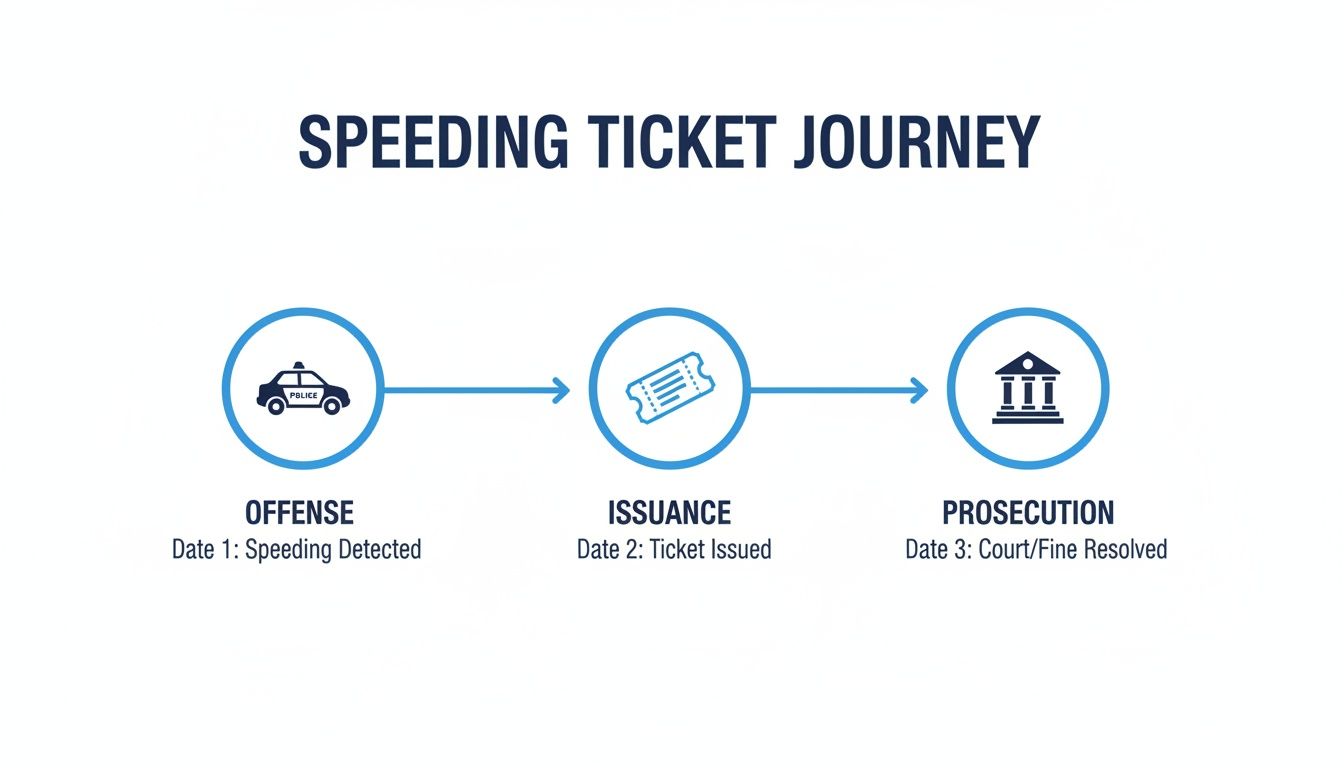
As you can see, getting the ticket is just the first step. The state has a much longer, one-year window to kick off the formal legal process.
How Severity Changes the Timeline
Now, it’s vital to understand that the one-year rule applies to your standard, non-criminal speeding ticket. Once you cross into the world of criminal traffic violations, the clock runs for a lot longer.
Second-Degree Misdemeanor: For something like reckless driving without serious injury, the state gets two years to prosecute.
First-Degree Misdemeanor: For more serious charges, like leaving the scene of an accident with property damage, the state also has two years.
This distinction is huge. A driver facing a reckless driving charge in a busy county like Miami-Dade is looking at a much longer period of legal jeopardy than someone with a simple 15-mph-over speeding ticket. This is exactly why you need to know the specific violation you were cited for.
Across the country, the statute of limitations for speeding tickets is typically measured in months or a few years, usually governing how long authorities have to start a case—not how long it follows you. Most states fall in the 1–3 year range, meaning Florida’s one-year rule is on the shorter end of the spectrum.
Of course, the best strategy is always to handle a ticket correctly from the start to keep points off your license and your insurance rates down. Even if a dismissal isn't in the cards, an option like a traffic ticket deferral might be a way to protect your record. Consulting with a lawyer who focuses on traffic defense is the surest way to understand all the options on the table.
How a Speeding Ticket Conviction Affects Your Record
It's a tempting myth, and a common one: if you just ignore a speeding ticket long enough, it’ll simply vanish. Many drivers think the statute of limitations is some kind of magic eraser that wipes the slate clean after a legal deadline passes. The reality, however, is a whole lot different—and much more serious for your driving record.
The statute of limitations is very specific. It only governs one thing: the timeframe the state has to prosecute a new case. It does not erase a conviction that’s already on your record. The moment you pay that fine (which is an admission of guilt) or are found guilty in court, the conviction becomes a permanent part of your driving history. A whole new clock starts ticking on its consequences.

This distinction is crucial. That one-year window for prosecution is all about the court process. But the fallout from a conviction can haunt you for years, impacting everything from your insurance premiums to your ability to get certain jobs.
The Lasting Impact on Your Florida Driving Record
In Florida, a speeding ticket conviction doesn't just disappear after a year. The points that come with that violation will typically hang around on your public-facing driving record for three to five years. During that time, they are fair game for insurance companies, potential employers, and law enforcement to see.
This means a single ticket from a trip through Miami-Dade County could follow you for years, even if it felt like a minor headache at the time. Every new ticket just piles on more points, and Florida's system is built to come down hard on repeat offenders.
The core takeaway is this: a conviction creates a long-term problem. Relying on the statute of limitations is a gamble on a procedural error, while actively defending against a ticket is a proactive strategy to protect your record for the future.
This long-term visibility is exactly why it’s so important to address a ticket head-on. Just hoping a deadline passes is a passive approach that leaves your record completely exposed.
Financial Consequences That Outlast Legal Deadlines
The most immediate and painful hit from a ticket conviction is almost always financial. The fine itself might be a few hundred dollars, but the ripple effect on your insurance premiums can cost you thousands over the next few years.
Insurance companies see a speeding conviction as a bright red flag signaling increased risk. After a conviction hits your record, they’re very likely to hike your rates at your next renewal. That rate increase can stick around for as long as the violation stays on your record—usually three to five years.
Think about these long-term financial hits:
Premium Hikes: Just one minor speeding ticket can make your auto insurance premiums jump by 20–22%.
Loss of Discounts: A conviction could easily get you disqualified from "good driver" or "safe driver" discounts, making your costs even higher.
Long-Term Costs: A rate hike of just $30 a month adds up to $1,080 over three years—way more than the original fine.
These financial penalties operate on a completely different timeline from the court system and its deadlines. Insurers base their decisions on your official driving record. The statute of limitations for the speeding ticket constrains the state, but it has zero control over how long that violation hurts your wallet, which can last for years after the legal filing window has slammed shut. To get a better handle on how long these consequences can stick around, you can explore our detailed guide on how long traffic tickets stay on your record.
Nationwide data shows a minor speeding conviction typically stays on a motor vehicle record for 3–5 years, while more serious offenses can remain for up to 10 years or more, depending on the state. Protecting your long-term record is just as vital as handling the immediate fine, which is why a proactive defense is almost always the smartest path forward. Our goal is to protect your license and record.
Exceptions That Can Pause the Legal Clock
The statute of limitations for speeding tickets isn't always a clean, straightforward countdown. Certain situations can legally "toll" the clock—which is just a fancy legal term for hitting the pause button. Think of it like a stopwatch in a race. If you hit pause, the clock stops ticking but picks right back up where it left off once the race resumes.

These exceptions exist for a simple reason: fairness. The law is designed to prevent someone from dodging responsibility just by running out the clock. This is exactly why you should never assume a deadline has passed without getting professional legal advice. Understanding these tolling rules is essential because they can dramatically extend the state's window to prosecute a ticket.
Leaving the State of Florida
One of the most common ways the legal clock gets paused is when a driver is continuously out of Florida. The law is set up to stop someone from getting a ticket, skipping town, and just waiting for the one-year statute of limitations to expire.
Imagine a tourist visiting Miami-Dade County for spring break. They get cited for speeding on the Dolphin Expressway and fly home to another state the very next day. In that scenario, the one-year clock for prosecution is frozen. It won't start ticking again until that person physically sets foot back in Florida.
This means years could go by. But the second they re-enter the state—even for a quick vacation or a business trip—that clock can start running again. This rule ensures out-of-state drivers are held to the same standards as Florida residents.
Providing False Information to Law Enforcement
Another situation that slams the brakes on the statute of limitations is when a driver gives false or misleading information to a police officer. This could be anything from giving a fake name or a bogus address to handing over a fraudulent driver's license during the traffic stop.
When that happens, law enforcement and the courts are essentially trying to prosecute a ghost. The legal process grinds to a halt because the state can't properly notify or even identify the actual person who committed the violation. The clock is officially paused until the driver's true identity is uncovered.
The core idea behind tolling is simple: you shouldn't be able to benefit from your own actions to evade prosecution. Whether you do that by leaving the state or by hiding your identity, those actions will temporarily suspend the legal deadline.
This exception is all about preventing deception from wrecking the justice system. The law gives the state extra time to sort things out and pursue the case once the correct information comes to light, no matter how much time has passed since the original stop.
The Discovery of More Serious Charges
Sometimes, what starts as a simple speeding ticket turns out to be tied to a much more serious crime. If new evidence pops up that elevates a traffic infraction to a criminal offense, the timeline can change completely.
For example, let's say a driver gets ticketed for excessive speeding. A few weeks later, an investigation connects their vehicle to a hit-and-run that happened just moments before the traffic stop. In a case like that, the one-year clock for a simple speeding ticket becomes totally irrelevant.
Instead, the more serious criminal charges take over, and they come with their own, much longer statutes of limitations.
Misdemeanors: The state generally has two years to prosecute.
Felonies: The deadlines can stretch to three years or longer, depending on how severe the crime is.
This "discovery rule" gives the legal system the flexibility to adapt to new information. It ensures that issuing a minor ticket at the scene doesn't stop the state from pursuing more significant charges if later findings warrant it. This is why our practice focuses on traffic and DUI defense; we handle criminal traffic matters across Florida and understand how these complex rules interact. Our goal is to protect your license and record. Past results do not guarantee future outcomes.
What to Do If You Believe a Deadline Was Missed
Figuring out that a legal deadline might have been missed on your speeding ticket can feel like you’ve found a golden ticket. It's a huge potential advantage, but what you do next is absolutely critical. A wrong move at this stage could flip a potential dismissal into a much bigger headache.
So, let's get one thing straight right away: never, ever ignore the ticket, no matter how old you think it is.
Ignoring a citation is the fastest route to a suspended driver's license, bar none. The court system runs on official procedures, and until a judge formally dismisses your case, that ticket is considered live and active. A failure to appear will trigger automatic penalties, turning a simple traffic issue into a serious legal problem that’s way harder and more expensive to fix.
Your First Steps: Document and Verify
Before you can even think about building a defense around the statute of limitations for speeding tickets, you need to get your facts straight. Assumptions and gut feelings won't hold up in court; you need cold, hard dates.
Start by putting together a clear timeline of events. This isn’t just about the day of the alleged violation; it’s about every single interaction you’ve had with the legal system since.
Date of the Alleged Offense: Find the exact date the officer says you were speeding. This is what starts the one-year prosecution clock.
Date of Citation Issuance: Note when you physically got the ticket. If it was mailed, save the envelope—the postmark date is key evidence.
Date of Court Filing: This is the most crucial date and often the trickiest to find on your own. It's the day the court clerk officially entered your ticket into the system, which formally kicks off the prosecution.
This information is the raw data you need to figure out if the state actually missed its one-year deadline. Any delay or discrepancy could be huge, but you need proof, not just a hunch.
Why You Should Never Argue This Defense Alone
Armed with your dates, you might feel tempted to walk into court and make your case. This is a common but extremely risky mistake. A statute of limitations defense isn't a simple "gotcha" moment you can just explain to a judge. It's a complex legal argument that must be presented through a formal Motion to Dismiss.
Attempting to navigate the procedural rules for a Motion to Dismiss on your own is like trying to perform surgery after reading a single medical article. The court has strict requirements for how these motions are written, filed, and argued. One tiny mistake can get your entire defense thrown out.
Florida traffic courts, especially in busy counties like Miami-Dade, follow rigid procedures. Proving the state missed its deadline requires a carefully crafted legal document that cites the right statutes and case law. An improperly filed motion is the same as no motion at all. This is a technical, procedural defense that requires a professional touch to have any chance of success.
Consult a Florida Traffic Ticket Attorney
The smartest and safest move you can make is to consult with a law firm that focuses on Florida traffic law. An experienced attorney can pull the official court records, verify the exact filing date of your citation, and quickly determine if a valid statute of limitations defense actually exists.
We handle criminal traffic matters across Florida and know the specific procedures in each county's court system like the back of our hand. Our job is to protect your license and your record by exploring every possible legal defense, including procedural ones like missed deadlines. An attorney can file the necessary motions correctly and argue them effectively for you.
If you’ve missed a court date while trying to sort all this out, the situation is even more urgent. To understand the serious consequences and what to do next, you should immediately review the steps for handling a missed court date for a traffic ticket.
Attorney Advertisement. Office in Broward. Past results do not guarantee future outcomes.
How a Traffic Law Firm Can Help Protect Your Record
Trying to navigate the maze of statute of limitations for speeding tickets on your own is a huge gamble. The rules are technical, the deadlines are unforgiving, and a single misstep can mean losing a perfectly valid defense. This is precisely where a dedicated traffic law firm steps in, ready to scrutinize every detail of your case.
Our attorneys live and breathe this stuff. We meticulously examine each citation for procedural mistakes, including the critical deadlines for prosecution. Handling cases across all 67 Florida counties gives us a deep understanding of local court procedures, especially in high-volume systems like Miami-Dade. That kind of localized knowledge is often the key to building a defense that actually works.
When you're looking for help, you'll see a lot of different legal practices out there. Some are general Law Firms & Attorneys that handle a bit of everything. Our firm, however, is different. We focus exclusively on traffic and DUI defense, which lets us zero in on the unique defenses—like a statute of limitations argument—that a general practice might overlook.
A Focused Approach to Protecting Your Driving Privileges
Our mission is simple: protect your license, your driving record, and your insurance rates. We do that by exploring every possible legal angle, from challenging the officer's evidence to filing a formal Motion to Dismiss because the state missed its deadline.
We believe in keeping you in the loop, making sure you always understand what's happening with your case and the strategy we're using. The whole point is to make this process as clear and stress-free for you as we possibly can.
Our goal is to protect your license and record. While no outcome can ever be guaranteed, a proactive and knowledgeable defense is the most effective tool a driver has when fighting a traffic citation.
Why Professional Legal Representation Matters
An experienced attorney can be the difference-maker. A lawyer knows exactly how to get official court documents, verify the ticket's true filing date, and build a legally sound argument that a judge will take seriously. Without that professional guidance, a valid defense can easily get lost in procedural red tape.
Plus, a conviction means points on your license, which can haunt you for years. If that’s a concern, our firm can also guide you on how to deal with those consequences. You can learn more in our detailed guide on how to remove points from your driving record.
Hiring a firm to handle your ticket means you’re putting a professional advocate in your corner. We're committed to a straightforward process aimed at getting you the best possible result.
Attorney Advertisement. Office in Broward. Past results do not guarantee future outcomes.
Frequently Asked Questions
Understanding the finer points of Florida's statute of limitations for speeding tickets can be tricky. Here are answers to some of the most common questions we hear from drivers about these critical legal deadlines.
Do Time Limits Apply to Red Light Camera Tickets?
Yes, but they operate a little differently. For a red light camera violation in Florida, a notice has to be mailed to the vehicle's registered owner within 30 days of the violation.
If the issuing authority, like the Miami-Dade County Clerk of Courts, misses that 30-day window, it can be a solid basis to challenge the ticket. This rule acts much like a statute of limitations, creating a firm, non-negotiable deadline for the government to take action.
What Happens if I Move Out of Florida After Getting a Ticket?
Leaving the state doesn't make a ticket disappear. In fact, being continuously absent from Florida can "toll" or pause the one-year statute of limitations clock.
The countdown freezes the day you leave and only starts ticking again if you physically return to the state, even for a quick visit. This rule is in place to prevent drivers from dodging responsibility simply by crossing state lines and waiting out the clock.
Can the State Still Prosecute if My Ticket Was Lost in the Mail?
This is a very tough situation for any driver. The legal standard hinges on whether the state provided proper "legal notice," which usually just means they mailed the ticket to the address you have on file with the Department of Highway Safety and Motor Vehicles.
Proving you never received it is an incredibly difficult defense to win on your own. It takes a specific legal strategy to show the notice was fundamentally flawed, making an attorney's help essential in these cases.
A claim of a lost ticket is not an automatic defense. The legal system presumes that mail sent to a correct address is received, and overcoming that presumption requires compelling evidence and proper legal motions.
How Are Deadlines Different for Criminal Speeding?
The distinction here is critical. A standard speeding ticket is a non-criminal infraction with a one-year statute of limitations for the state to prosecute.
However, criminal speeding (like driving 30+ mph over the limit) or reckless driving are misdemeanors. For these much more serious offenses, the state generally has two years to file charges, giving them a much longer window to build their case. Always confirm the specific violation on your ticket to know which deadline applies.
At Ticket Shield, PLLC, our practice is focused on traffic and DUI defense across all 67 Florida counties. If you're worried about a ticket deadline or need to protect your driving record, contact us 24/7 for a free, confidential consultation. Learn how we can help at https://www.ticketshield.com.