Statute of Limitations Traffic Violations: Florida Rules Explained
Florida’s statute of limitations traffic violations rules differ from the 30-day ticket deadline. See what happens after 30 days and late payment.
A common myth is that a traffic ticket will expire if you ignore it long enough. But in Florida, the concept of a statute of limitations for traffic violations is more complex than many people think. For most non-criminal tickets, the critical deadline isn't for the state—it's for you to respond, and that window is usually a tight 30 days.
Failing to act within that timeframe doesn't make the ticket vanish. Instead, it can start a chain reaction of lasting consequences, like a suspended license and growing fees that can follow you for years.
How We Reviewed Florida Traffic Violation Time Limits
This article separates two issues that Florida drivers often blend together: the deadline to respond to a ticket and the deadline for the state to start or pursue a case. To update it, we reviewed the Florida statutes that control civil traffic infractions, criminal limitation periods, and red-light camera notices, along with statewide guidance from the Florida Highway Safety and Motor Vehicles and county clerk procedures that explain what happens after a missed payment deadline.
We also treated civil infractions and criminal traffic charges differently on purpose. A speeding citation is usually governed by response rules in Chapter 318, while offenses such as reckless driving, DUI, or leaving the scene can trigger criminal filing deadlines under section 775.15 and trial-timing rules under the Florida Rules of Criminal Procedure. That distinction matters more than many expect. In our experience, clients commonly call asking whether a ticket is “too old,” when a more immediate problem is that the clerk has already moved the case into suspension processing.
Where county practice can vary—especially on late payments, collection referrals, and whether a short delay can still be resolved before a suspension posts—we say so directly. If a ticket involves a missed court date, an already-suspended license, injury, DUI allegations, or a warrant, the analysis changes and should be reviewed case by case.
The Truth About Florida Traffic Violation Time Limits
Many drivers mistakenly believe an old traffic ticket eventually becomes unenforceable, similar to how a statute of limitations works in criminal cases. They might tuck a citation in the glove box, hoping it gets forgotten by the system. This can be a costly assumption, especially in Florida.
For the vast majority of non-criminal traffic tickets, such as speeding, running a red light, or a stop sign violation, there is no traditional statute of limitations that absolves you. The "clock" that matters is the one that starts ticking the second that officer hands you the citation.
Why Ignoring a Ticket Is a Bad Strategy
Ignoring a ticket can start a series of administrative penalties that do not expire. Instead of fading away, the problem can get bigger and more complicated over time.
Here’s what typically happens:
License Suspension: After that 30-day response window closes, the court notifies the Florida Department of Highway Safety and Motor Vehicles (DHSMV). They will then suspend your driving privileges indefinitely.
Extra Fees: Late fees and reinstatement fees get tacked onto the original fine, dramatically increasing what you owe.
Collections: The outstanding debt can be sent to a collection agency, which can impact your credit score.
This means a forgotten $150 speeding ticket can spiral into hundreds of dollars in fines and fees, all while your license stays suspended. That suspension will stop you from legally driving, renewing your registration, or even getting a new license until the issue is resolved.
Attorney Advertisement: This blog post is for informational purposes only and does not constitute legal advice. Our practice focuses on traffic and DUI defense. Office in Broward.
To put it all in perspective, here’s a quick breakdown of the timelines and what happens if you miss them.
Florida Traffic Violation Timelines At a Glance
This table sums up the critical deadlines and potential outcomes for different types of Florida traffic violations. It’s a handy reference to understand what you’re up against from the moment you get a ticket.
Violation Type | Response Deadline | Prosecution Deadline | Common Enforcement Consequence if You Miss the Response Deadline |
|---|---|---|---|
Civil traffic infraction | Usually 30 days to pay, elect school, or request a hearing under section 318.14 | Generally 1 year for a noncriminal violation under section 775.15(2)(d) | Clerk may report noncompliance; license suspension and added costs can follow under section 318.15 |
Criminal traffic misdemeanor | Court date on citation or summons | Usually 1 year for a second-degree misdemeanor and 2 years for a first-degree misdemeanor under section 775.15 | Failure to appear can lead to a warrant, suspension, or additional charges |
Felony traffic offense | Court date, arrest conditions, or bond terms | Often 3 years for most felonies and 4 years for first-degree felonies under section 775.15 | Arrest exposure, felony prosecution, license consequences |
DUI administrative suspension issue | Very short deadlines can apply to challenge the administrative suspension; review the paperwork immediately with counsel and FLHSMV DUI procedures | Criminal DUI filing deadlines depend on charge level under section 775.15 | Loss of driving privilege, separate from the criminal case |
As you can see, for everyday tickets, the ball is entirely in your court. The state doesn't need to worry about a clock, because the penalties for ignoring the ticket are automatic and indefinite.
Violation Type | Initial Action Deadline | Consequence of Inaction | Is There a Prosecution Time Limit? |
|---|---|---|---|
Non-Criminal Traffic Infraction | 30 days to pay, elect school, or fight | License suspension, added fees, collections | No, administrative penalties do not expire. |
Criminal Traffic Violation (e.g., Reckless Driving) | Varies based on court date | Arrest warrant, license suspension | Yes, a 1 to 2-year statute of limitations typically applies. |
DUI (Driving Under the Influence) | 10 days for DMV hearing request | Administrative license suspension, criminal charges | Yes, a 2 to 3-year statute of limitations typically applies. |
The Real Timelines That Matter
Your focus shouldn't be on an imaginary expiration date for the state. It needs to be on the immediate deadlines you're facing. Understanding how long traffic tickets stay on your record will help you manage your driving history and insurance rates down the line.
Ultimately, the belief that a ticket will just "go away" is a myth that leads to severe, long-term headaches. The state's power to enforce penalties for an unpaid civil ticket doesn't have a time limit. Your best move is always to deal with the citation head-on within the timeframe you're given. Past results do not guarantee future outcomes, but our goal is to protect your license and record by handling these matters correctly from the start.
How Florida Sorts Traffic Offenses and Their Timelines
Florida traffic cases make more sense once you sort them into four buckets: civil infractions, criminal traffic misdemeanors, felony traffic offenses, and DUI-related matters that can involve both administrative and criminal deadlines. That framework is more useful than asking for one blanket rule, because the governing deadline changes with the type of allegation.
Civil Infractions: Short Response Window, Different Filing Rule
Most tickets drivers receive are noncriminal infractions handled under Chapter 318. Common Florida examples include speeding, failure to obey a traffic control device, improper lane change, and running a stop sign.
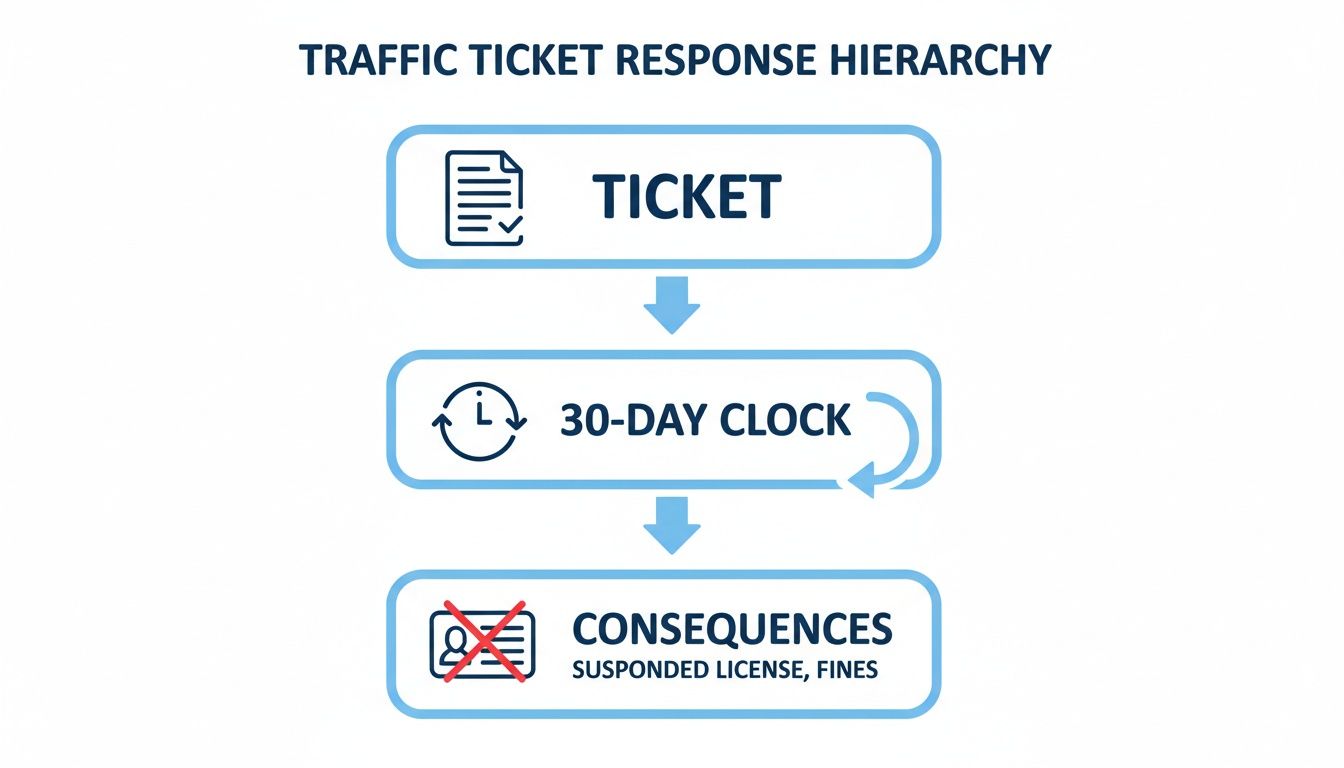
The practical deadline is usually your 30-day response period under section 318.14: pay, elect a school option if eligible, or request a hearing. But Florida also has a prosecution-related rule in the background. For a noncriminal violation, the state generally must commence the case within 1 year after the infraction under section 775.15(2)(d). That is the clearest example of why response deadlines and statute-of-limitations issues are not the same thing.
If the driver misses the 30-day response deadline, the usual consequence is not dismissal for the driver, but noncompliance, suspension exposure, and additional costs under section 318.15. In our practice, clients most often get tripped up: they hear “one year” somewhere online and assume they can wait, when the 30-day deadline is the one that hits first.
If you are not sure whether your ticket is the kind that adds points, start with our guide on what is a moving violation.
This graphic lays out the simple but critical process for a non-criminal ticket and shows exactly what happens if you do nothing.
Criminal Traffic Misdemeanors: The State Has Charging Deadlines
Once a traffic matter becomes criminal, the state’s filing deadline matters in a more familiar way. Examples include reckless driving under section 316.192, some driving-while-license-suspended charges under section 322.34, and leaving the scene with property damage under section 316.061.
Under section 775.15, the state generally has 1 year to prosecute a second-degree misdemeanor and 2 years for a first-degree misdemeanor. If that deadline expires before the state properly commences prosecution, dismissal can become a real issue. If the driver misses a mandatory court date, though, the more immediate danger is a bench warrant or failure-to-appear consequences—not a timeout that helps the defense.
Felony Traffic Offenses: Longer Limitation Periods, Higher Stakes
Felony traffic cases follow longer criminal limitation periods. Florida examples include leaving the scene of a crash involving injury or death under section 316.027, felony DUI variants under section 316.193, and habitual traffic offender-related driving charges under section 322.34.
For most felonies, the state usually has 3 years to prosecute, and 4 years for first-degree felonies, under section 775.15(2). Missing that prosecution deadline can support dismissal, but these cases also raise tolling issues, injury evidence questions, and charging-level disputes that need a file-specific review.
DUI-Related Timelines: Administrative and Criminal Clocks Can Run at Once
DUI causes confusion because it is not just one timeline. A DUI arrest can trigger an administrative license issue handled through FLHSMV DUI procedures and a separate criminal prosecution under section 316.193.
That means a driver may have an urgent license-related decision to make right away even while the criminal filing deadline is measured in years, not days. We routinely tell callers not to rely on a generic “traffic ticket statute of limitations” answer for DUI, because it hides the administrative side of the problem.
A pre-approved outside summary can also help illustrate how traffic matters shift from noncriminal to criminal depending on the allegation; see this overview of Florida limitation periods.
The Lasting Impact of an Unresolved Traffic Ticket
For a standard Florida ticket, the practical question is usually not whether the case is old. It is what stage the case has reached. A civil citation can move from a manageable 30-day response issue into a license-suspension problem surprisingly fast.
Florida Timeline After a Ticket Is Issued
Here is the sequence we want most drivers to understand:
Day 0: Ticket issued. The citation starts your response window. For many civil infractions, section 318.14 gives you about 30 days to choose a path.
By day 30: You must act. That usually means paying the civil penalty, electing an allowed school option, or requesting a hearing. Some counties publish this directly in their clerk instructions, such as the Miami-Dade traffic payment guidance.
After day 30: The case can be reported as delinquent or noncompliant. Under section 318.15, failing to comply can lead to a license suspension and added financial consequences.
After noncompliance is processed: Suspension and reinstatement issues can follow. FLHSMV’s driver license check tool is often the fastest way to confirm whether the ticket has already caused a status problem.
If the case remains unresolved: Collections or further enforcement may occur. County handling differs here. Some clerks refer unpaid obligations to collections or apply additional compliance steps depending on the age and status of the case.
That sequence is why an unpaid ticket does not disappear. In our office, we usually check the license status before discussing strategy because it tells us whether the problem is still a ticket issue or has already become a driving-privilege issue.
What Happens If You Do Not Pay Within 30 Days
In Florida, the 30-day mark is the pressure point for many routine citations. Once that response deadline passes, you can lose the easy options you had at the beginning. The clerk may mark the case delinquent, assess additional obligations, and move the case toward suspension reporting under section 318.15.
The practical fallout is often bigger than the original fine:
the driver may no longer be eligible for the same election options,
the amount due may increase,
a suspension can prevent lawful driving,
and fixing the case may require both payment and a reinstatement step with FLHSMV.
That is also why old tickets tend to surface at inconvenient times—during a stop, a renewal attempt, or after a background or motor-vehicle review.
If You Pay 1–2 Days Late, Is It Already Too Late?
Sometimes no, sometimes yes. A payment that is only one or two days late may still be accepted without the full chain of consequences if the clerk has not yet sent the case into suspension processing. But there is no statewide promise that a short delay is harmless. County clerks process cases on their own schedules, and once a noncompliance step has posted, paying online may not fully resolve the problem.
That is why we tell drivers not to guess. If you are only slightly late, call the clerk immediately and ask whether the case is still payable as a standard citation, whether a suspension has already been transmitted, and whether any additional reinstatement action is now required. If you are substantially overdue, assume the case may involve more than just the original fine until the clerk confirms otherwise.
Long-Term Consequences of Letting It Sit
An unresolved ticket can block ordinary tasks for years. Depending on the case status, you may run into trouble when renewing your license, driving for work, registering a vehicle, or obtaining insurance on better terms. The first step is to confirm what is on your record; see how to check your driving record to begin.
Attorney Advertisement: This content is for informational purposes and not legal advice. Our office is in Broward, and our practice focuses on traffic and DUI defense matters across Florida. Past results do not guarantee future outcomes.
Can a Case Be Dismissed for Timing Issues
Sometimes yes—but only if you match the right deadline to the right kind of case. A statute of limitations is not the same thing as a speedy-trial deadline, and neither is the same as a mailing or filing rule for a citation. The dismissal analysis depends on which clock was running.
1) Criminal Statute of Limitations: Deadline to Commence Prosecution
A statute of limitations controls how long the state has to start a criminal or noncriminal case. In Florida, that framework comes from section 775.15.
Two points matter here:
For a noncriminal violation, prosecution generally must be commenced within 1 year after the infraction, and the time starts running the day after the offense under section 775.15(2)(d).
For criminal traffic charges, the limitation period usually depends on offense level: 1 year for second-degree misdemeanors, 2 years for first-degree misdemeanors, 3 years for most felonies, and 4 years for first-degree felonies under section 775.15(2).
That means Florida is a useful example of how statute-of-limitations rules differ from ticket-response rules. A routine speeding or stop-sign matter may have a one-year prosecution framework in the background, but the driver still usually has only 30 days to respond to the citation. That distinction resolves much of the confusion about whether a traffic ticket can become “too old.”
2) Speedy Trial: Deadline to Bring a Charged Criminal Case to Trial
Speedy trial is a different concept. Once someone is arrested or otherwise taken into custody on a criminal traffic case, the state faces trial deadlines under Florida Rule of Criminal Procedure 3.191.
The standard periods are:
90 days for misdemeanors
175 days for felonies
Those deadlines do not answer when the state had to file charges in the first place. They answer how long the state has to bring the charged case to trial, subject to exceptions, waivers, continuances, and recapture procedures in Rule 3.191. If the period expires, counsel can pursue the notice-and-recapture process described in the rule rather than assuming the case vanishes automatically.
3) Mailing and Filing Deadlines for Certain Traffic Matters
Some traffic defenses turn on narrower procedural deadlines instead of classic limitation periods.
For red-light camera notices, section 316.0083 requires the notice of violation to be mailed within the statutory period. If that mailing requirement is not met, the notice may be vulnerable to challenge.
Florida traffic procedure also includes filing and court-processing rules for citations, but the importance of a filing delay depends on what rule was violated, whether the defect caused prejudice, and whether the court treats the issue as jurisdictional or curable. We do not assume a late administrative step equals dismissal; we review the exact document trail first.
Tolling and Exceptions Matter
Timing defenses are real, but they are not automatic. Under section 775.15, limitation periods can be affected by tolling rules and exceptions, including situations involving absence from the state or other statutory circumstances. Speedy-trial rights can also be waived or extended by defense requests and other procedural events under Rule 3.191.
That is why a timing dismissal usually turns on dates, service records, mailing proof, charging documents, and court activity—not just on how old the ticket feels. And if you’ve ever wondered what happens if you just don't go to court, our guide on missed court date for a traffic ticket has the answers you need.
Attorney Advertisement: This content is for informational purposes only. Our practice focuses on traffic and DUI defense in Florida. Office in Broward. Past results do not guarantee future outcomes.
A Practical Plan for Handling an Old Traffic Violation
Finding an old ticket is fixable, but the order of operations matters. We have seen people make the situation worse by paying first, calling the wrong county, or driving before they confirm whether a suspension has already posted. A more careful approach usually saves time and sometimes preserves better defense options.

Step 1: Check Your License Status First
Before you do anything else, confirm your current standing through the FLHSMV driver license check. If the license is suspended, that changes the risk immediately. Driving before you understand the status can create a separate criminal problem under Florida law.
When someone calls us about an old ticket, this is usually the first thing we review. If the license is still valid, the strategy may be straightforward. If a suspension is already in place, the plan has to account for both the underlying case and reinstatement.
Step 2: Contact the Clerk of Court With the Right Information Ready
Next, contact the clerk in the county where the ticket was issued. Before you call, gather:
your full name and date of birth,
driver license number,
citation number if available,
approximate date and county of the stop,
any notice you received from the court or FLHSMV,
and proof of updated address if you moved after the ticket.
Ask the clerk:
whether the case is still open,
the exact amount due,
whether the matter is payable, set for hearing, or already delinquent,
whether a suspension was reported to FLHSMV,
what is required to clear the case,
and whether any reinstatement paperwork is needed after payment.
If you are trying to stay organized while working through multiple deadlines, a simple court-tracking workflow can help; this overview of court deadline tracking via Attorney Assistant is a useful reference.
Do not assume that an online balance tells the whole story. Some cases look payable online even though a suspension or compliance hold has already been triggered.
Step 3: If the License Is Already Suspended, Ask Narrow Questions
If the clerk confirms a suspension issue, ask exactly what event caused it and what clears it. You want to know:
whether the suspension is for failure to comply, failure to appear, or another reason,
whether paying the ticket alone resolves the hold,
whether a court appearance is now required,
whether proof must be sent to FLHSMV,
and what reinstatement fee or separate compliance step applies.
County-specific procedure matters. A driver who is only a couple of days late may still be able to resolve the case quickly, while a driver whose suspension has already posted may need a different sequence.
Step 4: Do Not Pay Until You Understand the Consequences
Paying may be the correct move, but not always the best first move. For many civil tickets, payment closes the case as an admission and can lock in points or adjudication consequences that affect insurance and driving history. In other situations—especially where the case is already delinquent and no contest is realistically available—paying promptly may be the fastest way to stop the damage and start the reinstatement process.
This is a point we emphasize often: paying for convenience can close off better outcomes. Depending on the violation, there may still be room to request a hearing, seek a withhold, or challenge a procedural problem. That is why we advise people to understand the case posture before submitting money.
Step 5: Decide Whether You Need Legal Help
An attorney review is especially useful if the ticket is old, the license is suspended, the violation is criminal, there was a missed court date, or the dates suggest a mailing, filing, or timing defect. If the issue is a simple payable ticket with no suspension and no strategic downside, immediate payment may solve it. If not, a quick legal review can keep a manageable problem from becoming a much more expensive one.
How a Traffic Defense Attorney Helps Navigate Your Case
Trying to handle a traffic violation on your own, especially an old one that's been piling up penalties, can be frustrating. It's easy to make a costly mistake, like just paying the fine to make it go away. What you may be doing is pleading guilty, which can add points to your record and cause your insurance rates to increase.
Bringing in a law firm that focuses on traffic defense gives you a clear path forward and a better chance at a favorable outcome.

Investigating Your Case for Procedural Errors
A traffic defense attorney does more than just show up for court. They investigate the details of your citation and its history. A huge part of that is making sure law enforcement and the courts followed the rules to the letter.
For instance, was that red-light camera notice mailed out within the mandatory 30-day window? Was the original ticket filed correctly and on time? These aren't just suggestions; they're strict legal requirements. Any procedural misstep by the state can be powerful grounds for a motion to dismiss your case. Finding these technical defenses is step one in building a strong strategy.
Negotiating for More Favorable Outcomes
Even when a full dismissal isn't possible, a skilled negotiator can often work out a much better resolution than you could alone. Our primary goal is to protect your license and your driving record. Attorneys are in regular communication with prosecutors and judges, working toward resolutions that minimize the damage.
We often push for outcomes like:
Reduced Charges: Getting a serious violation knocked down to a less severe one.
Withholding Adjudication: Arguing for a result that keeps points off your license.
Fine Reductions: Working to lower the total amount you have to pay.
Attorney Advertisement: Submitting information through our website does not create an attorney-client relationship. Our office is located in Broward, and we handle traffic matters across Florida. Past results do not guarantee future outcomes.
Handling All Court Communications and Appearances
One of the biggest benefits is peace of mind. A traffic defense firm takes all the paperwork, deadlines, and court communications off your plate.
For most non-criminal infractions, your attorney can even show up in court for you. That means no taking time off work and no stress from having to stand in front of a judge. You get to carry on with your daily life while a professional handles all the legal legwork, keeping you in the loop every step of the way.
Frequently Asked Questions About Unpaid Florida Traffic Tickets
Do Unpaid Florida Traffic Tickets Ever Just Go Away?
Usually no. An unpaid civil ticket can remain unresolved until you deal with it, and the practical problem often becomes a license suspension or compliance hold rather than the original fine itself. The key date for most drivers is the 30-day response window in section 318.14, not a belief that the ticket will fade out on its own.
How Long Do You Have to Pay a Speeding Ticket in Florida?
For many routine speeding citations, you generally have 30 days to respond by paying, electing an eligible option, or contesting the citation under section 318.14. Always confirm the exact instructions on the citation and with the county clerk, because local payment systems and follow-up procedures can differ.
What Happens If You Do Not Pay a Ticket in 30 Days?
The clerk can treat the case as delinquent or noncompliant and report it for license-suspension action under section 318.15. You may also face added costs, loss of certain election options, and further collection activity depending on the county and the age of the case.
What Happens If You Pay a Ticket 2 Days Late?
If the case has not yet moved into suspension processing, the clerk may still accept payment and close it with limited extra trouble. If the clerk has already reported noncompliance, you may need more than just payment to fix the issue. That is why a short delay is sometimes fixable and sometimes not. The deciding factor is often the case status on the clerk’s side, not just the number of days late.
Can a Ticket Be Dismissed Because It Was Filed Too Late?
Sometimes, but it depends on the kind of case and which deadline was missed. For noncriminal violations, section 775.15 provides a general one-year period to commence prosecution. Criminal traffic charges follow different limitation periods based on offense level. Separate procedural deadlines, such as mailing rules for red-light camera notices under section 316.0083, can also matter.
Does Paying the Ticket End the Matter?
Often yes, but it can also lock in the outcome. Paying may close the case while adding points or an adjudication result that affects your record and insurance. We often tell callers that “resolved” and “resolved well” are not always the same thing.
What Should You Do First if You Find an Old Ticket?
Start with your license status using the FLHSMV online check, then contact the clerk in the county where the ticket was issued. Do not drive on assumptions, and do not pay until you understand whether the case is still a simple citation, a suspension issue, or a missed-court problem.
Don't let an old traffic ticket jeopardize your driving privileges and financial stability. At Ticket Shield, PLLC, our practice is focused on defending Florida drivers. We can help you understand your options and work toward the best possible outcome for your case. Contact us today for a free, confidential consultation. https://www.ticketshield.com