Speeding Ticket Record in Florida: Points, Timelines
Learn how your speeding ticket record affects your Florida license, insurance, and future. Understand points, timelines, and defense strategies.

You've just watched the blue lights appear in your mirror. The officer tells you that you were speeding, hands you a citation, and drives away. You're left with a fine, a deadline, and one urgent question: what happens to your speeding ticket record in Florida if you pay?
The answer matters more than most drivers realize. A speeding citation can affect your Florida license points, insurance underwriting, future enforcement exposure, and driving privileges. Paying may feel like the fastest way to end the problem, but it can close off defense options before you understand the consequences.
Florida law gives you ways to challenge the allegation or pursue a resolution that may protect your record. The key is acting before the citation becomes a conviction and before points are added.
Table of Contents
The Hidden Cost of Paying Your Florida Speeding Ticket
The fine is the visible part of a speeding ticket. The more serious cost may appear later, when the conviction reaches your driving record and your insurer evaluates the risk.
Florida drivers often treat payment as an administrative task. In practice, paying a civil traffic citation generally functions as an admission that you're responsible for the violation. Once the conviction is recorded, the result can affect your license and insurance. The exact consequences depend on the alleged speed, your existing record, and the resolution available in your case.
The financial impact can be substantial. A nationwide insurance study reported that a speeding ticket for driving 11 to 15 mph over the limit was associated with an average 22.7% increase in auto insurance premiums, equal to $524.74 more per year on average. The National Highway Traffic Safety Administration's data resources provide the referenced national insurance study information.
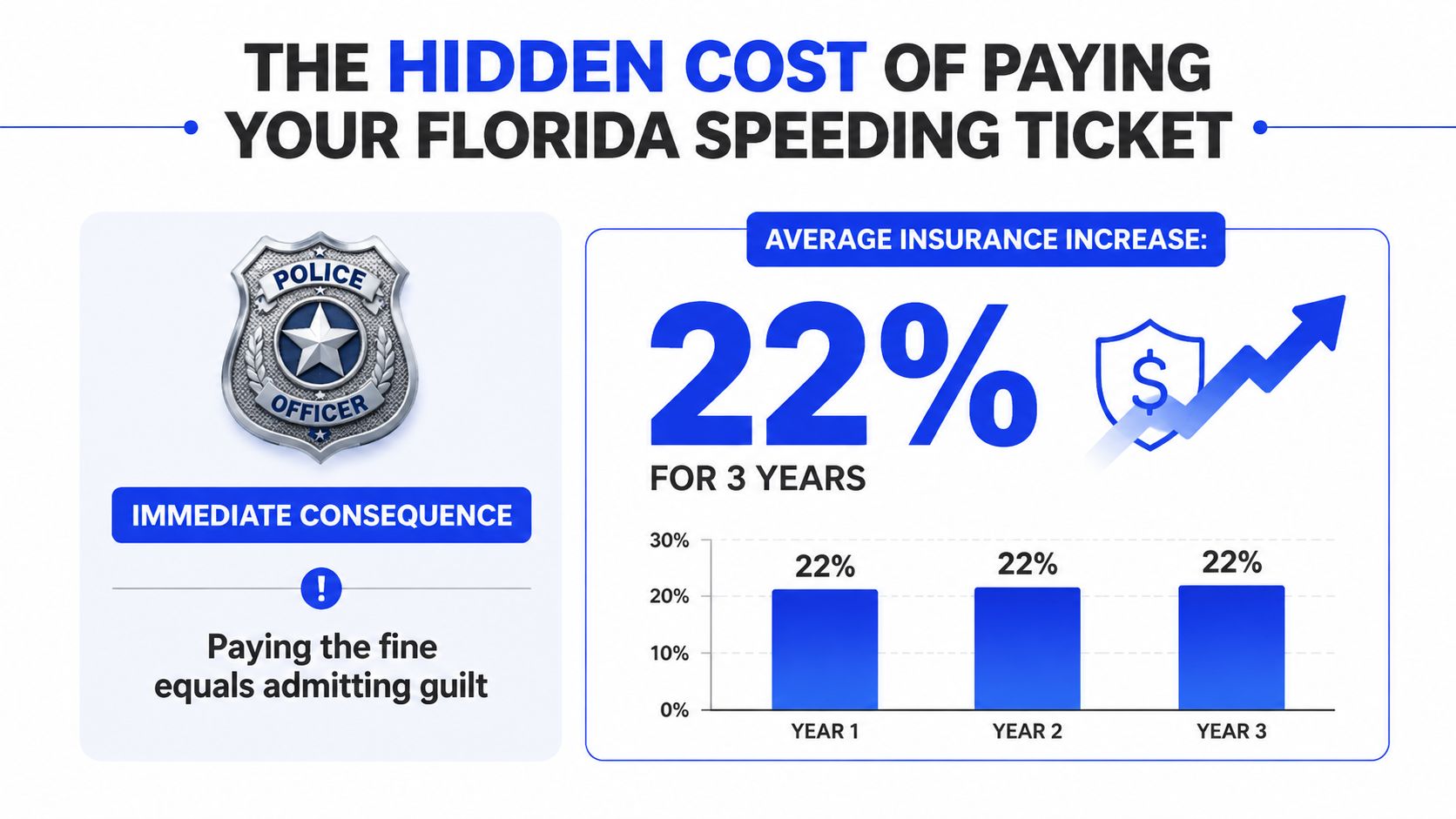
Why the fine is only the beginning
A conviction can also add points under Florida's system. Those points may combine with prior violations and create license-suspension exposure. Even when the points later stop counting toward a particular administrative total, the conviction may remain relevant to insurance underwriting.
Practical rule: Don't pay a Florida speeding ticket until you know exactly what payment will do to your license and insurance position.
Florida's enforcement environment is active and sustained. In Great Britain, official statistics recorded 2.52 million fixed penalty notices for speeding in 2022, which was 6% higher than the previous year and 69% above 2011 levels. The same official series reported 205,522 people found guilty of a speed-limit offence in 2024, still 87% higher than in 2011. The official vehicle speed compliance statistics illustrate the broader point: speeding citations are treated as recurring record events, not isolated inconveniences.
For Florida drivers, the strategic conclusion is straightforward. Defend the citation before it becomes a record event. A lawyer can review the allegation, evaluate the evidence, and pursue a result designed to avoid points where the facts and law permit.
How Florida Assigns Points for Speeding Violations
Florida doesn't assign the same consequence to every speeding allegation. The speed over the lawful or posted limit controls the point value, and the presence of a crash can increase the administrative impact.
Florida Highway Safety and Motor Vehicles states that unlawful speed under the applicable Florida statutes is worth 3 points when the speed is not more than 15 mph over the lawful or posted limit. Unlawful speed more than 15 mph over is worth 4 points, while unlawful speed resulting in a crash is worth 6 points. The agency also identifies 4 points for speed in excess of 50 mph under the listed provisions. Florida Highway Safety and Motor Vehicles' point and suspension guidance explains these assignments.
Florida speeding point assignment matrix
Speed Over Limit | Points Assigned | Additional Consequences |
|---|---|---|
Not more than 15 mph over | 3 points | Adds to the driver's formal point total and may affect insurance underwriting |
More than 15 mph over | 4 points | Creates greater point exposure and may increase the significance of the conviction |
More than 50 mph over | 4 points under the listed speeding provisions | May involve dangerous excessive-speeding analysis under separate statutory rules |
Unlawful speed resulting in a crash | 6 points | Creates heightened license and record consequences |
The table shows why a driver shouldn't describe a ticket as “only a few miles over” without checking the exact allegation. The difference between 3 points and 4 points can matter when your record already contains prior convictions.
A speeding citation also differs from a more serious statutory offense. A standard speeding matter may be handled as a civil traffic infraction, while dangerous excessive speeding can create separate mandatory penalties and revocation exposure. You need the exact statute and allegation, not a general estimate based on what happened during the roadside stop.
The speed written on the citation can determine whether your case remains a manageable record issue or becomes a serious license problem.
A defense strategy should therefore begin with the citation itself, your current point history, and the evidence supporting the alleged speed. Don't assume the officer's number automatically determines the outcome.
Understanding Florida Statute 316.187 and Speed Limits
Florida Statute 316.187 supplies legal authority for speed limits established by the Florida Department of Transportation. The statute states that violations of speed limits established under the section must be cited as moving violations and are punishable under Chapter 318. It also identifies maximum speeds for certain roadways, including 70 mph on limited-access highways and 65 mph on qualifying divided highways outside urban areas with 5,000 or more people. Florida Statute 316.187 provides the governing text.
A valid defense starts by separating three questions:
Was the limit legally established? The state must connect the alleged violation to a lawful statutory or posted limit.
Was the limit properly communicated? Signage and roadway conditions can matter when the defense examines whether a driver had reasonable notice.
Can the state prove the alleged speed? The prosecution still needs reliable evidence tying you to the claimed speed.

Evidence deserves careful review
A lawyer may examine the officer's observations, the location of the alleged violation, the posted limit, and the method used to measure speed. That can include reviewing available radar or lidar documentation, equipment maintenance materials, officer training records, video, and the wording of the citation.
The statute does not allow an officer's personal impression to replace the legal speed limit and proof requirements. A defense may focus on an incorrect limit, unclear signage, an unsupported measurement, or another defect in the state's proof. The outcome depends on the facts and the available evidence.
For a deeper explanation of how Florida's statutory speed rules operate, review what prima facie speed limits mean in Florida. Don't build your defense around a guessed technicality. Have counsel identify which issue is supported by the record and can be raised effectively.
Why Your Ticket Stays on Your Insurance Record Longer Than You Think
You pay a Florida speeding ticket, watch the points eventually disappear, and expect your insurance bill to recover. That assumption can cost you. DMV point expiration and insurance underwriting look-back periods are separate systems.
DMV points often expire in about 2 to 3 years, while insurers may consider a violation for 3 to 5 years. Some systems may hide a ticket from insurers only after specific steps, such as completing traffic school. Liberty Mutual's guidance on speeding tickets and insurance costs explains why administrative points and insurance treatment follow different timelines.
The record has more than one timeline
A violation can stop counting toward your DMV point total while the conviction remains visible on a motor vehicle report or affects renewal underwriting. New York illustrates the distinction, although Florida drivers must apply Florida-specific rules. In New York, speeding-ticket points stop counting toward DMV totals after 24 months from the violation date, but the conviction remains on the driving record as long as it stays there and may still be considered by insurers. The referenced DMV record analysis describes that separation.
Florida drivers should apply the same practical warning: a point-free DMV total does not guarantee a premium-free insurance history. An insurer can evaluate convictions under its own underwriting rules, and renewal decisions may arrive long after the state's point calculation changes. Read understanding how much a speeding ticket raises your Florida insurance premium before deciding that the financial impact is over.
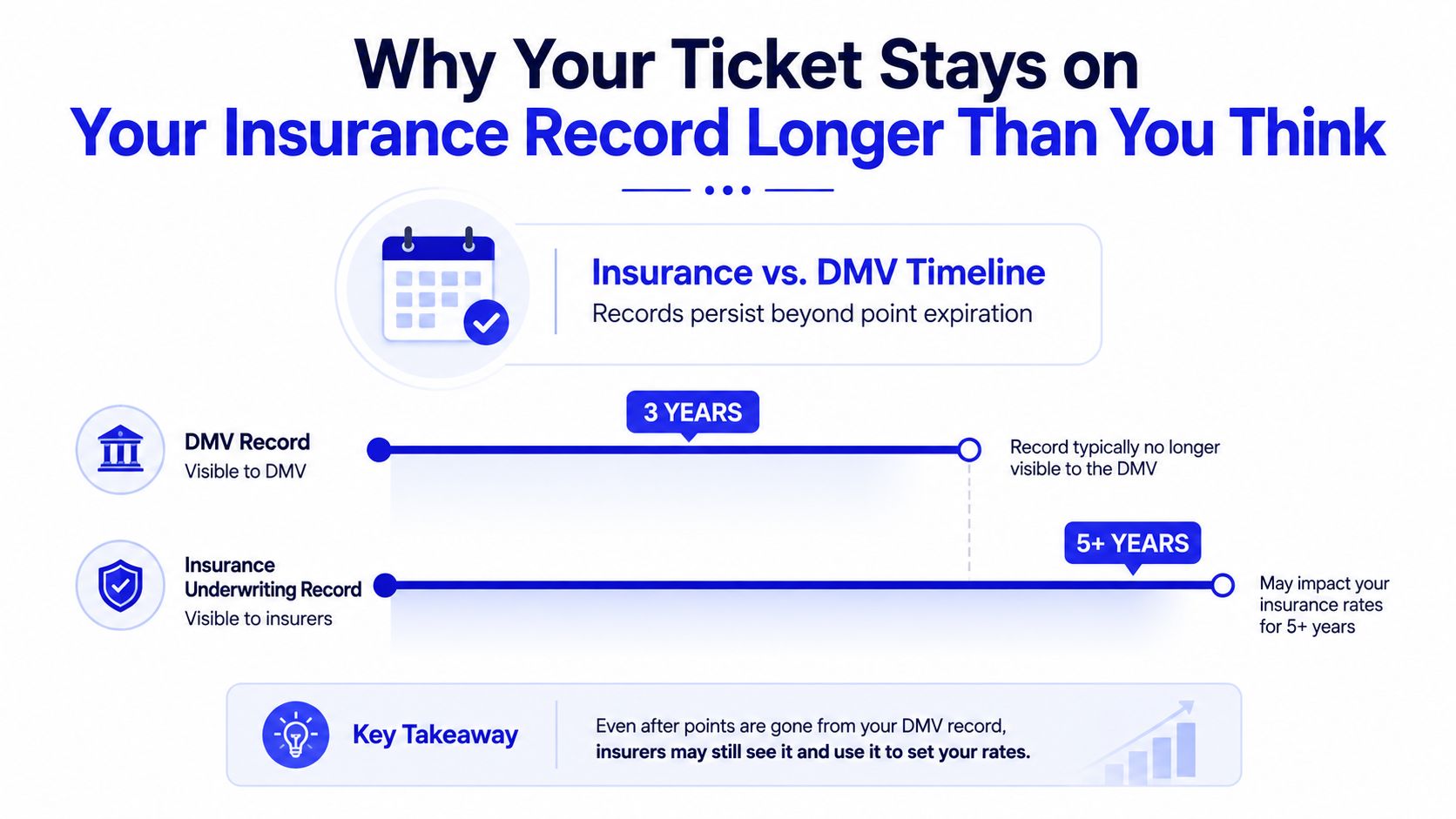
Waiting is not a defense. Once a conviction enters the system, you may have little control over how agencies and insurers interpret it. Your strongest option is to prevent the conviction, pursue dismissal, or seek a lawful resolution that protects your record when available.
Speak with a lawyer about insurance consequences before choosing payment, traffic school, or another resolution. Automated ticket systems cannot reliably account for your underwriting exposure. Ask, “Will this conviction still affect my insurance?” Direct attorney communication gives you the clearest answer before a decision becomes difficult to undo.
The Severe Penalties of Dangerous Excessive Speeding
Florida treats dangerous excessive speeding differently from an ordinary speeding infraction. Section 316.1922, within Chapter 316, creates a separate offense for driving 50 mph or more over the limit, or driving 100 mph or more while committing a moving traffic violation and causing a crash or serious bodily injury. The statute's requirements and penalties appear in Florida's Chapter 316 statutory text.
For a first violation, the statute requires either a $500 fine or 25 hours of community service, and it adds 6 points. A second or subsequent violation requires a $1,000 fine and another 6 points. A second or subsequent conviction within 5 years triggers a driving-privilege revocation of at least 180 days and up to 1 year.
Standard versus excessive speeding penalties in Florida
Penalty Category | Standard Speeding, 1 to 29 mph over | Excessive Speeding, 50+ mph over or 100+ mph |
|---|---|---|
Classification | Ordinary speeding allegation, subject to the applicable citation | Separate dangerous excessive-speeding offense when statutory conditions apply |
Points | Often 3 or 4, depending on the speed and circumstances | 6 points under the dangerous excessive-speeding statute |
Mandatory financial or service consequence | Depends on the citation and resolution | First violation requires a $500 fine or 25 hours of community service |
Repeat-offense consequence | Depends on the record and applicable law | Second or subsequent violation requires a $1,000 fine; qualifying repeat conviction may trigger revocation |
Defense posture | Review proof, limit, equipment, and procedural facts | Immediate attorney intervention is critical because mandatory consequences may apply |
A dangerous excessive-speeding allegation demands immediate legal review. The attorney should examine the recorded speed, roadway limit, crash allegations, statutory wording, measurement method, and whether the facts satisfy every required element.
Read what Florida criminal speeding means before treating an extreme-speed citation like a routine fine. The consequences can reach beyond ordinary point assessment.
Point Accumulation and License Suspension Thresholds
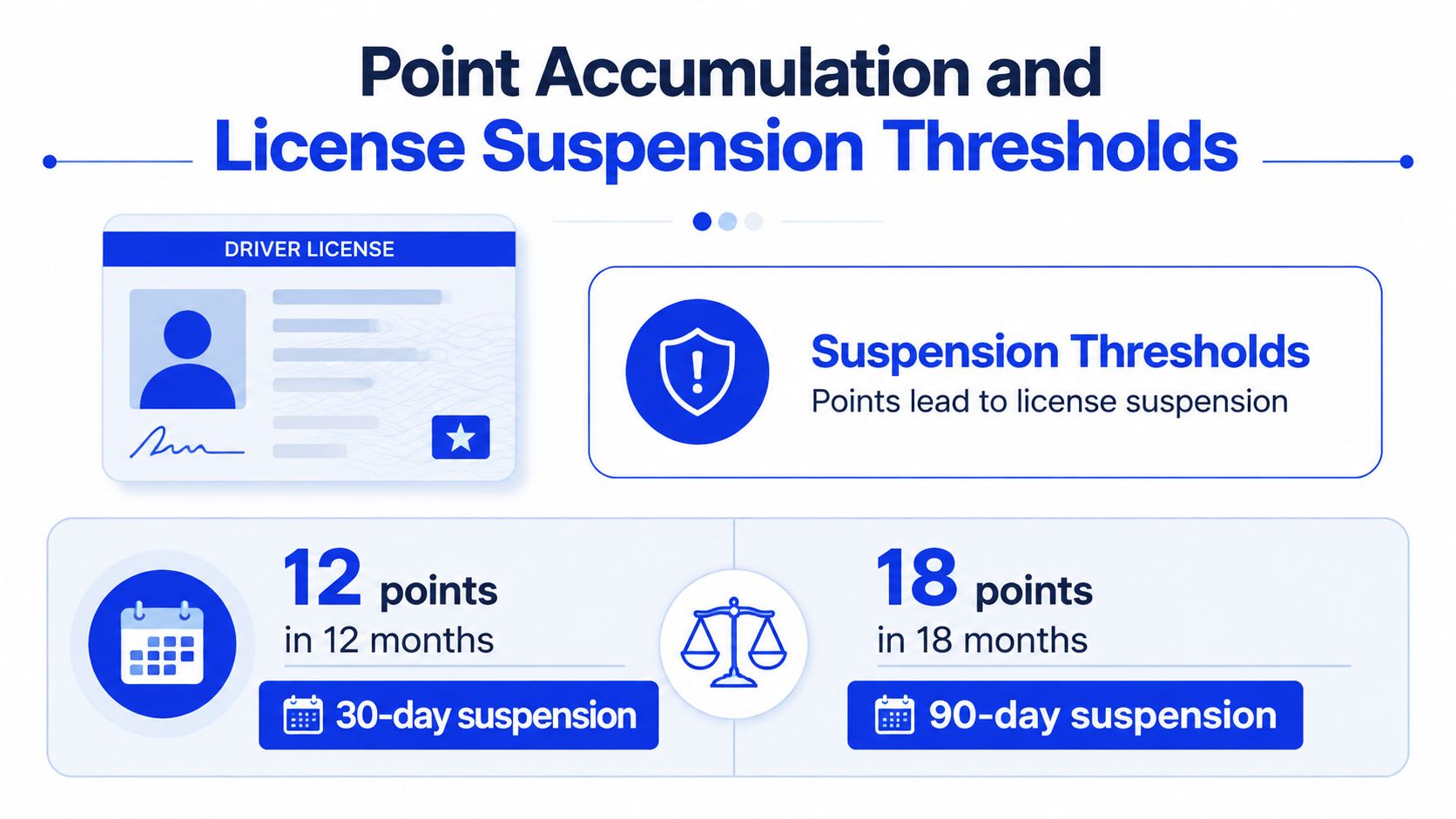
A speeding ticket can look minor until it becomes the violation that crosses a suspension threshold. Florida counts violations across defined time periods, so paying each citation separately can hide the risk building on your driving record.
Florida imposes a 30-day suspension at 12 points within 12 months, a 3-month suspension at 18 points within 18 months, and a 1-year suspension at 24 points within 36 months. Review the agency's Florida driver-license point guidance to confirm how these thresholds apply to your record.
Read your record before choosing a resolution
Check the violation dates, conviction dates, point values, and prior suspension notices before choosing how to resolve a ticket. A 3-point or 4-point assessment can determine whether an existing record reaches the suspension limit.
Traffic school may be available, but it is not a universal fix. Florida Statute 318.14(9) limits a driver's school election to five times in a lifetime. Confirm eligibility first, then assess how the election affects your record and insurance position. Clearing points from a DMV record does not necessarily end the financial consequences. Insurers may use a longer underwriting look-back period, allowing an older ticket to influence premiums after the points no longer control your license.
Before accepting payment, school, or another resolution, answer four questions:
What points are already active? Obtain your current Florida driving record.
Which time window applies? Compare every violation date with the relevant rolling period.
Which outcome protects the record? Evaluate dismissal, withholding of adjudication where legally available, and other defense options before making an election.
What will payment trigger? Confirm the point and insurance consequences first.
Use this Florida driver-license points explanation to review the basic rules, then speak directly with an attorney about your dates, prior violations, and insurance exposure. Automated ticket mills cannot reliably account for the gap between DMV point expiration and insurer underwriting. Direct attorney communication gives you a real strategy before the ticket is resolved.
Why You Need a Lawyer Instead of an Automated App
Automated ticket apps process cases at scale. That model may be convenient, but convenience isn't the same as a defense strategy. A chatbot or intake portal usually can't question the officer about positioning, analyze the measurement evidence, inspect signage, or decide whether a hearing is worth pursuing based on your specific record.
A lawyer can look beyond the citation's basic fields. The review may include:
Measurement evidence: Determine how radar, lidar, pacing, or another method was used and whether supporting records exist.
Officer documentation: Compare the citation, report, testimony, training information, and available video for inconsistencies.
Roadway proof: Examine the posted speed limit, signage, location, and statutory authority for the limit.
Record exposure: Assess how the proposed resolution could affect points, suspension risk, and insurance underwriting.
Middlemen create dangerous gaps
Ticket mills often rely on a volume process. You may communicate with a corporate answering service, an intermediary, or an automated system instead of the attorney handling the legal strategy. When the prosecutor rejects a generic request or the court requires a more focused response, you may not know who is responsible for protecting your case.
Direct attorney communication changes the quality of the consultation. You should be able to explain what happened, ask why a particular resolution is being considered, and receive a clear answer from the lawyer handling the matter.
Ticket Shield, PLLC offers a lawyer-led Florida traffic defense model in which clients can communicate directly with their attorney by phone or text. The firm handles speeding matters and may evaluate evidence, challenge proof, and pursue outcomes designed to avoid points when the law and facts support that result.
Ask before hiring: Who is reviewing my citation, who is appearing for me, and can I speak directly with that attorney?
Read why an attorney is different from a speeding-ticket app before choosing an automated service. A cost-effective decision should account for the full record and insurance consequences, not just the initial service price.
Immediate Steps to Protect Your Driving Privilege
Your first decision can determine whether you preserve legal options. Don't pay online or at the clerk's office because the process is easy. Payment can resolve the citation while also creating the record consequences you were trying to avoid.
Use this immediate checklist:
Secure the citation. Photograph every page and preserve the original. Record the exact location, alleged speed, posted limit, date, time, weather, traffic conditions, and anything the officer said about the stop.
Do not make an admission. Avoid written or recorded statements that concede the violation before a lawyer reviews the case.
Preserve video. Request available dashcam or body-camera footage through the appropriate public-records process. Keep copies of every request and response.
Check your record. Obtain your Florida driving record so counsel can identify existing points, prior convictions, and suspension exposure.
Contact a Florida traffic lawyer promptly. Discuss the citation before selecting payment, traffic school, a hearing, or another resolution.
Why timing matters
Evidence can become harder to obtain as time passes. Video retention, equipment records, witness recollection, and officer availability all affect how effectively a defense can be prepared. Your attorney also needs enough time to evaluate the citation and preserve the available procedural options.
Don't rely on a general internet answer about whether a ticket will “fall off.” The correct strategy depends on the charge, the proof, your record, and the resolution options in the court handling the citation. A direct legal review is more reliable than an automated recommendation that doesn't know your facts.
Secure Your Defense and Keep Points Off Your License
You received a speeding ticket, not a final judgment about your driving future. The citation still needs to be evaluated, and the state still has to support the alleged violation through the applicable legal process.
A strategic review can identify problems with the alleged speed, roadway limit, equipment evidence, citation details, or officer testimony. Depending on the circumstances, the defense may pursue dismissal, challenge the allegation, or seek a resolution that avoids points. No lawyer can promise a particular result, but you can protect yourself by making the decision before payment locks in the record consequences.
The insurance question should remain central. A DMV point total and an insurer's underwriting history don't always move together, so waiting for points to expire may leave the financial problem unresolved. Protecting the speeding ticket record starts before conviction, not after the premium increase appears.
If you're stressed, act today. Gather the citation, check your Florida driving record, and speak with a lawyer who will explain the available path directly instead of sending you through an automated system.
Ticket Shield, PLLC provides lawyer-led Florida speeding-ticket defense with direct attorney communication by phone or text, evidence review, and strategic efforts to keep points off your license. Visit Ticket Shield, PLLC for a free consultation and take the first step toward the ultimate goal, achieving “No Points” on your license.