Speeding Ticket Fighting: Proven Florida Strategies for 2026
Learn proven speeding ticket fighting strategies in Florida. From evidence gathering to court hearings, protect your record and pursue no points on your

You just got the ticket, and the first instinct is to breathe out, pay it, and move on. That's the wrong move. In Florida, a speeding citation can follow you far longer than the roadside stop, because the cost shows up in points, insurance, and suspension risk, not just the fine on the face of the ticket.
Table of Contents
Why Paying the Ticket Is the Most Expensive Choice
The citation is sitting in your hand, and the clerk's website makes payment look easy. That ease is the trap. Once you pay, you're usually accepting the violation, and for a speeding case that can mean a record hit that keeps working against you long after the stop is over.
Florida treats speeding as a point-producing offense, and the state's points schedule shows that 4 points apply when a driver is cited under sections 316.183(2), 316.187, or 316.189 for speed in excess of 50 mph, according to Florida Highway Safety and Motor Vehicles. That matters because points don't live in a vacuum. They stack with other violations over time, and once you cross suspension thresholds, the ticket stops being a nuisance and starts becoming a licensing problem.
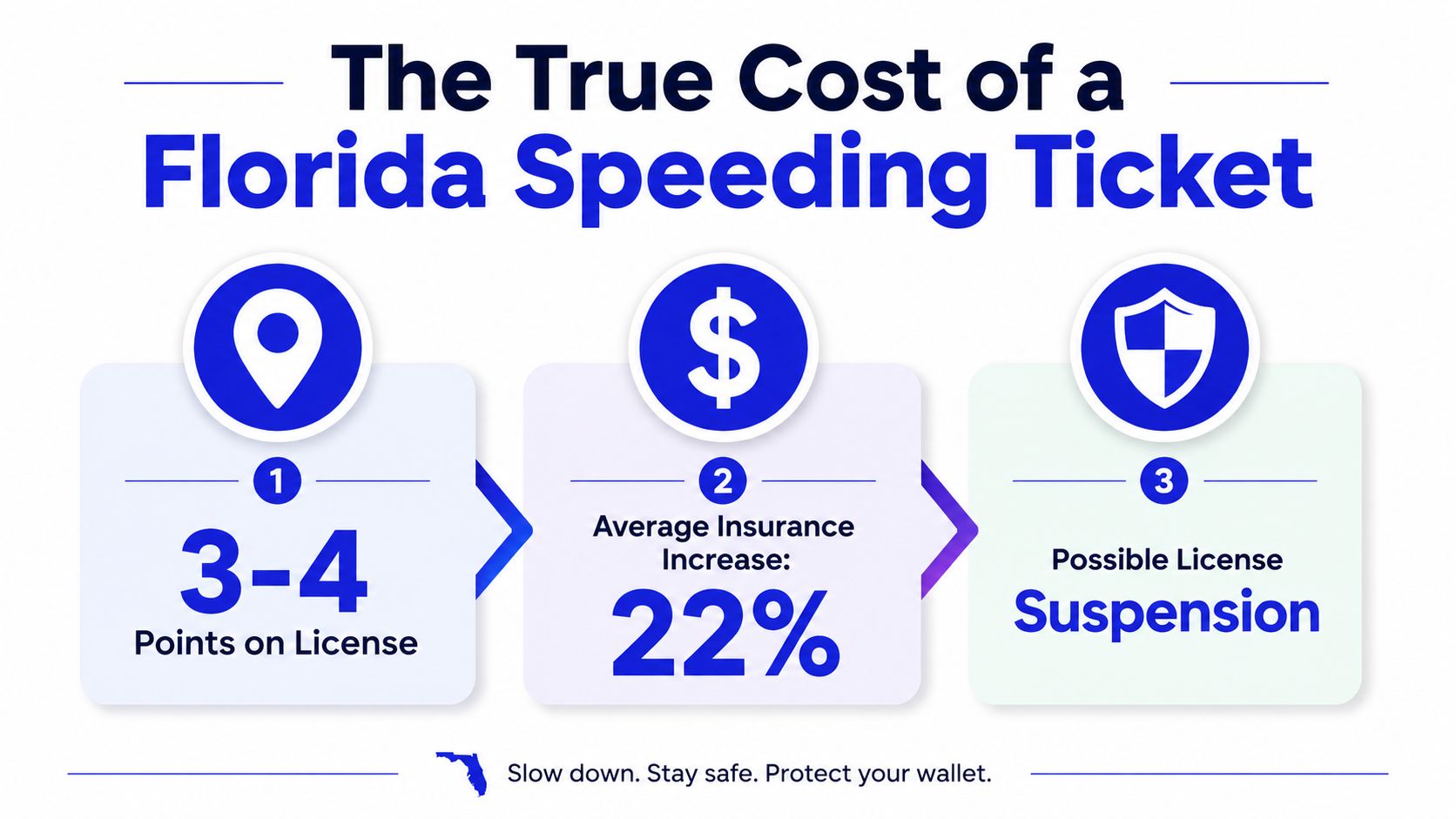
Practical rule: if you can lawfully keep the conviction off your record, you usually should. The fine is the smallest part of the damage.
A conviction can also drag in the kind of consequences drivers feel every month, not just once. The traffic-ticket cost question is why you should read a direct comparison like when to pay versus hire a lawyer before you make a fast decision that turns into a long one.
Florida Speeding Cost Cascade | Typical Range | Time Window |
|---|---|---|
Court fine and court costs | Varies by citation and county | Immediate |
Points on license | 4 points for certain high-speed citations under Florida's schedule | Stays on the driving record during the applicable points window |
Insurance and record impact | Potentially far more than the ticket itself | Multi-year effect after conviction |
A guilty plea is not the safe default. It's the expensive default.
The Florida Legal Framework You Are Fighting Under
Paying the ticket turns the charge into a conviction, and that conviction affects your record, insurance, and license status. Start with the law that governs the stop, then build your defense around it.
Florida gives you a legal map, and you need to read it before you argue facts. Florida Statute 316.187 is one of the key speed-limit statutes in Chapter 316. It lets the Florida Department of Transportation set or change speed limits after an engineering and traffic investigation shows the current speed is not reasonable or safe, and those limits take effect when proper signs are posted. The statute also sets a 70 mph maximum on limited-access highways and a 60 mph ceiling for other roadway limits under FDOT authority, according to the text of section 316.187.
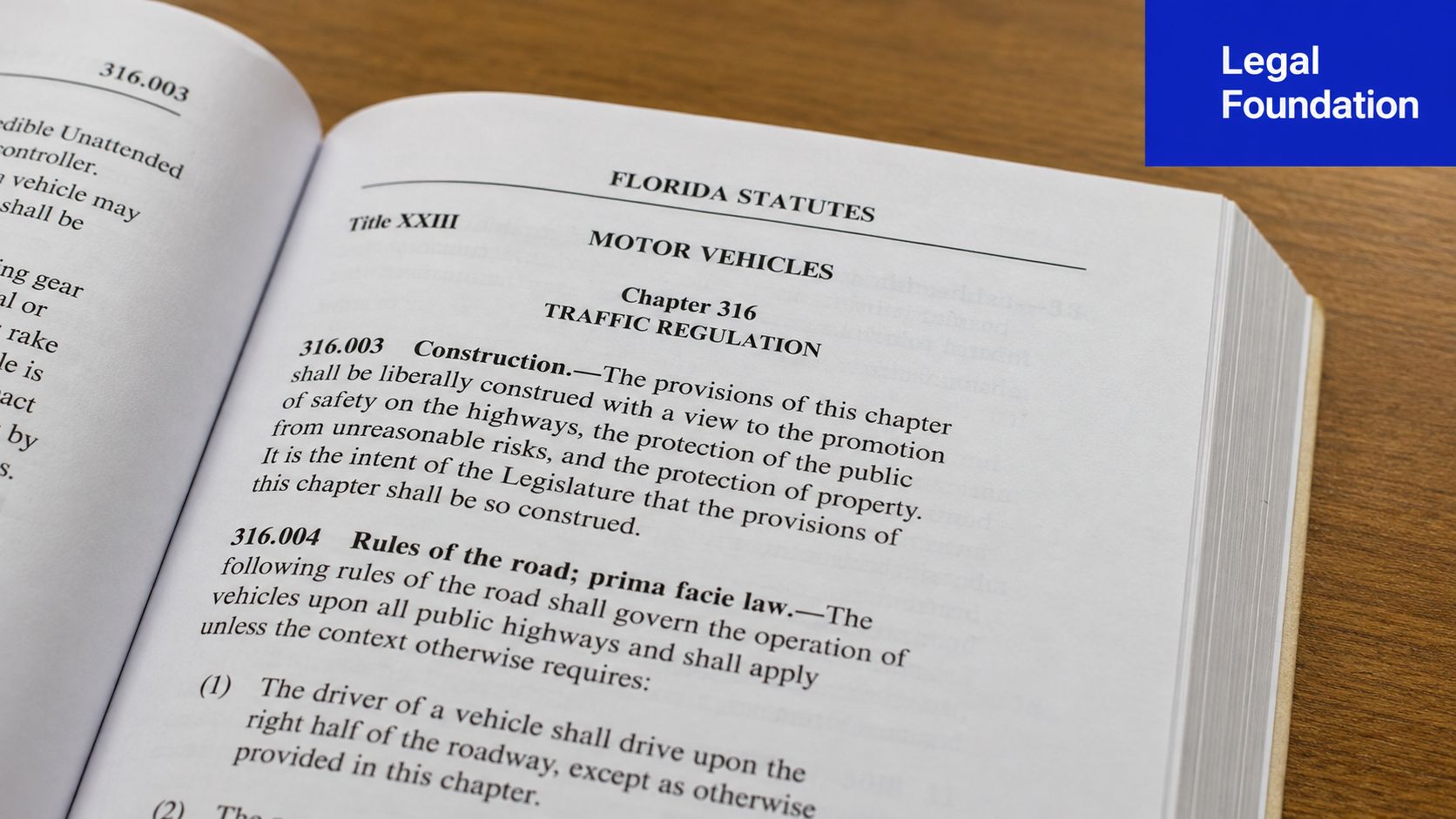
The point system is the other half of the fight. Florida tracks points across multiple windows, not one. Under the state's suspension thresholds, 12 points in 12 months can trigger a 30-day suspension, 18 points in 18 months can trigger a 3-month suspension, and 24 points in 36 months can trigger a 1-year suspension, according to Florida's point-suspension guidance.
That matters because one speeding case rarely stands alone. If your record already carries points, the next citation lands on top of the old ones and moves you closer to a licensing problem.
The statute alone does not tell you how officers, prosecutors, and judges usually frame these cases. For that practical view, read how Florida speeding law is framed in practice. Know the charge, know the penalty matrix, and do not argue blind.
Pre-Court Options That Can End the Case Before a Hearing
Most drivers wait too long, then act surprised when the court says the easiest path is gone. In Florida traffic practice, the first move is simple. Check the docket, confirm the deadline, and decide whether the case can be handled without a live hearing. Public court systems often let you search by citation number or driver's license number, which is the fastest way to see the court, the status, and the contest window. For a quick reference on the main paths, Florida speeding ticket options lays them out clearly.
The options below apply to most Florida counties. Your local court may have extra procedures, so verify that first.
The first move is documentation
Before you choose a path, gather the citation, the court name, and any notice that came with the ticket. If you plan to contest by written declaration, many jurisdictions require a full fine deposit first, with a refund only if you win. That is not a reason to avoid the process. It is a reason to treat the process seriously and choose the right one.
Traffic school is a tool, not a surrender
Basic driver improvement school works when your goal is to protect the record, not to stage a courtroom fight. Use it when the case is weak enough that preserving your license matters more than pressing for dismissal. If the citation has a real defect or the stop was handled poorly, school can give up value you might have kept. The mistake is pleading too early, before you know whether the ticket can still be challenged.
Deadline discipline wins cases
Miss the contest deadline and the court usually stops caring about your explanation. The same is true if you wait too long to request mitigation where that option exists. In Florida, the contest window is typically 30 days from the citation date. Check your local court's rules for the exact deadline.
If the deadline passed, the best defense in the world may be too late.
The right pre-court move preserves your position. The wrong one closes off options you may not get back.
Building the Evidence That Moves Speeding Cases
Speeding cases are not won by talking louder than the officer. They are won by making the state prove the number on the citation, step by step. Focus on the measurement chain, not roadside drama. Radar, lidar, pacing, and officer observation each leave a different proof trail, and each trail has weak points.
Start with the paper trail. Ask for the citation, the officer's notes, any calibration or maintenance records tied to the speed-measurement device, and any dashcam or bodycam footage that captured the stop. If a device was used, ask whether it was tested and whether the operator was trained or certified. If witnesses or nearby drivers saw the traffic conditions, get those statements too.
You also need to know how the reading was made. A clear explanation of how radar speed guns work helps you see where the state's proof can crack.
Here is what drivers miss. The state does not need every document to file the case, but the defense only needs one weak link to create doubt. Missing calibration records, incomplete notes, unclear video, and sloppy testimony all help you. A ticket that looks routine on paper can become shaky once discovery starts.
Texts and messages can matter too. If your own records help show where you were, when you were notified, or what you were told after the stop, read protecting messages for legal cases and preserve them now.
Evidence rule: do not argue the whole case first. Force the state to show the device, the record, and the person behind the number.
If the citation lists a speed far above the posted limit, calibration records become the document that matters most. Request them immediately.
Courtroom Strategy From Plea to Verdict
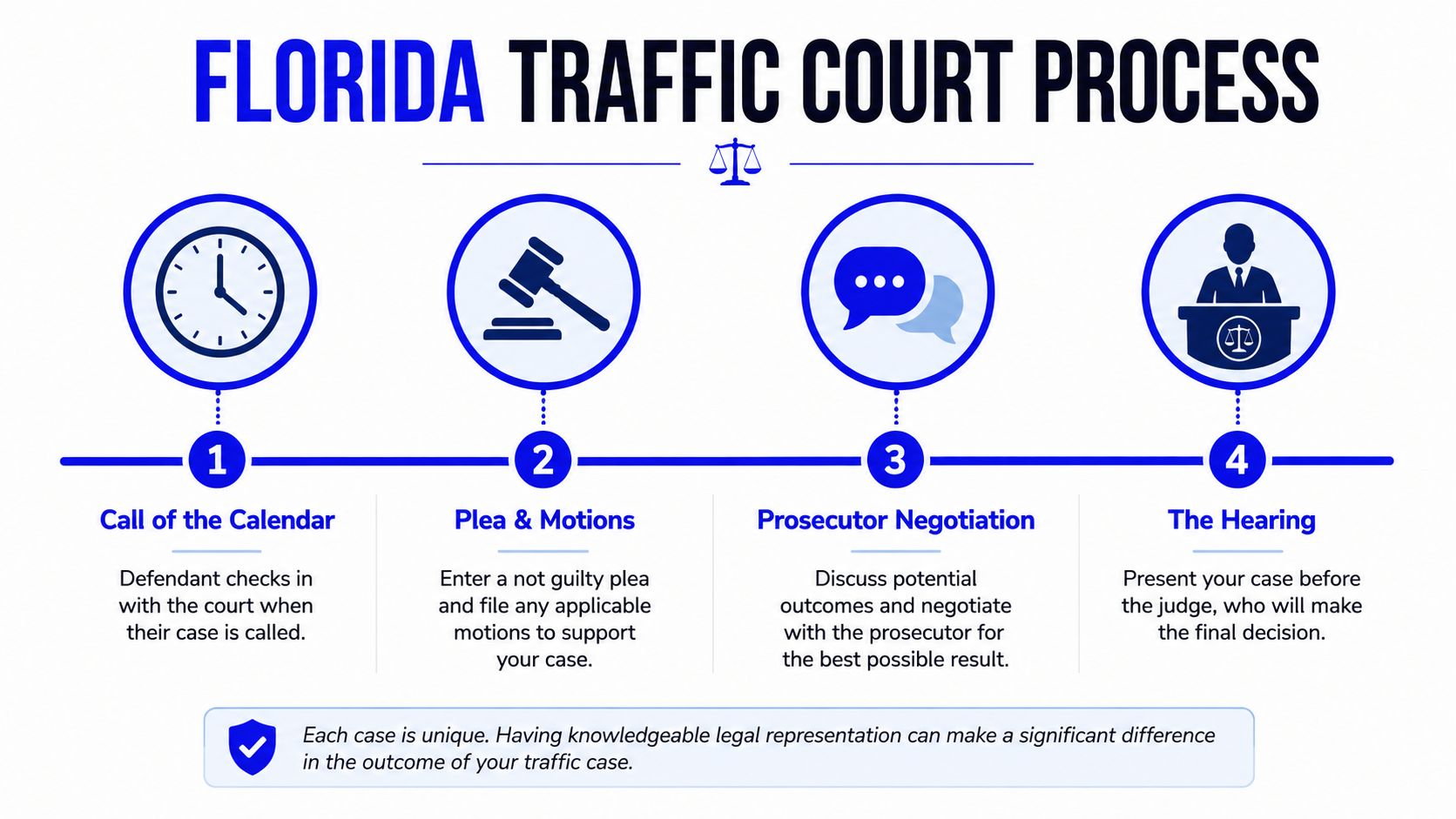
A Florida traffic courtroom runs on procedure. That's good for you if you stay calm and follow the sequence. You check in, the calendar is called, the plea is entered, and then the case moves into motions, negotiation, or a live hearing. Drivers who understand that rhythm usually do better than drivers who treat it like a personal argument with a uniform.
Start by controlling the plea
A not guilty plea keeps your options open. That matters because it preserves your ability to request discovery, challenge the evidence, and negotiate from a position of refusal rather than acceptance. Once you've given up that ground, your bargaining power gets thinner fast.
Officer absence changes the room
If the officer doesn't appear, your position changes immediately. The court may continue the matter, but the absence often weakens the state's presentation and can create room for dismissal or a better negotiated resolution. That doesn't mean you celebrate early. It means you stay ready to ask for the right outcome at the right moment.
Cross-examine the method, not the person
The fastest way to lose credibility is to turn a hearing into a shouting match. Focus on how the speed was measured, what the officer observed, and whether the documentation matches the stop. A calm, method-based challenge keeps the judge on your side and gives the prosecutor a cleaner reason to reduce the charge.
Typical negotiated results include a reduced speed, school election, withhold, or dismissal. Those outcomes are not guaranteed, but they are realistic enough that you should pursue them with intent rather than hope.
For a plain-English look at courtroom decision points, the topic is also handled in Florida speeding ticket strategy materials. The hearing is a procedure, not a personality contest. Drivers who understand that usually leave with a better result.
Lawyer-Led Defense Versus Automated Ticket Apps
Automated apps sell convenience. They give you forms, upload portals, and status pings. That is fine for paperwork. Effective defense depends on motions, negotiation, and courtroom judgment.
A lawyer-led defense works differently from the start. You get someone who can read the citation, test the officer's proof, and change course when the docket changes. If the case needs a motion, a negotiation call, or a hearing decision, a direct attorney can make that call. Ticket Shield, PLLC is built for that kind of handling, with direct phone and text communication instead of a middle layer of automated support.
That difference matters when the case gets messy. Independent legal-industry analysis has reported better outcomes for represented drivers than for people who handle the case alone, with complete dismissals in a meaningful share of cases through technical defenses, procedural errors, or insufficient evidence, according to one traffic-outcome analysis. For speeding cases, the same source reported dismissals tied to calibration and technical challenges. Those figures do not guarantee a win. They do show that process quality matters.
Defense Model Comparison | Lawyer-Led Defense | Automated App or Ticket Mill |
|---|---|---|
Communication | Direct phone or text access to the attorney | Forms, queues, or scripted support |
Strategy | Adjusts to the citation, officer, and docket | Usually follows a fixed workflow |
Courtroom value | Can handle negotiation and hearing decisions | Often optimized for filing, not advocacy |
Outcome focus | Protecting record, points, and leverage | Convenience first, sometimes at the expense of depth |
A good app can collect documents. It cannot read a judge, press a prosecutor, or decide whether to push for dismissal, reduction, or a better plea. If you want to see how the app model is pitched, read this Ticket Shield review of ticket apps. If you want a reminder that process design drives results in legal marketing and intake too, the Algomizer guide to legal client acquisition makes the point plainly.
Take the Next Step Toward No Points on Your License
Treat the case like a sequence, not a slogan. Check the deadline. Demand the records. Challenge the measurement. Force the state to prove the stop. That order matters because a missed deadline, weak paperwork, or a sloppy speed reading can change the result fast.
As noted earlier, Florida point totals can lead to suspension if you ignore the citation and let points stack up. That is why a speeding ticket deserves immediate attention, especially when a reduction or dismissal can protect your license before the case hardens into a bigger problem.
Defense Model Comparison | Lawyer-Led Defense | Automated App or Ticket Mill |
|---|---|---|
Communication | Direct phone or text access to the attorney | Forms, queues, or scripted support |
Strategy | Adjusts to the citation, officer, and docket | Usually follows a fixed workflow |
Courtroom value | Can handle negotiation and hearing decisions | Often optimized for filing, not advocacy |
Outcome focus | Protecting record, points, and insurance rates | Convenience first, sometimes at the expense of depth |
A good app can collect documents. It cannot read a judge, press a prosecutor, or decide whether to push for dismissal, reduction, or a better plea. If you want real protection for your record, call Ticket Shield, PLLC and get a lawyer who will run the defense, not a form that just files it.