Speeding Ticket Attorney Cost in Florida Explained
Learn speeding ticket attorney cost in Florida by severity and outcome, plus when hiring pays for itself in points and insurance savings.

In Florida, a routine speeding ticket lawyer often charges a flat fee of about $50 to $300, while a speeding case that requires a court appearance often lands around $300 to $800. That fee is separate from your ticket fine, which means your real decision isn't just what the citation costs today. It's what a conviction can cost your record next.
You're probably looking at a citation on your kitchen counter, wondering whether hiring a lawyer makes any sense if the fine looks manageable. That's the trap. Most drivers compare the attorney fee to the fine and stop there. In Florida, that's the wrong comparison.
The right comparison is this: what does this ticket do to your license, your points, and your insurance risk if you pay it? A speeding ticket is rarely just a one-time payment. It can become a record problem.
A good Florida defense decision is about break-even, not sticker shock. And if you're dealing with a court-required case, a high-speed allegation, or a record you can't afford to damage, direct access to a real attorney matters a lot more than an automated app or a ticket mill that routes you through a call center.
Table of Contents
What You Actually Pay When You Get a Florida Speeding Ticket
How Florida Law Defines Speeding and Why It Changes Your Cost
When the Attorney Fee Pays for Itself in Points and Insurance Savings
Protect Your License With a Free Consultation Focused on No Points
What You Actually Pay When You Get a Florida Speeding Ticket
The moment you sign a speeding citation, you're on the clock. Then the question hits. Do you pay it and move on, or do you fight it?
If you just pay the ticket, you're not buying convenience. You're usually closing the case by accepting the violation. That's why the first number you should care about isn't only the fine. It's the total cost of the conviction.
Your cost has two separate parts
The money side usually breaks into two categories:
Cost Category | What It Covers | Why It Matters |
|---|---|---|
Statutory fine | The amount tied to the citation itself | This closes the ticket, but it doesn't tell you the long-term impact |
Attorney fee | What you pay a lawyer to defend the case | This is a separate flat fee in many speeding cases |
National pricing guides consistently show speeding defense is usually billed as a flat-fee matter, not hourly work. One long-running guide places routine traffic-ticket attorney fees around $50 to $300, with more involved matters often falling in the $300 to $800 range, and some contested or appeal-level work going higher. The same guide places the average traffic-ticket lawyer fee at about $250 per ticket, with a broader common range of $100 to $500 in many cases, as outlined in this traffic-ticket attorney cost guide.
The mistake drivers make
Drivers often say, “Why would I pay a lawyer more than the fine?”
Because the fine isn't the whole bill.
A neutral legal cost guide points out the gap in most discussions of speeding ticket attorney cost. The attorney fee can exceed the fine on a low-level ticket, but that still may be rational when points, insurance consequences, and record exposure matter more than the ticket amount alone, as explained in this breakdown of speeding ticket lawyer cost.
Practical rule: Don't compare lawyer fee versus fine. Compare lawyer fee versus the cost of a Florida conviction on your record.
That distinction matters even more if your job depends on driving, your record is already carrying prior issues, or the officer wrote the speed high enough that the court is going to treat the case more seriously.
If you want a broader look at what Florida tickets can really cost once the direct and indirect consequences are on the table, review this guide on Florida traffic ticket cost.
How Florida Law Defines Speeding and Why It Changes Your Cost
Florida doesn't treat every speeding case the same, and neither should you. Cost rises with exposure. Exposure comes from the statute, the speed alleged, and whether the case stays simple or starts demanding court time.
The legal authority behind your ticket
Florida gives law enforcement clear authority to write speeding tickets under Chapter 316. Under section 316.187, a driver must operate at a careful and prudent speed and must not exceed posted limits. Under section 316.183, Florida sets statewide maximum speed limits, including 30 mph in business or residence districts and 55 mph in other locations, as stated in Florida's Chapter 316 speed statutes.
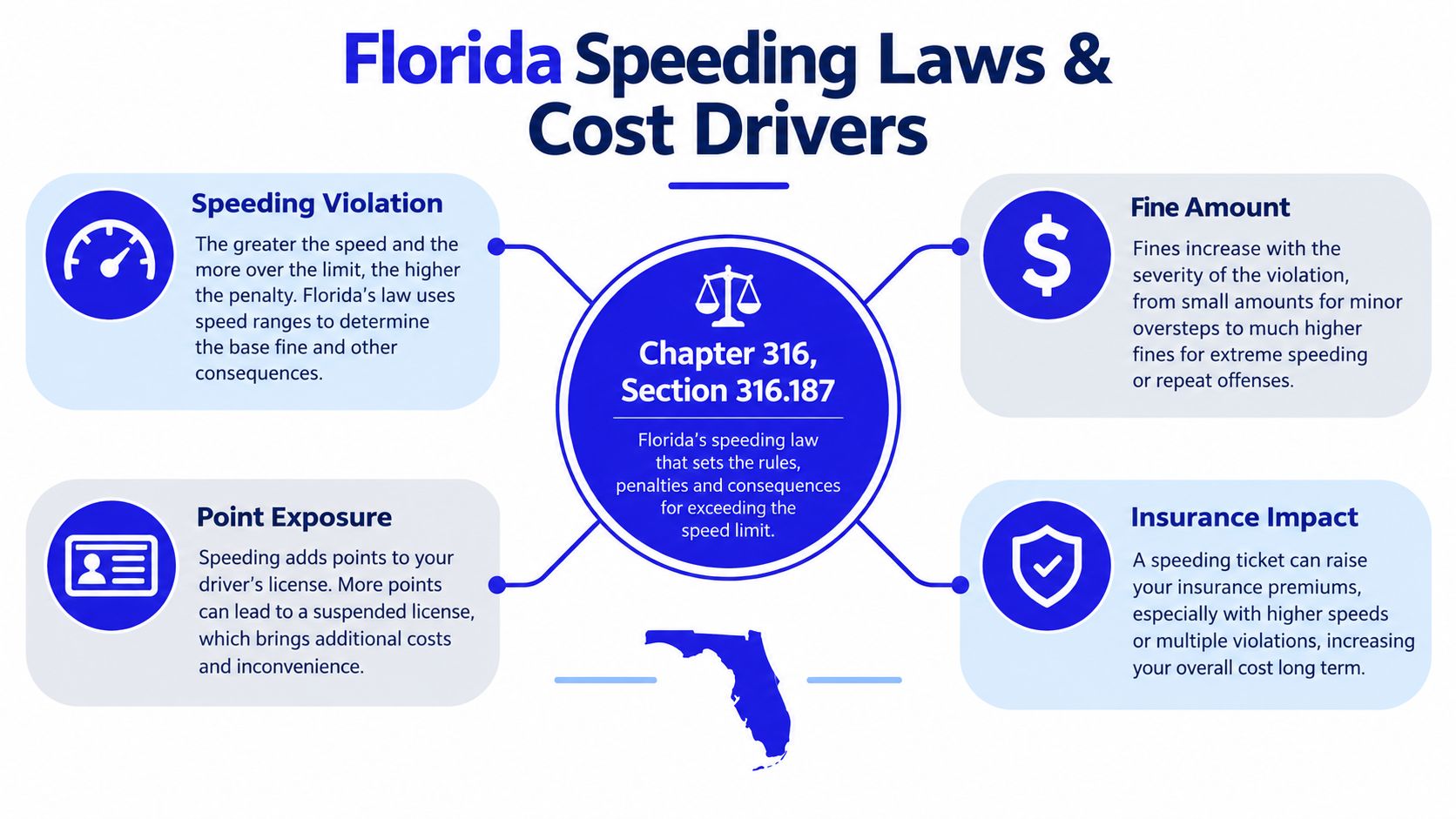
That matters because your lawyer isn't defending a generic “ticket.” Your lawyer is defending a charge grounded in a specific statute, a specific speed allegation, and a specific court process.
Why the alleged speed changes the defense cost
A mild over-limit citation and a high-speed allegation don't carry the same practical risk.
Here's why attorney pricing changes:
Low-speed allegations: These are often handled as routine civil matters. They're more likely to fit within the lower flat-fee range.
Higher-speed allegations: These usually demand closer review of the officer's observations, speed measurement method, and local court expectations.
Court-required cases: Once a hearing or appearance becomes necessary, attorney time increases. So does the fee.
Record-sensitive situations: If you already have exposure on your license, your defense strategy has to be tighter.
A ticket isn't expensive because paper was issued. It becomes expensive when the charge creates leverage against your license.
If you're trying to understand when a speeding allegation in Florida starts becoming a more serious court problem, this overview of what is criminal speeding helps frame the issue in plain language.
Florida Speeding Ticket Attorney Cost by Case Severity
You get cited on I-95 for 18 over. The fine looks manageable. The cost question is whether this stays a routine civil ticket or turns into a points problem that follows you for years. In Florida, attorney pricing usually tracks that risk.
Florida Speeding Defense Attorney Fee Bands by Severity
Case Type | Typical Attorney Fee Range | What Affects Price |
|---|---|---|
Routine speeding defense | $50 to $300 | Lower alleged speed, straightforward civil citation, limited review, no unusual court demands |
Standard traffic-ticket defense | $100 to $500 | County procedures, attorney access, negotiation time, and how much record protection is needed |
Case requiring court appearance | $300 to $800 | Hearing preparation, appearance time, scheduling burden, and local court process |
Contested or appeal-level traffic matter | $500 to $1,500 or more | Multiple hearings, deeper legal work, post-judgment issues, and added filing demands |
Those ranges are general. Florida drivers should read them by severity, not by fine amount. The higher the speed allegation, the more likely you need actual defense work instead of basic ticket handling.
A Florida lawyer is pricing several things at once: the alleged speed, whether Chapter 316 exposure creates a bigger record risk, whether points put your license in danger, and whether the court will require more than a quick negotiated resolution.
What pushes a Florida speeding case into a higher fee range
Some tickets stay low-cost because the work stays narrow. Others get expensive fast.
Fees usually rise when:
The alleged speed is high. A 9-over case and a 29-over case do not create the same urgency.
A court appearance is required. Appearance time drives cost more than the paper citation itself.
You want to fight for a no-points result. Contested defense takes more preparation than closing the case.
Your driving record already has exposure. If another conviction hurts your license status, the strategy has to be tighter.
The county is harder to deal with. Local procedure, calendars, and hearing practices affect fee quotes.
That is the break-even test Florida drivers should use. Do not compare the attorney fee only to the fine. Compare it to the cost of points, insurance increases, and added license risk if you just pay.
Severity matters more than bargain pricing
Low quotes often come from high-volume ticket mills or app-based services that sell convenience first and direct lawyer access second. That model can work for a very minor case. It is a bad bet when the alleged speed is high, your record already matters, or you want clear advice from a Florida traffic defense attorney who is accountable for the result.
Ask one direct question before you hire anyone: does the fee include attorney handling, client communication, negotiation, and any required appearance, or are you buying a cheap entry number that grows later?
For a closer look at how flat fees, appearance fees, and contested-hearing pricing usually work, review this breakdown of traffic lawyer fee structures by case type.
Paying the Fine Versus Hiring an Attorney in Florida
For a lot of drivers, this is the only comparison that matters. Pay now and be done, or spend more up front to try to protect the record.
Start with the fine schedule itself.
Florida fixes speeding fines by statute under section 318.18. 1 to 5 mph over is a warning, 6 to 9 mph over is $25, 10 to 14 mph over is $100, 15 to 19 mph over is $150, 20 to 29 mph over is $175, and 30 mph or more over is $250, as set out in Florida Statute 318.18.
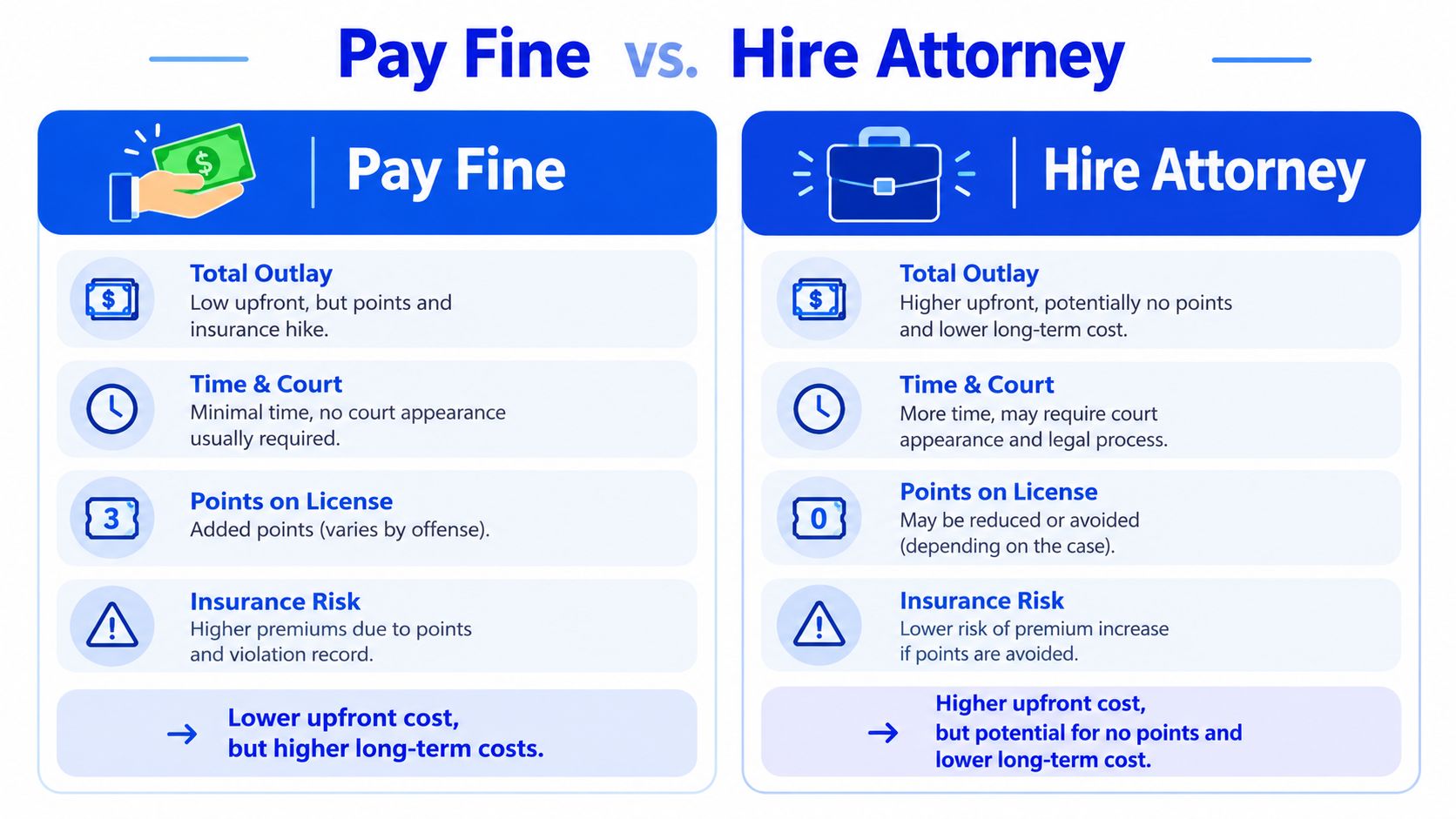
That schedule explains why so many people hesitate to hire counsel. On paper, some fines look low. But a low fine can still lead to a bad outcome if your goal is keeping your record clean.
Side-by-side decision check
Option | Upfront Cost | Time Burden | Record Risk | Good Fit |
|---|---|---|---|---|
Pay the fine | Usually lower today | Usually fast | Higher risk of a conviction staying on your record | Drivers who accept the long-term consequences |
Hire an attorney | Usually higher today | Less direct handling by you | Better chance to pursue a cleaner outcome | Drivers protecting points, insurance position, or license status |
Paying a ticket may feel efficient. It can also be the most expensive decision once your record starts carrying the violation.
Here's the practical split:
Paying may make sense if the citation is minor, your record is otherwise clean, and you've made a deliberate choice to absorb the impact.
Hiring counsel makes sense when the speed alleged is higher, your license is already exposed, or your work and family obligations make a damaged driving record a real problem.
Direct attorney access matters when the case needs judgment calls, not canned updates from a chatbot.
This short video helps frame that decision in a simple format:
If you're weighing the two options seriously, this page on paying a ticket versus hiring a lawyer lays out the trade-offs in Florida terms.
When the Attorney Fee Pays for Itself in Points and Insurance Savings
You pay the ticket on your lunch break. Weeks later, the conviction is sitting on your Florida record, points are in play, and your insurer has a reason to price you as a bigger risk. That is when a cheap ticket gets expensive.
In Florida, the smart cost question is not fine versus lawyer fee. It is whether paying now exposes you to more loss under Chapter 316 than a defense would have cost.
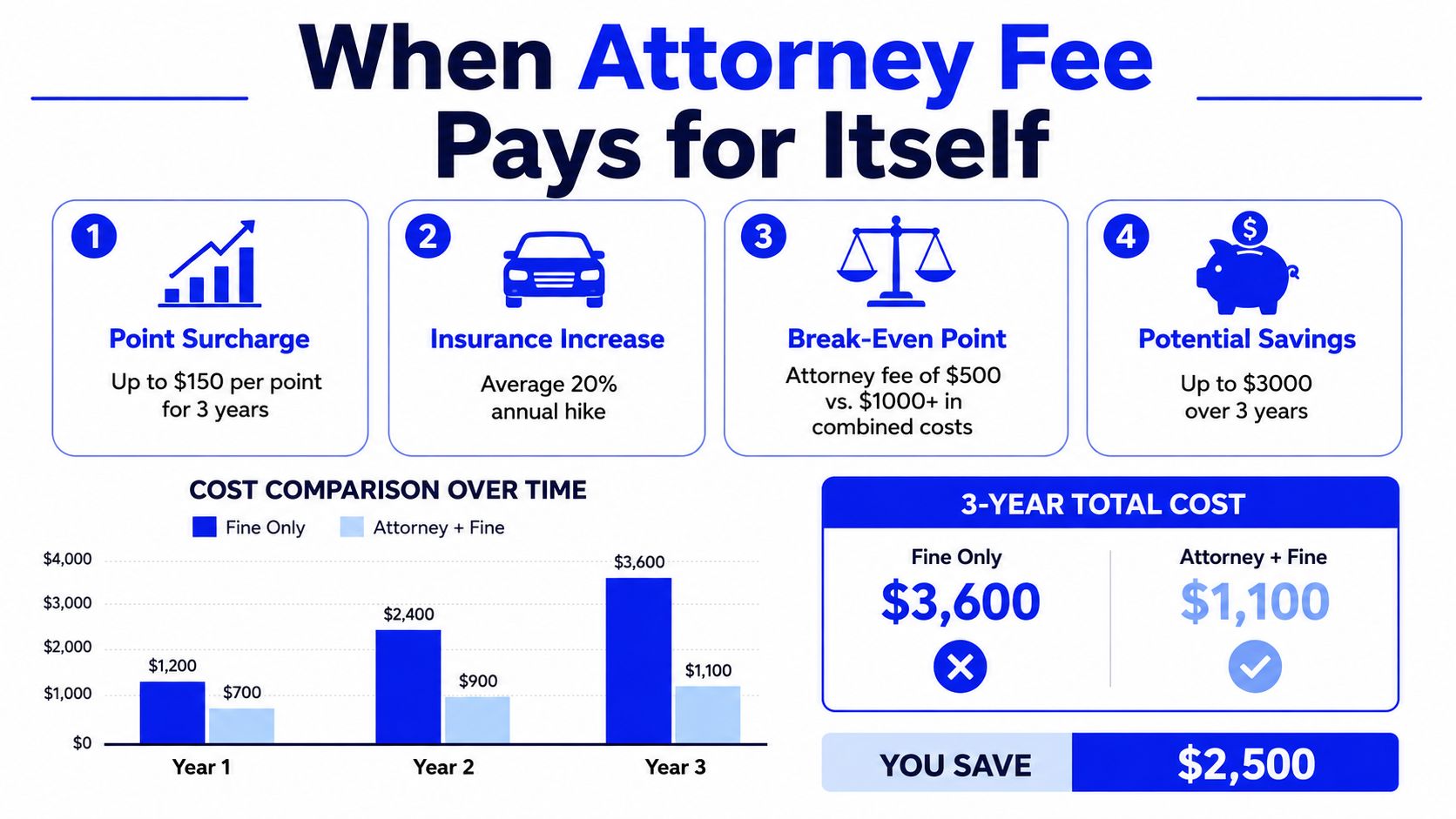
Start with the break-even test. A lawyer fee pays for itself when it helps you avoid the outcomes that keep costing you after court closes.
points on your license
a conviction on your driving record
insurance pressure at renewal
added license risk if you already have prior points
job problems if your work depends on a clean driving history
Florida law makes that analysis more urgent because speeding cases are not all equal. A standard speeding conviction can put points on your record. Excessive speeding under section 316.1922 can carry harsher consequences, including 6 points on a first conviction. As the charge gets more serious, the value of a defense goes up fast.
Here is the practical way to decide.
If your record is clean, the speed was modest, and you have no commercial driving, fleet, clearance, or family transportation concerns, you may accept the long-term hit. Make that choice with your eyes open.
If you already have points, drive for work, insure multiple vehicles, or were cited at a speed that pushes the case into a more serious category, do not treat this like a small errand. That is where attorney cost often breaks even or wins.
A simple example shows why. Suppose the fine looks tolerable today, but the conviction creates insurance trouble for the next policy period and adds points that put your license closer to suspension territory. In that situation, the legal fee is not just buying convenience. It is buying distance from a much more expensive chain reaction.
Use this rule: If a conviction would hurt your record, insurance position, or license status for longer than the case lasts, fight the ticket before you pay it.
One option in this market is Ticket Shield, PLLC, a Florida law firm that handles traffic defense statewide with lawyer-led communication by phone or text rather than pushing drivers through a ticket mill or app workflow.
If you want to pressure-test the insurance side of the math, review this guide on the cost of insurance increase after a Florida speeding ticket.
Choosing Your Defense Experience in Florida
Once you decide to fight the ticket, your next choice is just as important. Who is handling your case?
That answer changes everything. Some services are lawyer-led. Others operate like volume businesses. Your file moves through staff, intake teams, and automated systems, and you may never get direct contact with the attorney responsible for your outcome.

Direct lawyer access versus middlemen
A lawyer-led defense model gives you something automated apps and ticket mills usually can't. Direct judgment.
That matters because Florida speeding cases aren't all interchangeable. A standard speeding violation under section 316.187 carries 3 points on a driver license. Florida also treats dangerous excessive speeding more harshly under section 316.1922, which carries 6 points on a first conviction and an additional 6 points on a second or subsequent conviction, along with statutory fines of $500 and $1,000 respectively, as stated in Florida's Chapter 316 point and excessive speeding provisions.
When the consequences rise, you don't want a service model built around generic updates.
What to look for before you hire
Use this checklist:
Ask who communicates with you. If the answer is mostly staff, intake reps, or a platform dashboard, that's a warning sign.
Ask whether you can text or call your attorney directly. In traffic defense, quick answers matter.
Ask how the case is staffed. Volume systems often prioritize processing, not strategy.
Ask what happens if the court requires more than routine handling. Some low-price models are built for only the easiest files.
You're not hiring software. You're hiring legal judgment tied to your license.
A Florida speeding case may look simple at first and still need a smart, fast response. That's why I strongly favor direct attorney access over corporate answering services and automated chat tools. If your license matters, you should be able to reach the lawyer protecting it.
Protect Your License With a Free Consultation Focused on No Points
You don't need more confusion. You need a clear decision and fast action.
If you've been cited for speeding in Florida, treat the case like a license-protection problem, not a paperwork nuisance. The fine on the citation is only one part of the risk. Your record is the target.
The right next move
Before you pay anything, do three things:
Read the exact speed alleged. Small differences in speed can change the posture of the case.
Check whether your record can absorb another problem. If points would create pressure, don't improvise.
Get legal input early. Delay narrows options.
A strong consultation should give you direct answers about the likely fee structure, the likely court path, and whether the case is one you should fight hard for a No Points outcome.
Don't hand your case to a system
Automated apps are built for intake efficiency. Ticket mills are built for volume. That isn't the same as protection.
You want a lawyer-led Florida defense that treats your speeding ticket attorney cost as part of a larger strategy. The goal is not paying less today. The goal is protecting your driving privilege, minimizing long-term damage, and pushing for the cleanest result available.
Visit TicketShield.com now for a free consultation focused on one objective: No Points on your Florida license.
Ticket Shield, PLLC offers Florida traffic defense with direct attorney communication by phone or text, not a middleman model. If you're weighing speeding ticket attorney cost against the risk to your record, visit Ticket Shield, PLLC for a free consultation and a strategy focused on No Points.