Run Stop Sign Ticket Cost: What Florida Drivers Pay in 2026
See what a run stop sign ticket cost looks like in Florida, including fines, court fees, and points added to your license, plus tips to reduce the impact.

A typical Florida stop-sign ticket costs between $158 and $318 total, including the base fine, the mandatory $3 court cost, and local surcharges of up to $30. The bigger danger is what follows, including points on your license, insurance consequences, and possible suspension risk.
You may be sitting at home with a citation on the kitchen counter, wondering whether paying it will end the problem. It may not. In Florida, a stop-sign violation can create a financial cascade that reaches beyond the amount printed on the ticket.
The first decision you make matters. Paying, choosing an approved traffic-school option, or contesting the citation can produce very different results for your driving record and insurance position.
Table of Contents
How Many Points Does a Stop Sign Violation Add to Your License
Why Lawyer-Led Defense Protects Your Record Better Than Apps
What Happens When You Miss a Stop Sign in Florida
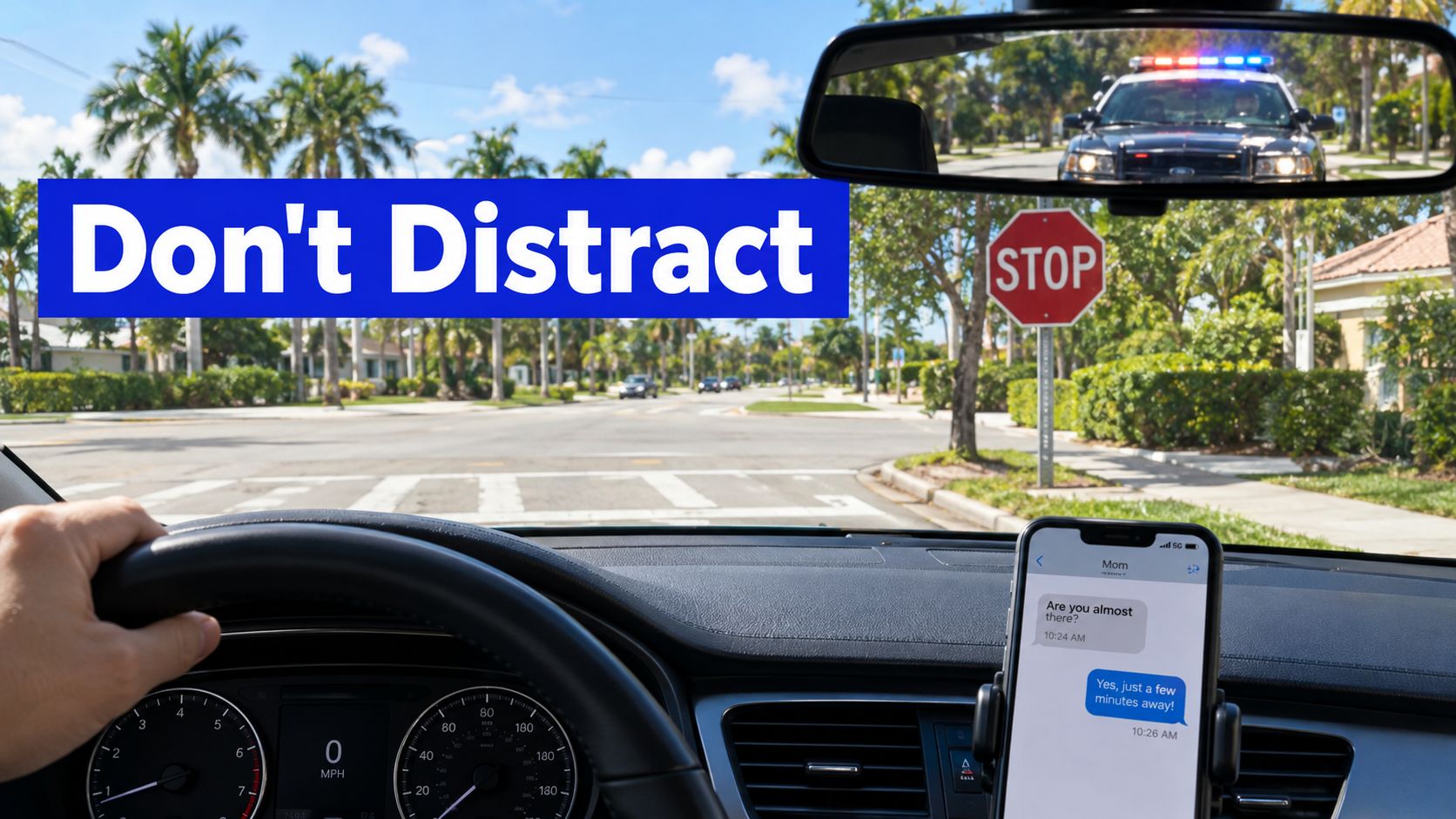
You glance at your phone while approaching an intersection. You brake, but your vehicle rolls past the stop line. A patrol car is behind you. Blue lights appear in the mirror, and minutes later you're holding a citation.
Many drivers see a civil fine and assume the matter is minor. Florida Statute §316.123 requires a complete stop at the clearly marked stop line. If there isn't a line, you must stop before the nearest crosswalk. If neither exists, you must stop at the point nearest the intersecting roadway where you can see approaching traffic. The statute also requires you to yield to vehicles already in the intersection or approaching closely enough to create an immediate hazard. Florida Statute §316.123
The citation is only the first event
The violation is classified as a noncriminal traffic infraction and treated as a moving violation under Chapter 318. That means the issue isn't limited to whether you owe the base fine. Court costs, authorized local charges, points, and insurance consequences may all become relevant.
At a four-way stop, the first vehicle to stop generally proceeds first. When vehicles stop at the same time, the driver on the left yields to the driver on the right. Those details can matter if the citation involves disputed right-of-way facts rather than a simple allegation that you failed to stop.
Practical rule: Don't evaluate a stop-sign citation by the printed fine alone. Evaluate the effect of the resolution on your record.
The Florida Highway Safety and Motor Vehicles point system can lead to escalating license consequences when convictions accumulate. A single ticket may seem manageable, but it can become more serious when added to points already on your record or when an insurer reviews the conviction.
Breaking Down the True Cost of a Stop Sign Ticket
The amount printed on a citation isn't necessarily the amount you'll ultimately pay. Florida's traffic-penalty system can add a $3 court cost for each infraction, and Chapter 318 allows a county or municipality to impose a court-facilities surcharge of up to $30 for an infraction. Florida Statute §318.18
The exact total depends on the citation, the court handling it, and applicable local charges. The base civil penalty is only one component.
Cost Component | Typical Amount | Mandatory or Optional |
|---|---|---|
Base civil penalty | $125 to $285 | Generally mandatory if the citation is paid or results in a conviction |
Court cost | $3 | Mandatory statutory court cost |
Local court-facilities surcharge | Up to $30 | Authorized local surcharge, depending on the court |
Point and insurance consequences | Varies | Not a ticket charge, but a potential longer-term cost |
The range above reflects the common total described for a Florida stop-sign citation, from $158 to $318, when the base penalty, court cost, and applicable local surcharge are considered. Don't treat that range as a guaranteed quote for your specific citation. Read the citation and confirm the amount with the issuing court.
For a broader explanation of how Florida citations are calculated, review this guide to Florida traffic ticket costs. The more important financial question is whether paying the citation creates a record consequence that exceeds the immediate payment.
A cost-effective decision compares the total exposure, not just the checkout screen. Traffic school or a contested resolution may involve its own requirements, but the outcome can be more valuable than just closing the case by paying.
How Many Points Does a Stop Sign Violation Add to Your License
A Florida stop-sign conviction is treated as a moving violation, so the conviction can affect your official driving record. The key issue isn't only today's payment. It's whether the result adds to a point history that can threaten your license later.
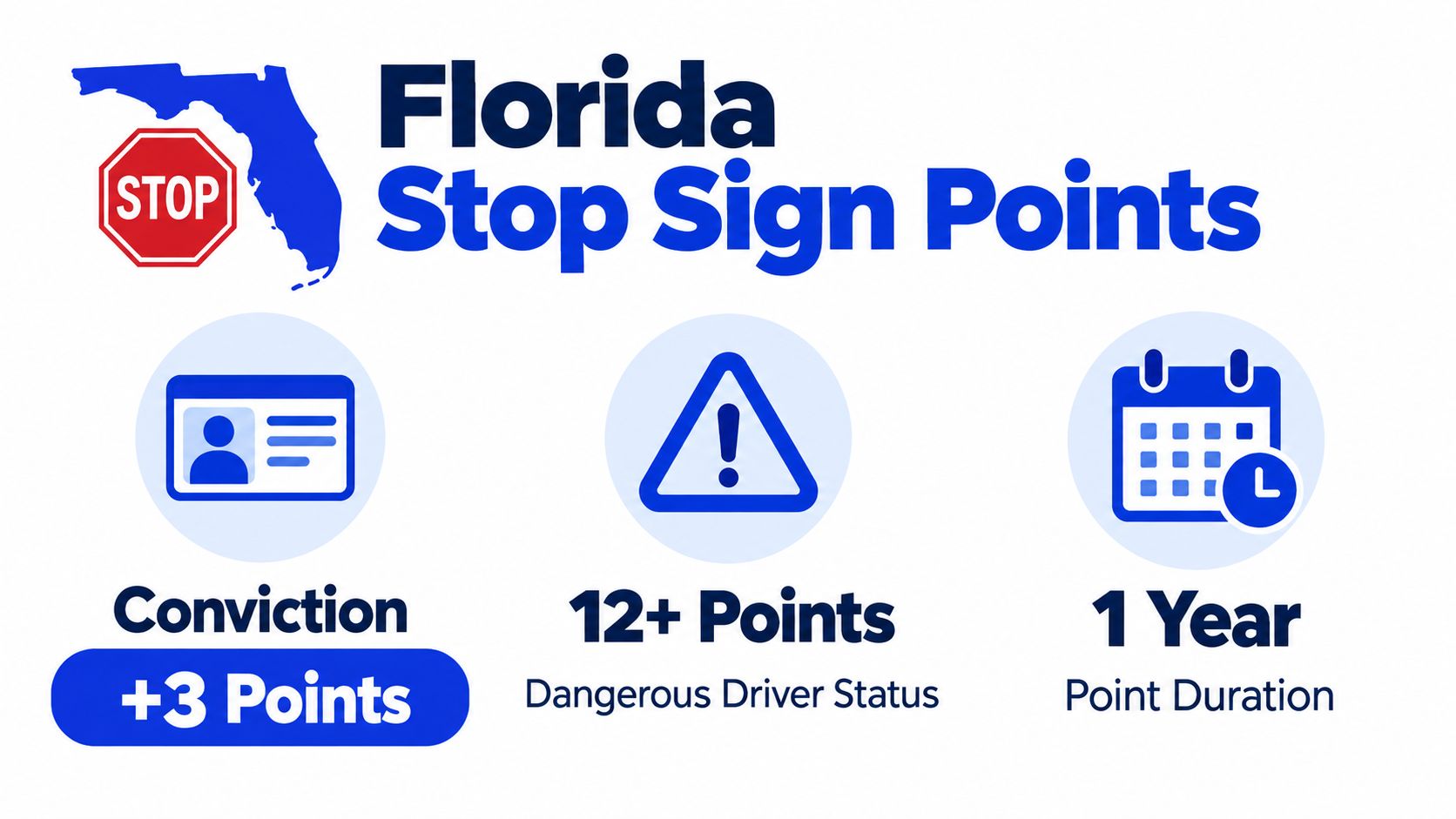
Florida Highway Safety and Motor Vehicles states that 12 points within 12 months can result in a 30-day suspension, 18 points within 18 months can result in a three-month suspension, and 24 points within 36 months can result in a one-year suspension. Points remain on the driving record for at least five years from the disposition date. Florida Highway Safety and Motor Vehicles point schedule
Why the record matters
The point schedule applies according to the type of conviction. Because §316.123 classifies a stop-sign violation as a moving violation, you should not assume that paying the citation is a neutral administrative choice.
Check your current record before choosing a resolution. A driver with no recent convictions may have more options than a driver already near a suspension threshold. The same citation can carry very different practical risk for two motorists.
Review your history: Know whether other convictions are already affecting your point total.
Check the disposition date: The retention period is measured from the disposition date, not just the day of the traffic stop.
Protect your license first: A short-term payment decision can have consequences for your ability to drive to work, school, or medical appointments.
A detailed explanation of the issue appears in this guide to Florida stop-sign points. The sensible objective is to avoid a conviction when the facts or available resolution options support that result.
Will a Stop Sign Ticket Increase Your Insurance Rates
A stop-sign conviction can put your insurance position at risk, but the answer isn't as simple as saying every ticket automatically increases your rate. Florida materials indicate that choosing an approved traffic-school option can prevent an insurance increase and policy cancellation, subject to eligibility and the applicable rules.
That protection is different from paying the ticket. Payment may resolve the court obligation while still producing a conviction and moving-violation record. Traffic school also isn't automatic. You must confirm that you're eligible and follow the required election and completion process.
Compare the insurance outcomes
Your insurer may evaluate a moving-violation conviction when reviewing your policy. The resulting action can vary. It may involve a premium increase, loss of a favorable rating, or cancellation concerns. You shouldn't assume the insurer will ignore a conviction because the underlying event involved a stop sign rather than a more serious traffic allegation.
The practical comparison looks like this:
Paying the citation: This is the fastest administrative path, but it may leave you with a conviction and its record consequences.
Electing approved traffic school: This may protect against an insurance increase and policy cancellation when you're eligible and complete the requirements.
Contesting the citation: A dismissal or other favorable result can protect the record without relying solely on traffic-school eligibility.
Insurance question to ask first: “Which resolution protects my policy and my driving record?” The cheapest upfront payment isn't always the lowest total-cost choice.
Before you decide, review this information about lowering insurance rates after a Florida traffic ticket. Then check the citation deadline, your eligibility, and your existing driving history. Waiting until renewal or cancellation paperwork arrives leaves you with fewer practical options.
Three Ways to Handle Your Stop Sign Citation in Florida
You generally face three practical paths after receiving a Florida stop-sign citation. Each one trades convenience, cost, control, and risk differently.
Resolution path | Main advantage | Main risk |
|---|---|---|
Pay the citation | Fast and simple | May result in a conviction and moving-violation consequences |
Elect approved traffic school | May protect insurance and the record when eligible | Eligibility and completion requirements apply |
Contest the citation | Creates an opportunity to challenge the allegation | The result isn't guaranteed |
Paying the citation
Payment closes the court obligation, but it can also function as acceptance of the citation's consequences. If your driving record already contains points, this path deserves careful review before you use it.
Choosing traffic school
An approved course may offer a way to protect your insurance position and avoid the usual record impact, but you must verify eligibility. Don't confuse a course election with automatic dismissal. The court's procedures and your prior use of traffic school can matter.

Contesting the allegation
A lawyer can examine where you stopped, whether the line or crosswalk was visible, what the officer could observe, and whether the yield requirement was violated. The defense may focus on the facts, the officer's observations, the citation, or the legal requirements.
This guide explains how to fight a traffic ticket without going to court. You can also use the following video as a general starting point for understanding the process.
My recommendation is direct. Don't pay before you know whether traffic school is available and whether contesting the citation offers a realistic route to No Points.
Why Lawyer-Led Defense Protects Your Record Better Than Apps
Automated apps and ticket mills can make traffic defense sound like a button press. They often place a middleman, corporate answering service, or chatbot between you and the lawyer responsible for the case. That structure can leave you without a direct answer when the facts become important.
A lawyer-led service gives you a person who can discuss the citation, your driving history, the intersection, and your priorities. Stop-sign cases often turn on precise details, including the location of the stop line, the visibility of traffic, and whether the officer's view matched your vehicle's movement.

Direct communication changes the experience
Ticket Shield, PLLC describes its service as lawyer-led, with clients communicating directly with their attorney by phone or text. The firm states that it serves all 67 Florida counties, uses former prosecutors, offers pricing starting at $39.99, and reports that over 99% of clients never appear in court. Ticket Shield's explanation of lawyer-led representation
Those are service details, not guarantees of a particular result. No attorney can promise dismissal or No Points in every case. A proper review still requires the citation, deadline, facts, and your driving history.
Ask who will answer your question. If the answer is a chatbot or a call center, you may not be receiving the direct legal communication your record requires.
The right representation should explain your available resolutions, identify eligibility limits, and tell you what happens next. It should also make clear whether the lawyer, rather than an automated platform, is handling communications and court work.
The Hidden Consequences of Ignoring Your Stop Sign Ticket
The citation sits unpaid while the deadline passes. Then the problem can shift from a traffic allegation to a license, registration, and court-enforcement issue. Treat the deadline as a legal obligation, not a suggestion.
A stop-sign violation is noncriminal, but the financial consequences can still reach beyond the printed fine. Florida requires a driver to stop before deciding whether the intersection appears clear, and right-of-way rules govern who proceeds first at a four-way stop. Those duties protect drivers, pedestrians, and cyclists who may enter the intersection unexpectedly.
The Federal Highway Administration reports that stop-sign-controlled intersections account for approximately one-third of all intersection crashes and more than 40% of fatal intersection crashes, based on IIHS data published in 2000. Read the Federal Highway Administration intersection safety information to review the source and its age.
A missed deadline creates avoidable risk
Ignoring the citation can remove favorable ways to resolve it and trigger additional financial obligations, license-related consequences, registration problems, or court enforcement. Paying without reviewing the available options may also leave a moving-violation conviction on your record, with possible effects on insurance and future driving privileges.
An empty intersection does not erase the alleged violation. The required stop comes before the driver decides that no traffic is nearby. You may dispute the officer's account or the stopping facts, but missing the response deadline can prevent that dispute from being handled properly.
Public-safety reporting shows why traffic-control violations receive serious attention. Colorado State Patrol reported 587 crashes in 2025 involving an at-fault driver who disregarded a traffic-control device or stop sign, according to Colorado State Patrol reporting.
That number is not a Florida penalty or Florida crash count. It does show why this citation deserves prompt action. Preserve the ticket and related evidence, confirm the deadline, and obtain legal advice before choosing between payment, traffic school, or a contested resolution.
Protect Your License and Achieve No Points Today
A stop-sign citation deserves a record-focused response. Start by reviewing the exact statute listed, the court deadline, the stopping location, the road markings, and whether another vehicle was close enough to create an immediate hazard.
Then compare the available outcomes. Paying may be convenient, but it can expose you to a moving-violation conviction. Traffic school may protect your insurance position when you're eligible and complete the requirements. Contesting the citation may provide a path to dismissal or another result that avoids points.
Keep your evidence. Save photographs of the intersection, note where the stop line and crosswalk were located, and write down what the officer said while the details are fresh. If a collision, injury, disputed stopping location, or contested right-of-way issue is involved, treat the matter as more than a routine payment decision.
Ticket Shield, PLLC states that it provides a free consultation, direct attorney communication by phone or text, and representation throughout all 67 Florida counties, including Miami-Dade, Broward, Palm Beach, Hillsborough, Orange, and Duval counties. The firm handles traffic citations and evaluates options aimed at protecting the driver's license and pursuing No Points where the facts and law support that outcome.
You don't need to decide based only on the fine printed on the citation. Get the record and insurance consequences evaluated before you choose a resolution.
Ticket Shield, PLLC offers lawyer-led Florida traffic defense with direct communication by phone or text, rather than relying on automated apps or middlemen. Visit Ticket Shield, PLLC for a free consultation about your stop-sign citation and take the first step toward achieving No Points on your license.