How to Fight a Traffic Ticket Without Going to Court
Learn how to fight a traffic ticket without going to court in Florida. Explore options like attorney help or mail-in pleas. Protect your driving record.

A Florida ticket hits fast. You are irritated, busy, and tempted to just pay it so the problem goes away. That instinct is expensive.
If you want to know how to fight a traffic ticket without going to court, the short answer is this: in many Florida cases, you do not avoid court by ignoring the process. You avoid court by using the process correctly, or by having a lawyer go for you.
That distinction matters. A submitted form is not a defense. A written explanation is not strategy. And paying the ticket is usually a guilty plea with consequences that can follow you long after the fine is gone.
Table of Contents
You Have the Ticket Now What
Yes, you can often fight a Florida traffic ticket without personally going to court. In most minor cases, a lawyer can appear for you, and firms report that most clients avoid in-person hearings while protecting against points, insurance hikes, and long-term record damage.
You have the citation in your hand. The clock is running.
At that moment, most drivers make one of two mistakes. They either pay too fast, or they wait too long. Both hand control to the system.

If your ticket was written in Hillsborough County and your case would run through the Edgecomb Courthouse in Tampa, the paperwork may look routine. It is not. A traffic citation is a legal allegation. For speeding, that often means a charge under Florida Statute 316.187, which deals with unlawful speed. Once you treat it like “just a fine,” you usually give away the advantage you still had.
Why your first reaction can cost you
A ticket does not stop at the fine. The damage shows up later.
According to Super Lawyers on contesting a traffic ticket without going to court, traffic tickets can increase insurance rates by 20-30% on average after conviction, and avoiding that conviction can save $300-500 annually for 3-5 years. The same source states that over 99% of clients avoid in-person hearings when attorney representation is used in most minor cases.
That is why I tell drivers the same thing every day. Do not measure this problem by the amount printed on the citation. Measure it by what lands on your record.
If you are a rideshare driver, delivery driver, military service member, or a professional who cannot waste a morning in court, the risk is not abstract. Your driving record affects work, access, and credibility.
Immediate rule: Do not pay the ticket until you understand exactly what that payment means for your license and record.
What no court really means in Florida
A lot of people hear “without going to court” and think it means clicking through a portal, uploading a statement, and hoping a clerk or judge is in a generous mood.
That is not the strongest version of this strategy.
The stronger version is attorney appearance. In many minor Florida traffic cases, your lawyer can appear on your behalf, negotiate directly, challenge weak points in the case, and resolve the matter without you taking off work or stepping into the courtroom. That is an active defense.
If you just got cited and need a clear first move, review what to do when you get a ticket before you make any election.
Use these immediate steps:
Read the charge carefully: Confirm what statute or offense is listed on the ticket.
Check the response deadline: Florida deadlines matter early, not later.
Preserve evidence now: Save dashcam footage, location photos, repair records, and any app logs that may help.
Do not admit facts casually: What you text, email, or say can box you in.
Choose a strategy fast: Delay kills options.
You do not need panic. You need a plan.
What Are Your Real Options for Avoiding Court
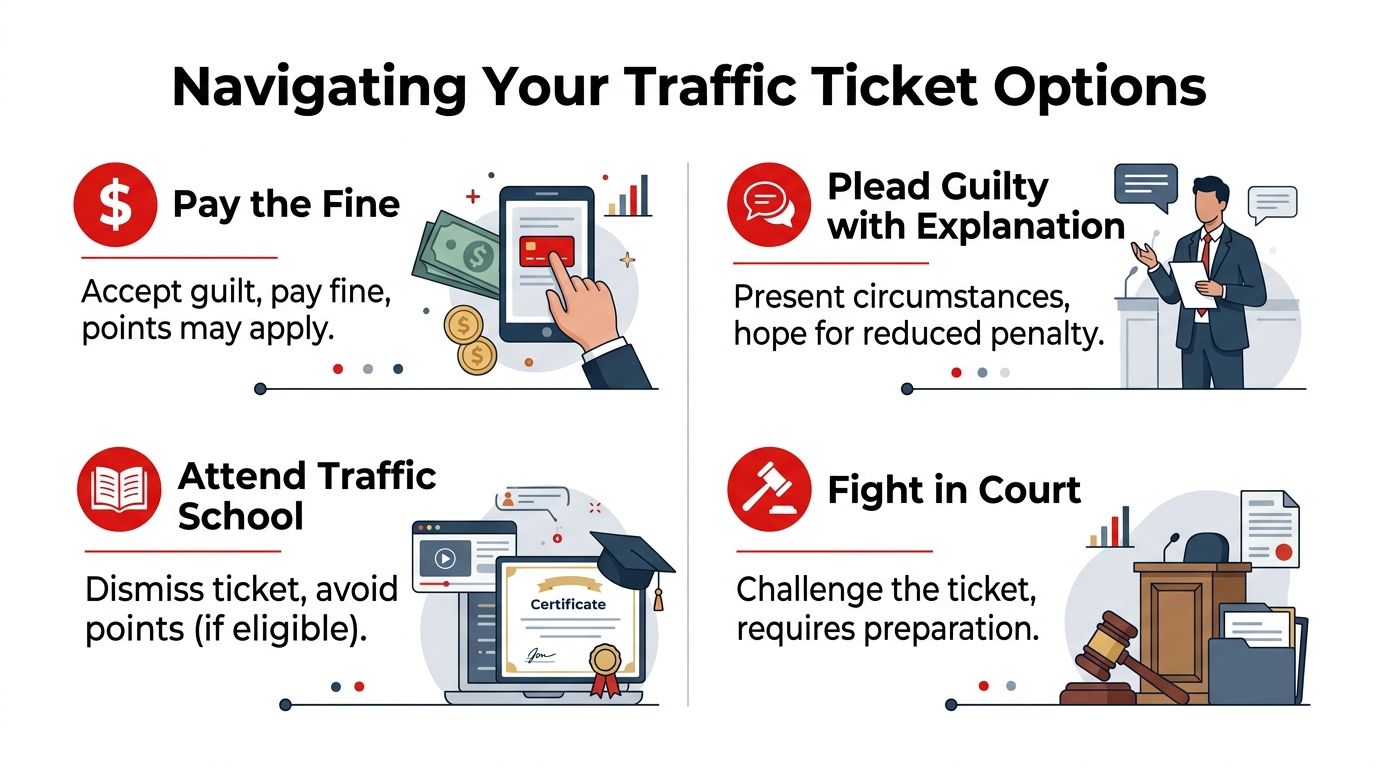
Florida drivers usually have four practical paths after a traffic ticket. Only one of them gives you full control. One of them gives you partial relief. Two of them mostly shift risk onto you.
What happens if you just pay it
Paying the fine is fast. It is also the path people regret later.
When you pay, you are usually resolving the case as charged. That may close the file, but it does nothing to challenge the officer’s basis, preserve defenses, or negotiate a better result. If your priority is No Points, paying is the weakest option.
Traffic school can be useful in the right case. It can also be wasted if you use it too quickly without asking whether a reduction, dismissal, or other negotiated resolution was available first.
Contesting the ticket yourself by mail or portal is possible. It is limited. You are trying to persuade the system in writing, without live advocacy, and without the benefit of courtroom relationships or prosecutor-facing strategy.
Hiring counsel changes the posture. You stop being a driver asking for leniency and start being a represented party with someone handling procedure, timing, and negotiation.
How the four paths compare
Here is the clean comparison.
Method | Immediate Cost | Points Risk | Insurance Impact | Best For |
|---|---|---|---|---|
Pay the Fine | Fine paid now | High if the charge stands | Risk of long-term increase if conviction remains | Drivers focused only on immediate closure |
Plead Guilty with Explanation | Fine or modified outcome may still apply | Still risky because you are not contesting from strength | Depends on outcome and record effect | Drivers hoping circumstances alone persuade the court |
Attend Traffic School | Course time and compliance | Can help eligible drivers avoid points in some situations | May reduce record damage, but it is not a defense to every case | Eligible drivers with limited options who want an administrative solution |
Hire an Experienced Attorney | Legal fee upfront | Focused on reducing or avoiding points through defense and negotiation | Best fit for protecting the driving record and limiting downstream harm | Busy professionals, repeat-ticket concerns, gig drivers, military personnel |
That table is blunt because it needs to be.
Your four paths after a Florida traffic ticket
The primary decision is not “How do I make this disappear today?” The primary decision is “Which option protects your license and record with the least risk?”
Consider each path this way:
Pay the fine: Fastest. Least strategic. You give up your chance to challenge the allegation.
Plead guilty with explanation: Sometimes people choose this because they want to tell their side. Courts hear explanations every day. Explanation is not the same as defense.
Traffic school: Useful when available and used deliberately. Not a substitute for evaluating whether the charge should be challenged first.
Attorney representation: This is how many drivers achieve the practical outcome they want, which is handling the case without personal appearance while someone advocates for a record-protective result.
Key takeaway: Convenience and protection are not the same thing. Paying is convenient. Representation is protective.
If you are deciding between administrative shortcuts and a true defense path, read traffic ticket deferral carefully before you commit. Deferral-type thinking can help in some cases, but it should never replace a record-first analysis.
A Florida ticket should be treated like a legal problem with collateral consequences. Once you see it that way, the “best” option becomes obvious. The right option is the one that keeps the charge from damaging your record.
Why Is a Lawyer Your Strongest Shield
There is a major difference between a lawyer-led defense and an automated service that funnels you through forms, status updates, and canned answers.
One gives you judgment. The other gives you processing.

A real lawyer does more than submit paperwork
A traffic case turns on details. Sometimes the issue is the officer’s pacing method. Sometimes it is visibility, identification, lane position, signage, notes, or how the charge was written. Sometimes the strongest move is negotiation. Sometimes it is pressing on proof.
You want a lawyer who can make that call and then stand behind it.
This is the point people miss when they search how to fight a traffic ticket without going to court. They think the benefit is only convenience. It is not. The primary benefit is that counsel can appear for you and actively manage the case.
That means a lawyer can:
Review the charging basis: Is the cited offense accurate and supportable?
Evaluate your strategic position: Is this a case for reduction, dismissal pressure, or mitigation?
Handle court communication: Your attorney can deal with the clerk, prosecutor, and scheduling issues directly.
Protect your record first: The target is not just closure. The target is a result that keeps your record cleaner.
If you want an outside perspective on when representation makes sense, this guide on need a lawyer for traffic court is worth reading alongside Florida-specific advice.
Why automated services leave you exposed
Automated apps and ticket mills sell simplicity. What they do not offer is accountability.
According to Law Redress on ways to make a traffic ticket go away, many traffic ticket resolution services provide zero quantitative data on success rates, average fine reductions, or how often prosecutors agree to downgrade charges. That same source highlights how critical that gap is for drivers whose work depends on a clean record. It also notes that a dedicated law firm’s 99% no-court-appearance rate is supported by jurisdiction-specific outcomes and transparency that automated services do not provide.
That accountability gap matters in Florida. If an app cannot tell you who is handling your case, how the decision was made, or what strategy is being used, you are not represented. You are being processed.
Protective advice: If you cannot speak directly to the attorney responsible for your case, you should question whether anyone is defending it.
A lawyer-led firm matters because it gives you a real advocate. At Ticket Shield, PLLC, clients speak directly with their attorney by phone or text. That matters when the issue is not just filing a response, but deciding how to protect a license, avoid points, and keep a work-sensitive record clean. You can learn more about what an actual traffic ticket attorney does before you choose a path.
I do not recommend surrendering a Florida traffic case to software and hoping for a favorable outcome. That is not defense. That is distance.
Can You Fight a Ticket Yourself Without a Lawyer
Yes. You can. In some Florida cases, you can contest a ticket remotely on your own.
You just need to understand what you are taking on.

A common example is a speeding citation under Florida Statute 316.187. If you choose the do-it-yourself route, precision matters. Florida procedure is not forgiving when you miss a deadline or submit a weak defense package.
What you must do first
The basic first step is essential. According to this guide on fighting a speeding ticket without going to court, in Florida you must plead not guilty within 30 days under Florida Statute 318.14 if you are contesting the citation by mail, and you should submit a letter requesting prosecutorial review. The same source states that DIY mail pleas succeed in about 40% of minor infraction cases, while attorney-led negotiations see 70-85% reduction rates. It also states that 90% of DIY dismissals fail because deadlines are missed.
That tells you two things immediately.
First, DIY is possible. Second, DIY is unforgiving.
Your opening checklist should look like this:
Calendar the deadline: Treat the 30-day response window as fixed.
Read every line on the citation: Confirm the location, speed alleged, and offense description.
Request the right review: If remote challenge is available, ask for prosecutorial review in writing.
Keep copies of everything: Your submission should be organized like a legal file, not a casual email chain.
How to build a written defense
A written challenge needs facts, not outrage.
If your argument is that the officer’s equipment may have been unreliable, support matters. The same source notes that success can hinge on evidence such as dashcam footage suggesting a radar issue and references NIST Handbook 44 standards on calibration. That does not mean every radar case is defective. It means unsupported accusations go nowhere.
Use a structure like this:
State your plea clearly
Write that you are pleading not guilty and requesting review.
Identify the citation
Include ticket number, date, county, and vehicle details.
Present a narrow defense
Focus on one or two credible points. Do not throw in every excuse you can think of.
Attach exhibits
Dashcam clips, GPS logs, photographs, repair records, or anything else that directly supports your position.
Ask for a defined outcome
Request dismissal, amendment, or another record-protective resolution.
Tip: The strongest written defenses are restrained. If your letter sounds emotional or scattered, you weaken your own credibility.
A short explainer on remote ticket challenges can help frame the issue before you file anything:
Where DIY drivers usually lose ground
Most self-represented drivers do not lose because they care too little. They lose because they do not know what the court needs.
The usual problems are predictable:
Missed deadlines: This is the fastest way to lose your advantage.
Weak exhibits: Photos that prove nothing and statements with no support do not move a case.
Overexplaining: Long personal stories rarely answer the legal issue.
Accidental admissions: Many drivers attach explanations that help the prosecution more than the defense.
No strategic ask: If you do not know what outcome to pursue, your filing drifts.
If the officer does not appear, some drivers assume the case will collapse. That is a risky assumption. Review can I fight a ticket if the officer didn’t show up before you build your strategy around that idea.
DIY can work. But you should be honest about the tradeoff. You are acting as your own lawyer in a process built around deadlines, written procedure, and courtroom habits you do not see.
If your record matters, your time matters, or your livelihood depends on the outcome, that is a heavy gamble.
What Situations Absolutely Require a Professional
Some tickets are not DIY tickets. They are warnings that the legal risk has crossed into territory where self-representation is the wrong call.
Red flags that change everything
If any of these apply, stop looking for a form-based solution.
Criminal traffic charges: Reckless driving, DUI-related allegations, and other criminal traffic matters carry consequences beyond a simple infraction. You are no longer just trying to avoid a fine.
Accident-related citations: If the ticket came out of a crash, especially one involving injury, every statement matters. Liability issues can spill into insurance disputes and civil exposure.
Commercial driver issues: If you hold a CDL, your margin for error is narrower. Your livelihood is tied to your driving history.
Multiple recent tickets: One isolated citation is different from a pattern that could trigger harsher treatment or license trouble.
Court appearance language on the ticket: If the paperwork suggests mandatory appearance or a more serious allegation, do not assume remote handling will solve it by itself.
Work-sensitive records: Rideshare drivers, delivery drivers, military personnel, and licensed professionals should not gamble with a record that affects income or clearance.
Florida’s point system also matters in the background. As noted earlier in the article, too many points can create license problems, and in Florida 12 points within 12 months trigger license review according to the verified data tied to the earlier Super Lawyers discussion. You do not need to be at that edge before taking a ticket seriously.
Practical rule: If the ticket threatens your job, your license, or your criminal record, hire counsel first and ask questions second.
A routine civil ticket may be manageable. A case with career or criminal consequences is not the place to experiment.
Secure Your No Points Outcome Today
You do not need to appear in court personally to fight many Florida tickets. But you do need to choose a serious strategy.
That is the core issue.
The safest move is the one that protects your record
If you just pay the citation, you close the matter quickly and expose yourself to long-term fallout. If you fight it yourself, you may save money upfront but assume the burden of deadlines, drafting, evidence selection, and procedural risk. If you use an impersonal automated service, you may never know who is making decisions or whether anyone is advocating for your record.
A lawyer-led defense is different because the objective is not just “case closed.” The objective is No Points, or the closest record-protective result available under the facts.
For context on how harsh point systems can become when drivers underestimate “small” tickets, this overview of Michigan's Driver Points System is a useful reminder that point accumulation changes lives fast. Florida drivers should take the same lesson seriously, even though the statutes and procedures here are Florida-specific.
If your priority is keeping your record clean without defaulting to traffic school, review how to remove points without traffic school and then act quickly.
You do not need a chatbot. You do not need a middleman. You need a clear legal response before the deadline closes and your options shrink.
The right move is the one that protects your license first.
If you want a real shot at a No Points result, visit Ticket Shield, PLLC for a free consultation. Get direct guidance from a Florida traffic defense attorney, protect your record, and move quickly before the deadline limits your options.